
Search
found 263 results
Images for earthquake-affected; more images...
Building resilience in transient rural communities – a post-earthquake reg…
Research papers, Lincoln University
This report forms part of a research project examining rural community resilience to natural hazard events, with a particular focus on transient population groups. A preliminary desktop and scoping exercise was undertaken to examine nine communities affected by the Kaikoura earthquake and to identify the variety of transient population groups that are commonly (and increasingly) found in rural New Zealand (see Wilson & Simmons, 2017). From this, four case study communities – Blenheim, Kaikoura, Waiau and St Arnaud – were selected to represent a range of settlement types. These communities varied in respect of social, economic and geographic features, including the presence of particular transient population groups, and earthquake impact. While the 2016 Kaikoura earthquake provided a natural hazard event on which to focus the research, the research interest was in long-term (and broad) community resilience, rather than short-term (and specific) response and recovery actions which occurred post-earthquake.
Fairfax Video, September 2012 (5)
Videos, UC QuakeStudies
A video about several retail stores in Westfield Riccarton giving Christchurch women makeovers after the 22 February 2011 earthquake. Twenty-one women who were affected by the earthquakes or contributed to the recovery effort, were given a $1000 makeover by Blue Illusion, Rodney Wayne, Life Pharmacy, All About You, and Coffee Culture. The video includes an interview with Jude Kahui from Blue Illusion, who organised the makeovers. It also includes an interview with Shirley Quinn, one of the makeover recipients, as she receives her makeover.
Insurance in the tourism sector after the Canterbury earthquakes.
Research papers, University of Canterbury Library
The Canterbury earthquakes caused huge amounts of damage to Christchurch and the surrounding area and presented a very challenging situation for both insurers and claimants. While tourism has suffered significant losses as a result, particularly due to the subsequent decrease in visitor numbers, the Canterbury region was very fortunate to have high levels of insurance coverage. This report, based on data gathered from tourism operators on the ground in Canterbury, looks at how this sector has been affected by the quakes, claims patterns, and the behaviour and perceptions of tourism operators about insurance.
Christchurch Press Image: Stacy Squires 2010:12:13 10:26:05
Images, UC QuakeStudies
Photograph captioned by Fairfax, "Christchurch CBD was 'yarn-bombed' during the weekend using yarn and fabric pieces to brighten public areas and earthquake-affected spaces. Visitor Ann Rees and her husband Bernard from South Wales said when looking at the yarn-bombed busts at the Arts Centre that it didn't appear like the work of vandals, but looked quite homely and warm".
Christchurch Press Image: Stacy Squires 2010:12:13 10:25:56
Images, UC QuakeStudies
Photograph captioned by Fairfax, "Christchurch CBD was 'yarn-bombed' during the weekend using yarn and fabric pieces to brighten public areas and earthquake-affected spaces. Visitor Ann Rees and her husband Bernard from South Wales said when looking at the yarn-bombed busts at the Arts Centre that it didn't appear like the work of vandals, but looked quite homely and warm".
Christchurch Press Image: Stacy Squires 2010:12:13 10:25:36
Images, UC QuakeStudies
Photograph captioned by Fairfax, "Christchurch CBD was 'yarn-bombed' during the weekend using yarn and fabric pieces to brighten public areas and earthquake-affected spaces. Visitor Ann Rees and her husband Bernard from South Wales said when looking at the yarn-bombed busts at the Arts Centre that it didn't appear like the work of vandals, but looked quite homely and warm".
Big Bake off
Audio, Radio New Zealand
A big bake off is being planned in Auckland this weekend to raise funds for the people affected by the Christchurch earthquake. The sale is taking place at Queen Elizabeth Square, opposite Britomart on Monday from 10.30 to 12.30. All the funds raised will go to the Red Cross. The organiser Glenn Browne has had such a strong response he's had to close the doors of his business and concentrate on the event.
Frustration at govt work tackling our suicide rates
Audio, Radio New Zealand
There's growing frustration over the government's work to match it's promise to tackle the country's suicide rates. A Mental Health Commission report describes frustration over the pace of change - and points to an urgent need for an overarching action plan. Mental health advocates are also criticising the lack of progress in helping people in Canterbury, with many still severely affected by ongoing trauma from earthquakes and the 2019 Mosque shootings. Eleisha Foon reports.
Christchurch Press Image: Joseph Johnson 2010:09:08 10:07:06
Images, UC QuakeStudies
Photograph captioned by Fairfax, "John Key on his visit to Kaiapoi and Hororata to meet badly-affected people and see the damage from the earthquake. John Key talks to Murray Rowlands, the Federated Farmers North Canterbury Grain and Feeds Chairperson, with Agriculture Minister David Carter. They are on the Deans' property in Homebush".
The Nelson Mail Image: Martin de Ruyter 2010:09:09 11:08:04
Images, UC QuakeStudies
Photograph captioned by Fairfax, "Nelson College for Girls year 12 leaders (from left) Sophie Day, Petra Matz, Sascha Miller, Jessica Rose, Kate Mickleson, Ming Pons, Yvette Jones-White, Nicola Britten, Eilish Wilson (obscured), Zoey Coombs-King, Abigail Goodison and Mackenzie Orange have started a collection at the college of cans and cash to aid people of Canterbury affected by the recent earthquake".
Cyclone Gabrielle: Minister on insurance help service set to launch today
Audio, Radio New Zealand
Those displaced or affected by the Auckland floods and Cyclone Gabrielle can get help with insurance claims through a new service from today. The Government has launched the New Zealand Claims Resolution Service for homeowners to resolve issues and settle claims. The service is modelled on two that were used during the Canterbury earthquakes. Minister of Commerce and Consumer Affairs Duncan Webb spoke to Guyon Espiner.
PM announces fundraiser appeal for Cyclone Gabrielle rebuild
Audio, Radio New Zealand
The government is crowdsourcing the cyclone recovery bill. It has launched an international fundraising effort, modelled on the Christchurch Earthquake Appeal - which raised almost $100 million. A separate special Lotto draw will also be held on March 18 with all proceeds going to affected communities. Prime Minister Chris Hipkins has urged New Zealanders to get behind the effort. He defended asking people to chip in when the cost-of-living is so high.
Impacts of site specific information on post-earthquake cordons: A compara…
Research papers, University of Canterbury Library
Post-earthquake cordons have been used after seismic events around the world. However, there is limited understanding of cordons and how contextual information of place such as geography, socio-cultural characteristics, economy, institutional and governance structure etc. affect decisions, operational procedures as well as spatial and temporal attributes of cordon establishment. This research aims to fill that gap through a qualitative comparative case study of two cities: Christchurch, New Zealand (Mw 6.2 earthquake, February 2011) and L’Aquila, Italy (Mw 6.3 earthquake, 2009). Both cities suffered comprehensive damage to its city centre and had cordons established for extended period. Data collection was done through purposive and snowball sampling methods whereby 23 key informants were interviewed in total. The interviewee varied in their roles and responsibilities i.e. council members, emergency managers, politicians, business/insurance representatives etc. We found that cordons were established to ensure safety of people and to maintain security of place in both the sites. In both cities, the extended cordon was met with resistance and protests. The extent and duration of establishment of cordon was affected by recovery approach taken in the two cities i.e. in Christchurch demolition was widely done to support recovery allowing for faster removal of cordons where as in L’Aquila, due to its historical importance, the approach to recovery was based on saving all the buildings which extended the duration of cordon. Thus, cordons are affected by site specific needs. It should be removed as soon as practicable which could be made easier with preplanning of cordons.
Evans, Malcolm Paul, 1945- :"That's it - I'm out!" ... 23 June 2011
Images, Alexander Turnbull Library
In the top frame a man reads a newspaper report that says 'Govt to buy up red stickered homes' and shouts 'That's it - I'm out!' His mate comments that he thought it was his neighbour's house that was munted and that his house was ok. In the lower frame the first man says 'That's right... and I don't want to live next door to a politician?!' Context - A report released 23 June 2011 has divided quake-hit Canterbury into four zones with those in the worst affected residential red zone offered cash to move out. The man in the cartoon thinks that the government is buying up the houses so that politicians can live in them. Colour and black and white versions available Quantity: 2 digital cartoon(s).
Urban Disaster Recovery in Christchurch: The Central Business District Cor…
Research papers, University of Canterbury Library
The Canterbury earthquakes, which involved widespread damage in the February 2011 event and ongoing aftershocks near the Christchurch central business district (CBD), presented decision-makers with many recovery challenges. This paper identifies major government decisions, challenges, and lessons in the early recovery of Christchurch based on 23 key-informant interviews conducted 15 months after the February 2011 earthquake. It then focuses on one of the most important decisions – maintaining the cordon around the heavily damaged CBD – and investigates its impacts. The cordon displaced 50,000 central city jobs, raised questions about (and provided new opportunities for) the long-term viability of downtown, influenced the number and practice of building demolitions, and affected debris management; despite being associated with substantial losses, the cordon was commonly viewed as necessary, and provided some benefits in facilitating recovery. Management of the cordon poses important lessons for planning for catastrophic urban earthquakes around the world.
Evans, Malcolm Paul, 1945- :"Hello EQC here! - you know how the quakes lef…
Images, Alexander Turnbull Library
The Earthquake Commission calls a householder and tells him the 'good news' that his house which was left by the earthquakes in 'such an angle you couldn't live in it' has been refloated by the recent heavy rain and is now level again. The 'bad news' is that the house was last seen floating in the sea off Sumner. In June 2013 heavy rains had caused flooding in Canterbury. Christchurch was affected especially in the liquefaction prone areas, where the ground had sunk because of the earthquakes. Colour and black and white versions available Other Titles - Evans, Malcolm Paul, 1945-:"Established in a conservation estate...likely to harm our unique flora and fauna..." 31 May 2013 Quantity: 2 digital cartoon(s).
Examining the spatial and temporal patterns of crime in pre- and post-eart…
Research papers, University of Canterbury Library
The 2010-2011 Canterbury Earthquakes brought devastation to the city of Christchurch and has irrevocably affected the lives of the city’s residents. Years after the conclusion of these earthquakes, Christchurch and its residents are well on the path to recovery. Crime has proven an ongoing topic of discussion throughout this period, with news reports of increased burglary and arson in areas left largely abandoned by earthquake damage, and a rise in violent crime in suburban areas of Christchurch. Following the body of research that has considered the reaction of crime to natural disasters, this research has sought to comprehensively examine and understand the effects that the Canterbury Earthquakes had on crime. Examining Christchurch-wide offending, crime rates fell over the study period (July 2008 to June 2013), with the exception of domestic violence. Aside from a momentary increase in burglary in the days immediately following the Christchurch Earthquake, crime rates (as of 2013) have remained largely below pre-earthquake levels. Using Dual Kernel Density Estimation Analysis, a distinct spatial change in pre-earthquake crime hotspots was observed. These changes included an enormous decrease in central city offences, a rise in burglary in the eastern suburbs, and an increase in assault in areas outside of the central city. Logistic regression analysis, using a time-compensated dependent variable, identified a number of statistically-significant relationships between per CAU crime rate change and factors measuring socio-demographic characteristics, community cohesion, and the severity of disaster effects. The significance of these findings was discussed using elements of Social Disorganisation Theory, Routine Activity Theory, and Strain Theory. Consistent with past findings, social order was largely maintained following the Canterbury Earthquakes, with suggestion that increased collective efficacy and therapeutic communities had a negative influence on crime in the post-earthquake period. Areas of increased burglary and assault were associated with large population decreases, suggesting a link with the dissolution of communities and the removal of their inherent informal guardianship. Though observed, the increase in domestic violence was not associated with most neighbourhood-level variables. Trends in crime after the Canterbury Earthquakes were largely consistent with past research, and the media’s portrayal.
Earthquake impacts in old-growth Nothofagus forests in New Zealand
Research papers, Lincoln University
Six stands located on different land forms in mixed old-growth Nothofagus forests in the Matiri Valley (northwest of South Island, New Zealand) were sampled to examine the effects of two recent large earthquakes on tree establishment and tree-ring growth, and how these varied across land forms. 50 trees were cored in each stand to determine age structure and the cores were cross-dated to precisely date unusual periods of radial growth. The 1968 earthquake (M = 7.1, epicentre 35 km from the study area) had no discernible impact on the sampled stands. The impact of the 1929 earthquake (M = 7.7, epicentre 20 km from the study area) varied between stands, depending on whether or not they had been damaged by soil or rock movement. In all stands, the age structures showed a pulse of N. fusca establishment following the 1929 earthquake, with this species dominating establishment in large gaps created by landslides. Smaller gaps, created by branch or tree death, were closed by both N. fusca and N. menziesii. The long period of releases (1929-1945) indicates that direct earthquake damage was not the only cause of tree death, and that many trees died subsequently most likely of pathogen attack or a drought in the early 1930s. The impacts of the 1929 earthquake are compared to a storm in 1905 and a drought in 1974-1978 which also affected forests in the region. Our results confirm that earthquakes are an important factor driving forest dynamics in this tectonically active region, and that the diversity of earthquake impacts is a major source of heterogeneity in forest structure and regeneration.
The Nelson Mail Image: Martin de Ruyter 2010:09:09 11:10:50
Images, UC QuakeStudies
Photograph captioned by Fairfax, "Nelson College for Girls year 12 leaders (from left) Sophie Day, Petra Matz, Sascha Miller, Jessica Rose, Kate Mickleson, Ming Pons, Emma Dallison, Yvette Jones-White, Nicola Britten, Eilish Wilson, Zoey Coombs-King, Abigail Goodison and Mackenzie Orange have started a collection at the college of cans and cash to aid people of Canterbury affected by the recent earthquake".
The Nelson Mail Image: Martin de Ruyter 2010:09:09 11:10:50
Images, UC QuakeStudies
Photograph captioned by Fairfax, "Nelson College for Girls year 12 leaders (from left) Sophie Day, Petra Matz, Sascha Miller, Jessica Rose, Kate Mickleson, Ming Pons, Emma Dallison, Yvette Jones-White, Nicola Britten, Eilish Wilson, Zoey Coombs-King, Abigail Goodison and Mackenzie Orange have started a collection at the college of cans and cash to aid people of Canterbury affected by the recent earthquake".
The Role of Central Government following the Lombok Earthquake 2018: the p…
Research papers, Lincoln University
Recovery from disasters is a significant issue faced by all countries in the world at various times. Governments, including central and local governments, are the key actors regarding post-disaster recovery because they have the authority and responsibility to rescue affected people and recover affected areas (Yang, 2010). Planning is a critical step in the recovery process and provides the basis for defining a shared vision for recovery, clear objectives and intended results. Subsequently, the concept of collaborative planning and ‘build back better’ are highly desirable in recovery planning. However, in practice, these concepts are difficult to achieve. A brief description of the recovery planning in Christchurch City following the Canterbury earthquakes 2011 is provided as an example and comparison. This research aims to analyse the planning process to develop a post-disaster recovery plan in Indonesia using Mataram City’s recovery plan following the Lombok Earthquakes 2018 as the case study. It will emphasise on the roles of the central and local governments and whether they collaborate or not, and the implications of decentralisation for recovery planning. The methodology comprised a combination of legislation analysis and semi-structure interviews with the representatives of the central and local governments who were involved in the planning process. The results indicate that there was no collaboration between the central and local governments when developing the recovery plan, with the former tend to dominate and control the planning process. It is because there are regulatory and institutional problems concerning disaster management in Indonesia. In order to improve the implementation of disaster management and develop a better recovery plan, some recommendations are proposed. These include amendments the disaster management law and regulations to provide a clear guideline regarding the roles and responsibilities of both the central and local governments. It is also imperative to improve the capacity and capability of the local governments in managing disaster.
Performance of unreinforced stone masonry buildings during the 2010/2011 C…
Research papers, The University of Auckland Library
The sequence of earthquakes that has greatly affected Christchurch and Canterbury since September 2010 has again demonstrated the need for seismic retrofit of heritage unreinforced masonry buildings. Commencing in April 2011, the damage to unreinforced stone masonry buildings in Christchurch was assessed and recorded with the primary objective being to document the seismic performance of these structures, recognising that they constitute an important component of New Zealand’s heritage architecture. A damage statistics database was compiled by combining the results of safety evaluation placarding and post-earthquake inspections, and it was determined that the damage observed was consistent with observations previously made on the seismic performance of stone masonry structures in large earthquakes. Details are also given on typical building characteristics and on failure modes observed. Suggestions on appropriate seismic retrofit and remediation techniques are presented, in relation also to strengthening interventions that are typical for similar unreinforced stone masonry structures in Europe.
Fairfax Video, September 2010 (15)
Videos, UC QuakeStudies
A video about the government's financial aid plan for workers affected by the 4 September 2010 earthquake. Prime Minister John Key has travelled to Christchurch to announce the plan. This video includes footage of a press conference with John Key at the Christchurch Art Gallery. It also includes footage of John Key meeting residents at the Civil Defence Centre at Addington Raceway.
Earthquake risk over time windows: Do people bias risk to the end of an in…
Research papers, Victoria University of Wellington
Located on the edge of two tectonic plates, New Zealand has numerous fault lines and seismic risk across the whole country. The way this risk is communicated affects whether people prepare effectively or at all. Research has shown that perceptions of risk are affected by slight changes in wording, and that probabilities commonly reported by experts and media are often interpreted subjectively based on context. In the context of volcanoes, research has found that given a certain probability of a volcano in a specific time window, people perceive risk as higher in later time intervals within that window. The present study examines this pattern with regard to earthquakes and aftershocks in the New Zealand context. Participants in both Wellington (N = 102) and Christchurch (N = 98) were presented an expert statement of earthquake risk within a given time window in Wellington and aftershock risk in Christchurch, and asked to rate their perception of risk in specific intervals across the time window. For a Wellington earthquake, participants perceived risk as incrementally higher toward the end of the 50 year time window whereas for a Christchurch aftershock, risk perception increased slightly for the first three intervals of the 12 month time window. Likelihood of preparing was constant over the time windows, with Wellington citizens rating themselves more likely than Christchurch citizens to prepare for either an earthquake or aftershock, irrespective of current level of preparedness. These findings suggest that people view earthquakes as more likely later toward the end of a given time window and that they view aftershocks very differently to scientific predictions.
The Housing Slump
Images, UC QuakeStudies
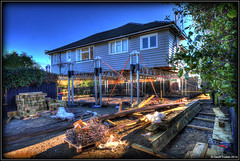
Two images of a house, taken before and after the earthquakes. In the after photograph the chimneys are gone, a column supporting the car port has partly collapsed, windows are broken, and the previously neat lawn and driveway are overgrown. The photographer comments, "This was a house that I was selling up to the September 2010 earthquake in Christchurch. It was on Avonside Drive, which was an area that has been badly hit in every earthquake that has hit the area. In the September quake parts of the house moved in different directions and one of the upstairs doors had to be smashed open to release one of the sons from his bedroom. This occurred in the dark with numerous aftershocks shaking the house. Liquefaction poured up through the floor and flowed down the drive. Everyone got out OK, but soon after the house was red stickered meaning it was dangerous to enter. The house was looted many times even though there was constant police patrols. When the most violent earthquake occurred on 22 February 2012 both the tall heavy chimneys came crashing through into the living areas. Subsequent earthquakes and aftershocks have caused one of the brick fence pillars to fall and the front garage pillar to break up and twist. The family's troubles did not end there. They moved into the home of one of their parents and this mansion of a home was so badly affected by the February earthquake that no one could enter to collect any of their or their parents' belongings. They now own a new home, which they are fond of except when the ground shakes yet again. There has been to date 10,712 earthquakes and aftershocks since 4 September 2010".
Cost-Effective Consideration Of Non-Structural Elements: Lessons From The …
Research papers, University of Canterbury Library
By closely examining the performance of a 22-storey steel framed building in Christchurch subject to various earthquakes over the past seven years, it is shown that a number of lessons can be learnt regarding the cost-effective consideration of non-structural elements. The first point in this work is that non-structural elements significantly affected the costs associated with repairing steel eccentrically braced frame (EBF) links. The decommissioning or rerouting of non-structural elements in the vicinity of damaged links in the case study building attributed to approximately half the total cost of their repair. Such costs could be significantly reduced if the original positioning of non-structural elements took account of the potential need to repair the EBF links. The second point highlighted is the role that pre-cast cladding apparently played on the distribution and type of damage in the building. Loss estimates obtained following the FEMA P-58 framework vary considerably when cladding is or isnt modelled, both because of changes to drift demands up the height of the building and because certain types of subsequent damage are likely to be cheaper to repair than others. Finally, costly repairs to non-structural partition walls were required not only after the moment magnitude 7.1 earthquake in 2010 but also in multiple aftershocks in the years that followed. Repair costs associated with aftershock events exceeded those from the main event, emphasizing the need to consider aftershocks within modern performance-based earthquake engineering and also the opportunity that exists to make more cost-effective repair strategies following damaging earthquakes.
Evaluation of the Earthquake Support Coordination Service
Research papers, University of Canterbury Library
The Canterbury earthquakes, which started with the 7.1 magnitude event on September 4, 2010, caused significant damage in the region. The September 4 earthquakes brought substantial damage to land, buildings, and infrastructure, while the 6.3 magnitude earthquake on February 22, 2011 (and its subsequent aftershocks), brought even greater property damage, but also significant loss of life in addition to the region. Thousands were injured, and 185 persons died. A national State of Emergency was declared and remained in effect until April 30, 2011. A significant number of people required immediate assistance and support to deal with loss, injury, trauma experiences, and property damages. Many had to find alternate accommodation as their houses were too damaged to stay in. Of those affected, many were already vulnerable, and others had been too traumatized by the events to effectively deal with the challenges they were faced with. A number of human service organizations in the region, from both government and non-government sectors, joined forces to be able to more effectively and efficiently help those in need. This was the start of what would become known as the Earthquake Support Coordination Service. The aim of this report is to present an evaluation of the Earthquake Support Coordination Service and its collaborative organization, based on documentation and interviews with key stakeholders of the service. The aim is also to evaluate the service based on perspectives gathered among the clients as well as the coordinators working in the service. The final aim is to offer a reflection on the service model, and on what factors enabled the service, as well as recommendations regarding aspects of the service which may require review, and aspects which may be useful in other contexts.
The Southland Times Image: Stacy Squires 2010:12:13 10:26:26
Images, UC QuakeStudies
Photograph captioned by Fairfax, "Christchurch CBD was 'yarn-bombed' during the weekend using yarn and fabric pieces to brighten public areas and earthquake-affected spaces. Visitor Ann Rees and her husband Bernard from South Wales said when looking at the yarn-bombed busts at the Arts Centre (from left: Diana Isaac, Elisie Locke, Charles Luney and Margaret Mahy) that it didn't appear like the work of vandals, but looked quite homely and warm".
Christchurch Press Image: Stacy Squires 2010:12:13 10:26:47
Images, UC QuakeStudies
Photograph captioned by Fairfax, "Christchurch CBD was 'yarn-bombed' during the weekend using yarn and fabric pieces to brighten public areas and earthquake-affected spaces. Visitor Ann Rees and her husband Bernard from South Wales said when looking at the yarn-bombed busts at the Arts Centre (from left: Diana Isaac, Elisie Locke, Charles Luney and Margaret Mahy) that it didn't appear like the work of vandals, but looked quite homely and warm".
Fairfax Video, August 2013 (6)
Videos, UC QuakeStudies
A video of an interview with Linda Stewart, Chairperson of the Burwood-Pegasus Community Board, about how the 2010 and 2011 Canterbury earthquakes have affected the facilities in her ward. Stewart talks about the loss of recreational reserves such as QEII Park, and the likelihood that residents will leave the area if they cannot teach their children to swim. She also talks about the repair process, and the need for community meeting places.