

Search
found 20 results
Images for my house; more images...

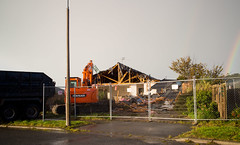
My trees have gone!
Images, eqnz.chch.2010
20130613_7577_1D3-24 My Trees cut down so a house being removed from behind could get out above the fence on one of those elevating house removal trailers. I don't know the story about the yellow (recycling) wheelie bin - the wheels have been removed. This was my house from March 2004 to mid-2012 when it was purchased by the government as it s...
My Neighbour's House Being De-Constructed
Images, UC QuakeStudies
A digitally manipulated image of an excavator demolishing a house. The photographer comments, "My neighbour I thought was going to be one of the first to be rebuilt in the area after being damaged in the 22 February 2011 earthquake, but the builders have knocked it down and not returned yet".
20130610_7556_EOS M-22 HireQuip toilet (Day 161/365)
Images, eqnz.chch.2010
Sitting on the concrete in front of what was my model railway room - a single car garage at the rear of our house in Pacific Park. Reason it is here - one of the houses behind my old house is going to be trucked out. See previous photo.
20140526_8961_EOS M-22 It is happening now
Images, eqnz.chch.2010
My house (bought in March 2004) till the government procured it in October 2012, is finally being demolished. It will be an empty section in a couple of days, once they rip up the concrete base. Note the rainbow on right.
20130112_2583_G12-14 High Tide on Avon River, Pacific Park, Bexley.
Images, eqnz.chch.2010
All this is "red zone" after the earthquakes and has to be demolished. The roof of my "old" house (now owned by the government) can be seen between the third and fourth river-side houses.
My Photographic Visualisation of the Christchurch Earthquake
Images, UC QuakeStudies
A motion-blurred photograph of houses, with the Port Hills in the background. The photographer comments, "This I hope gives you a feel of what it feels like in an earthquake. When you spend your whole life thinking that you and your home are built on solid ground, it can be quite a shock when you find it is not. You can feel the house shaking like a dog with a toy, rising up violently underneath you or the most gentle form which is when the ground moves gently like a wave moving under a rowing boat. It is not just the movement, you often get a rumbling sound which can precede a violent shake or can result in no movement at all. This means that some vehicles can sound like the rumbling initially and in the early days would get your heart racing. Another form of stress is when big excavators as heavy as a tank move as you can feel the ground shake from streets away, but you do not always hear the engine. For most of us the problem when the shaking starts, is wondering if this is the start of an extremely violent earthquake or will it peter out".
Another one bites the dust
Images, eqnz.chch.2010
20120702_1387_G12-18 Another one bites the dust 8 Velsheda Street, Bexley, Christchurch, across the road from my house was demolished a week or so ago, just one of many demolitions of Red Zone properties at the moment. This house was about ten years old and suffered land damage during the 4th September 2010 and 22nd February 2011 earthquakes. ...
20120827_2023_G12-08 Container about to be unloaded
Images, eqnz.chch.2010
RWTU3388135 (ex Triton TTNU3388135) about to be placed on the ground outside my "Red Zone" house. This is the second container, the first is away in storage with 95% of the house hold stuff. This one is for the hobby (no, not photography gear) and garage stuff.
Dallington 7
Articles, UC QuakeStudies
A photograph captioned, "My daughter grew up in this house. She's 10 now. She is going to miss it - and Dallington. It's where she's grown up, what she knows. She'll miss it alright. Me too".
Dallington 12
Articles, UC QuakeStudies
Photograph captioned, "I'll have mixed feelings when I leave. I'll be sad to go - and sad to see my house go. But I hope it'll be a good feeling once it's over. I'll be pleased to get to that stage and feel like I'm finally moving on".
19 Velsheda Street
Images, eqnz.chch.2010
20130613_7580_1D3-24 19 Velsheda Street The two nice trees in the front of my old property on the right (now owned by the government) have been cut down so the main section of the house behind could be trucked down the drive. The truck must have been up against the fence to get the height above the house to the left (15 Velsheda Street). Down t...
20130328_1148_EOS M-49 T-Rex may have visited
Images, eqnz.chch.2010
The seismic survey truck T-Rex (from University of Texas) was in Bexley and Pacific Park a few days ago and may have left this calling card on the front lawn of my old "red zone" house. Obviously the geotechs will know what it means.
It has started!
Images, eqnz.chch.2010
20140521_1080_1D3-24 It has started! Removal of the double-glazed windows is underway at my "red zone" house, now owned by the Government of New Zealand. Sold to CERA (the government agency) in October 2012 and has remained empty since, despite having little damage, apart from the tilt to the front from the land damage that occurred during the...
Maxine Bennett's Blog 12/02/2013: Of sorrow and salvage. Op-Shop Show-Off …
Articles, UC QuakeStudies
An entry from Maxine Bennett's blog, "Blackbird Has Spoken: Having a go at this blogging lark" (http://www.blackbirdhasspoken.com). The entry for 12 February 2013 is titled "Of sorrow and salvage. Op-Shop Show-Off Feb 12th 2013". Maxine writes, "I’m Max, an English girl in, and in love with New Zealand, and the New Zealander husband. In an almost forgotten previous life I worked as a psychotherapist and psychiatric nurse; now I’m the contented stay at home mother of Claudine who's almost 3, and the baby-boy-currently-gestating. We live a quiet life in a small rural town in our arts and crafts house, but dream of moving out to some land one day, to build our own home and enjoy a long view. I like to laugh, be outside, craft, grow, op-shop, read and cook. My little Kiwi family, learning new things, quiet, beauty and reading blogs make me the happiest of all. My blog is a record of my enthusiasms, fleeting and enduring, and a means of communication with you kindred spirits near and far." Note that the blog post has been converted to PDF format for archiving, which may have resulted in changes to the formatting and layout of the page.
101 demolitions : how a disaster shed light on life in nineteenth century …
Research papers, University of Canterbury Library
On 22 February 2011, Ōtautahi Christchurch was struck by a devastating earthquake. The city was changed forever: lives were lost, buildings destroyed and much of the city’s infrastructure needed to be repaired or replaced. One of the unexpected outcomes of the process of recovery was the volume of archaeological work that was carried out in the city, including the substantial amount of buildings archaeology that was undertaken (that is, recording standing buildings prior to and during their demolition, using archaeological techniques). Amongst the numerous buildings recorded in this way were 101 houses from across the city (but concentrated in those areas hit hardest by the earthquakes), built between 1850 and 1900. This work yielded a wealth of data about what houses in the city looked like in the nineteenth century. It is this data that forms the core of my thesis, providing an opportunity to examine the question of what life was like in nineteenth century Christchurch through these houses and the people who built them. Christchurch was founded in 1850 by European settlers, most of whom were English. These people came to New Zealand to build a better life for themselves and their families. For many of them, this ‘better life’ included the possibility of owning their own home and, in some instances, building that house (or at least, commissioning its construction). The buildings archaeology data collected following the Canterbury earthquakes enabled a detailed analysis of what houses in the city looked like in the nineteenth century – their form, and both their external and internal appearance – and how this changed as the century progressed. A detailed examination of the lives of those who built 21 of the houses enabled me to understand why each house looked the way it did, and how the interplay of class, budget and family size and expectations (amongst other factors) shaped each house. It is through these life stories that more about life in Christchurch in the nineteenth century was revealed. These are stories of men and women, of success and failure, of businesses and bankruptcies. There are themes that run through the stories: class, appearances, death, religion, gender, improvement. Just as importantly, though, they reveal the everyday experiences of people as they set about building a new city. Thus, through the archaeology of the houses and the history of the people who built them, an earthquake has revealed more about life in nineteenth century Christchurch, as well as providing the means for a deeper understanding of the city’s domestic architecture.
Question Time for 18 October 2012
Audio, Radio New Zealand
Hon NANAIA MAHUTA to the Minister of Education: Is it still her strategy in education to "focus on teaching and learning quality" and "transparent accountabilities"? MAGGIE BARRY to the Minister of Finance: What progress is the Government making in supporting jobs and economic growth? EUGENIE SAGE to the Minister for the Environment: Does she stand by her statement that, "My preference will always be for all our sites to be safe for swimming"? CHARLES CHAUVEL to the Attorney-General: Who, other than himself and the Prime Minister, was present at the discussion on the Government Communications Security Bureau's unlawful surveillance of Mr Dotcom? NICKY WAGNER to the Minister for Canterbury Earthquake Recovery: What reports has he received on the outlook for increased employment opportunities in the rebuilding of Greater Christchurch? Rt Hon WINSTON PETERS to the Prime Minister: Does he think it is important that his Ministers, including himself, come to the House prepared to give honest answers? DARIEN FENTON to the Minister of Labour: How will employers know whether a job applicant aged 18 or 19 has been receiving a benefit for 6 months or more in order to pay the Government's starting-out wage? TIM MACINDOE to the Minister for Social Development: What announcements has she made on the new Children's Teams which form part of the Government's White Paper for Vulnerable Children? Dr DAVID CLARK to the Prime Minister: Does he stand by his comment that Government computer systems "can't actually support radical changes from Government"? Hon TAU HENARE to the Minister of Customs: How successful has SmartGate technology been at processing passengers at the border? CHRIS HIPKINS to the Minister of Education: How long will boards of trustees of the schools she proposes to close or merge in Christchurch have to consult with their local communities before they are required to provide feedback to her ahead of a final decision? CATHERINE DELAHUNTY to the Minister of Education: Does she stand by her statement to schools, about their obligation under the Official Information Act 1982, that, "New Zealand is an open and transparent democracy. They [schools] are required to release this information. You are public entities."?
Question Time for 15 December 2010
Audio, Radio New Zealand
1. AMY ADAMS to the Minister of Finance: What progress has the Government made this year in laying the foundations for a more ambitious and faster growing economy? 2. Hon PHIL GOFF to the Prime Minister: Does he stand by his statement that by early 2010 New Zealand will be coming out of the recession "reasonably aggressively"? 3. ALLAN PEACHEY to the Minister of Education: What feedback has she received about the quality of school reports to parents this year? 4. Hon CLAYTON COSGROVE to the Minister for Canterbury Earthquake Recovery: Is he satisfied that the Canterbury earthquake business support measures undertaken by the Government have worked as intended? 5. Dr KENNEDY GRAHAM to the Minister for Climate Change Issues (International Negotiations): Will the Cancun Agreements achieve the agreed goal of confining global warming to 2 degrees Celsius by 2020; if so, how? 6. Dr PAUL HUTCHISON to the Minister of Health: What reports has he received on improved access to medicines? 7. Hon DAMIEN O'CONNOR to the Prime Minister: Does he stand by his statement that "It's clearly been a large sum of money. But at the end of the day I gave a commitment to the families at Pike River I'd do everything I could to get their men out, I stand by that. I think the Government has done everything it can do so far"? 8. Dr CAM CALDER to the Minister of Corrections: Has she received any progress reports on the Government's Prisoner Skills and Employment Strategy? 9. Hon DAVID PARKER to the Minister for Economic Development: How many additional Cabinet papers has he submitted to Cabinet since he told the House in July "In my capacity as Minster for Economic Development I have submitted 14 papers to Cabinet in the last 6 months"? 10. HONE HARAWIRA to the Minister of Foreign Affairs: What steps has the New Zealand Government taken to denounce the shooting by Chilean forces of indigenous Rapa Nui, during an operation to evict them from stolen ancestral lands that they were seeking to reclaim? 11. Hon JIM ANDERTON to the Minister for ACC: Does he have any concerns about the way ACC in general and claims general manager Denise Cosgrove in particular, is interpreting ACC legislation regarding personal injury claims which are being declined on the basis of degeneration or pre-existing conditions? 12. COLIN KING to the Minister of Fisheries: How will fisheries officers be helping to better protect New Zealand's fisheries this summer?
Question Time for 25 October 2012
Audio, Radio New Zealand
Hon DAVID PARKER to the Minister of Finance: Does he stand by his answer on Tuesday regarding jobs "I think that the number of 170,000 may come from the initial Budget forecast for 2009, perhaps. I cannot remember the year exactly."? Dr KENNEDY GRAHAM to the Minister for Climate Change Issues: Given the recent loss of Māori Party support for his Climate Change Response (Emissions Trading and Other Matters) Amendment Bill, will he consider working with opposition parties on amendments to improve it? LOUISE UPSTON to the Minister of Finance: How is the Government's infrastructure programme contributing to building a more competitive economy? Hon DAVID CUNLIFFE to the Minister for Economic Development: Does he agree with the NZIER shadow board that "the growth outlook for the second half of 2012 looks weak and unemployment remains stubbornly high."? IAN McKELVIE to the Minister for Social Development: What announcements has she made to review Child Youth and Family's complaints process? Hon MARYAN STREET to the Minister of Health: What progress has been made in the delivery of the Prime Minister's Youth Mental Health Project announced in April of this year with an extra $11.3 million provided to support it? JACQUI DEAN to the Minister for the Environment: What reports has she received on the time taken for decisions on notified consents issued under the Resource Management Act 1991? GARETH HUGHES to the Minister of Foreign Affairs: Why did New Zealand pull out of a joint proposal with the United States to create a marine reserve in Antarctica's Ross Sea? Rt Hon WINSTON PETERS to the Prime Minister: Does he stand by the answers he gave yesterday to supplementary question 5 on Oral Question No 7 and supplementary question 3 on Oral Question No 12? NICKY WAGNER to the Minister for Canterbury Earthquake Recovery: What progress has the Government made to support repairing damaged houses and infrastructure following the Canterbury earthquakes? SUE MORONEY to the Prime Minister: Does he stand by his statement on 3News last night, on the subject of Business New Zealand's assertion that women need retraining when returning to employment after extended parental leave that "no. It wouldn't be my view"? JAMI-LEE ROSS to the Minister of Immigration: What is the Government doing to ensure that New Zealanders have first priority for jobs in the Canterbury rebuild?
Question Time for 6 March 2014
Audio, Radio New Zealand
DAVID BENNETT to the Minister of Finance: How is the Government's economic programme helping to keep interest rates lower during this economic cycle, compared to the previous economic cycle in the mid-2000s? Dr RUSSEL NORMAN to the Minister of Energy and Resources: How much more is an average New Zealand household that uses 8,000kwh of power annually paying for electricity per year as of November 2013 compared to November 2008, according to the Ministry of Business, Innovation, and Employment's latest Quarterly Survey of Domestic Electricity Prices? Hon DAVID PARKER to the Minister of Finance: What will he do to "spread some of the benefits of growth" when hourly wage rates have only grown by 1.6 percent in the year to December 2013, which is close to 0 percent in real terms, when 45 percent of listed corporates have double-digit profit growth? JACQUI DEAN to the Minister for the Environment: What recent announcements has the Government made on the classification for drilling for oil and gas in New Zealand's Exclusive Economic Zone? GRANT ROBERTSON to the Minister of Justice: When she told the House yesterday "I had previously told Oravida that it could not use my name or photograph to endorse or promote its business products or services" when was that and what specific circumstances did it relate to? COLIN KING to the Minister for Tertiary Education, Skills and Employment: How is the Youth Guarantee Scheme helping the Government achieve the Better Public Services target of 85 percent of all 18-year-olds achieving NCEA Level two or an equivalent qualification in 2017? CAROL BEAUMONT to the Minister of Women's Affairs: Does she have confidence in the Ministry of Women's Affairs given their 2013 Annual Report shows that six out of seven policy outcomes have stayed the same or gone backwards in the last past year; if so, why? SCOTT SIMPSON to the Minister for Courts: How is the Government improving the way the Disputes Tribunal works to make it easier for New Zealanders to resolve civil disputes? Hon TREVOR MALLARD to the Minister of Internal Affairs: What action, if any, has he taken this year to show the Prime Minister that he has met the highest ethical standards required by Section 2.53 of the Cabinet Manual? ALFRED NGARO to the Minister of Pacific Island Affairs: What steps is the Government taking to lift the skills of Pacific people in New Zealand? DENIS O'ROURKE to the Minister for Canterbury Earthquake Recovery: Does he accept the conclusion in the Human Rights Commission's report Monitoring Human Rights in the Canterbury Earthquake Recovery that "many people affected by the earthquakes continue to experience deteriorating standards of living and impacts on their quality of life that go beyond the immediate effects of the disaster"? CATHERINE DELAHUNTY to the Minister of Energy and Resources: Has he had any discussions with any Indian Government Ministers about selling Solid Energy assets?
The impact of domestic cats (Felis catus) living around Travis Wetland, Ch…
Research papers, University of Canterbury Library
Cats all over the world hunt wild animals and can contribute to the extinction of threatened species. In New Zealand, around half of all households have at least one cat. When cats live close to a natural area, such as a wetland, they may have impacts on native species. A previous study on the movements and hunting behaviour of domestic (house) cats around the Travis Wetland, Christchurch, New Zealand during 2000-2001 raised concerns about the effects of cats on the local skink population, as skinks were a frequent prey item. My study is a comparison to the prior study, to determine if impacts have changed alongside changes in human populations in the area post-earthquake. The domestic cat population in the area was estimated by a household survey in March-April 2018. For a 6 month period from March-September 2018, 26 households recorded prey brought home by their 41 cats. During April-July 2018, 14 cats wore Global Positioning System (GPS) devices for 7 days each to track their movements. Skink abundance was measured with pitfall trapping over 20 days in February 2018. There were more households in the area in 2018 than there were in 2000, but the numbers of cats had decreased. In the 196 ha study area around Travis Wetland, the domestic cat population was estimated at 429 cats, down from the previous 494. Most of the cats were free roaming, but the majority had been desexed and many were mostly seen at home. A total of 42 prey items were reported from 26 households and 41 cats over 6 months. Of these, 62% were rodents, 26% were exotic birds, and 12% were native birds. There were no native skinks, other mammals, or other vertebrates such as fish and amphibians (invertebrates were not included in this study). Eight male and six female cats were tracked by GPS. Home range sizes for the 100% minimum convex polygons (MCPs) ranged from 1.34 to 9.68 ha (mean 4.09 ha, median 3.54 ha). There were 9/14 (64%) cats that entered the edge of the wetland. Males had significantly larger home range areas at night and in general compared with females. However, age and distance of the cat’s household to the wetland did not have a significant effect on home range size and there was no significant correlation between home range size and prey retrieved. In 20 days of skink trapping, 11 Oligosoma polychroma were caught. The estimated catch rate was not significantly different from an earlier study on skink abundance in Travis Wetland. The apparently low abundance of skinks may have been the result of successful wetland restoration creating less suitable skink habitat, or of other predators other than cats. In the future, increased education should be provided to the public about ways to increase wildlife in their area. This includes creating lizard friendly habitat in their gardens and increasing management for cats. Generally, only a few cats bring home prey often, and these select cats should be identified in initial surveys and included in further studies. In New Zealand, until management programmes can target all predators in urban areas, domestic cats could stay out at night and inside during the day to help decrease the abundance of rodents at night and reduce the number of birds and lizards caught during the day.
- 1