
Search
found 31 results
Images for center; more images...


Rise Up Christchurch : te kotahitanga : global telethon.
Other, National Library of New Zealand
A 12-hour 'entertainment spectacular' centered in Christchurch. Features entertainers from around the world raising funds for the New Zealand Government's Christchurch Earthquake Appeal.
Christchurch Earthquake, New Zealand, 2010
Images, eqnz.chch.2010
Hit at 4.35am (local time) on Saturday, September 4th 2010, measuring a 7.1 and centered 40km west of the city
Christchurch Earthquake, New Zealand, 2010
Images, eqnz.chch.2010
Hit at 4.35am (local time) on Saturday, September 4th 2010, measuring a 7.1 and centered 40km west of the city
Christchurch Earthquake, New Zealand, 2010
Images, eqnz.chch.2010
Hit at 4.35am (local time) on Saturday, September 4th 2010, measuring a 7.1 and centered 40km west of the city
Christchurch Earthquake, New Zealand, 2010
Images, eqnz.chch.2010
Hit at 4.35am (local time) on Saturday, September 4th 2010, measuring a 7.1 and centered 40km west of the city
Christchurch Earthquake, New Zealand, 2010
Images, eqnz.chch.2010
Hit at 4.35am (local time) on Saturday, September 4th 2010, measuring a 7.1 and centered 40km west of the city
Timaru Herald Image: Oisin Duke 2010:09:04 14:40:33
Images, UC QuakeStudies
Photograph captioned by Fairfax, "St. Mary's Anglican Church in Timaru is cordoned off due to the risk of falling masonry after the 7.1 magnitude earthquake centered near Darfield".
Full waveform seismic tomography for geological velocity model in Canterbu…
Research papers, University of Canterbury Library
None
Medway Street Bridge - River Road side looking upstream
Images, eqnz.chch.2010
The center of the river has slumped and the two banks have moved about a meter closer together which caused this footbridge to be so twisted. There is a suggestion that this be left as a memorial to the earthquake.
Medway Street Bridge
Images, eqnz.chch.2010
The center of the river has slumped and the two banks have moved about a meter closer together which caused this footbridge to be so twisted. There is a suggestion that this be left as a memorial to the earthquake.
Medway Street Bridge over Avon River
Images, eqnz.chch.2010
The center of the river has slumped and the two banks have moved about a meter closer together which caused this footbridge to be so twisted. There is a suggestion that this be left as a memorial to the earthquake.
Medway Street Bridge - River Road end
Images, eqnz.chch.2010
The center of the river has slumped and the two banks have moved about a meter closer together which caused this footbridge to be so twisted. There is a suggestion that this be left as a memorial to the earthquake.
River Avon - duck
Images, eqnz.chch.2010
The center of the river has slumped and the two banks have moved about a meter closer together which caused this footbridge to be so twisted. There is a suggestion that this be left as a memorial to the earthquake.
River Road end of Medway Street Bridge
Images, eqnz.chch.2010
The center of the river has slumped and the two banks have moved about a meter closer together which caused this footbridge to be so twisted. There is a suggestion that this be left as a memorial to the earthquake.
Bringing the house down
Images, eqnz.chch.2010
www.youtube.com/watch?v=SPXqb7k4azU Details inside a half demolished theatre in central Christchurch. November, 2012. Christchurch, NZ. (c)Mike Brebner. All rights reserved.
ILEE ROBUST project: Development of a multiple rocking steel structural sy…
Research papers, University of Canterbury Library
In recent years, rocking isolation has become an effective approach to improve seismic performance of steel and reinforced concrete structures. These systems can mitigate structural damage through rigid body displacement and thus relatively low requirements for structural ductility, which can significantly improve seismic resilience of structures and reduce repairing costs after strong earthquakes. A number of base rocking structural systems with only a single rocking interface have been proposed. However, these systems can have significant high mode effect for high rise structures due to the single rocking interface. This RObust BUilding SysTem (ROBUST) project is a collaborative China-New Zealand project sponsored by the International Joint Research Laboratory of Earthquake Engineering (ILEE), Tongji University, and a number of agencies and universities within New Zealand including the BRANZ, Comflor, Earthquake Commission, HERA, QuakeCoRE, QuakeCentre, University of Auckland, and the University of Canterbury. A number of structural configurations will be tested [1, 2], and non-structural elements including ceilings, infilling walls, glazed curtain walls, precast concrete panels, piping system will also be tested in this project [3]. Within this study, a multiple rocking column steel structural system was proposed and investigated mainly by Tongji team with assistance of NZ members. The concept of rocking column system initiates from the structure of Chinese ancient wooden pagoda. In some of Chinese wooden pagodas, there are continuous core columns hanged only at the top of each pagoda, which is not connected to each stories. This core column can effectively avoid collapse of the whole structure under large storey drifts. Likewise, there are also central continuous columns in the newly proposed steel rocking column system, which can avoid weak story failure mechanism and make story drifts more uniform. In the proposed rocking column system, the structure can switch between an elastic rigidly connected moment resisting frame and a controlled rocking column system when subjected to strong ground motion excitations. The main seismic energy can be dissipated by asymmetric friction beam–column connections, thereby effectively reducing residual displacement of the structure under seismic loading without causing excessive damage to structural members. Re–centering of the structure is provided not only by gravity load carried by rocking columns, but also by mould coil springs. To investigate dynamic properties of the proposed system under different levels of ground excitations, a full-scale threestory steel rocking column structural system with central continuous columns is to be tested using the International joint research Laboratory of Earthquake Engineering (ILEE) facilities, Shanghai, China and an analytical model is established. A finite element model is also developed using ABAQUS to simulate the structural dynamic responses. The rocking column system proposed in this paper is shown to produce resilient design with quick repair or replacement.
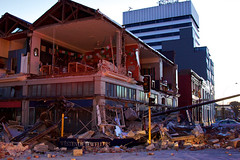
Canterbury Earthquake 2010
Images, eqnz.chch.2010
Shop Damage Ferry Road Woolston Christchurch Canterbury New Zealand © 2010 Phil Le Cren Photo Taken With: Canon EOS 1000D + Canon EF/EF-S lenses + 10.1 effective megapixels + 2.5-inch TFT color LCD monitor + Eye-level pentamirror SLR + Live View shooting. + EOS Built-in Sensor cleaning system + Wide-area 7 point AF with center ...
Canterbury Earthquake 2010
Images, eqnz.chch.2010
Shop Damage Ferry Road Woolston Christchurch Canterbury New Zealand © 2010 Phil Le Cren Photo Taken With: Canon EOS 1000D + Canon EF/EF-S lenses + 10.1 effective megapixels + 2.5-inch TFT color LCD monitor + Eye-level pentamirror SLR + Live View shooting. + EOS Built-in Sensor cleaning system + Wide-area 7 point AF with center ...
Canterbury Earthquake 2010
Images, eqnz.chch.2010
Shop Damage Ferry Road Woolston Christchurch Canterbury New Zealand © 2010 Phil Le Cren Photo Taken With: Canon EOS 1000D + Canon EF/EF-S lenses + 10.1 effective megapixels + 2.5-inch TFT color LCD monitor + Eye-level pentamirror SLR + Live View shooting. + EOS Built-in Sensor cleaning system + Wide-area 7 point AF with center ...
Canterbury Earthquake 2010
Images, eqnz.chch.2010
Shop Damage Ferry Road Woolston Christchurch Canterbury New Zealand © 2010 Phil Le Cren Photo Taken With: Canon EOS 1000D + Canon EF/EF-S lenses + 10.1 effective megapixels + 2.5-inch TFT color LCD monitor + Eye-level pentamirror SLR + Live View shooting. + EOS Built-in Sensor cleaning system + Wide-area 7 point AF with center ...
Canterbury Earthquake 2010
Images, eqnz.chch.2010
Shop Damage Ferry Road Woolston Christchurch Canterbury New Zealand © 2010 Phil Le Cren Photo Taken With: Canon EOS 1000D + Canon EF/EF-S lenses + 10.1 effective megapixels + 2.5-inch TFT color LCD monitor + Eye-level pentamirror SLR + Live View shooting. + EOS Built-in Sensor cleaning system + Wide-area 7 point AF with center ...
Plato Creative Photograph 06
Images, UC QuakeStudies
The interior of the octagonal corner section of the Cranmer Court building, which housed Plato Creative from March 2008 to November 2009. The photograph showcases the building's intricate wooden ceiling and high windows. A stained glass design is visible at the center of the windows with a motto underneath reading, "The spirit of this building lives on". Although designed to house a book depot, this section was used as the principal's office while Christchurch Normal School was operating from the building.
Plato Creative Photograph 08
Images, UC QuakeStudies
The interior of the octagonal corner section of the Cranmer Court building, which housed Plato Creative from March 2008 to November 2009. The photograph showcases the building's intricate wooden ceiling and high windows. A stained glass design is visible at the center of the window with a motto underneath reading, "The spirit of this building lives on". Although designed to house a book depot, this room was used as the principal's office while Christchurch Normal School was operating from the building.
The Naked Baker
Audio, Radio New Zealand
One Christchurch business has found just the right ingredients to rise again."The Naked Baker"gave away all of their cakes and buns and baked goods to the people of North Brighton after the earthquake on February 22nd. Co-owners Darren Carlaw and Andrew Snee started the bakery, coffee roastery and mobile food business 8 years ago. The cafe had to shut for more than 2 weeks to clean up all the damage . They didn't know what to expect when the business re-opened. What they discovered is that business is up by 30% thanks in part to their ability to bring their coffee and cakes to the many offices that have moved out of the center of town.
Innovative seismic solutions for multi-storey LVL timber buildings
Research papers, University of Canterbury Library
Describes an extensive experimental program at the University of Canterbury, for the development of new structural systems and connections for multi-storey laminated veneer lumber (LVL) timber buildings in earthquake-prone areas. The proposed innovative ductile timber connections are conceptually similar to recent seismic solutions successfully developed for precast concrete multi- storey buildings. The paper gives an overview of the research program, and the results of quasi-static cyclic tests on frame subassemblies, including exterior beam-column joints and cantilever columns, as well as pseudo-dynamic tests on cantilever columns. The experimental results showed significant dissipation of hysteretic energy, good self-centering capacity and no appreciable damage of the structural elements, confirming the expected enhanced performance of the proposed structural systems.
Management of Complex Cultural Heritage Projects: UC CEISMIC Earthquake Ar…
Research papers, University of Canterbury Library
The UC CEISMIC Canterbury Earthquakes Digital Archive contains tens of thousands of high value cultural heritage items related to a long series of earthquakes that hit Canterbury, New Zealand, from 2010 - 2012. The archive was built by a Digital Humanities team located at the center of the disaster in New Zealand's second largest city, Christchurch. The project quickly became complex, not only in its technical aspects but in its governance and general management. This talk will provide insight into the national and international management and governance frameworks used to successfully build and deliver the archive into operation. Issues that needed to be managed included human ethics, research ethics, stakeholder management, communications, risk management, curation and ingestion policy, copyright and content licensing, and project governance. The team drew heavily on industry-standard project management methods for the basic approach, but built their ecosystem and stakeholder trust on principles derived directly form the global digital humanities community.
Beyond ductility: parametric testing of a jointed rocking beam-column conn…
Research papers, University of Canterbury Library
Despite their good performance in terms of their design objectives, many modern code-prescriptive buildings built in Christchurch, New Zealand had to be razed after the 2010-2011 Canterbury earthquakes because repairs were deemed too costly due to widespread sacrificial damage. Clearly a more effective design paradigm is needed to create more resilient structures. Rocking, post-tensioned connections with supplemental energy dissipation can contribute to a damage avoidance designs (DAD). However, few have achieved all three key design objectives of damage-resistant rocking, inherent recentering ability, and repeatable, damage-free energy dissipation for all cycles, which together offer a response which is independent of loading history. Results of experimental tests are presented for a near full-scale rocking beam-column sub-assemblage. A matrix of test results is presented for the system under varying levels of posttensioning, with and without supplemental dampers. Importantly, this parametric study delineates each contribution to response. Practical limitations on posttensioning are identified: a minimum to ensure static structural re-centering, and a maximum to ensure deformability without threadbar yielding. Good agreement between a mechanistic model and experimental results over all parameters and inputs indicates the model is robust and accurate for design. The overall results indicate that it is possible to create a DAD connection where the non-linear force-deformation response is loading history independent and repeatable over numerous loading cycles, without damage, creating the opportunity for the design and implementation of highly resilient structures.
Earthquake News “Geotechnical Damage due to the 2011 Christchurch, New Zea…
Research papers, University of Canterbury Library
On 22 February 2011,a magnitude Mw 6.3 earthquake occurred with an epicenter located near Lyttelton at about 10km from Christchurch in Canterbury region on the South Island of New Zealand (Figure 1). Since this earthquake occurred in the midst of the aftershock activity which had continued since the 4 September 2010 Darfield Earthquake occurrence, it was considered to be an aftershock of the initial earthquake. Because of the short distance to the city and the shallower depth of the epicenter, this earthquake caused more significant damage to pipelines, traffic facilities, residential houses/properties and multi-story buildings in the central business district than the September 2010 Darfield Earthquake in spite of its smaller earthquake magnitude. Unfortunately, this earthquake resulted in significant number of casualties due to the collapse of multi-story buildings and unreinforced masonry structures in the city center of Christchurch. As of 4 April, 172 casualties were reported and the final death toll is expected to be 181. While it is extremely regrettable that Christchurch suffered a terrible number of victims, civil and geotechnical engineers have this hard-to-find opportunity to learn the response of real ground from two gigantic earthquakes which occurred in less than six months from each other. From geotechnical engineering point of view, it is interesting to discuss the widespread liquefaction in natural sediments, repeated liquefaction within short period and further damage to earth structures which have been damaged in the previous earthquake. Following the earthquake, an intensive geotechnical reconnaissance was conducted to capture evidence and perishable data from this event. The team included the following members: Misko Cubrinovski (University of Canterbury, NZ, Team Leader), Susumu Yasuda (Tokyo Denki University, Japan, JGS Team Leader), Rolando Orense (University of Auckland, NZ), Kohji Tokimatsu (Tokyo Institute of Technology, Japan), Ryosuke Uzuoka (Tokushima University, Japan), Takashi Kiyota (University of Tokyo, Japan), Yasuyo Hosono (Toyohashi University of Technology, Japan) and Suguru Yamada (University of Tokyo, Japan).
Melancholy, memories and six nostalgias: Postquake Christchurch and the pr…
Research papers, Lincoln University
The city of Christchurch, New Zealand, was until very recently a “Junior England”—a small city that still bore the strong imprint of nineteenth-century British colonization, alongside a growing interest in the underlying biophysical setting and the indigenous pre-European landscape. All of this has changed as the city has been subjected to a devastating series of earthquakes, beginning in September 2010, and still continuing, with over 12,000 aftershocks recorded. One of these aftershocks, on February 22, 2011, was very close to the city center and very shallow with disastrous consequences, including a death toll of 185. Many buildings collapsed, and many more need to be demolished for safety purposes, meaning that over 80 percent of the central city will have gone. Tied up with this is the city’s precious heritage—its buildings and parks, rivers, and trees. The threats to heritage throw debates over economics and emotion into sharp relief. A number of nostalgic positions emerge from the dust and rubble, and in one form is a reverse-amnesia—an insistence of the past in the present. Individuals can respond to nostalgia in very different ways, at one extreme become mired in it and unable to move on, and at the other, dismissive of nostalgia as a luxury in the face of more pressing crises. The range of positions on nostalgia represent the complexity of heritage debates, attachment, and identity—and the ways in which disasters amplify the ongoing discourse on approaches to conservation and the value of historic landscapes.
Seismic response and design of subassemblies for multi-storey prestressed …
Research papers, University of Canterbury Library
Timber has experienced renewed interests as a sustainable building material in recent times. Although traditionally it has been the prime choice for residential construction in New Zealand and some other parts of the world, its use can be increased significantly in the future through a wider range of applications, particularly when adopting engineered wood material, Research has been started on the development of innovative solutions for multi-storey non-residential timber buildings in recent years and this study is part of that initiative. Application of timber in commercial and office spaces posed some challenges with requirements of large column-free spaces. The current construction practice with timber is not properly suited for structures with the aforementioned required characteristics and new type of structures has to be developed for this type of applications. Any new structural system has to have adequate capacity for carry the gravity and lateral loads due to occupancy and the environmental effects. Along with wind loading, one of the major sources of lateral loads is earthquakes. New Zealand, being located in a seismically active region, has significant risk of earthquake hazard specially in the central region of the country and any structure has be designed for the seismic loading appropriate for the locality. There have been some significant developments in precast concrete in terms of solutions for earthquake resistant structures in the last decade. The “Hybrid” concept combining post-tensioning and energy dissipating elements with structural members has been introduced in the late 1990s by the precast concrete industry to achieve moment-resistant connections based on dry jointed ductile connections. Recent research at the University of Canterbury has shown that the concept can be adopted for timber for similar applications. Hybrid timber frames using post-tensioned beams and dissipaters have the potential to allow longer spans and smaller cross sections than other forms of solid timber frames. Buildings with post-tensioned frames and walls can have larger column-free spaces which is a particular advantage for non-residential applications. While other researchers are focusing on whole structural systems, this research concentrated on the analysis and design of individual members and connections between members or between member and foundation. This thesis extends existing knowledge on the seismic behaviour and response of post-tensioned single walls, columns under uni-direction loads and small scale beam-column joint connections into the response and design of post-tensioned coupled walls, columns under bi-directional loading and full-scale beam-column joints, as well as to generate further insight into practical applications of the design concept for subassemblies. Extensive experimental investigation of walls, column and beam-column joints provided valuable confirmation of the satisfactory performance of these systems. In general, they all exhibited almost complete re-centering capacity and significant energy dissipation, without resulting into structural damage. The different configurations tested also demonstrated the flexibility in design and possibilities for applications in practical structures. Based on the experimental results, numerical models were developed and refined from previous literature in precast concrete jointed ductile connections to predict the behaviour of post-tensioned timber subassemblies. The calibrated models also suggest the values of relevant parameters for applications in further analysis and design. Section analyses involving those parameters are performed to develop procedures to calculate moment capacities of the subassemblies. The typical features and geometric configurations the different types of subassemblies are similar with the only major difference in the connection interfaces. With adoption of appropriate values representing the corresponding connection interface and incorporation of the details of geometry and configurations, moment capacities of all the subassemblies can be calculated with the same scheme. That is found to be true for both post-tensioned-only and hybrid specimens and also applied for both uni-directional and bi-directional loading. The common section analysis and moment capacity calculation procedure is applied in the general design approach for subassemblies.
- 1
- »