
Search
found 15 results
Images for Street Art and Graffiti; more images...
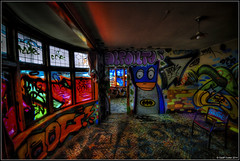
Graffiti House Christchurch
Images, eqnz.chch.2010
Christchurch's Graffiti House... This Cranford Street house was damaged in the earthquakes and is due for demolished this week but has been given a Graffiti Makeover by local Street Artists.
Forgotten Street Art
Images, UC QuakeStudies
Graffiti on a damaged building on Colombo Street. The photographer comments, "This street art has been unseen by the general Christchurch population as it was off limits in the Red Zone".
Painting ruins : graffiti and street art in post-earthquake Christchurch.
Research papers, University of Canterbury Library
This thesis considers the presence and potential readings of graffiti and street art as part of the wider creative public landscape of Christchurch in the wake of the series of earthquakes that significantly disrupted the city physically and socially. While documenting a specific and unprecedented period of time in the city’s history, the prominence of graffiti and street art throughout the constantly changing landscape has also highlighted their popularity as increasingly entrenched additions to urban and suburban settings across the globe. In post-quake Christchurch, graffiti and street art have often displayed established tactics, techniques and styles while exploring and exposing the unique issues confronting this disrupted environment, illustrating both a transposable nature and the entwined relationship with the surrounding landscape evident in the conception of these art forms. The post-quake city has afforded graffiti and street art the opportunity to engage with a range of concepts: from the re-activation and re-population of the empty and abandoned spaces of the city, to commentaries on specific social and political issues, both angry and humorous, and notably the reconsideration of entrenched and evolving traditions, including the distinction between guerrilla and sanctioned work. The examples of graffiti and street art within this work range from the more immediate post-quake appearance of art in a group of affected suburbs, including the increasingly empty residential red-zone, to the use of the undefined spaces sweeping the central city, and even inside the Canterbury Museum, which housed the significant street art exhibition Rise in 2013-2014. These settings expose a number of themes, both distinctive and shared, that relate to both the post-disaster landscape and the concerns of graffiti and street art as art movements unavoidably entangled with public space.
Spence Kingi Commemorative Art Work
Images, UC QuakeStudies
A graffiti-style recruitment advertisement for the NZ Police, depicting police officer Spence Kingi pulling a woman from the rubble.
Police Art on Montreal St, Christchurch
Images, UC QuakeStudies
A graffiti-style recruitment advertisement for the NZ Police, depicting police officer Spence Kingi pulling a woman from the rubble.
Christchurch: The Transitional City Pt IV, pages 328-329: Unsanctioned Gra…
Articles, UC QuakeStudies
A PDF copy of pages 328-329 of the book Christchurch: The Transitional City Pt IV. The pages document the transitional project 'Unsanctioned Graffiti Across the City'. Photo: Reuben Woods
You Do Not Have to Drop, Cover and Hold During a Quake
Images, UC QuakeStudies
Graffiti on a brick wall reads "Pray hope and don't worry". The photographer comments, "Seen on a wall on Moorhouse Avenue, Christchurch".
The Way
Images, UC QuakeStudies
An elaborate graffiti tag sprayed on a wall beside a demolition site on Tuam Street. A collection of abandoned objects lie on the site. The photographer comments, "Graffiti spotted in the Christchurch earthquake red zone. What I liked was the odd mixture of bits and bobs around it".
Christchurch: The Transitional City Pt IV, pages 326-327: Sanctioned Graff…
Articles, UC QuakeStudies
A PDF copy of pages 326-327 of the book Christchurch: The Transitional City Pt IV. The pages document the transitional project 'Sanctioned Graffiti Across the City'. Photos: Reuben Woods, Wongi FREAK Wilson (Deadpool Production, Graffalaphabet, BDS Full Production).
Three Leaf Clover
Images, UC QuakeStudies
Graffiti on a damaged building. The photographer comments, "They should have painted four leaf clover, if they wanted this tagging to survive the demolition of the earthquake damaged Ozone in Christchurch
20140112_7560_1D3-32 Graffiti book is open (SH 52)
Images, eqnz.chch.2010
Scavenger Hunt 101 - SH 52 (graffiti) Graffiti (or wall art) on the now visible side of a building in central Christchurch. There are still about 100 major buildings to be demolished in the city post the earthquakes.
The Christchurch Angel
Images, UC QuakeStudies
Graffiti of an angel clutching a bottle, accompanied by the text "Chritchurch (sic) living make a good man drink." The photographer comments, "Living in Christchurch during the earthquakes was hard on all of us. Some people got drunk to forget or blot out the aftershocks, whilst others dare not drink so that they would be in full control just in case another big earthquake/aftershock occurred. As of today 24 September 2011 there has been 8660 earthquakes/aftershocks in the Christchurch area".
Constable Nao Yoshimizu Comforts a Relative of an Earthquake Victim
Images, UC QuakeStudies
A graffiti-style recruitment advertisement for the NZ Police, depicting police officer Nao Yoshimizu comforting the grieving relative of an earthquake victim. The image has been further graffitied to hide the officer's uniform, and the original advertisement text ("You too can do something extraordinary. Become a cop.") altered to read "You too can do something ordinary. Become a human".
Photograph by Jocelyn Kinghorn 1793
Images, UC QuakeStudies
Various walls on the street of Christchurch have become public art spaces. This work, "The Phoenix", by professional graffiti artists, Jacob, aka Yikes, Nick, aka Icarus and Wongi includes a fire Phoenix and the words "Christchurch destined to rise". Above it is an advertisement for Phonequip.
Remembering the 22nd February 2011
Images, UC QuakeStudies
Graffiti on a wooden wall depicts a child pointing at a site across the street and reads "I remember when the Kazbah was over there." The photographer comments, "A local street artist has commemorated Christchurch's deadliest earthquake. The anniversary is tomorrow. Where the photograph was taken was the site of the Ozone Hotel, which has now gone as well. For some of us who live and work in the East of Christchurch the earthquake was not what happened in the City as we were almost unaware of it. We had no water, toilets and most of all no electricity for weeks. For myself petrol was low and with tales of all the petrol stations on our side of town being damaged we could not take the chance of venturing out on severely damaged roads to find no petrol and the possibility of not getting home. We walked around and saw the damage that was local to us. TJ's Kazbah was one that stood out. A building that had a beauty with its round tower standing proud and always looked well kept - it was now collapsed. Its tower, which was once pointing towards the sky was laying on its side. It had kept its shape, but had a lightning shaped crack through it. The one thing that kept us feeling almost normal through the coming weeks was The Press our daily paper still being delivered even though the Press building and staff had suffered so badly themselves.
- 1