
Search
found 23460 results
Images for 2013; more images...


20130130_1837_1D3-40 Forsythe Barr
Images, eqnz.chch.2010
Verandah roof of former Central Library on left. Rubble is from the former Farmers building and carpark.
20130106_1238_1D3-60 Medway Street footbridge-1
Images, eqnz.chch.2010
Earthquake damage. As a result of the September 2010 earthquake, with further damage from the February 2011 event.
Ambient noise cross-correlation observations of fundamental and higher-mod…
Research papers, Victoria University of Wellington
Measurement of basement seismic resonance frequencies can elucidate shallow velocity structure, an important factor in earthquake hazard estimation. Ambient noise cross correlation, which is well-suited to studying shallow earth structure, is commonly used to analyze fundamental-mode Rayleigh waves and, increasingly, Love waves. Here we show via multicomponent ambient noise cross correlation that the basement resonance frequency in the Canterbury region of New Zealand can be straightforwardly determined based on the horizontal to vertical amplitude ratio (H/V ratio) of the first higher-mode Rayleigh waves. At periods of 1-3 s, the first higher-mode is evident on the radial-radial cross-correlation functions but almost absent in the vertical-vertical cross-correlation functions, implying longitudinal motion and a high H/V ratio. A one-dimensional regional velocity model incorporating a ~ 1.5 km-thick sedimentary layer fits both the observed H/V ratio and Rayleigh wave group velocity. Similar analysis may enable resonance characteristics of other sedimentary basins to be determined. © 2013. American Geophysical Union. All Rights Reserved.
Fairfax Video, September 2011 (6)
Videos, UC QuakeStudies
A video of an interview with James Jameson about the lack of access to his apartment in the Victoria Apartments. Many of Jameson's possessions have been trapped in the building since the 22 February 2011 earthquake, including irreplaceable art and book collections. After the earthquake, Jameson was given a couple of hours to retrieve his computer and other essentials, but he has not been allowed in since. Jameson talks about the lack of communication from the authorities , the likelihood that his possessions have been ruined, and his inability to make an insurance claim until he knows he definitely cannot retrieve his possessions.
Fairfax Video, September 2011 (3)
Videos, UC QuakeStudies
A video of an interview with Alison Locke about the Elsie Locke Park in Christchurch which was created to honour her mother. Locke talks about finding out that the park will be replaced, her fears that other heritage sites in Christchurch will be lost, and her belief that her mother would have wanted the Centennial Swimming Pool to be saved. The park will be replaced with The Margaret Mahy Family Playground, which will include a mix of uniquely-designed playground equipment, recreational spaces, community gardens, art pieces, and water features.
Insurance in the tourism sector after the Canterbury earthquakes.
Research papers, University of Canterbury Library
The Canterbury earthquakes caused huge amounts of damage to Christchurch and the surrounding area and presented a very challenging situation for both insurers and claimants. While tourism has suffered significant losses as a result, particularly due to the subsequent decrease in visitor numbers, the Canterbury region was very fortunate to have high levels of insurance coverage. This report, based on data gathered from tourism operators on the ground in Canterbury, looks at how this sector has been affected by the quakes, claims patterns, and the behaviour and perceptions of tourism operators about insurance.
20130805_2212_1D3-120 Broken and closed
Images, eqnz.chch.2010
The South New Brighton Domain jetty into the Avon-Heathcote Estuary. A new jetty replaced an older one about 6-8 years ago, then the earthquakes happened! Before the earthquakes it was straight and level and open!
20130827_2674_1D3-35 Where Scott was
Images, eqnz.chch.2010
The site of the Robert Falcon Scott statue. Here is what it looked like before (lining up ICE from POLICE on the Police building) www.flickr.com/photos/johnstewartnz/5921425414/in/set-721...
20130130_1811_1D3-17 ANZ Port-A-Com
Images, eqnz.chch.2010
When this building was first brought on site I spent a few hours removing the tape/paper that had been covering every window.
20130627_8871_1D3-60 Container support
Images, eqnz.chch.2010
Cathedral of the Blessed Sacrameny aka Christchurch Basilica
20130130_1909_1D3-28 Closed!
Images, eqnz.chch.2010
Closed due to earthquake damage. But it looks in better condition than the building I work in!
The UC QuakeBox Project: Creation of a community-focused research archive
Research papers, University of Canterbury Library
The University of Canterbury is known internationally for the Origins of New Zealand English (ONZE) corpus (see Gordon et al 2004). ONZE is a large collection of recordings from people born between 1851 and 1984, and it has been widely utilised for linguistic and sociolinguistic research on New Zealand English. The ONZE data is varied. The recordings from the Mobile Unit (MU) are interviews and were collected by members of the NZ Broadcasting service shortly after the Second World War, with the aim of recording stories from New Zealanders outside the main city centres. These were supplemented by interview recordings carried out mainly in the 1990s and now contained in the Intermediate Archive (IA). The final ONZE collection, the Canterbury Corpus, is a set of interviews and word-list recordings carried out by students at the University of Canterbury. Across the ONZE corpora, there are different interviewers, different interview styles and a myriad of different topics discussed. In this paper, we introduce a new corpus – the QuakeBox – where these contexts are much more consistent and comparable across speakers. The QuakeBox is a corpus which consists largely of audio and video recordings of monologues about the 2010-2011 Canterbury earthquakes. As such, it represents Canterbury speakers’ very recent ‘danger of death’ experiences (see Labov 2013). In this paper, we outline the creation and structure of the corpus, including the practical issues involved in storing the data and gaining speakers’ informed consent for their audio and video data to be included.
Sustainability, microclimate and culture in post-earthquake Christchurch
Research papers, Lincoln University
A series of earthquakes has forced Christchurch to re-plan and rebuild. Discussions about rebuilding strategies have emphasized the intention of making it a city for the future, sustainable and vibrant. This paper discusses the relationship between microclimate and urban culture in Christchurch based upon the concept of urban comfort. It explores the relationships between environment, people and culture to help understand the local requirements for urban landscape design. In this paper we claim that cultural requirements also should be taken into account when looking for sustainable strategies. A distinctive feature of this research is its focus on the way people are adapting to both surviving prequake and new post‐quake environments. Preliminary findings from the first year of field work using participant observation and 61 in‐depth interviews with Christchurch residents are presented. The interviews were carried out in a variety of urban settings including: established sites (places sustaining relatively little damage) and emerging sites (those requiring rebuilding) during 2011‐2012. Evidence from the interviews highlight future challenges regarding sustainability and urban comfort issues. Post‐quake Christchurch presents a remarkable opportunity to design an urban landscape which provides environmental, economic, social and cultural sustainability. However, to achieve successful outcomes it is fundamental to respond to the local culture. Field data suggest that the strong connections between urban and rural settings present in local culture, lifestyle and landscape generate a particular aesthetic and recreation preference for urban spaces, which should be considered in the urban landscape design strategies.
Waimakariri District Council's integrated, community-based recovery framew…
Research papers, Lincoln University
This report focuses on the Waimakariri District Council's approach to earthquake recovery which was developed as an Integrated, Community-based Recovery Framework. This approach has been held up as exemplary in a number of fora and has received a great deal of interest and support both nationally and internationally. It has evolved as a result of the September earthquake and the thousands of aftershocks that have followed, along with the regulatory changes that have impacted on building safety and land availability since, but it builds on a set of pre-existing competencies and a well-established organisational culture that focusses on: * Working with communities and each other; * Keeping people informed; * Doing better everyday; * Taking responsibility; * Acting with integrity, honesty and trust. The report identifies, and speaks to, three themes or tensions drawn from either the disaster/emergency management literature or actual cases of recovery practice observed here in Canterbury over the last 2 years. These themes are the: 1. unique position of local government to undertake integrated or ‘holistic’ recovery work with community at the centre, versus the lack of clarity around both community and local government’s role in disaster recovery; 2. general consensus that good local government-community relationships are crucial to recovery processes, versus the lack of practical advice on how best to engage, and engage with, communities post-disaster; and 3. balancing Business as Usual (BaU) with recovery issues.Ministry of Civil Defence and Emergency Management.
Swimming in Christchurch: how the industry was affected by the earthquakes
Research papers, Lincoln University
Throughout 2010 and 2011, the city of Christchurch, New Zealand, suffered a series of devastating earthquakes that caused serious damage to the city. This study examines the effect these earthquakes have had on the sport of swimming in Christchurch. It specifically focuses on three different aspects of the swimming industry: indoor competitive swimming, open water swimming and learning to swim. It reports on the industry prior to the earthquakes before examining the developments subsequent to the shakes. The effects on both facilities and participation numbers were examined. Results showed that many indoor swimming facilities were lost which had significant flow-on effects. In addition, many beaches were out of bounds and almost half of the schools in Canterbury lost the use of their own swimming pools. In terms of participation numbers, results showed that while there was a decrease in the number of indoor competitive swimmers, Canterbury clubs were still highly competitive and their rankings at events either remained similar or bettered during and after the period of the earthquakes. On the other hand, an increase in the number of participants was seen in swimming lessons as temporary pools were constructed and subsidies were offered to cover transport and lesson costs. Open water swimming, however, seems to have been relatively unaffected by the earthquakes.This report was made possible through Lincoln University’s Summer Scholarship programme. The authors would also like to acknowledge those anonymous interviewees who provided some valuable insight into the swimming industry in Christchurch.
The Panel with Gordon McLauchlan and David Farrar (Part 2)
Audio, Radio New Zealand
Topics - Katy Perry opened the ceremony in Los Angeles with a Japanese-themed performance of Unconditionally, dressed as a Geisha. Within minutes, fans and viewers were accusing her of racism. A citizens initiated referendum on the sale of state assets is in full swing. The referendum isn't binding on the Government, in fact the Government has already promised to ignore it. Newly published research shows that the Canterbury earthquakes were even more unusual than first thought, with such a sequence unlikely to occur anywhere else in the world. The research, published this week in Nature Geoscience, challenges the common assumption that the strength of the Earth's crust is constant.
The Panel with Simon Pound and Islay McLeod (Part 1)
Audio, Radio New Zealand
Topics - Twelve charges laid against the former Pike River Coal chief executive Peter Whittall in relation to the 2010 disaster at the mine have been dropped. In a shock development in the Christchurch District Court today, the Crown said that after an extensive review it was "not appropriate to continue with the prosecution against Mr Whittall''. More than half of the 2.15 million KiwiSaver members are either not contributing to the retirement scheme or not saving enough to collect the $521 annual tax credit from the Government, according to the Inland Revenue Department. The number of people with dire needs on Housing New Zealand's waiting list has tripled since the Christchurch earthquakes.
The Panel with Tony Doe and Josie McNaught (Part 2)
Audio, Radio New Zealand
Topics - The Gettysburg address, the short speech given by Abraham Lincoln 150 years ago today, the finest short speech in the English language, and one of the great political utterances of all time. A strong earthquake that hit Christchurch last night has been upgraded by GNS Science to a magnitude 4.6. It was also shallower than first believed, with GNS reporting it was 8km deep rather than 11km. Wallabies rugby coach Ewen McKenzie has made no apologies for suspending six of his players in what's been described as "a hard-line move designed to set the standards required to win the 2015 World Cup".
We Lived Here: Oxford Terrace Photograph 068
Images, UC QuakeStudies
A photograph of graffiti on one of the walls of the kitchen in Donna Allfrey's house at 406 Oxford Terrace. Parts of the graffiti read, "Quakes, a national disaster", "Recovery, a national disgrace", "'It's been a lot of fun' - John Key, yeah right!", "Brownlee sucks, "Ring fn EQC, ring fn insurance", "Useless fn council", "Sideshow Bob is an idiot", "Don't let the bastards get you down", "Avon Loop - park or developers fodder?", and "Never trust a Carter". There are also shopping and to-do lists scrawled amongst these messages.
We Lived Here: Oxford Terrace Photograph 078
Images, UC QuakeStudies
A photograph of graffiti on one of the walls of the kitchen in Donna Allfrey's house at 406 Oxford Terrace. Parts of the graffiti read, "Quakes, a national disaster", "Recovery, a national disgrace", "'It's been a lot of fun' - John Key, yeah right!", "Brownlee sucks, "Ring fn EQC, ring fn insurance", "Useless fn council", "Sideshow Bob is an idiot", "Don't let the bastards get you down", "Avon Loop - park or developers fodder?", and "Never trust a Carter". There are also shopping and to-do lists scrawled amongst these messages.
We Lived Here: Oxford Terrace Photograph 077
Images, UC QuakeStudies
A photograph of graffiti on one of the walls of the kitchen in Donna Allfrey's house at 406 Oxford Terrace. Parts of the graffiti read, "Quakes, a national disaster", "Recovery, a national disgrace", "'It's been a lot of fun' - John Key, yeah right!", "Brownlee sucks, "Ring fn EQC, ring fn insurance", "Useless fn council", "Sideshow Bob is an idiot", "Don't let the bastards get you down", "Avon Loop - park or developers fodder?", and "Never trust a Carter". There are also shopping and to-do lists scrawled amongst these messages.
Mark Lincoln Photograph 202
Images, UC QuakeStudies
A residential property in Bexley has an offensive message spray-painted on the garage door warning off intruders. The photographer comments, "Today I took a drive around the residential area between Bexley and New Brighton. It was a stark reminder to be thankful for the situation we're in and perhaps not complain too much that our garden wall hasn't yet been rebuilt ... Saddest of all are the messages that have been scrawled on walls and garage doors by departing locals. At one end of the scale, thanking the family home for the memories, and at the other end of the scale cursing the looters which have made a bad situation that much more unbearable".
The Panel with Brian Edwards and Michele Boag (Part 1)
Audio, Radio New Zealand
Topics - Official statistics released today show New Zealand's population has increased by 214,000 people in the seven years since the last census. The census, usually held every five years, was delayed in 2011 due to the Christchurch earthquakes. In what has been described as a "stealthy assault" in Somalia - and also in a raid in Libya's capital - US special forces have struck out against Islamic extremists who carried out terrorist attacks in East Africa. The commandos snatched a Libyan al-Qaida leader allegedly involved in the bombings of US embassies 15 years ago - but aborted a mission to capture a terrorist suspect linked to last month's Nairobi shopping mall attack after a fierce firefight.
Leading in a Post-disaster Setting: Guidance for Human Resource Practition…
Research papers, University of Canterbury Library
Based on a qualitative study of four organisations involving 47 respondents following the extensive 2010 – 2011 earthquakes in Christchurch, New Zealand, this paper presents some guidance for human resource practitioners dealing with post-disaster recovery. A key issue is the need for the human resource function to reframe its practices in a post-disaster context, developing a specific focus on understanding and addressing changing employee needs, and monitoring the leadership behaviour of supervisors. This article highlights the importance of flexible organisational responses based around a set of key principles concerning communication and employee perceptions of company support.
20131231_8509_EOS M-22 Forsyth Barr building with remains of PWC just behi…
Images, eqnz.chch.2010
20131231_8509_EOS M-22 Forsyth Barr building with remains of PWC just behind the green fence (across river) Another city walk around, this time with my brother-in-law from Auckland. Also went to the Quake City exhibition in the city organised by the Canterbury Museum. First fine day for a while. #4506
20130915_3534_1D3-24 Cardboard Cathedral
Images, eqnz.chch.2010
A couple of city blocks away from the now damaged Cathedral a temporary $4million cathedral has been built using large cardboard tubes and sheeting.
20130130_1832_1D3-67 Clarendon Towers
Images, eqnz.chch.2010
Haha! This is the day before Mainzeal (see sign on fence at left) announced they had gone into receivership owing millions to the banks and sub-contractors like Smiths whose equipment is here.
20130130_1860_1D3-24 St Lukes in the City - stone memorial
Images, eqnz.chch.2010
185 pieces of Rock from Halswell Quarry to represent the 185 lives lost as a result of the 22/02/11 earthquake.
20131231_8504_EOS M-22 Looking up Cashel Street
Images, eqnz.chch.2010
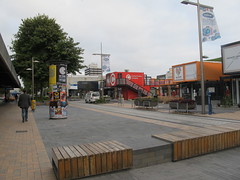
20131231_8504_EOS M-22 Looking up Cashel Street Another city walk around, this time with my brother-in-law from Auckland. Also went to the Quake City exhibition in the city organised by the Canterbury Museum. First fine day for a while. For 36 years I worked in a now gone building where that red car is parked (on the left). and would have wa...
20131231_8513_EOS M-22 The chocolate double decker
Images, eqnz.chch.2010
20131231_8513_EOS M-22 The chocolate double decker Another city walk around, this time with my brother-in-law from Auckland. Also went to the Quake City exhibition in the city organised by the Canterbury Museum. First fine day for a while. This bus is used as a chocolate restaurant, and is parked next to the Pallet Pavilion on the site of th...