

Search
found 2267 results
Images for Christchurch earthquake damage; more images...


Observatory Tower Photograph 33
Images, UC QuakeStudies
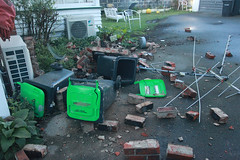
A photograph of the rubble of the Observatory tower in the South Quad of the Christchurch Arts Centre. The tower collapsed during the 22 February 2011 earthquake. A digger was used to clear the rubble away from the building. Scaffolding constructed around the tower has also collapsed and is amongst the rubble. In the background is the damaged tower with a tarpaulin draped over the top.
Observatory Tower Photograph 15
Images, UC QuakeStudies
A photograph of the rubble of the Observatory tower in the South Quad of the Christchurch Arts Centre. The tower collapsed during the 22 February 2011 earthquake and a digger was used to clear the rubble away from the building. Scaffolding constructed around the tower has also collapsed and is amongst the rubble. In the background is the damaged tower with a tarpaulin draped over the top.
WEMO ERT Set 1 - March 2011 - Photograph 75
Images, UC QuakeStudies
A photograph of the earthquake damage to a building in central Christchurch. Broken glass and other rubble litters the courtyard in front of the building. There is a large crack in the brick wall to the right. A red sticker on the glass door indicates that the building is unsafe to enter.
Cylic Undrained DSS Testing of Christchurch Sands
Research papers, University of Canterbury Library
Earthquake-triggered soil liquefaction caused extensive damage and heavy economic losses in Christchurch during the 2010-2011 Canterbury earthquakes. The most severe manifestations of liquefaction were associated with the presence of natural deposits of clean sands and silty sands of fluvial origin. However, liquefaction resistance of fines-containing sands is commonly inferred from empirical relationships based on clean sands (i.e. sands with less than 5% fines). Hence, existing evaluation methods have poor accuracy when applied to silty sands. Also, existing methods do not quantify appropriately the influence on liquefaction resistance of soil fabric and structure, which are unique to a specific depositional environment. This study looks at the influence of fines content, soil fabric (i.e. arrangement of soil particles) and structure (e.g. layering, segregation) on the undrained cyclic behaviour and liquefaction resistance of fines-containing sandy soils from Christchurch using Direct Simple Shear (DSS) tests on soil specimens reconstituted in the laboratory with the water sedimentation technique. The poster describes experimental procedures and presents early test results on two sands retrieved at two different sites in Christchurch.
Photograph by Neil Macbeth 337
Images, UC QuakeStudies
An earthquake-damaged road in north-east Christchurch. The manhole in the centre of the road has risen and a road cone has been placed in the centre to warn road users. Residents have piled liquefaction from their properties on the side of the road where it will be collection by road maintenance contractors.
WEMO ERT Set 1 - February 2011 - Photograph 24
Images, UC QuakeStudies
A photograph of the earthquake damage to the Cathedral of the Blessed Sacrament on Barbadoes Street. The tower on the right has crumbled, and the masonry has fallen to the pavement below. A car has been crushed by the fallen rubble. Windows in the tower behind are broken.
Artificial neural networks approach to predict principal ground motion par…
Research papers, The University of Auckland Library
Having a quick but reliable insight into the likelihood of damage to bridges immediately after an earthquake is an important concern especially in the earthquake prone countries such as New Zealand for ensuring emergency transportation network operations. A set of primary indicators necessary to perform damage likelihood assessment are ground motion parameters such as peak ground acceleration (PGA) at each bridge site. Organizations, such as GNS in New Zealand, record these parameters using distributed arrays of sensors. The challenge is that those sensors are not installed at, or close to, bridge sites and so bridge site specific data are not readily available. This study proposes a method to predict ground motion parameters for each bridge site based on remote seismic array recordings. Because of the existing abundant source of data related to two recent strong earthquakes that occurred in 2010 and 2011 and their aftershocks, the city of Christchurch is considered to develop and examine the method. Artificial neural networks have been considered for this research. Accelerations recorded by the GeoNet seismic array were considered to develop a functional relationship enabling the prediction of PGAs. http://www.nzsee.org.nz/db/2013/Posters.htm
Innovative judging following natural disasters: Lessons from the Christchu…
Research papers, The University of Auckland Library
In September 2010 and February 2011 the Canterbury region of New Zealand was struck by two powerful earthquakes, registering magnitude 7.1 and 6.3 respectively on the Richter scale. The second earthquake was centred 10 kilometres south-east of the centre of Christchurch (the region’s capital and New Zealand’s third most populous urban area, with approximately 360,000 residents) at a depth of five kilometres. 185 people were killed, making it the second deadliest natural disaster in New Zealand’s history. (66 people were killed in the collapse of one building alone, the six-storey Canterbury Television building.) The earthquake occurred during the lunch hour, increasing the number of people killed on footpaths and in buses and cars by falling debris. In addition to the loss of life, the earthquake caused catastrophic damage to both land and buildings in Christchurch, particularly in the central business district. Many commercial and residential buildings collapsed in the tremors; others were damaged through soil liquefaction and surface flooding. Over 1,000 buildings in the central business district were eventually demolished because of safety concerns, and an estimated 70,000 people had to leave the city after the earthquakes because their homes were uninhabitable. The New Zealand Government declared a state of national emergency, which stayed in force for ten weeks. In 2014 the Government estimated that the rebuild process would cost NZ$40 billion (approximately US$27.3 billion, a cost equivalent to 17% of New Zealand’s annual GDP). Economists now estimate it could take the New Zealand economy between 50 and 100 years to recover. The earthquakes generated tens of thousands of insurance claims, both against private home insurance companies and against the New Zealand Earthquake Commission, a government-owned statutory body which provides primary natural disaster insurance to residential property owners in New Zealand. These ranged from claims for hundreds of millions of dollars concerning the local port and university to much smaller claims in respect of the thousands of residential homes damaged. Many of these insurance claims resulted in civil proceedings, caused by disputes about policy cover, the extent of the damage and the cost and/or methodology of repairs, as well as failures in communication and delays caused by the overwhelming number of claims. Disputes were complicated by the fact that the Earthquake Commission provides primary insurance cover up to a monetary cap, with any additional costs to be met by the property owner’s private insurer. Litigation funders and non-lawyer claims advocates who took a percentage of any insurance proceeds also soon became involved. These two factors increased the number of parties involved in any given claim and introduced further obstacles to resolution. Resolving these disputes both efficiently and fairly was (and remains) central to the rebuild process. This created an unprecedented challenge for the justice system in Christchurch (and New Zealand), exacerbated by the fact that the Christchurch High Court building was itself damaged in the earthquakes, with the Court having to relocate to temporary premises. (The High Court hears civil claims exceeding NZ$200,000 in value (approximately US$140,000) or those involving particularly complex issues. Most of the claims fell into this category.) This paper will examine the response of the Christchurch High Court to this extraordinary situation as a case study in innovative judging practices and from a jurisprudential perspective. In 2011, following the earthquakes, the High Court made a commitment that earthquake-related civil claims would be dealt with as swiftly as the Court's resources permitted. In May 2012, it commenced a special “Earthquake List” to manage these cases. The list (which is ongoing) seeks to streamline the trial process, resolve quickly claims with precedent value or involving acute personal hardship or large numbers of people, facilitate settlement and generally work proactively and innovatively with local lawyers, technical experts and other stakeholders. For example, the Court maintains a public list (in spreadsheet format, available online) with details of all active cases before the Court, listing the parties and their lawyers, summarising the facts and identifying the legal issues raised. It identifies cases in which issues of general importance have been or will be decided, with the expressed purpose being to assist earthquake litigants and those contemplating litigation and to facilitate communication among parties and lawyers. This paper will posit the Earthquake List as an attempt to implement innovative judging techniques to provide efficient yet just legal processes, and which can be examined from a variety of jurisprudential perspectives. One of these is as a case study in the well-established debate about the dialogic relationship between public decisions and private settlement in the rule of law. Drawing on the work of scholars such as Hazel Genn, Owen Fiss, David Luban, Carrie Menkel-Meadow and Judith Resnik, it will explore the tension between the need to develop the law through the doctrine of precedent and the need to resolve civil disputes fairly, affordably and expeditiously. It will also be informed by the presenter’s personal experience of the interplay between reported decisions and private settlement in post-earthquake Christchurch through her work mediating insurance disputes. From a methodological perspective, this research project itself gives rise to issues suitable for discussion at the Law and Society Annual Meeting. These include the challenges in empirical study of judges, working with data collected by the courts and statistical analysis of the legal process in reference to settlement. September 2015 marked the five-year anniversary of the first Christchurch earthquake. There remains widespread dissatisfaction amongst Christchurch residents with the ongoing delays in resolving claims, particularly insurers, and the rebuild process. There will continue to be challenges in Christchurch for years to come, both from as-yet unresolved claims but also because of the possibility of a new wave of claims arising from poor quality repairs. Thus, a final purpose of presenting this paper at the 2016 Meeting is to gain the benefit of other scholarly perspectives and experiences of innovative judging best practice, with a view to strengthening and improving the judicial processes in Christchurch. This Annual Meeting of the Law and Society Association in New Orleans is a particularly appropriate forum for this paper, given the recent ten year anniversary of Hurricane Katrina and the plenary session theme of “Natural and Unnatural Disasters – human crises and law’s response.” The presenter has a personal connection with this theme, as she was a Fulbright scholar from New Zealand at New York University in 2005/2006 and participated in the student volunteer cleanup effort in New Orleans following Katrina. http://www.lawandsociety.org/NewOrleans2016/docs/2016_Program.pdf
Scrutinising The Prediction of Liquefaction Through New Zealand Case Histo…
Research papers, University of Canterbury Library
Background Liquefaction induced land damage has been identified in more than 13 notable New Zealand earthquakes within the past 150 years, as presented on the timeline below. Following the 2010-2011 Canterbury Earthquake Sequence (CES), the consequences of liquefaction were witnessed first-hand in the city of Christchurch and as a result the demand for understanding this phenomenon was heightened. Government, local councils, insurers and many other stakeholders are now looking to research and understand their exposure to this natural hazard.
WEMO ERT Set 1 - March 2011 - Photograph 71
Images, UC QuakeStudies
A photograph of the earthquake damage to the Iconic Bar and the former Christchurch City Council offices on Manchester Street. The outer walls of the Council offices and the top storey of Iconic have collapsed, exposing the insides of the buildings. The bricks and other rubble have been cleared from the footpath in front. USAR codes have been spray-painted next to the entrance of Iconic.
WEMO ERT Set 2 - February 2011 - Photograph 07
Images, UC QuakeStudies
A photograph of the earthquake-damaged Cathedral of the Blessed Sacrament on Barbadoes Street. Rubble from the collapsed tower is lying on the ground in front. A car has been crushed under this rubble. Wire fencing, shipping containers, and road cones have been placed around the building as a cordon.
WEMO ERT Set 3 - February 2011 - Photograph 051
Images, UC QuakeStudies
A photograph of the earthquake-damaged Cathedral of the Blessed Sacrament on Barbadoes Street. Rubble from the collapsed tower is lying on the ground in front. A car has been crushed under this rubble. Wire fencing, shipping containers, and road cones have been placed around the building as a cordon.
WEMO ERT Set 3 - February 2011 - Photograph 052
Images, UC QuakeStudies
A photograph of the earthquake-damaged Cathedral of the Blessed Sacrament on Barbadoes Street. Rubble from the collapsed tower is lying on the ground in front. A car has been crushed under this rubble. Wire fencing, shipping containers, and road cones have been placed around the building as a cordon.
Performance-based seismic assessment of an historic high-rise masonry buil…
Research papers, The University of Auckland Library
The Manchester Courts building was a heritage building located in central Christchurch (New Zealand) that was damaged in the Mw 7.1 Darfield earthquake on 4 September 2010 and subsequently demolished as a risk reduction exercise. Because the building was heritage listed, the decision to demolish the building resulted in strong objections from heritage supporters who were of the opinion that the building had sufficient residual strength to survive possible aftershock earthquakes. On 22 February 2011 Christchurch was struck by a severe aftershock, leading to the question of whether building demolition had proven to be the correct risk reduction strategy. Finite element analysis was used to undertake a performance-based assessment, validating the accuracy of the model using the damage observed in the building before its collapse. In addition, soil-structure interaction was introduced into the research due to the comparatively low shear wave velocity of the soil. The demolition of a landmark heritage building was a tragedy that Christchurch will never recover from, but the decision was made considering safety, societal, economic and psychological aspects in order to protect the city and its citizens. The analytical results suggest that the Manchester Courts building would have collapsed during the 2011 Christchurch earthquake, and that the collapse of the building would have resulted in significant fatalities.
BeckerFraserPhotos March 2011 photograph 227
Images, UC QuakeStudies
A yellow sticker on the door of a house in Worcester Street reading, "Restricted use. No entry except on essential business. Warning: This building has been damaged and its structural safety is questionable. Earthquake aftershocks present danger. Enter only at own risk. Subsequent events may result in increased damage and danger, changing this assessment. Reinspection may be required. The damage is as described below: partial collapse of longitudinal walls". Following on from this are the specific conditions that must be complied with to enable entry into the property, the inspector's identification details, and the date and time the building was inspected. At the bottom the form reads, "Do not remove this placard. Placed by order of the territorial authority Christchurch City Council".
Play, politics and the production of space: DIY urbanism in post-earthquak…
Research papers, The University of Auckland Library
The Canterbury earthquake sequence of 2010-2011 wrought ruptures in not only the physical landscape of Canterbury and Christchurch’s material form, but also in its social, economic, and political fabrics and the lives of Christchurch inhabitants. In the years that followed, the widespread demolition of the CBD that followed the earthquakes produced a bleak landscape of grey rubble punctuated by damaged, abandoned buildings. It was into this post-earthquake landscape that Gap Filler and other ‘transitional’ organisations inserted playful, creative, experimental projects to bring life and energy back into the CBD. This thesis examines those interventions and the development of the ‘Transitional Movement’ between July 2013 and June 2015 via the methods of walking interviews and participant observation. This critical period in Christchurch’s recovery serves as an example of what happens when do-it-yourself (DIY) urbanism is done at scale across the CBD and what urban experimentation can offer city-making. Through an understanding of space as produced, informed by Lefebvre’s thinking, I explore how these creative urban interventions manifested a different temporality to orthodox planning and demonstrate how the ‘soft’ politics of these interventions contain the potential for gentrification and also a more radical politics of the city, by creating an opening space for difference.
Low-damage gravity rocking connection for multi-storey moment frame buildi…
Research papers, The University of Auckland Library
A review of the literature showed the lack of a truly effective damage avoidance solution for timber or hybrid timber moment resisting frames (MRFs). Full system damage avoidance selfcentring behaviour is difficult to achieve with existing systems due to damage to the floor slab caused by beam-elongation. A novel gravity rocking, self-centring beam-column joint with inherent and supplemental friction energy dissipation is proposed for low-medium rise buildings in all seismic zones where earthquake actions are greater than wind. Steel columns and timber beams are used in the hybrid MRF such that both the beam and column are continuous thus avoiding beam-elongation altogether. Corbels on the columns support the beams and generate resistance and self-centring through rocking under the influence of gravity. Supplemental friction sliders at the top of the beams resist sliding of the floor whilst dissipating energy as the floor lifts on the corbels and returns. 1:20 scale tests of 3-storey one-by-two bay building based on an earlier iteration of the proposed concept served as proof-of-concept and highlighted areas for improvement. A 1:5 scale 3-storey one-by-one bay building was subsequently designed. Sub-assembly tests of the beam-top asymmetric friction sliders demonstrated repeatable hysteresis. Quasi-static tests of the full building demonstrated a ‘flat bottomed’ flag-shaped hysteresis. Shake table tests to a suite of seven earthquakes scaled for Wellington with site soil type D to the serviceability limit state (SLS), ultimate limit state (ULS) and maximum credible event (MCE) intensity corresponding to an average return period of 25, 500 and 2500 years respectively were conducted. Additional earthquake records from the 22 February 2011 Christchurch earthquakes we included. A peak drift of 0.6%, 2.5% and 3.8% was reached for the worst SLS, ULS and MCE earthquake respectively whereas a peak drift of 4.5% was reached for the worst Christchurch record for tests in the plane of the MRF. Bi-directional tests were also conducted with the building oriented at 45 degrees on the shake table and the excitation factored by 1.41 to maintain the component in the direction of the MRF. Shear walls with friction slider hold-downs which reached similar drifts to the MRF were provided in the orthogonal direction. Similar peak drifts were reached by the MRF in the bi-directional tests, when the excitation was amplified as intended. The building self-centred with a maximum residual drift of 0.06% in the dynamic tests and demonstrated no significant damage. The member actions were magnified by up to 100% due to impact upon return of the floor after uplift when the peak drift reached 4.5%. Nonetheless, all of the members and connections remained essentially linearelastic. The shake table was able to produce a limited peak velocity of 0.275 m/s and this limited the severity of several of the ULS, MCE and Christchurch earthquakes, especially the near-field records with a large velocity pulse. The full earthquakes with uncapped velocity were simulated in a numerical model developed in SAP2000. The corbel supports were modelled with the friction isolator link element and the top sliders were modelled with a multi-linear plastic link element in parallel with a friction spring damper. The friction spring damper simulated the increase in resistance with increasing joint rotation and a near zero return stiffness, as exhibited by the 1:5 scale test building. A good match was achieved between the test quasi-static global force-displacement response and the numerical model, except a less flat unloading curve in the numerical model. The peak drift from the shake table tests also matched well. Simulations were also run for the full velocity earthquakes, including vertical ground acceleration and different floor imposed load scenarios. Excessive drift was predicted by the numerical model for the full velocity near-field earthquakes at the MCE intensity and a rubber stiffener for increasing the post joint-opening stiffness was found to limit the drift to 4.8%. Vertical ground acceleration had little effect on the global response. The system generates most of its lateral resistance from the floor weight, therefore increasing the floor imposed load increased the peak drift, but less than it would if the resistance of the system did not increase due to the additional floor load. A seismic design procedure was discussed under the framework of the existing direct displacement-based design method. An expression for calculating the area-based equivalent viscous damping (EVD) was derived and a conservative correction factor of 0.8 was suggested. A high EVD of up to about 15% can be achieved with the proposed system at high displacement ductility levels if the resistance of the top friction sliders is maximised without compromising reliable return of the floor after uplift. Uniform strength joints with an equal corbel length up the height of the building and similar inter-storey drifts result in minimal relative inter-floor uplift, except between the first floor and ground. Guidelines for detailing the joint for damage avoidance including bi-directional movement were also developed.
Elizabeth Ackermann Photograph 336
Images, UC QuakeStudies
A photograph of the north side of the ChristChurch Cathedral in Cathedral Square. The front of the building has been propped up with steel bracing but further earthquakes have caused more damage, leaving a gap between the bracing and the wall. The tower has been partially demolished, but the lower section is still visible. Wire fencing has been placed around the entire building. In the background, a crane is rising high above the square.
Elizabeth Ackermann Photograph 337
Images, UC QuakeStudies
A photograph of the north side of the ChristChurch Cathedral in Cathedral Square. The front of the building has been propped up with steel bracing but further earthquakes have caused more damage, leaving a gap between the bracing and the wall. The tower has been partially demolished, but the lower section is still visible. Wire fencing has been placed around the entire building. In the background, a crane is rising high above the square.
Elizabeth Ackermann Photograph 347
Images, UC QuakeStudies
A photograph of the north side of the ChristChurch Cathedral in Cathedral Square. The front of the building has been propped up with steel bracing but further earthquakes have caused more damage, leaving a gap between the bracing and the wall. The tower has been partially demolished, but the lower section is still visible. Wire fencing has been placed around the entire building. In the background, a crane is rising high above the square.
Experimental testing and modelling to address the performance of RC walls …
Research papers, The University of Auckland Library
The current seismic design practice for reinforced concrete (RC) walls has been drawn into question following the unsatisfactory performance of several RC wall buildings during the Canterbury earthquakes. An overview of current research being undertaken at the University of Auckland into the seismic behaviour of RC walls is presented. The main objectives of this research project are to understand the observed performance of RC walls in Christchurch, quantify the seismic loads on RC walls, and developed improved design procedures for RC walls that will assist in revisions to the New Zealand Concrete Structures Standard. A database summarising the performance of RC wall buildings in the Christchurch CBD was collated to identify damage modes and case-study buildings. A detailed investigation is underway to verify the seismic performance of lightly reinforced concrete walls and initial numerical modeling and small-scale tests are presented in addition to details of planned experimental tests of RC walls. Numerical modelling is being used to understand the potential influence that interactions between walls and other structural elements have on the seismic response of buildings and the loads generated on RC walls. The results from finite element analysis of a severely damaged RC wall in Christchurch highlighted the effect that the floor diaphragms have on the distribution of shear stains in the wall.
Performance of as-built and retrofitted parapets during the 2010/2011 Cant…
Research papers, The University of Auckland Library
Unrestrained unreinforced clay brick masonry (URM) parapets are found atop a large number of vintage URM buildings. Parapets are typically non-structural cantilevered wall elements that form a fire barrier and in most cases form decorative and ornamental features of vintage URM buildings. Parapets are considered to be one of the most vulnerable elements that are prone to out-of-plane collapse when subjected to earthquake induced shaking. An in-depth analysis of the damage database collected following the 2010/2011 Canterbury earthquakes was performed to obtain information about the distribution, characteristics and observed performance of both the as-built and retrofitted parapets in the Christchurch region. Results, statistical interpretation and implications are presented herein. http://www.aees.org.au/downloads/conference-papers/2015-2/
WEMO ERT Set 1 - February 2011 - Photograph 26
Images, UC QuakeStudies
A photograph of the earthquake damage to the Provincial Hotel on the corner of Barbadoes and Cashel Streets. The second storey walls have crumbled, and the bricks have fallen onto the ground below. Scaffolding erected in front of the building is now on a lean. Wire fencing has been placed around the building as a cordon.
Development of Seismic Testing and Design Prediction Techniques for Buried…
Research papers, The University of Auckland Library
The recent instances of seismic activity in Canterbury (2010/11) and Kaikōura (2016) in New Zealand have exposed an unexpected level of damage to non-structural components, such as buried pipelines and building envelope systems. The cost of broken buried infrastructure, such as pipeline systems, to the Christchurch Council was excessive, as was the cost of repairing building envelopes to building owners in both Christchurch and Wellington (due to the Kaikōura earthquake), which indicates there are problems with compliance pathways for both of these systems. Councils rely on product testing and robust engineering design practices to provide compliance certification on the suitability of product systems, while asset and building owners rely on the compliance as proof of an acceptable design. In addition, forensic engineers and lifeline analysts rely on the same product testing and design techniques to analyse earthquake-related failures or predict future outcomes pre-earthquake, respectively. The aim of this research was to record the actual field-observed damage from the Canterbury and Kaikōura earthquakes of seismic damage to buried pipeline and building envelope systems, develop suitable testing protocols to be able to test the systems’ seismic resilience, and produce prediction design tools that deliver results that reflect the collected field observations with better accuracy than the present tools used by forensic engineers and lifeline analysts. The main research chapters of this thesis comprise of four publications that describe the gathering of seismic damage to pipes (Publication 1 of 4) and building envelopes (Publication 2 of 4). Experimental testing and the development of prediction design tools for both systems are described in Publications 3 and 4. The field observation (discussed in Publication 1 of 4) revealed that segmented pipe joints, such as those used in thick-walled PVC pipes, were particularly unsatisfactory with respect to the joint’s seismic resilience capabilities. Once the joint was damaged, silt and other deleterious material were able to penetrate the pipeline, causing blockages and the shutdown of key infrastructure services. At present, the governing Standards for PVC pipes are AS/NZS 1477 (pressure systems) and AS/NZS 1260 (gravity systems), which do not include a protocol for evaluating the PVC pipes for joint seismic resilience. Testing methodologies were designed to test a PVC pipe joint under various different simultaneously applied axial and transverse loads (discussed in Publication 3 of 4). The goal of the laboratory experiment was to establish an easy to apply testing protocol that could fill the void in the mentioned standards and produce boundary data that could be used to develop a design tool that could predict the observed failures given site-specific conditions surrounding the pipe. A tremendous amount of building envelope glazing system damage was recorded in the CBDs of both Christchurch and Wellington, which included gasket dislodgement, cracked glazing, and dislodged glazing. The observational research (Publication 2 of 4) concluded that the glazing systems were a good indication of building envelope damage as the glazing had consistent breaking characteristics, like a ballistic fuse used in forensic blast analysis. The compliance testing protocol recognised in the New Zealand Building Code, Verification Method E2/VM1, relies on the testing method from the Standard AS/NZS 4284 and stipulates the inclusion of typical penetrations, such as glazing systems, to be included in the test specimen. Some of the building envelope systems that failed in the recent New Zealand earthquakes were assessed with glazing systems using either the AS/NZS 4284 or E2/VM1 methods and still failed unexpectedly, which suggests that improvements to the testing protocols are required. An experiment was designed to mimic the observed earthquake damage using bi-directional loading (discussed in Publication 4 of 4) and to identify improvements to the current testing protocol. In a similar way to pipes, the observational and test data was then used to develop a design prediction tool. For both pipes (Publication 3 of 4) and glazing systems (Publication 4 of 4), experimentation suggests that modifying the existing testing Standards would yield more realistic earthquake damage results. The research indicates that including a specific joint testing regime for pipes and positioning the glazing system in a specific location in the specimen would improve the relevant Standards with respect to seismic resilience of these systems. Improving seismic resilience in pipe joints and glazing systems would improve existing Council compliance pathways, which would potentially reduce the liability of damage claims against the government after an earthquake event. The developed design prediction tool, for both pipe and glazing systems, uses local data specific to the system being scrutinised, such as local geology, dimensional characteristics of the system, actual or predicted peak ground accelerations (both vertically and horizontally) and results of product-specific bi-directional testing. The design prediction tools would improve the accuracy of existing techniques used by forensic engineers examining the cause of failure after an earthquake and for lifeline analysts examining predictive earthquake damage scenarios.
Empowered Christchurch Social Media Campaigns: Risk Acceptance
Images, UC QuakeStudies
A poster created by Empowered Christchurch to advertise their submission to the CERA Draft Transition Recovery Plan on social media.The poster reads, "Submission, CERA Draft Transition Recovery Plan. Risk Acceptance. It is the role of insurance companies, the EQC included, to accept the risks covered under their terms of reference/policies and compensate policyholders when such risks eventuate. However, many policyholders in Christchurch have not been compensated for the damage to their homes and their lives. These responsibilities need to be faced by the entities responsible. An equitable solution needs to be found for properties with hazards such as flooding that are a direct result of the earthquakes. In tandem with this, every effort must be made to protect residents from the risks posed by climate change. We need a city that is driven by the people that live in it, and enabled by a bureaucracy that accepts and mitigates risks, rather than transferring them to the most vulnerable residents".
Earthquake response #1: Enquiry, research, design and community projects, …
Research papers, Lincoln University
The September and February earthquakes were terrifying and devastating. In February, 185 people were killed (this number excludes post earthquake related deaths) and several thousand injured. Damage to infrastructure above and below ground in and around Christchurch was widespread and it will take many years and billions of dollars to rebuild. The ongoing effects of the big quakes and aftershocks are numerous, with the deepest impact being on those who lost family and friends, their livelihoods and homes. What did Cantabrians do during the days, weeks and months of uncertainty and how have we responded? Many grieved, some left, some stayed, some arrived, many shovelled (liquefaction left thousands of tons of silt to be removed from homes and streets), and some used their expertise or knowledge to help in the recovery. This book highlights just some of the projects staff and students from The Faculty of Environment, Society and Design have been involved in from September 2010 to October 2012. The work is ongoing and the plan is to publish another book to document progress and new projects.
Image - A Helping Hand in a Disaster Zone
Images, UC QuakeStudies
An image from an Army News March 2011 article titled, "A Helping Hand in a Disaster Zone". The image is of the Cathedral of the Blessed Sacrament on Barbadoes Street, severely damaged after the 22 February 2011 earthquake. The domes on either side of the Cathedral have collapsed and are lying in the area in front.
WEMO ERT Set 1 - March 2011 - Photograph 82
Images, UC QuakeStudies
A photograph of the earthquake-damaged to a house in Christchurch. The far wall has collapsed and many of the concrete blocks have spilled into the garden in front. Emergency tape has been draped in front of the wall as a cordon. A red sticker has also been stuck on the furthest window, indicating that the house is unsafe to enter.
Life-Safety Risk in Earthquakes: Investigating Risk Factors and Developmen…
Research papers, The University of Auckland Library
This thesis investigates life-safety risk in earthquakes. The first component of the thesis utilises a dataset of earthquake injuries and deaths from recent earthquakes in New Zealand to identify cause, context, and risk factors of injury and death in the 2011 MW6.3 Christchurch earthquake and 2016 MW7.8 Kaikōura earthquake. Results show that nearly all deaths occurred from being hit by structural elements from buildings, while most injuries were caused by falls, strains and being hit by contents or non-structural elements. Statistical analysis of injured cases compared to an uninjured control group found that age, gender, building damage, shaking intensity, and behaviour during shaking were the most significant risk factors for injury during these earthquakes. The second part of the thesis uses the empirical findings from the first section to develop two tools for managing life-safety risk in earthquakes. The first tool is a casualty estimation model for health system and emergency response planning. An existing casualty model used in New Zealand was validated against observed data from the 2011 Christchurch earthquake and found to underestimate moderate and severe injuries by an order of magnitude. The model was then updated to include human behaviour such as protective actions, falls and strain type injuries that are dependent on shaking intensity, as well as injuries and deaths outside buildings. These improvements resulted in a closer fit to observed casualties for the 2011 Christchurch earthquake. The second tool that was developed is a framework to set seismic loading standards for design based on fatality risk targets. The proposed framework extends the risk-targeted hazard method, by moving beyond collapse risk targets, to fatality risk targets for individuals in buildings and societal risk in cities. The framework also includes treatment of epistemic uncertainty in seismic hazard to allow this uncertainty to be used in risk-based decision making. The framework is demonstrated by showing how the current New Zealand loading standards could be revised to achieve uniform life-safety risk across the country and how the introduction of a new loading factor can reduce risk aggregation in cities. Not on Alma, moved and emailed. 1/02/2023 ce
Mark Lincoln Photograph 179
Images, UC QuakeStudies
Shoppers and tourists in the Re:Start mall. The photographer comments, "The new temporary city mall has been open in Christchurch now for a week. Buildings damaged in the earthquake have been demolished and replaced with cargo containers to create a new, temporary, Cashel Mall. I visited the mall yesterday and was quite impressed with what they have done. The cargo containers have been nicely converted, brightly painted and smartly branded to create some good looking stores".