

Search
found 2267 results
Images for Christchurch earthquake damage; more images...


WEMO ERT Set 1 - March 2011 - Photograph 01
Images, UC QuakeStudies
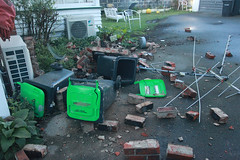
A photograph of a member of the Wellington Emergency Management Office Emergency Response Team pointing to an earthquake-damaged house in central Christchurch. A large section of the house has collapsed, the rubble spilling onto the driveway. Emergency tape has been draped across the driveway as a cordon.
Rebekah Rogers WEMO Photograph 070
Images, UC QuakeStudies
A photograph of the earthquake damage to a property in the Christchurch central city. Part of the roof of the property has collapsed, spilling material onto the balcony below. A sign in the foreground reads, "Wots your councillor doing for your water?".
Residual Capacity and Repairability of Reinforced Concrete Frame Buildings
Research papers, The University of Auckland Library
Reinforced concrete (RC) frame buildings designed according to modern design standards achieved life-safety objectives during the Canterbury earthquakes in 2010-11 and the Kaikōura earthquake in 2016. These buildings formed ductile plastic hinges as intended and partial or total building collapse was prevented. However, despite the fact that the damage level of these buildings was relatively low to moderate, over 60% of multi-storey RC buildings in the Christchurch central business district were demolished due to insufficient insurance coverage and significant uncertainty in the residual capacity and repairability of those buildings. This observation emphasized an imperative need to improve understanding in evaluating the post-earthquake performance of earthquake-damaged buildings and to develop relevant post-earthquake assessment guidelines. This thesis focuses on improving the understanding of the residual capacity and repairability of RC frame buildings. A large-scale five-storey RC moment-resisting frame building was tested to investigate the behaviour of earthquake-damaged and repaired buildings. The original test building was tested with four ground motions, including two repeated design-level ground motions. Subsequently, the test building was repaired using epoxy injection and mortar patching and re-tested with three ground motions. The test building was assessed using key concepts of the ATC-145 post-earthquake assessment guideline to validate its assessment procedures and highlight potential limitations. Numerical models were developed to simulate the peak storey drift demand and identify damage locations. Additionally, fatigue assessment of steel reinforcement was conducted using methodologies as per ATC-145. The residual capacity of earthquake-strained steel reinforcement was experimentally investigated in terms of the residual fatigue capacity and the residual ultimate strain capacity. In addition to studying the fatigue capacity of steel reinforcement, the fatigue damage demand was estimated using 972 ground motion records. The deformation limit of RC beams and columns for damage control was explored to achieve a low likelihood of requiring performance-critical repair. A frame component test database was developed, and the deformation capacity at the initiation of lateral strength loss was examined in terms of the chord rotation, plastic rotation and curvature ductility capacity. Furthermore, the proposed curvature ductility capacity was discussed with the current design curvature ductility limits as per NZS 3101:2006.
Observatory Tower Photograph 38
Images, UC QuakeStudies
A photograph of the earthquake-damaged Observatory tower at the Christchurch Arts Centre. The photograph was taken using a cellphone camera. The top of the tower collapsed during the 22 February 2011 earthquake. The rubble from the tower has been cleared and a tarpaulin has been placed over the top of the broken tower. Tyres have been placed on the tarpaulin to hold it down. A temporary roof has also been constructed over the tower to keep out the rain. Two vehicles are parked in front.
Implications of the Canterbury earthquake sequence for Adelaide, South Aus…
Research papers, The University of Auckland Library
The city of Christchurch has experienced over 10,000 aftershocks since the 4th of September 2010 earthquake of which approximately 50 have been greater than magnitude 5. The damage caused to URM buildings in Christchurch over this sequence of earthquakes has been well documented. Due to the similarity in age and construction of URM buildings in Adelaide, South Australia and Christchurch (they are sister cities, of similar age and heritage), an investigation was conducted to learn lessons for Adelaide based on the Christchurch experience. To this end, the number of URM buildings in the central business districts of both cities, the extent of seismic strengthening that exists in both cities, and the relative earthquake hazards for both cities were considered. This paper will report on these findings and recommend strategies that the city of Adelaide could consider to significantly reduce the seismic risk posed by URM buildings in future earthquake.
New Zealand Defence Force photograph 691
Images, UC QuakeStudies
A cafe that was damaged severely in the earthquake. The front wall of the top storey has crumbled onto the street, crushing a car. Wire fencing and road cones have been used to create a cordon around the buildings.
WEMO ERT Set 1 - March 2011 - Photograph 16
Images, UC QuakeStudies
A photograph of members of the New Zealand Police using a rescue dog to inspect an earthquake-damaged house in Christchurch. The front and side of the house has collapsed, the bricks and other rubble spilling onto the garden, exposing the rooms inside.
Seismic performance of a six storey reinforced masonry building during the…
Research papers, The University of Auckland Library
During the Christchurch earthquake of February 2011, several midrise buildings of Reinforced Concrete Masonry (RCM) construction achieved performance levels in the range of life safety to near collapse levels. These buildings were subjected to seismic demands higher than the building code requirements of the time and higher than the current New Zealand Loadings Standard (NZS-1170.5:2004). Structural damage to these buildings has been documented and is currently being studied to establish lessons to be learned from their performance and how to incorporate these lessons into future RCM design and construction practices. This paper presents a case study of a six story RCM building deemed to have reached the near collapse performance level. The RCM walls on the 2nd floor failed due to toe crushing reducing the building’s lateral resistance in the east-west direction. A nonlinear dynamic analysis on a 3D model was conducted to simulate the development of the governing failure mechanism. Preliminary analysis results show that the damaged walls were initially under large compression forces from gravity loads which caused increase in their lateral strength and reduced their ductility. After toe crushing failure developed, axial instability of the model was prevented by a redistribution of gravity loads.
Urban comfort: adaptive capacity in post-earthquake Christchurch
Research papers, Lincoln University
The urban environment influences the way people live and shape their everyday lives, and microclimate sensitive design can enhance the use of urban streets and public spaces. Innovative approaches to urban microclimate design will become more important as the world’s population becomes ever more urban, and climate change generates more variability and extremes in urban microclimatic conditions. However, established methods of investigation based upon conventions drawn from building services research and framed by physiological concepts of thermal comfort may fail to capture the social dynamics of urban activity and their interrelationship with microclimate. This research investigates the relationship between microclimate and urban culture in Christchurch, New Zealand, based upon the concept of urban comfort. Urban comfort is defined as the socio-cultural (therefore collective) adaptation to microclimate due to satisfaction with the urban environment. It involves consideration of a combination of human thermal comfort requirements and adaptive comfort circumstances, preferences and strategies. A main methodological challenge was to investigate urban comfort in a city undergoing rapid physical change following a series of major earthquakes (2010-2011), and that also has a strongly seasonal climate which accentuates microclimatic variability. The field investigation had to be suitable for rapidly changing settings as buildings were demolished and rebuilt, and be able to capture data relevant to a cycle of seasons. These local circumstances meant that Christchurch was valuable as an example of a city facing rapid and unpredictable change. An interpretive, integrative, and adaptive research strategy that combined qualitative social science methods with biophysical measures was adopted. The results are based upon participant observation, 86 in-depth interviews with Christchurch residents, and microclimate data measurements. The interviews were carried out in a variety of urban settings including established urban settings (places sustaining relatively little damage) and emerging urban settings (those requiring rebuilding) during 2011-2013. Results of this research show that urban comfort depends on adaptive strategies which in turn depend on culture. Adaptive strategies identified through the data analysis show a strong connection between natural and built landscapes, combined with the regional outdoor culture, the Garden City identity and the connections between rural and urban landscapes. The results also highlight that thermal comfort is an important but insufficient indicator of good microclimate design, as social and cultural values are important influences on climate experience and adaptation. Interpretive research is needed to fully understand urban comfort and to provide urban microclimate design solutions to enhance the use of public open spaces in cities undergoing change.
Helen Devereux Photograph 095
Images, UC QuakeStudies
For the first time in November 2011, Christchurch residents finally had the opportunity to see the earthquake-damaged city centre on the Red Zone bus tours organised by CERA. The podium which formerly held the Godley statue. Behind is the Regent Theatre dome which has been removed from the building.
A simple and rapid approach to post-earthquake assessment of bridge condit…
Research papers, The University of Auckland Library
The paper proposes a simple method for quick post-earthquake assessment of damage and condition of a stock of bridges in a transportation network using seismic data recorded by a strong motion array. The first part of the paper is concerned with using existing free field strong motion recorders to predict peak ground acceleration (PGA) at an arbitrary bridge site. Two methods are developed using artificial neural networks (a single network and a committee of neural networks) considering influential parameters, such as seismic magnitude, hypocentral depth and epicentral distance. The efficiency of the proposed method is explored using actual strong motion records from the devastating 2010 Darfield and 2011 Christchurch earthquakes in New Zealand. In the second part, two simple ideas are outlined how to infer the likely damage to a bridge using either the predicted PGA and seismic design spectrum, or a broader set of seismic metrics, structural parameters and damage indices.
Post-Earthquake Residual Capacity of Reinforced Concrete Plastic Hinges
Research papers, The University of Auckland Library
Reinforced concrete buildings that satisfied modern seismic design criteria generally behaved as expected during the recent Canterbury and Kaikoura earthquakes in New Zealand, forming plastic hinges in intended locations. While this meant that life-safety performance objectives were met, widespread demolition and heavy economic losses took place in the aftermath of the earthquakes.The Christchurch central business district was particularly hard hit, with over 60% of the multistorey reinforced concrete buildings being demolished. A lack of knowledge on the post-earthquake residual capacity of reinforced concrete buildings was a contributing factor to the mass demolition.Many aspects related to the assessment of earthquake-damaged reinforced concrete buildings require further research. This thesis focusses on improving the state of knowledge on the post earthquakeresidual capacity and reparability of moderately damaged plastic hinges, with an emphasis on plastic hinges typical of modern moment frame structures. The repair method focussed on is epoxy injection of cracks and patching of spalled concrete. A targeted test program on seventeen nominally identical large-scale ductile reinforced concrete beams, three of which were repaired by epoxy injection following initial damaging loadings, was conducted to support these objectives. Test variables included the loading protocol, the loading rate, and the level of restraint to axial elongation.The information that can be gleaned from post-earthquake damage surveys is investigated. It is shown that residual crack widths are dependent on residual deformations, and are not necessarily indicative of the maximum rotation demands or the plastic hinge residual capacity. The implications of various other types of damage typical of beam and column plastic hinges are also discussed.Experimental data are used to demonstrate that the strength and deformation capacity of plastic hinges with modern seismic detailing are often unreduced as a result of moderate earthquake induced damage, albeit with certain exceptions. Special attention is given to the effects of prior yielding of the longitudinal reinforcement, accounting for the low-cycle fatigue and strain ageing phenomena. A material-level testing program on the low-cycle fatigue behaviour of grade 300E reinforcing steel was conducted to supplement the data available in the literature.A reduction in stiffness, relative to the initial secant stiffness to yield, occurs due to moderate plastic hinging damage. This reduction in stiffness is shown to be correlated with the ductility demand,and a proposed model gives a conservative lower-bound estimate of the residual stiffness following an arbitrary earthquake-type loading. Repair by epoxy injection is shown to be effective in restoring the majority of stiffness to plastic hinges in beams. Epoxy injection is also shown to have implications for the residual strength and elongation characteristics of repaired plastic hinges.
WEMO ERT Set 1 - February 2011 - Photograph 54
Images, UC QuakeStudies
A photograph of the earthquake-damaged Canterbury Provincial Chambers on Durham Street. The roof and upper walls of the Stone Chamber have collapsed, the masonry falling onto the footpath below. The building has been cordoned off with wire fencing.
WEMO ERT Set 1 - February 2011 - Photograph 58
Images, UC QuakeStudies
A photograph of the earthquake-damaged Canterbury Provincial Chambers on Durham Street. The roof and upper walls of the Stone Chamber have collapsed, the masonry falling onto the footpath below. The building has been cordoned off with wire fencing.
Observatory Tower Photograph 09
Images, UC QuakeStudies
A photograph of staff from the Department of Physics and Astronomy from the University of Canterbury recovering parts of the Townsend Telescope from the rubble of the Observatory tower. The telescope was housed in the tower at the Christchurch Arts Centre. It was severely damaged when the tower collapsed during the 22 February 2011 earthquake.
Observatory Tower Photograph 10
Images, UC QuakeStudies
A photograph of staff from the Department of Physics and Astronomy from the University of Canterbury recovering parts of the Townsend Telescope from the rubble of the Observatory tower. The telescope was housed in the tower at the Christchurch Arts Centre. It was severely damaged when the tower collapsed during the 22 February 2011 earthquake.
People in Disasters Conference - Education Renewal: A sector response to t…
Videos, UC QuakeStudies
A video of a presentation by Garry Williams during the fourth plenary of the 2016 People in Disasters Conference. Williams is the Programme Manager of the Ministry of Education's Greater Christchurch Education Renewal Programme. The presentation is titled, "Education Renewal: A section response to the February 2011 Christchurch earthquake".The abstract for this presentation reads as follows: The Canterbury earthquakes caused a disaster recovery situation unparalleled in New Zealand's history. In addition to widespread damage to residential dwellings and destruction of Christchurch's central business district, the earthquakes damaged more than 200 schools from Hurunui in the north, to the Mackenzie District in the east, and Timaru in the south. The impact on education provision was substantial, with the majority of early childhood centres, schools and tertiary providers experiencing damage or subsequent, with the majority of early childhood centres, schools and tertiary providers experiencing damage or subsequent operational issues caused by the ensuing migration of people. Following the February earthquake, over 12,000 students had left the school they had been attending and enrolled elsewhere - often at a school outside the region. Shortened school days and compression of teaching into short periods meant shift-sharing students engaged in the curriculum being delivered in more diverse ways. School principals and staff reported increased fatigue and stress and changes in student behaviours, often related to repeated exposure to and ongoing reminders of the trauma of the earthquakes. While there has been a shift from direct, trauma-related presentations to the indirect effects of psychological adversity and daily life stresses, international experiences tells us that psychological recovery generally lags behind the immediate physical recovery and rebuilding. The Ministries of Health and Education and the Canterbury District Health Board have developed and implemented a joint action plan to address specifically the emerging mental health issues for youth in Canterbury. However, the impact of vulnerable and stressed adults on children's behaviour contributes to the overall impact of ongoing wellbeing issues on the educational outcomes for the community. There is substantial evidence supporting the need to focus on adults' resilience so they can support children and youth. Much of the Ministry's work around supporting children under stress is through supporting the adults responsible for teaching them and leading their schools. The education renewal programme exists to assist education communities to rebuild and look toward renewal. The response to the earthquakes provides a significant opportunity to better meet the needs and aspirations of children and youth people. All the parents want to see their children eager to learn, achieving success, and gaining knowledge and skills that will, in time, enable them to become confident, adaptable, economically independent adults. But this is not always the case, hence our approach to education renewal seeks to address inequities and improve outcome, while prioritising actions that will have a positive impact on learners in greatest need of assistance.
Jim Baltaxe WEMO Photograph 122
Images, UC QuakeStudies
A photograph of the earthquake damage to the Christchurch Chinese Methodist Church on Papanui Road. The gable walls have crumbled, bricks spilling onto the ground. The tower has been removed and braced on the ground in front. Cordon fencing has been placed around the building. Parts of the fence have been decorated with hearts and the word 'love'.
WEMO ERT Set 1 - March 2011 - Photograph 15
Images, UC QuakeStudies
A photograph of the earthquake damage to a house in Christchurch. The front and side of the house has collapsed, the bricks and other rubble spilling onto the garden, exposing the rooms inside. Emergency tape has been draped across the front of the property as a cordon.
Rebekah Rogers WEMO Photograph 049
Images, UC QuakeStudies
A photograph of an earthquake-damaged house in Christchurch. The house has moved off its foundations and many of the walls have crumbled, the bricks spilling onto the street in front. Messages such as "Clear" and "Danger keep out" have been spray-painted on the foundation wall.
Rebekah Rogers WEMO Photograph 051
Images, UC QuakeStudies
A photograph of an earthquake-damaged house in Christchurch. The house has moved off its foundations and many of the walls have crumbled, the bricks spilling onto the street in front. Messages such as "Clear" and "Danger keep out" have been spray-painted on the foundation wall.
Rebekah Rogers WEMO Photograph 050
Images, UC QuakeStudies
A photograph of an earthquake-damaged house in Christchurch. The house has moved off its foundations and many of the walls have crumbled, the bricks spilling onto the street in front. Messages such as "Clear" and "Danger keep out" have been spray-painted on the foundation wall.
WEMO ERT Set 1 - March 2011 - Photograph 14
Images, UC QuakeStudies
A photograph of the earthquake damage to a house in Christchurch. The front and side of the house has collapsed, the bricks and other rubble spilling onto the garden, exposing the rooms inside. Emergency tape has been draped across the front of the property as a cordon.
Insurance as a Double-Edged Sword: Quantitative Evidence from the 2011 Chr…
Research papers, Victoria University of Wellington
We examine the role of business interruption (BI) insurance in business recovery following the Christchurch earthquake in 2011. First, we ask whether BI insurance increases the likelihood of business survival in the immediate (3-6 months) aftermath of a disaster. We find positive but statistically insignificant evidence that those firms that had incurred damage, but were covered by BI insurance, had higher likelihood of survival post-quake compared with those firms that did not have any insurance. For the medium-term (2-3 years) survival of firms, our results show a more explicit role for insurance. Firms with BI insurance experience increased productivity and improved performance following a catastrophe. Furthermore, we find that those organisations that receive prompt and full payments of their claims have a better recovery than those that had protracted or inadequate claims payments, but this difference between the two groups is not statistically significant. We find no statistically significant evidence that the latter group (inadequate payment) did any better than those organisations that had damage but no insurance coverage. In general, our analysis indicates the importance not only of adequate insurance coverage, but also of an insurance system that delivers prompt claim payments. This is a post-peer-review, pre-copyedit version of an article published in 'The Geneva Papers on Risk and Insurance - Issues and Practice'. The final authenticated version is available online at: https://doi.org/10.1057/s41288-017-0067-y. The following terms of use apply: https://www.springer.com/gp/open-access/publication-policies/aam-terms-of-use.
Empowered Christchurch Letter to Queen Elizabeth II
Articles, UC QuakeStudies
A copy of a document from Empowered Christchurch which was sent to Queen Elizabeth. The document consists of a letter from Empowered Christchurch to Douglas Martin, Crown Manager from the Christchurch City Council, and Official Information Act requests sent to Building and Construction Minister Maurice Williamson and Canterbury Earthquake Recovery Minister Gerry Brownlee. It also includes an appeal to the Queen on behalf of Christchurch residents with badly-damaged houses. Please note that a letter from the Ministry of Business, Innovation and Employment, which was originally included in the document, has been removed due to copyright issues.
WEMO ERT Set 1 - March 2011 - Photograph 79
Images, UC QuakeStudies
A photograph of the earthquake damage to a block of buildings in central Christchurch. The basement of the buildings have collapsed and the concrete blocks have spilled into the car park. Large cracks have also formed in between the blocks in the walls of the building to the left.
New Zealand Defence Force photograph 760
Images, UC QuakeStudies
The Cathedral of the Blessed Sacrament on Barbadoes Street, severely damaged after the 22 February 2011 earthquake. The domes on either side of the Cathedral have collapsed and are lying in the area in front. To the right, a crushed car can just be seen.
New Zealand Defence Force photograph 761
Images, UC QuakeStudies
The Cathedral of the Blessed Sacrament on Barbadoes Street, severely damaged after the 22 February 2011 earthquake. The domes on either side of the Cathedral have collapsed and are lying in the area in front. To the right, a crushed car can just be seen.
Cyclic Undrained DSS Testing of Christchurch Sandy Silty Soils
Research papers, University of Canterbury Library
Earthquake-triggered soil liquefaction caused extensive damage and heavy economic losses in Christchurch during the 2010-2011 Canterbury earthquakes. The most severe manifestations of liquefaction were associated with the presence of natural deposits of clean sands and silty sands of fluvial origin. However, liquefaction resistance of fines-containing sands is commonly inferred from empirical relationships based on clean sands (i.e. sands with less than 5% fines). Hence, existing evaluation methods have poor accuracy when applied to silty sands. The liquefaction behaviour of Christchurch fines-containing (silty) sands is investigated through a series of Direct Simple Shear (DSS) tests. This type of test better resembles earthquake loading conditions in soil deposits compared to cyclic triaxial tests. Soil specimens are reconstituted in the laboratory with the water sedimentation technique. This preparation method yields soil fabrics similar to those encountered in fluvial soil deposits, which are common in the Christchurch area. Test results provide preliminary indications on how void ratio, relative density, preparation method and fines content influence the cyclic liquefaction behaviour of sand-silt mixtures depending on the properties of host sand and silt.
New Zealand Defence Force photograph 690
Images, UC QuakeStudies
Damage to buildings along Norwich Quay in Lyttelton. To the left is the Lyttelton Hotel with a crumbled top. Bricks have fallen on the awning and all along the footpath. To the right is a cafe that was damaged severely in the earthquake. The front wall of the top storey has crumbled onto the street, crushing a car. Wire fencing and road cones have been used to create a cordon around the buildings.