
Search
found 191 results
Images for lifted; more images...

Bike Ride in the East Side - Photograph 59
Images, UC QuakeStudies
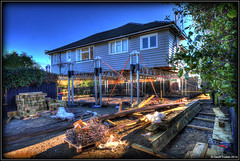
A sewage pumping station on Avonside Drive has been lifted out of the ground by liquefaction. In the background, the damaged Snell Place footbridge over the Avon River is closed off with cordon fencing. The photographer comments, "A Sunday afternoon ride to New Brighton, then back via Aranui, Wainoni, Dallington, and Richmond. Not a cheerful experience. Dallington footbridge. The two pieces of this foot bridge have moved towards each other, so the bridge has developed quite a peak. The sewage pumping station has been heaved out of the ground by hydraulic pressure during quakes".
Mark Lincoln Photograph 047
Images, UC QuakeStudies
A car stuck in liquefaction on Breezes Road. The front wheels have fallen into a submerged pothole, lifting the back wheels off the ground. A line of other vehicles drive around the partially-submerged car. The photographer comments, "The most common sight was extensive damage to the roads. Papanui, Breezes, Wainoni, Shortland Street and many more roads had large cracks and large sink holes. There were approximately 6 cars and 1 large Ready Mix cement truck that had fallen into holes within a few blocks of each other. All people appear to have escaped without serious injury as far as I could tell".
Mark Lincoln Photograph 045
Images, UC QuakeStudies
A car stuck in liquefaction on Breezes Road. The front wheels have fallen into a submerged pothole, lifting the back wheels off the ground. A line of other vehicles drive around the partially-submerged car. The photographer comments, "The most common sight was extensive damage to the roads. Papanui, Breezes, Wainoni, Shortland Street and many more roads had large cracks and large sink holes. There were approximately 6 cars and 1 large Ready Mix cement truck that had fallen into holes within a few blocks of each other. All people appear to have escaped without serious injury as far as I could tell".
Evans, Malcolm Paul, 1945-: "Relax! - the neighbour hasn't a clue we're em…
Images, Alexander Turnbull Library
It is night and a man and his wife are lifting their chemical toilet over the garden fence with the intention of emptying it into the neighbour's longdrop. The man confidently tells his wife to relax as the neighbour hasn't a clue they are planning to do this. The neighbour, meanwhile, sits in the outhouse holding a cricket bat at the ready. Context - toilet problems in Christchurch post earthquake 22 February 2011. Colour and black and white versions available Quantity: 2 digital cartoon(s).
The Week in Review - week ending 10 February 2011
Audio, Radio New Zealand
In this edition: The report into the collapse of the CTV building in the Christchurch earthquake a year ago is released, the Maori Council lodges claims with the Waitangi tribunal that could throw a spanner in the works of the Government's asset sales programme, the Earthquake Recovery Minister nearing the end of his tether with the Christchurch City Council, more from the Pike River Royal Commission, Radio Live could face a potential one hundred thousand dollar fine under the electoral act over John Key's hour long radio show in the run up to the 2011 election, banks lift their collective profits for the second half of 2011 by 25 percent and the winners are announced at the 2012 Halberg Awards.
Top Stories for Friday 25 August 2017
Audio, Radio New Zealand
Police have arrested Rollie James Heke after a two-week nationwide manhunt. The government's come up with a radical new plan to tackle Auckland's critical teacher shortage offering thousands of dollars to any new graduate prepared to stay at any city school for at least three years. The All Blacks and the Wallabies will observe a minute's silence at Saturday's Bledisloe Cup match in Dunedin. The government has confirmed speed limits on some of the main expressways will be lifted to 110km/h. National's MP for Kaikoura, Stuart Smith, has leaked when State Highway 1 north of Kaikoura will be re-opened - on December 15. The country's building regulator admits it needs a major overhaul after years scrambling just to react to leaky homes and the Canterbury and Kaikoura earthquakes. Peter Dunne's shock exit this week has forced both National and Labour to completely re-evaluate their strategies in the contest for the Ohariu electorate.
What now? The post disaster experiences of small inner city retail busines…
Research papers, Lincoln University
The Christchurch earthquakes brought to an abrupt halt a process of adaptive reuse and gentrification that was underway in the south eastern corner of the central business district. The retail uses that were a key to the success of this area pre-earthquake could be characterised as small, owner operated, quirky, bohemian, chaotic and relatively low rent. This research reports on the progress of a long term, comprehensive case study that follows the progress of these retailers both before and after the earthquakes. Findings include the immediate post-earthquake intentions to resume business in the same location as soon as possible were thwarted by government imposed cordons of the CBD that were only lifted nearly three years later. But, businesses were resilient and generally reinvented themselves quickly in alternative suburban locations where government “rebuild” restrictions were absent. It remains to be seen if this type of retail will ever return to the CBD as government imposed plans and the rents demanded for retail space in new buildings appear to preclude small owner-operated businesses.
Question Time for 8 August 2018
Audio, Radio New Zealand
Hon SIMON BRIDGES to the Prime Minister: Does she stand by all her Government’s policies and actions? KIRITAPU ALLAN to the Minister of Finance: What reports has he seen on the need for innovation in the New Zealand economy? Hon AMY ADAMS to the Minister of Finance: Does he agree with the Prime Minister’s comment, “I absolutely believe that our agenda will grow the economy, will make sure businesses are in a position to grow and prosper, because I need that economic growth to be able to lift the well-being of all New Zealanders”? Hon PAUL GOLDSMITH to the Minister for Economic Development: Does he still think the ANZ survey of business confidence is junk? Dr DUNCAN WEBB to the Minister of Justice: What recent announcements has he made about the Family Court? Hon MICHAEL WOODHOUSE to the Minister of Immigration: Does he stand by all of his statements and actions? JONATHAN YOUNG to the Minister of Energy and Resources: What advice, if any, did she receive in respect of the obligation to act in accordance with the Minerals Programme for Petroleum regarding the Government’s decision to offer no new offshore permits? ANDREW BAYLY to the Minister for Building and Construction: What procedures, if any, will she put into place to ensure Government agencies adhere to MBIE’s Government procurement guidelines for construction projects? Hon Dr NICK SMITH to the Minister of Justice: Does he stand by all of his statements on the Electoral (Integrity) Amendment Bill and the potential chilling effect it will have on the expression of dissenting views? CHRIS BISHOP to the Minister of Internal Affairs: Does she stand by all her statements around the Government inquiry into the appointment of the Deputy Commissioner of Police? Dr LIZ CRAIG to the Minister of Health: What confidence can the public take from the review of the National Bowel Screening Programme that was released this morning? STUART SMITH to the Minister of Justice: What advice, if any, has he received on the need for the Canterbury Earthquakes Insurance Tribunal?
Question time for 2 August 2012
Audio, Radio New Zealand
PAUL GOLDSMITH to the Minister of Finance: What reports has he received on progress in lifting New Zealand’s household savings and reducing household debt? EUGENIE SAGE to the Minister for Canterbury Earthquake Recovery: Did the advice he has received on Christchurch City Council assets contemplate a sell off or sell down of shares in companies supervised by Christchurch City Holdings Ltd or of other council assets; if so, which ones? Hon DAVID PARKER to the Minister of Finance: Does he stand by his answer to yesterday’s primary question “as I understand it, there are no regional statistics that specifically isolate the number of people leaving any particular region to move overseas” and has the Treasury reported to him the existence of official statistics on permanent and long-term migration compiled by local council area and region? SCOTT SIMPSON to the Minister for Tertiary Education, Skills and Employment: What changes is the Government making to improve results from industry training? Hon LIANNE DALZIEL to the Minister for Canterbury Earthquake Recovery: Which of the assets identified by CERA in response to his request has he ruled out asking Christchurch City Council to sell? KATRINA SHANKS to the Minister of Justice: What changes is she making to improve the Family Court? Le'aufa'amulia ASENATI LOLE-TAYLOR to the Minister for Whānau Ora: Does she stand by her statement that “I don’t object to any vulnerable family receiving Whānau Ora support, because that’s what the money is for”? Hon ANNETTE KING to the Minister of Housing: Does he stand by all his comments on housing; if not, why not? Dr KENNEDY GRAHAM to the Minister of Foreign Affairs: What is the total number and cost of uncontested contracts given by the Ministry of Foreign Affairs and Trade to external consultants in the last two financial years? MARK MITCHELL to the Minister for Communications and Information Technology: Has she received any reports on the progress of the Government’s Ultra-Fast Broadband and Rural Broadband Initiatives? DARIEN FENTON to the Minister of Labour: Does she stand by her statement regarding foreign chartered fishing vessels “If breaches of labour law occur – such as underpayment of wages or illegal deductions or breaches of the Code of Practice, the Department of Labour will be able to investigate them and take action”? NICKY WAGNER to the Minister for the Environment: What recent announcements has she made in relation to the Waste Minimisation Fund?
Question Time for 6 March 2014
Audio, Radio New Zealand
DAVID BENNETT to the Minister of Finance: How is the Government's economic programme helping to keep interest rates lower during this economic cycle, compared to the previous economic cycle in the mid-2000s? Dr RUSSEL NORMAN to the Minister of Energy and Resources: How much more is an average New Zealand household that uses 8,000kwh of power annually paying for electricity per year as of November 2013 compared to November 2008, according to the Ministry of Business, Innovation, and Employment's latest Quarterly Survey of Domestic Electricity Prices? Hon DAVID PARKER to the Minister of Finance: What will he do to "spread some of the benefits of growth" when hourly wage rates have only grown by 1.6 percent in the year to December 2013, which is close to 0 percent in real terms, when 45 percent of listed corporates have double-digit profit growth? JACQUI DEAN to the Minister for the Environment: What recent announcements has the Government made on the classification for drilling for oil and gas in New Zealand's Exclusive Economic Zone? GRANT ROBERTSON to the Minister of Justice: When she told the House yesterday "I had previously told Oravida that it could not use my name or photograph to endorse or promote its business products or services" when was that and what specific circumstances did it relate to? COLIN KING to the Minister for Tertiary Education, Skills and Employment: How is the Youth Guarantee Scheme helping the Government achieve the Better Public Services target of 85 percent of all 18-year-olds achieving NCEA Level two or an equivalent qualification in 2017? CAROL BEAUMONT to the Minister of Women's Affairs: Does she have confidence in the Ministry of Women's Affairs given their 2013 Annual Report shows that six out of seven policy outcomes have stayed the same or gone backwards in the last past year; if so, why? SCOTT SIMPSON to the Minister for Courts: How is the Government improving the way the Disputes Tribunal works to make it easier for New Zealanders to resolve civil disputes? Hon TREVOR MALLARD to the Minister of Internal Affairs: What action, if any, has he taken this year to show the Prime Minister that he has met the highest ethical standards required by Section 2.53 of the Cabinet Manual? ALFRED NGARO to the Minister of Pacific Island Affairs: What steps is the Government taking to lift the skills of Pacific people in New Zealand? DENIS O'ROURKE to the Minister for Canterbury Earthquake Recovery: Does he accept the conclusion in the Human Rights Commission's report Monitoring Human Rights in the Canterbury Earthquake Recovery that "many people affected by the earthquakes continue to experience deteriorating standards of living and impacts on their quality of life that go beyond the immediate effects of the disaster"? CATHERINE DELAHUNTY to the Minister of Energy and Resources: Has he had any discussions with any Indian Government Ministers about selling Solid Energy assets?
Low-damage gravity rocking connection for multi-storey moment frame buildi…
Research papers, The University of Auckland Library
A review of the literature showed the lack of a truly effective damage avoidance solution for timber or hybrid timber moment resisting frames (MRFs). Full system damage avoidance selfcentring behaviour is difficult to achieve with existing systems due to damage to the floor slab caused by beam-elongation. A novel gravity rocking, self-centring beam-column joint with inherent and supplemental friction energy dissipation is proposed for low-medium rise buildings in all seismic zones where earthquake actions are greater than wind. Steel columns and timber beams are used in the hybrid MRF such that both the beam and column are continuous thus avoiding beam-elongation altogether. Corbels on the columns support the beams and generate resistance and self-centring through rocking under the influence of gravity. Supplemental friction sliders at the top of the beams resist sliding of the floor whilst dissipating energy as the floor lifts on the corbels and returns. 1:20 scale tests of 3-storey one-by-two bay building based on an earlier iteration of the proposed concept served as proof-of-concept and highlighted areas for improvement. A 1:5 scale 3-storey one-by-one bay building was subsequently designed. Sub-assembly tests of the beam-top asymmetric friction sliders demonstrated repeatable hysteresis. Quasi-static tests of the full building demonstrated a ‘flat bottomed’ flag-shaped hysteresis. Shake table tests to a suite of seven earthquakes scaled for Wellington with site soil type D to the serviceability limit state (SLS), ultimate limit state (ULS) and maximum credible event (MCE) intensity corresponding to an average return period of 25, 500 and 2500 years respectively were conducted. Additional earthquake records from the 22 February 2011 Christchurch earthquakes we included. A peak drift of 0.6%, 2.5% and 3.8% was reached for the worst SLS, ULS and MCE earthquake respectively whereas a peak drift of 4.5% was reached for the worst Christchurch record for tests in the plane of the MRF. Bi-directional tests were also conducted with the building oriented at 45 degrees on the shake table and the excitation factored by 1.41 to maintain the component in the direction of the MRF. Shear walls with friction slider hold-downs which reached similar drifts to the MRF were provided in the orthogonal direction. Similar peak drifts were reached by the MRF in the bi-directional tests, when the excitation was amplified as intended. The building self-centred with a maximum residual drift of 0.06% in the dynamic tests and demonstrated no significant damage. The member actions were magnified by up to 100% due to impact upon return of the floor after uplift when the peak drift reached 4.5%. Nonetheless, all of the members and connections remained essentially linearelastic. The shake table was able to produce a limited peak velocity of 0.275 m/s and this limited the severity of several of the ULS, MCE and Christchurch earthquakes, especially the near-field records with a large velocity pulse. The full earthquakes with uncapped velocity were simulated in a numerical model developed in SAP2000. The corbel supports were modelled with the friction isolator link element and the top sliders were modelled with a multi-linear plastic link element in parallel with a friction spring damper. The friction spring damper simulated the increase in resistance with increasing joint rotation and a near zero return stiffness, as exhibited by the 1:5 scale test building. A good match was achieved between the test quasi-static global force-displacement response and the numerical model, except a less flat unloading curve in the numerical model. The peak drift from the shake table tests also matched well. Simulations were also run for the full velocity earthquakes, including vertical ground acceleration and different floor imposed load scenarios. Excessive drift was predicted by the numerical model for the full velocity near-field earthquakes at the MCE intensity and a rubber stiffener for increasing the post joint-opening stiffness was found to limit the drift to 4.8%. Vertical ground acceleration had little effect on the global response. The system generates most of its lateral resistance from the floor weight, therefore increasing the floor imposed load increased the peak drift, but less than it would if the resistance of the system did not increase due to the additional floor load. A seismic design procedure was discussed under the framework of the existing direct displacement-based design method. An expression for calculating the area-based equivalent viscous damping (EVD) was derived and a conservative correction factor of 0.8 was suggested. A high EVD of up to about 15% can be achieved with the proposed system at high displacement ductility levels if the resistance of the top friction sliders is maximised without compromising reliable return of the floor after uplift. Uniform strength joints with an equal corbel length up the height of the building and similar inter-storey drifts result in minimal relative inter-floor uplift, except between the first floor and ground. Guidelines for detailing the joint for damage avoidance including bi-directional movement were also developed.