
Search
found 354 results
Images for damage; more images...


Canterbury Earthquake September 2010 - Photograph 26
Images, UC QuakeStudies
Damage to a house in Richmond. Part of a brick wall has slumped, leaving a large gap between the wall and a window frame. The photographer comments, "Sunroom window frame".
Central City Tour, 4 April 2011 - Photograph 32
Images, UC QuakeStudies
Damage to the Country Theme shop on St Asaph Street. The upper storey of the building has collapsed. The photographer comments, "A bike ride around the CBD. St Asaph St".
Central City Tour, 4 April 2011 - Photograph 54
Images, UC QuakeStudies
People look through the cordon fence at the badly damaged Stone Chamber of the Provincial Council Buildings. The photographer comments, "A bike ride around the CBD. Provincial Chambers, Durham St".
Henry Africa's Demolition - Photograph 04
Images, UC QuakeStudies
A broken window in the Henry Africa's building. The photographer comments, "A building housing a restaurant and a great little neighbourhood bar is finally coming down because of earthquake damage. Window above Janes Bar".
Canterbury Earthquake September 2010 - Photograph 05
Images, UC QuakeStudies
Internal damage to a house in Richmond. A crack in a windowsill where the sill has separated from the window frame. The photographer comments, "Window frame in dining nook".
Canterbury Earthquake September 2010 - Photograph 36
Images, UC QuakeStudies
Damage to a house in Richmond. A brick chimney has partially collapsed. The photographer comments, "The chimney above our bedroom crumbled - glad it didn't come down in one piece".
Canterbury Earthquake September 2010 - Photograph 27
Images, UC QuakeStudies
Damage to a house in Richmond. There is a large crack in the driveway, and cracks in the brickwork of a house. The photographer comments, "Tarsealed driveways have numerous cracks".
Henry Africa's Demolition - Photograph 05
Images, UC QuakeStudies
A broken window in the Henry Africa's building. The photographer comments, "A building housing a restaurant and a great little neighbourhood bar is finally coming down because of earthquake damage. Window above Janes Bar".
Henry Africa's Demolition - Photograph 06
Images, UC QuakeStudies
Detail of the partially-demolished Henry Africa's building. The photographer comments, "A building housing a restaurant and a great little neighbourhood bar is finally coming down because of earthquake damage. Bricks coming down".
Henry Africa's Demolition - Photograph 07
Images, UC QuakeStudies
Detail of the partially-demolished Henry Africa's building. The photographer comments, "A building housing a restaurant and a great little neighbourhood bar is finally coming down because of earthquake damage. Bricks coming down".
Henry Africa's Demolition - Photograph 17
Images, UC QuakeStudies
An interior door exposed by the demolition of Henry Africa's. The photographer comments, "A building housing a restaurant and a great little neighbourhood bar is finally coming down because of earthquake damage. Demolition door".
22 February Earthquake - Photograph 09
Images, UC QuakeStudies
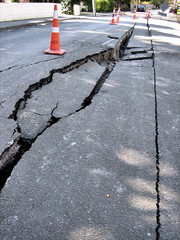
Damage to River Road in Richmond. The road surface is badly cracked and slumped, and liquefaction silt covers part of the road. The photographer comments, "Lateral spreading cracks in River Rd".
Central City Tour, 4 April 2011 - Photograph 12
Images, UC QuakeStudies
Large cracks in River Road, where the road has slumped towards the river. The photographer comments, "River Rd, near Swanns Rd. Lateral spreading damage in River Rd near Avonside GHS".
Henry Africa's Demolition - Photograph 12
Images, UC QuakeStudies
Detail of the partially-demolished Henry Africa's building. The photographer comments, "A building housing a restaurant and a great little neighbourhood bar is finally coming down because of earthquake damage. The doorway still stands".
Central City Tour, 4 April 2011 - Photograph 53
Images, UC QuakeStudies
People walk past the cordon fence beside the badly damaged Stone Chamber of the Provincial Council Buildings. The photographer comments, "A bike ride around the CBD. Provincial Chambers, Durham St".
Central City Tour, 4 April 2011 - Photograph 50
Images, UC QuakeStudies
People walk past the cordon fence beside the badly damaged Stone Chamber of the Provincial Council Buildings. The photographer comments, "A bike ride around the CBD. Provincial Chambers, Durham St".
Addington Rugby Stadium & CBS Arena
Images, eqnz.chch.2010
Helicopter Flight over Christchurch New Zealand
Experimental investigation of the seismic residual capacity of earthquake-…
Research papers, University of Canterbury Library
This poster presents preliminary results of ongoing experimental campaigns at the Universities of Auckland and Canterbury, aiming at investigating the seismic residual capacity of damaged reinforced concrete plastic hinges, as well as the effectiveness of epoxy injection techniques for restoring their stiffness, energy dissipation, and deformation capacity characteristics. This work is part of wider research project which started in 2012 at the University of Canterbury entitled “Residual Capacity and Repairing Options for Reinforced Concrete Buildings”, funded by the Natural Hazards Research Platform (NHRP). This research project aims at gaining a better understanding and providing the main end-users and stakeholders (practitioner engineers, owners, local and government authorities, insurers, and regulatory agencies) with comprehensive evidence-based information and practical guidelines to assess the residual capacity of damaged reinforced concrete buildings, as well as to evaluate the feasibility of repairing and thus support their delicate decision-making process of repair vs. demolition or replacement.
LINKING BUILDING PROPERTIES TO EARTHQUAKE-INDUCED DAMAGE AND BUSINESS DOWN…
Research papers, University of Canterbury Library
The 2010-2011 Canterbury earthquake sequence, and the resulting extensive data sets on damaged buildings that have been collected, provide a unique opportunity to exercise and evaluate previously published seismic performance assessment procedures. This poster provides an overview of the authors’ methodology to perform evaluations with two such assessment procedures, namely the P-58 guidelines and the REDi Rating System. P-58, produced by the Federal Emergency Management Agency (FEMA) in the United States, aims to facilitate risk assessment and decision-making by quantifying earthquake ground shaking, structural demands, component damage and resulting consequences in a logical framework. The REDi framework, developed by the engineering firm ARUP, aids stakeholders in implementing resilience-based earthquake design. Preliminary results from the evaluations are presented. These have the potential to provide insights on the ability of the assessment procedures to predict impacts using “real-world” data. However, further work remains to critically analyse these results and to broaden the scope of buildings studied and of impacts predicted.
Bike Ride in the East Side - Photograph 28
Images, UC QuakeStudies
Interior damage in a house in Richmond. Cracks are visible in the walls. The photographer comments, "Revisiting our abandoned house. Looking from the lounge back to the dining room".
Central City Tour, 4 April 2011 - Photograph 14
Images, UC QuakeStudies
Damage to a house in Richmond. The foundation is cracked, and a gap is visible between the foundation and the house. The photographer comments, "A bike ride around the CBD. Broken foundations, River Rd".
Canterbury Earthquake September 2010 - Photograph 31
Images, UC QuakeStudies
Damage to a house in Richmond. Part of a concrete patio has slumped, leaving large cracks. In the background, cracks are visible in the brickwork of the house. The photographer comments, "More patio cracks".
22 February Earthquake - Photograph 80
Images, UC QuakeStudies
Damage to a wooden building on Bealey Avenue. Windows on the lower storey are covered in tarpaulins. The photographer comments, "One large timber building stands, the dust from a demolition can be seen at right".
Bike Ride in the East Side - Photograph 20
Images, UC QuakeStudies
A vehicle drives onto the damaged Dallington bridge. The land has slumped relative to the bridge, leaving the approach road at a steep incline. The photographer comments, "Dallington Bridge northern approach, Gayhurst Rd".
Canterbury Earthquake September 2010 - Photograph 14
Images, UC QuakeStudies
Damage to a house in Richmond. A large crack runs through a concrete patio. The photographer comments, "The concrete patio is broken into big slabs. Over the following week this subsided even further".
Canterbury Earthquake September 2010 - Photograph 01
Images, UC QuakeStudies
Internal damage to a house in Richmond. A crack runs diagonally upwards from the corner of a doorway. Below, a picture is askew. The photographer comments, "Small cracks in the kitchen wall".
Canterbury Earthquake September 2010 - Photograph 08
Images, UC QuakeStudies
Internal damage to a house in Richmond. A large crack in wallboard shows how the corner of the room has moved. The photographer comments, "Cracks in the wall of the sunroom".
Canterbury Earthquake September 2010 - Photograph 32
Images, UC QuakeStudies
Damage to a house in Richmond. Part of the brick wall is visibly out of alignment, leaving large gaps at the corner of the house. The photographer comments, "Dining room exterior wall".
22 February Earthquake - Photograph 12
Images, UC QuakeStudies
Damage to River Road in Richmond. The river bank has slumped towards the river, opening up a large crack along the side of the road. The photographer comments, "Lateral spreading in River Rd".
Central City Tour, 4 April 2011 - Photograph 13
Images, UC QuakeStudies
Damage to a house in Richmond. The foundation is cracked, and a gap is visible between the foundation and the house. The photographer comments, "River Rd, between Stanmore Rd and Fitzgerald Ave".