

Search
found 2047 results
Images for Christchurch earthquake damage; more images...


Observatory Tower Photograph 14
Images, UC QuakeStudies
A close-up photograph of parts of the Townsend Telescope recovered from the rubble of the Observatory tower. The telescope was housed in the tower at the Christchurch Arts Centre. It was severely damaged when the tower collapsed during the 22 February 2011 earthquake.
BeckerFraserPhotos September 2010 photograph 027
Images, UC QuakeStudies
Cordon fencing around the Arts Centre on Worcester Boulevard. A man with a hard hats and hi-vis vest on can be. Wooden bracing has been placed on the gable on the tower to limit further earthquake damage. There is a crane sitting inside the fenced area.
Jim Baltaxe WEMO Photograph 041
Images, UC QuakeStudies
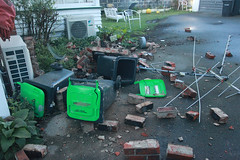
A photograph of the earthquake damage to a house in Christchurch. A view through the window reveals that the side wall has crumbled. A pile of bricks can be seen in the car port.
Helen Devereux Photograph 093
Images, UC QuakeStudies
For the first time in November 2011, Christchurch residents finally had the opportunity to see the earthquake-damaged city centre on the Red Zone bus tours organised by CERA. A partial view of Christ Church Cathedral.
Kim Wright WEMO Photograph 060
Images, UC QuakeStudies
A photograph of volunteers fron the Wellington Emergency Management Office walking down an earthquake damaged street in Christchurch. In the background, one of the houses has a yellow sticker, indicating that access is restricted.
Helen Devereux Photograph 088
Images, UC QuakeStudies
For the first time in November 2011, Christchurch residents finally had the opportunity to see the earthquake-damaged city centre on the Red Zone bus tours organised by CERA. A partial view of the Hotel Grand Chancellor.
Work Has Started
Images, eqnz.chch.2010
The earthquake re-pair work has started on the Knox Church on Bealey Avenue, August 14, 2013 Christchurch New Zealand. While building after building is torn down in Christchurch, plans are in place to ensure as much of a 131-year-old church is retained as possible. Knox Church on Bealey Avenue suffered major damage in the February 22 earthquak...
Band-Aid Bandits Photograph 5
Images, UC QuakeStudies
A photograph of a paste-up on the wall of the earthquake-damaged Knox Church. The paste-up depicts a bandaid with a speech bubble reading, "I'll kiss it better".
Band-Aid Bandits Photograph 4
Images, UC QuakeStudies
A photograph of a paste-up on the wall of the earthquake-damaged Knox Church. The paste-up depicts a bandaid with a speech bubble reading, "I'll kiss it better".
Band-Aid Bandits Photograph 1
Images, UC QuakeStudies
A photograph of a paste-up on the wall of the earthquake-damaged Knox Church. The paste-up depicts a bandaid with a speech bubble reading, "I'll kiss it better".
Band-Aid Bandits Photograph 3
Images, UC QuakeStudies
A photograph of a paste-up on the wall of the earthquake-damaged Knox Church. The paste-up depicts a bandaid with a speech bubble reading, "I'll kiss it better".
WEMO ERT Set 1 - February 2011 - Photograph 66
Images, UC QuakeStudies
A photograph of emergency management personnel exiting the car park of the earthquake-damaged Press House on Gloucester Street. One of the team is pushing a wheelbarrow full of various supplies.
Observatory Tower Photograph 23
Images, UC QuakeStudies
A photograph of the earthquake damage to the Observatory tower at the Christchurch Arts Centre. The top two storeys of the tower collapsed during the 22 February 2011 earthquake and the rubble spilled into the courtyard in front. A digger was used to clear the rubble away from the building. A tarpaulin has been draped over the top of the tower and the roof of the building behind.
Observatory Tower Photograph 16
Images, UC QuakeStudies
A photograph of the earthquake damage to the Observatory tower at the Christchurch Arts Centre. The top two storeys of the tower collapsed during the 22 February 2011 earthquake and the rubble spilled into the courtyard in front. A digger was used to clear the rubble away from the building. A tarpaulin has been draped over the top of the broken tower and the roof behind.
Observatory Tower Photograph 17
Images, UC QuakeStudies
A photograph of the earthquake damage to the Observatory tower at the Christchurch Arts Centre. The top two storeys of the tower collapsed during the 22 February 2011 earthquake and the rubble spilled into the courtyard in front. A digger was used to clear the rubble away from the building. A tarpaulin has been draped over the top of the broken tower and the roof behind.
Observatory Tower Photograph 32
Images, UC QuakeStudies
A photograph of the earthquake damage to the Observatory tower at the Christchurch Arts Centre. The top two storeys of the tower collapsed during the 22 February 2011 earthquake and the rubble spilled into the courtyard in front. A digger was used to clear the rubble away from the building. A tarpaulin has been draped over the top of the broken tower and the roof behind.
Observatory Tower Photograph 13
Images, UC QuakeStudies
A close-up photograph of parts of the Townsend Telescope recovered from the rubble of the Observatory tower. The telescope was housed in the tower at the Christchurch Arts Centre. It was severely damaged when the tower collapsed during the 22 February 2011 earthquake.
Observatory Tower Photograph 18
Images, UC QuakeStudies
A photograph of the earthquake damage to the second story of the Observatory tower at the Christchurch Arts Centre. The front of the storey has collapsed, exposing the inside. A tarpaulin has been draped over the top and the roof of the building behind.
BeckerFraserPhotos December 2011 photograph 0196
Images, UC QuakeStudies
Photograph captioned by BeckerFraserPhotos, "A detail of the new Christchurch Press building. This facade is a replica of the previous Press building's facade which was badly damaged in the 22 February 2011 earthquake".
BeckerFraserPhotos February 2012 photograph 0354
Images, UC QuakeStudies
A photograph of the ChristChurch Cathedral showing the damage to the west wall and steel bracing. In the foreground is the plinth where a statue of John Robert Godley stood prior to the February 2011 earthquake.
Jim Baltaxe WEMO Photograph 098
Images, UC QuakeStudies
A photograph of the earthquake damage to a hotel in the Christchurch central city. Cordon tape has been placed across the entrance to the hotel and USAR codes have been spray-painted on the footpath outside.
Jim Baltaxe WEMO Photograph 037
Images, UC QuakeStudies
A photograph of a member of the New Zealand Army on the roof of an earthquake-damaged property in Christchurch. A tarpaulin has been placed over a hole in the roof caused by the collapsed chimney.
Observatory Tower Photograph 11
Images, UC QuakeStudies
A photograph of the largest section of the Townsend Telescope recovered from the rubble of the Observatory tower. The telescope was housed in the tower at the Christchurch Arts Centre. It was severely damaged when the tower collapsed during the 22 February 2011 earthquake.
Helen Devereux Photograph 097
Images, UC QuakeStudies
For the first time in November 2011, Christchurch residents finally had the opportunity to see the earthquake-damaged city centre on the Red Zone bus tours organised by CERA. Partial view of the Citizens' War Memorial beside the cathedral.
Bridge of Remembrance posters
Articles, UC QuakeStudies
Posters which describe the earthquake damage, planned restoration methods and historic information about the Bridge of Remembrance and Memorial Arch. These posters were hung on the fencing around the Bridge and Arch to inform the public about the work taking place.
Mike Cameron WEMO Photograph 21
Images, UC QuakeStudies
A photograph of the earthquake damage to the Chinese Methodist Church on Papanui Road. The bricks at the top of the tower have crumbled, and the wooden bracing is hanging half off the building. The spire of the tower can be seen to the left where it was moved to following the 4 September 2010 earthquake.
Helen Devereux Photograph 096
Images, UC QuakeStudies
For the first time in November 2011, Christchurch residents finally had the opportunity to see the earthquake-damaged city centre on the Red Zone bus tours organised by CERA. The Regent Theatre dome which has been removed from the building.
Helen Devereux Photograph 090
Images, UC QuakeStudies
For the first time in November 2011, Christchurch residents finally had the opportunity to see the earthquake-damaged city centre on the Red Zone bus tours organised by CERA. Looking into Cathedral Square, the Regent Theatre dome can be partially seen.
Observatory Tower Photograph 37
Images, UC QuakeStudies
A photograph of the earthquake-damaged Observatory tower at the Christchurch Arts Centre. The photograph was taken using a cellphone camera. The top of the tower collapsed during the 22 February 2011 earthquake. The rubble from the tower has been cleared and a tarpaulin has been placed over the top of the broken tower. Tyres have been placed on the tarpaulin to hold it down. A temporary roof has also been constructed over the tower to keep out the rain.
Rebekah Rogers WEMO Photograph 033
Images, UC QuakeStudies
A photograph of an earthquake-damaged building in Christchurch. The wall on the side of the house has crumbled, and the bricks have fallen onto the fence and damaged it. Wooden planks have been used to brace the wall towards the back of the property. A red sticker on the front window indicates that the house is unsafe to enter.