

Search
found 2047 results
Images for Christchurch earthquake damage; more images...


WEMO ERT Set 1 - February 2011 - Photograph 52
Images, UC QuakeStudies
A photograph of a member of the Wellington Emergency Management Office Emergency Response Team taking photograph through a car window. In the distance is the earthquake-damaged tower of the ChristChurch Cathedral.
WEMO ERT Set 1 - March 2011 - Photograph 07
Images, UC QuakeStudies
A photograph of the earthquake damage to a room inside a house in Christchurch. Large sections of the plaster have crumbled from the walls, revealing the brick wall underneath.
A machine learning-supported rapid classification of building damage follo…
Research papers, The University of Auckland Library
The rapid classification of building damage states or placards after an earthquake is vital for enabling an efficient emergency response and informed decision-making for rehabilitation and recovery purposes. Traditional methods rely heavily on inspector-led on-site surveys, which are often time-consuming, resource-intensive, and susceptible to human error. This study introduces a machine learning-supported surrogate model designed to streamline the assessment of building damage, focusing on the automated assignment of damage placards within the context of New Zealand's post-earthquake evaluation frameworks. The study evaluates two key safety evaluation protocols—Rapid Building Assessment (RBA) and Detailed Damage Evaluation (DDE)—and integrates corresponding databases derived from the 2010–2011 Canterbury Earthquake Sequence (CES) in Christchurch. Six ML classifiers—Multilayer Perceptron (MLP), Random Forest (RF), Support Vector Machine (SVM), K-Nearest Neighbours (KNN), Gradient Boosting Classifier (GBC), and Gradient Bagging (GBag)—were rigorously tested across both databases. The results indicate that the RF-based surrogate model outperforms the other classifiers across both RBA and DDE protocols. Two distinct sets of critical predictors have been further identified for each protocol, allowing for the rapid retrieval of essential data for future on-site surveys, while retaining the RF model's predictive accuracy. The developed surrogate model provides a pragmatic tool for practising engineers to rapidly assign placards to damaged structures and for policymakers and building owners to make informed recovery decisions for earthquake-affected buildings.
WEMO ERT Set 1 - March 2011 - Photograph 27
Images, UC QuakeStudies
A photograph of a member of the Wellington Emergency Management Office Emergency Response Team standing among broken furniture and rubble in the room of an earthquake-damaged house in Christchurch.
WEMO ERT Set 1 - March 2011 - Photograph 26
Images, UC QuakeStudies
A photograph of a member of the Wellington Emergency Management Office Emergency Response Team standing amongst broken furniture and rubble in the room of an earthquake-damaged house in Christchurch.
WEMO ERT Set 1 - March 2011 - Photograph 162
Images, UC QuakeStudies
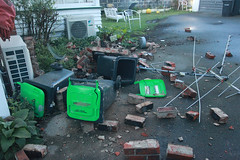
A photograph of the earthquake damage to a house in the Christchurch central city. The bricks walls of the building have collapsed and the bricks have spilt into the garden.
Sylviane Lebon WEMO Photograph 6
Images, UC QuakeStudies
A photograph of the earthquake damage to the curb of a street in Christchurch. The curb has cracked in two places and slumped, exposing the earth beneath the grass turf.
WEMO ERT Set 1 - March 2011 - Photograph 81
Images, UC QuakeStudies
A photograph of the earthquake damage to a building in central Christchurch. The basement of the building has collapsed and the concrete blocks have broken away from each other. The left corner of the building has also suffered damage, with many of the concrete blocks shaking loose.
Print III
Images, eqnz.chch.2010
The obligatory earthquake damage shot. Taken on Ilford Pan F+ with a Yashica-Mat 124G, developed in ID-11 for 8.5 minutes, printed on Ilford Multigrade IV RC, print developed in Ilford Universal PQ.
OTBC - closeup of shoring on front
Images, eqnz.chch.2010
Oxford Terrace Baptist Church on the corner of Madras St and Oxford Terrace, and alongside the Central City Fire Station on Kilmore St.
Observatory Tower Photograph 24
Images, UC QuakeStudies
A photograph of the earthquake damage to the Observatory tower at the Christchurch Arts Centre. The top two storeys of the tower collapsed during the 22 February 2011 earthquake and the rubble spilled into the courtyard in front. A digger was used to clear the rubble away from the building. A tarpaulin has been draped over the top of the tower.
Predicting Seismic Damage and Loss for Residential Buildings using Data Sc…
Research papers, The University of Auckland Library
This thesis presents the application of data science techniques, especially machine learning, for the development of seismic damage and loss prediction models for residential buildings. Current post-earthquake building damage evaluation forms are developed for a particular country in mind. The lack of consistency hinders the comparison of building damage between different regions. A new paper form has been developed to address the need for a global universal methodology for post-earthquake building damage assessment. The form was successfully trialled in the street ‘La Morena’ in Mexico City following the 2017 Puebla earthquake. Aside from developing a framework for better input data for performance based earthquake engineering, this project also extended current techniques to derive insights from post-earthquake observations. Machine learning (ML) was applied to seismic damage data of residential buildings in Mexico City following the 2017 Puebla earthquake and in Christchurch following the 2010-2011 Canterbury earthquake sequence (CES). The experience showcased that it is readily possible to develop empirical data only driven models that can successfully identify key damage drivers and hidden underlying correlations without prior engineering knowledge. With adequate maintenance, such models have the potential to be rapidly and easily updated to allow improved damage and loss prediction accuracy and greater ability for models to be generalised. For ML models developed for the key events of the CES, the model trained using data from the 22 February 2011 event generalised the best for loss prediction. This is thought to be because of the large number of instances available for this event and the relatively limited class imbalance between the categories of the target attribute. For the CES, ML highlighted the importance of peak ground acceleration (PGA), building age, building size, liquefaction occurrence, and soil conditions as main factors which affected the losses in residential buildings in Christchurch. ML also highlighted the influence of liquefaction on the buildings losses related to the 22 February 2011 event. Further to the ML model development, the application of post-hoc methodologies was shown to be an effective way to derive insights for ML algorithms that are not intrinsically interpretable. Overall, these provide a basis for the development of ‘greybox’ ML models.
WEMO ERT Set 1 - March 2011 - Photograph 28
Images, UC QuakeStudies
A photograph of two residents standing in front of an earthquake-damaged house in Christchurch. In the background a member of the Wellington Emergency Management Office is standing on the doorstep.
Post-earthquake assessment of damaged and repaired reinforced concrete wal…
Research papers, The University of Auckland Library
High demolition rates were observed in New Zealand after the 2010-2011 Canterbury Earthquake Sequence despite the success of modern seismic design standards to achieve required performance objectives such as life safety and collapse prevention. Approximately 60% of the multi-storey reinforced concrete (RC) buildings in the Christchurch Central Business District were demolished after these earthquakes, even when only minor structural damage was present. Several factors influenced the decision of demolition instead of repair, one of them being the uncertainty of the seismic capacity of a damaged structure. To provide more insight into this topic, the investigation conducted in this thesis evaluated the residual capacity of moderately damaged RC walls and the effectiveness of repair techniques to restore the seismic performance of heavily damaged RC walls. The research outcome provided insights for developing guidelines for post-earthquake assessment of earthquake-damaged RC structures. The methodology used to conduct the investigation was through an experimental program divided into two phases. During the first phase, two walls were subjected to different types of pre-cyclic loading to represent the damaged condition from a prior earthquake, and a third wall represented a repair scenario with the damaged wall being repaired using epoxy injection and repair mortar after the pre-cyclic loading. Comparisons of these test walls to a control undamaged wall identified significant reductions in the stiffness of the damaged walls and a partial recovery in the wall stiffness achieved following epoxy injection. Visual damage that included distributed horizontal and diagonal cracks and spalling of the cover concrete did not affect the residual strength or displacement capacity of the walls. However, evidence of buckling of the longitudinal reinforcement during the pre-cyclic loading resulted in a slight reduction in strength recovery and a significant reduction in the displacement capacity of the damaged walls. Additional experimental programs from the literature were used to provide recommendations for modelling the response of moderately damaged RC walls and to identify a threshold that represented a potential reduction in the residual strength and displacement capacity of damaged RC walls in future earthquakes. The second phase of the experimental program conducted in this thesis addressed the replacement of concrete and reinforcing steel as repair techniques for heavily damaged RC walls. Two walls were repaired by replacing the damaged concrete and using welded connections to connect new reinforcing bars with existing bars. Different locations of the welded connections were investigated in the repaired walls to study the impact of these discontinuities at the critical section. No significant changes were observed in the stiffness, strength, and displacement capacity of the repaired walls compared to the benchmark undamaged wall. Differences in the local behaviour at the critical section were observed in one of the walls but did not impact the global response. The results of these two repaired walls were combined with other experimental programs found in the literature to assemble a database of repaired RC walls. Qualitative and quantitative analyses identified trends across various parameters, including wall types, damage before repair, and repair techniques implemented. The primary outcome of the database analysis was recommendations for concrete and reinforcing steel replacement to restore the strength and displacement capacity of heavily damaged RC walls.
Helen Devereux Photograph 089
Images, UC QuakeStudies
For the first time in November 2011, Christchurch residents finally had the opportunity to see the earthquake-damaged city centre on the Red Zone bus tours organised by CERA. Looking into Cathedral Square.
Helen Devereux Photograph 094
Images, UC QuakeStudies
For the first time in November 2011, Christchurch residents finally had the opportunity to see the earthquake-damaged city centre on the Red Zone bus tours organised by CERA. Looking into Cathedral Square.
Helen Devereux Photograph 091
Images, UC QuakeStudies
For the first time in November 2011, Christchurch residents finally had the opportunity to see the earthquake-damaged city centre on the Red Zone bus tours organised by CERA. Looking into Cathedral Square.
Helen Devereux Photograph 092
Images, UC QuakeStudies
For the first time in November 2011, Christchurch residents finally had the opportunity to see the earthquake-damaged city centre on the Red Zone bus tours organised by CERA. Looking into Cathedral Square.
The Effects of Earthquakes on Wastewater Pipelines in New Zealand: Evaluat…
Research papers, The University of Auckland Library
Utility managers are always looking for appropriate tools to estimate seismic damage in wastewater networks located in earthquake prone areas. Fragility curves, as an appropriate tool, are recommended for seismic vulnerability analysis of buried pipelines, including pressurised and unpressurised networks. Fragility curves are developed in pressurised networks mainly for water networks. Fragility curves are also recommended for seismic analysis in unpressurised networks. Applying fragility curves in unpressurised networks affects accuracy of seismic damage estimation. This study shows limitations of these curves in unpressurised networks. Multiple case study analysis was applied to demonstrate the limitations of the application of fragility curves in unpressurised networks in New Zealand. Four wastewater networks within New Zealand were selected as case studies and various fragility curves used for seismic damage estimation. Observed damage in unpressurised networks after the 2007 earthquake in Gisborne and the 2010 earthquake in Christchurch demonstrate the appropriateness of the applied fragility curves to New Zealand wastewater networks. This study shows that the application of fragility curves, which are developed from pressurised networks, cannot be accurately used for seismic damage assessment in unpressurised wastewater networks. This study demonstrated the effects of different parameters on seismic damage vulnerability of unpressurised networks.
Kim Wright WEMO Photograph 046
Images, UC QuakeStudies
A photograph of an earthquake damaged road in Christchurch. Road cones, cracks, and the remants of liquefaction can be seen on the road. There is a queue of traffic along the street.
WEMO ERT Set 3 - February 2011 - Photograph 268
Images, UC QuakeStudies
A photograph of earthquake damage to the ChristChurch Cathedral in Cathedral Square. The tower has been partially demolished and a pile of rubble sits in front. A Daniel Smith Industries Ltd crane is sitting to the left.
WEMO ERT Set 3 - February 2011 - Photograph 267
Images, UC QuakeStudies
A photograph of earthquake damage to the ChristChurch Cathedral in Cathedral Square. The tower has been partially demolished and a pile of rubble sits in front. A Daniel Smith Industries Ltd crane is sitting to the left.
WEMO ERT Set 1 - February 2011 - Photograph 60
Images, UC QuakeStudies
A photograph looking south down Colombo Street towards the earthquake-damaged ChristChurch Cathedral. A crane is sitting on the road in front of the Cathedral. In the background is a pile of rubble from the partially-demolished tower.
WEMO ERT Team Set 3 - April 2011 - Photograph 03
Images, UC QuakeStudies
A photograph of a Christchurch City Council red sticker. The sticker was used by the Civil Defence after the 2010 and 2011 earthquakes to indicate that a building had been inspected and that serious structural damage had been found. The sticker states that there should be no entry to the building. It also states that 'entry may result in death or injury'.
Observatory Tower Photograph 12
Images, UC QuakeStudies
A photograph of parts of the Townsend Telescope recovered from the rubble of the Observatory tower. The telescope was housed in the tower at the Christchurch Arts Centre. It was severely damaged when the tower collapsed during the 22 February 2011 earthquake.
Kim Wright WEMO Photograph 051
Images, UC QuakeStudies
A photograph of earthquake damage to a road in Christchurch. A hole has been filled with gravel, and a road cone placed on top. In the background, cracks and liquefaction can be seen.
WEMO ERT Set 1 - March 2011 - Photograph 17
Images, UC QuakeStudies
A photograph of the earthquake damage to a house in Christchurch. The front and side of the house has collapsed, the bricks and other rubble spilling onto the garden, exposing the rooms inside.
Dan Neely WEMO Photograph 03
Images, UC QuakeStudies
A photograph of an earthquake damaged house in Christchurch. USAR codes have been spray painted on the front wall. A red sticker in the window indicates that the building is unsafe to enter.
Mike Cameron WEMO Photograph 20
Images, UC QuakeStudies
A photograph of the earthquake damage to the Christchurch Chinese Methodist Church on Papanui Road. The wall of the gable has crumbled, the bricks spilling onto the lawn below. Wire fencing has been placed around the building as a cordon.
Jim Baltaxe WEMO Photograph 126
Images, UC QuakeStudies
A photograph of the earthquake damage to the Christchurch Chinese Methodist Church on Papanui Road. The gable wall has crumbled, the bricks and window frame falling onto the ground. Wire fencing has been placed around the building as a cordon.