

Search
found 1861 results
Images for Canterbury earthquakes; more images...


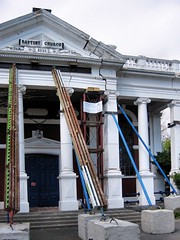
The Timaru Herald Image: Luke Thomas 2010:10:08 03:22:16
Images, UC QuakeStudies
Photograph captioned by Fairfax, "Teddy time: A Whanganui man has sent dozens of teddy bears to Rangiora to be distributed to children affected by the Canterbury earthquake. Ted Cheriton sent the teddies to National MP Kate Wilkinson's office to be distributed. Ms Wilkinson said it was a fantastic gesture. 'I am sure they will be welcome in Kaiapoi and beach settlements where damage from the earthquake has severely affected many families', she said. 'Hopefully these teddies will bring a smile to some young children and cheer them up in what has been a very trying and traumatic time'".
Fairfax Media Auckland Bureau Image: John Selkirk 2010:10:04 21:26:09
Images, UC QuakeStudies
Photograph captioned by Fairfax, "The Canterbury Earthquake Business Benefit Dinner hosted by the Prime Minister, was held tonight at Sky City in Auckland. Shown at the dinner is Eddie Berla who managed to get Richie McCaw's Bid paddle signed by the All Black for the woman (Helen) at Sky City who made the bid paddles for the evening".
Sunrise Over Manchester Destruction
Images, eqnz.chch.2010
Taken as the severity of the situation began to sink in to most of the people wandering around. Police, Fire and other emergency personal showed a fantastic response to how they dealt with the situation they had.
Best of the Week - 8 October 2010
Audio, Radio New Zealand
Highlights from Radio New Zealand National's programmes for the week ending Friday 8 October. This week.....Canterbury marks a month since its earthquake, a co-producer of The Hobbit speaks out about union activity threatening the film's production in New Zealand, can the Commonwealth Games media stomach Delhi, Michael Caine talks about his new autobiography and we get the lowdown on whitebait.
UC Civil and Natural Resources Engineering Photograph 069
Images, UC QuakeStudies
A photograph of the earthquake damage to a dairy on the corner of Barbadoes Street and Edgeware Road. The second storey of the dairy has collapsed, and the bricks have fallen onto the footpath, taking the awning with them. Police tape and road cones have been placed around the building as a cordon.
UC Civil and Natural Resources Engineering Photograph 065
Images, UC QuakeStudies
A photograph of the earthquake damage to a group of shops on the corner of Barbadoes Street and Edgeware Road. The second storey of the shops has collapsed, and the bricks have fallen to the footpath, taking the awnings with them. Police tape and road cones have been placed around the buildings as a cordon.
UC Civil and Natural Resources Engineering Photograph 068
Images, UC QuakeStudies
A photograph of the earthquake damage to a group of shops on the corner of Barbadoes Street and Edgeware Road. The second storey of the shops has collapsed, and the bricks have fallen to the footpath, taking the awnings with them. Police tape and road cones have been placed around the buildings as a cordon.
UC Civil and Natural Resources Engineering Photograph 067
Images, UC QuakeStudies
A photograph of the earthquake damage to a group of shops on the corner of Barbadoes Street and Edgeware Road. The second storey of the shops has collapsed, and the bricks have fallen to the footpath, taking the awnings with them. Police tape and road cones have been placed around the buildings as a cordon.
UC Civil and Natural Resources Engineering Photograph 066
Images, UC QuakeStudies
A photograph of the earthquake damage to a group of shops on the corner of Barbadoes Street and Edgeware Road. The second storey of the shops has collapsed, and the bricks have fallen to the footpath, taking the awnings with them. Police tape and road cones have been placed around the buildings as a cordon.
Christchurch Mail Image: John Bisset 2010:09:10 14:24:02
Images, UC QuakeStudies
Photograph captioned by Fairfax, "Members of the Red Cross civil defence response team and South Canterbury Police have been in Christchurch helping with the earthquake clean up. Welfare checks required the team to walk along River Road checking on householders. Pictured looking at a damaged bridge on River Road near Tai Tapu are (from left) Andy Todd, Anna Munro and Ken Weavers".
Christchurch Press Image: Robyn Edie 2010:09:10 14:40:45
Images, UC QuakeStudies
Photograph captioned by Fairfax, "Gorge Road School held a 'Red & Black' themed dress day and a gold coin donation (which they made into a coin trail) to raise funds for earthquake-stricken Canterbury. Pictured with their coins are Logan Marshall (5) on the left and Aaron Hart (6), with school pupils in behind. The fifty-pupil school managed to raise $136.00".
The Nelson Mail Image: Martin de Ruyter 2010:09:09 11:08:04
Images, UC QuakeStudies
Photograph captioned by Fairfax, "Nelson College for Girls year 12 leaders (from left) Sophie Day, Petra Matz, Sascha Miller, Jessica Rose, Kate Mickleson, Ming Pons, Yvette Jones-White, Nicola Britten, Eilish Wilson (obscured), Zoey Coombs-King, Abigail Goodison and Mackenzie Orange have started a collection at the college of cans and cash to aid people of Canterbury affected by the recent earthquake".
Christchurch Mail Image: John Bisset 2010:09:10 14:25:04
Images, UC QuakeStudies
Photograph captioned by Fairfax, "Members of the Red Cross civil defence response team and South Canterbury Police have been in Christchurch helping with the earthquake clean up. Welfare checks required the team to walk along River Road checking on householders. Pictured from left are Aaron Sole, Andy Todd, Anna Munro, Ken Weavers, Tim Mitchell (Emergency Management Officer) and Tom Connolly".
Shake proves precautions at chemistry faculty
Research papers, University of Canterbury Library
The University of Canterbury Dept. of Chemistry has weathered the Canterbury Earthquake of September 4, 2010 very well due to a combination of good luck, good planning and dedicated effort. We owe a great deal to university Emergency Response Team and Facilities Management Personnel. The overall emergency preparedness of the university was tested to a degree far beyond anything else in its history and shown to be well up to scratch. A strong cooperative relationship between the pan-campus controlling body and the departmental response teams greatly facilitated our efforts. Information and assistance was provided promptly, as and when we needed it without unnecessary bureaucratic overheads. At the departmental level we are indebted to the technical staff who implemented the invaluable pre-quake mitigation measures and carried the majority of the post-quake clean-up workload. These people put aside their personal concerns and anxieties at a time when magnitude-5 aftershocks were still a regular occurrence.
"I'm still here!" Jim Anderton for Mayor. 14 September 2010
Images, Alexander Turnbull Library
MP Jim Anderton who is standing for Mayor of Christchurch in the coming local body elections (9th October) stands up to his chest in a crack in the road waving a sign that reads 'Jim Anderton for mayor' and yelling "I'm still here!' Refers to the very high profile that his rival the standing mayor Bob Parker has enjoyed in the aftermath of the Christchurch earthquake of 4th September 2010. Jim Anderton has rather faded out of the limelight by comparison. Quantity: 1 digital cartoon(s).
The Nelson Mail Image: Martin de Ruyter 2010:09:09 11:10:50
Images, UC QuakeStudies
Photograph captioned by Fairfax, "Nelson College for Girls year 12 leaders (from left) Sophie Day, Petra Matz, Sascha Miller, Jessica Rose, Kate Mickleson, Ming Pons, Emma Dallison, Yvette Jones-White, Nicola Britten, Eilish Wilson, Zoey Coombs-King, Abigail Goodison and Mackenzie Orange have started a collection at the college of cans and cash to aid people of Canterbury affected by the recent earthquake".
The Nelson Mail Image: Martin de Ruyter 2010:09:09 11:10:50
Images, UC QuakeStudies
Photograph captioned by Fairfax, "Nelson College for Girls year 12 leaders (from left) Sophie Day, Petra Matz, Sascha Miller, Jessica Rose, Kate Mickleson, Ming Pons, Emma Dallison, Yvette Jones-White, Nicola Britten, Eilish Wilson, Zoey Coombs-King, Abigail Goodison and Mackenzie Orange have started a collection at the college of cans and cash to aid people of Canterbury affected by the recent earthquake".
Best of the Week - 17 September 2010
Audio, Radio New Zealand
Highlights from Radio New Zealand National's programmes for the week ending Friday 17 September. This week........criticism of some media over coverage of the Canterbury earthquake, the French five hour working week exposed, Sir Keith Park's legacy 70 years after the Battle of Britain, Cold - a new book explores this temperature good and bad and fond memories shared of the Monde Marie coffee shop in Wellington.
The Hutt News Image: Michael Kopp 2010:10:16 13:41:41
Images, UC QuakeStudies
Photograph captioned by Fairfax, " At the Love and Harmony benefit concert for Canterbury earthquake relief, Chaz Cummings and his sister Kalsey, of Naenae, jive it up in rock 'n' roll fashion for a crowd of one hundred at Naenae Community Centre. They are members of the Hutt Valley Rock 'n' Roll Club, and Chaz was the winner of New Zealand's Got Talent in 2008".
The Timaru Herald: John Bisset 2010:09:10 15:08:23
Images, UC QuakeStudies
Photograph captioned by Fairfax, "Members of the Red Cross civil defence response team and South Canterbury Police have been in Christchurch helping with the earthquake clean up. Pictured from left are Trooper Jesse Gaffney (ex-Timaru), St Andrews Police Constable Tim Hartnell and Constable Cath Hone of Timaru. They have been posted around Christchurch road blocks over the last week. They are pictured at the Manchester and Tuam cordon".
The Panel with Stephen Franks and Neil Miller (Part 2))
Audio, Radio New Zealand
Topics - A couple of New Zealand women, determined to carry on clubbing with kids, have launched the first New Zealand-based"Baby Loves Disco"franchise in Auckland's Viaduct. The"sheer strength and power"of the September the 4th earthquake has more than doubled the number of reported supernatural events in Canterbury, according to a paranormal investigator. The 2010 Census of Women's Participation reveals that female participation in governance, professional and public life is slipping away - erasing gains made in the past decades.
ELM Offices Level 7 Library - Photograph 02
Images, UC QuakeStudies
The University of Canterbury's E-Learning team's temporary office in the James Hight building. The photographer comments, "First looks at our new temporary (maybe) office space. Our group will stay here until April or May 2011, then will move to another floor in the Central Library. Foyer lifts etc. Female toilets are off the foyer to the left. These lifts start at Level 2 of the Library, and are heavily used by students. (Once the building is repaired after the earthquake; several floors are still in a mess)".
The Week in Review - week ending 17 September 2010
Audio, Radio New Zealand
A review of the week's news including the latest on the Canterbury earthquake as aftershocks continue to hit the region, ACT MP David Garrett quits the party amid shocking revelations, a report into the Air New Zealand crash off the French coast in 2008 blames poor maintenance and pilot error, first steps are taken to repeal the Foreshore and Seabed Act, the New Zealand Airforce evacuates an ill man from Antarctica, New Zealand's athletes could pull out of the Commonwealth Games and immigrant birds that mimic the native species.
Top Stories for 30 September 2010
Audio, Radio New Zealand
Chaos predicted with switch in give way rules, The first GST increase in 21 years comes into force at midnight tonight, Villages around Samoa, American Samoa and Tonga are today remembering the day one year ago when lives, homes and businesses were destroyed by a deadly tsunami , One of Auckland most distinctive local bodies has made an emotional exit one month before the creation of the new super city, The Law Society has added its voice to condemnation the government is giving itself far too much power by passing the emergency Canterbury earthquake legislation.
"Hey Phil... It's a 'Dear John' letter..." 8 September 2010
Images, Alexander Turnbull Library
The Queen tells Prince Philip that she has received a 'Dear John' letter from PM John Key and that it 'seems the earth has moved for him back in NZ'. Text above reads 'Keynote'. In a second version the queen says that John Key 'preferred to stay at home 'cos the earth moved'. A third version refers to the decision of the PM to remain in New Zealand because of the Christchurch earthquake instead of going on a trip to Europe with his wife during which they were to have stayed at the invitation of the Queen at Balmoral Castle in Scotland. Quantity: 3 digital cartoon(s).
Probabilistic seismic performance and loss assessment of a bridge–foundati…
Research papers, University of Canterbury Library
This paper presents the probabilistic seismic performance and loss assessment of an actual bridge– foundation–soil system, the Fitzgerald Avenue twin bridges in Christchurch, New Zealand. A two-dimensional finite element model of the longitudinal direction of the system is modelled using advanced soil and structural constitutive models. Ground motions at multiple levels of intensity are selected based on the seismic hazard deaggregation at the site. Based on rigorous examination of several deterministic analyses, engineering demand parameters (EDP’s), which capture the global and local demand, and consequent damage to the bridge and foundation are determined. A probabilistic seismic loss assessment of the structure considering both direct repair and loss of functionality consequences was performed to holistically assess the seismi risk of the system. It was found that the non-horizontal stratification of the soils, liquefaction, and soil–structure interaction had pronounced effects on the seismic demand distribution of the bridge components, of which the north abutment piles and central pier were critical in the systems seismic performance. The consequences due to loss of functionality of the bridge during repair were significantly larger than the direct repair costs, with over a 2% in 50 year probability of the total loss exceeding twice the book-value of the structure.
Question time for 26 October 2010
Audio, Radio New Zealand
Questions to Ministers 1. Hon DAVID CUNLIFFE to the Minister of Finance: Does he agree with Reserve Bank Governor Alan Bollard's assessment that the economic recovery is proving to be "slow and fragile"? 2. CRAIG FOSS to the Minister of Finance: What reports has he received on the economy? 3. Hon TREVOR MALLARD to the Minister for Economic Development: What specific actions has he taken since becoming Minister of Economic Development to secure the New Zealand film industry? 4. KATRINA SHANKS to the Minister of Housing: What reports has he received about the stakeholder engagement carried out by the Housing Shareholders' Advisory Group? 5. Hon CLAYTON COSGROVE to the Minister for Canterbury Earthquake Recovery: Will he support my recommendation to set up an advocacy support service to provide earthquake-affected residents with help in dealing with their private insurers to prevent them being shunted between these insurers and the Earthquake Commission? 6. Dr RUSSEL NORMAN to the Minister of Conservation: What steps, if any, is she taking to protect the unique, rare and threatened Nevis "Gollum galaxiid", a native fish species found only in the Nevis River in Central Otago? 7. GRANT ROBERTSON to the Minister for Tertiary Education: How does removing $55 million from industry training help the growth of the productive economy? 8. CHRIS AUCHINVOLE to the Minister for the Environment: What progress is the Government making in improving New Zealand's freshwater management? 9. SUE MORONEY to the Minister of Education: Does she stand by all her statements about subsidies and fee controls in early childhood education? 10. Hon RODNEY HIDE to the Attorney-General: Is it Government policy to exempt the holders of customary marine title from the application of the Resource Management Act 1991 and provide the holders with the sole right to give, or deny, a Resource Management Act permission right with no right of appeal or objection against the decision, as described in Bell Gully's Newsletter Update October 2010 on the Marine and Coastal Area (Takutai Moana) Bill? 11. Hon NANAIA MAHUTA to the Minister responsible for Whānau Ora: Is she satisfied with the process to shortlist Whānau Ora providers? 12. PESETA SAM LOTU-IIGA to the Minister of Energy and Resources: Why is the Government funding the Energy Spot advertising campaign?
Question Time for 15 December 2010
Audio, Radio New Zealand
1. AMY ADAMS to the Minister of Finance: What progress has the Government made this year in laying the foundations for a more ambitious and faster growing economy? 2. Hon PHIL GOFF to the Prime Minister: Does he stand by his statement that by early 2010 New Zealand will be coming out of the recession "reasonably aggressively"? 3. ALLAN PEACHEY to the Minister of Education: What feedback has she received about the quality of school reports to parents this year? 4. Hon CLAYTON COSGROVE to the Minister for Canterbury Earthquake Recovery: Is he satisfied that the Canterbury earthquake business support measures undertaken by the Government have worked as intended? 5. Dr KENNEDY GRAHAM to the Minister for Climate Change Issues (International Negotiations): Will the Cancun Agreements achieve the agreed goal of confining global warming to 2 degrees Celsius by 2020; if so, how? 6. Dr PAUL HUTCHISON to the Minister of Health: What reports has he received on improved access to medicines? 7. Hon DAMIEN O'CONNOR to the Prime Minister: Does he stand by his statement that "It's clearly been a large sum of money. But at the end of the day I gave a commitment to the families at Pike River I'd do everything I could to get their men out, I stand by that. I think the Government has done everything it can do so far"? 8. Dr CAM CALDER to the Minister of Corrections: Has she received any progress reports on the Government's Prisoner Skills and Employment Strategy? 9. Hon DAVID PARKER to the Minister for Economic Development: How many additional Cabinet papers has he submitted to Cabinet since he told the House in July "In my capacity as Minster for Economic Development I have submitted 14 papers to Cabinet in the last 6 months"? 10. HONE HARAWIRA to the Minister of Foreign Affairs: What steps has the New Zealand Government taken to denounce the shooting by Chilean forces of indigenous Rapa Nui, during an operation to evict them from stolen ancestral lands that they were seeking to reclaim? 11. Hon JIM ANDERTON to the Minister for ACC: Does he have any concerns about the way ACC in general and claims general manager Denise Cosgrove in particular, is interpreting ACC legislation regarding personal injury claims which are being declined on the basis of degeneration or pre-existing conditions? 12. COLIN KING to the Minister of Fisheries: How will fisheries officers be helping to better protect New Zealand's fisheries this summer?
Effects of Fines on the Undrained Behaviour of Christchurch Sandy Soils
Research papers, University of Canterbury Library
Liquefaction of sandy soil has been observed to cause significant damage to infrastructure during major earthquakes. Historical cases of liquefaction have typically occurred in sands containing some portion of fines particles, which are defined as 75μm or smaller in diameter. The effects of fines on the undrained behaviour of sand are not however fully understood, and this study therefore attempts to quantify these effects through the undrained testing of sand mixed with non-plastic fines sourced from Christchurch, New Zealand. The experimental program carried out during this study consisted of undrained monotonic and cyclic triaxial tests performed on three different mixtures of sand and fines: the Fitzgerald Bridge mixture (FBM), and two Pinnacles Sand mixtures (PSM1 and PSM2). The fines content of each host sand was systematically varied up to a maximum of 30%, with all test specimens being reconstituted using moist tamping deposition. The undrained test results from the FBM soils were interpreted using a range of different measures of initial state. When using void ratio and relative density, the addition of fines to the FBM sand caused more contractive behaviour for both monotonic and cyclic loadings. This resulted in lower strengths at the steady state of deformation, and lower liquefaction resistances. When the intergranular void ratio was used for the interpretation, the effect of additional fines was to cause less contractive response in the sand. The state parameter and state index were also used to interpret the undrained cyclic test results – these measures suggested that additional fines caused less contractive sand behaviour, the opposite to that observed when using the void ratio. This highlighted the dependency on the parameter chosen as a basis for the response comparison when determining the effects of fines, and pointed out a need to identify a measure that normalizes such effects. Based on the FBM undrained test results and interpretations, the equivalent granular void ratio, e*, was identified from the literature as a measure of initial state that normalizes the effects of fines on the undrained behaviour of sand up to a fines content of 30%. This is done through a parameter within the e* definition termed the fines influence factor, b, which quantifies the effects of fines from a value of zero (no effect) to one (same effect as sand particles). The value of b was also determined to be different when interpreting the steady state lines (bSSL) and cyclic resistance curves (bCR) respectively for a given mixture of sand and fines. The steady state lines and cyclic resistance curves of the FBM soils and a number of other sand-fines mixtures sourced from the literature were subsequently interpreted using the equivalent granular void ratio concept, with bSSL and bCR values being back-calculated from the respective test data sets. Based on these interpretations, it was concluded that e* was conceptually a useful parameter for characterizing and quantifying the effects of fines on the undrained behaviour of sand, assuming the fines influence factor value could be derived. To allow prediction of the fines influence factor values, bSSL and bCR were correlated with material and depositional properties of the presented sand-fines mixtures. It was found that as the size of the fines particles relative to the sand particles became smaller, the values of bSSL and bCR reduced, indicating lower effect of fines. The same trend was also observed as the angularity of the sand particles increased. The depositional method was found to influence the value of bCR, due to the sensitivity of cyclic loading to initial soil fabric. This led to bSSL being used as a reference for the effect of fines, with specimens prepared by moist tamping having bCR > bSSL, and specimens prepared by slurry deposition having bCR < bSSL. Finally the correlations of the fines influence factor values with material and depositional properties were used to define the simplified estimation method – a procedure capable of predicting the approximate steady state lines and cyclic resistance curves of a sand as the non-plastic fines content is increased up to 30%. The method was critically reviewed based on the undrained test results of the PSM1 and PSM2 soils. This review suggested the method could accurately predict undrained response curves as the fines content was raised, based on the PSM1 test results. It also however identified some key issues with the method, such as the inability to accurately predict the responses of highly non-uniform soils, a lack of consideration for the entire particle size distribution of a soil, and the fact the errors in the prediction of bSSL carry through into the prediction of bCR. Lastly some areas of further investigation relating to the method were highlighted, including the need to verify the method through testing of sandy soils sourced from outside the Christchurch area, and the need to correlate the value of bCR with additional soil fabrics / depositional methods.
Question Time for 7 December 2010
Audio, Radio New Zealand
1. Dr RUSSEL NORMAN to the Minister of Trade: Does he still consider that the United States will benefit from being part of the Trans-Pacific Partnership; if so, how? 2. Hon PHIL GOFF to the Prime Minister: Does he believe that all persons who have served as Ministers in his Government have met the requirement of the Cabinet Manual to behave in a way that upholds, and is seen to uphold, the highest ethical standards in their ministerial capacity, their political capacity and their personal capacity; if so, why? 3. CRAIG FOSS to the Minister of Finance: What reports has he received on the Government's financial position? 4. Hon ANNETTE KING to the Minister of Tourism: How many full-time permanent jobs has his cycleway project created? 5. JONATHAN YOUNG to the Minister for Communications and Information Technology: What progress has been made on the Ultra-fast broadband initiative? 6. Hon TREVOR MALLARD to the Minister of Education: Which ministers, if any, did she personally consult with on the question of removing the requirement for police checks for employees of limited attendance early childhood centres before she introduced the Education Amendment Bill (No 2)? 7. AARON GILMORE to the Minister of Revenue: What examples can he give of families claiming social assistance for which they are not entitled and what has this Government done to stop this abuse? 8. Hon DAVID CUNLIFFE to the Minister of Finance: How much lower will the growth forecast be for the year to March 2011 in the Half Year Economic and Fiscal Update compared with the Budget 2010 forecast? 9. SHANE ARDERN to the Minister of Agriculture: What recent actions has the Government taken to improve the welfare of pigs in New Zealand? 10. Hon RUTH DYSON to the Minister of Health: Will he act to prevent closure of health services in Taihape? 11. AMY ADAMS to the Minister for Land Information: What steps has Land Information New Zealand taken to help in the rebuilding of Canterbury following the 4 September earthquake? 12. Hon DARREN HUGHES to the Minister of Transport: Which project has the higher benefit cost ratio: the Auckland CBD rail loop or the Puhoi to Wellsford Road of National Significance?