
Search
found 173 results
Images for removed; more images...


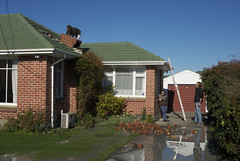
Jim Baltaxe WEMO Photograph 086
Images, UC QuakeStudies
A photograph of road works on a residential street in Christchurch. A patch of asphalt has been removed and a digger and a steam roller are parked to the side. A worker in a high-visibility vest and hard hat is directing traffic along one lane.
Kim Wright WEMO Photograph 016
Images, UC QuakeStudies
A photograph of two chimneys on the footpath in front of the Cranmer Courts on the corner of Montreal and Kilmore Streets. The chimneys were removed from the building to limit further damage by aftershocks. Wire fencing has also been placed around the building as a cordon.
BeckerFraserPhotos April 2011 photograph 323
Images, UC QuakeStudies
A cordoned off area in Christ's College where bricks from the heritage buildings have been removed and stacked. Scaffolding can be seen on the building in the distance and a prefab building to the right which was being used as classrooms while the buildings are still unsafe to enter.
OVTRK Blog Post 2015:07:21 - Transition to Regeneration Plan - Have Your S…
Articles, UC QuakeStudies
A pdf copy of a post from the One Voice Te Reo Kotahi blog. The post is titled, "Transition to Regeneration Plan - Have Your Say!". Note that video material originally included on the page has been removed for display reasons.
BeckerFraserPhotos March 2012 photograph 200
Images, UC QuakeStudies
The southern side of the Christ Church Cathedral with boarded up windows and damage to the roof above both of the transepts. Damaged masonry has been piled on the ground in front and one of the spires has been removed and braced with steel in the foreground.
Bike Ride in the East Side - Photograph 55
Images, UC QuakeStudies
Tree stumps and wood chips from trees that were removed from the South Brighton pine forest. The photographer comments, "A Sunday afternoon ride to New Brighton, then back via Aranui, Wainoni, Dallington, and Richmond. Not a cheerful experience. South Brighton pine forest - gone! The pines had become poisoned by the rising saline water table, so they've all had to come out".
Soft Stripping
Images, eqnz.chch.2010
Victoria Apartments demolition is under way on a walk around the city to find out what is happening in the city. Feb 17, 2014 Christchurch New Zealand. "soft-stripped", which means that any remaining belongings will be removed, as well as furnishings and internal walls.
WEMO ERT Set 1 - March 2011 - Photograph 113
Images, UC QuakeStudies
A photograph of a member of the Wellington Emergency Management Office Emergency Response Team standing on Dundas Street near the Smiths City car park. In the background several crushed cars have been removed from the car park and stacked on the road.
BeckerFraserPhotos May 2011 photograph 0527
Images, UC QuakeStudies
A plaque for an artwork on the corner of High Street and Tuam Street reads "'Corgis on High'. A Christchurch City Council Public Artwork. Artist David Marshall. Proudly Sponsored by Central City Revitalisation Project, Christchurch City Council, Lion Foundation, McKenzie and Willis Ltd. Supported by South Island Welsh Corgi League. 6 December 2003." The photographer comments, "The corgis have been removed. Temporarily??".
Kim Wright WEMO Photograph 015
Images, UC QuakeStudies
A photograph of the earthquake damage to the Cranmer Courts on the corner of Montreal and Kilmore Streets. The top of the closest gable has broken and is now covered in a tarpaulin. In the distance, a chimney has also been removed. Wire fencing and road cones have been placed around the building as a cordon.
Approval for Pipeline Rehabilitation Contractors and Systems
Articles, UC QuakeStudies
A document which explains the pre-approval process for specialist lining contractors working on the SCIRT horizontal repair programme.This document has had sections removed and redacted to protect contractors' commercial interests.For a current list of approved contractors authorised to carry out lining works on Christchurch City Council assets, contact the Council.
WEMO ERT Set 1 - March 2011 - Photograph 53
Images, UC QuakeStudies
A photograph of the earthquake damage to the John Burns & Co. Ltd building on Lichfield Street. The top section of the side wall has collapsed and the bricks have spilled onto the car park below, exposing the inside of the building. Several crushed cars have been removed from the car park and stacked on the street.
Rebekah Rogers WEMO Photograph 045
Images, UC QuakeStudies
A photograph of a pile of liquefaction and other rubble on the side of a residential road in Christchurch. The material has been removed from a property and placed on the road for the Christchurch City Council to collect. A road cone has been placed next to the pile to warn road users of its presence.
OVTRK Blog Post 2015:09:05 - Update re OVTRK, CCC Resilience Assessment an…
Articles, UC QuakeStudies
A pdf copy of a post from the One Voice Te Reo Kotahi blog. The post is titled, "Update re OVTRK, CCC Resilience Assessment and CERA research on NGOs". Note that video material originally included on the page has been removed for display reasons.
WEMO ERT Set 1 - March 2011 - Photograph 54
Images, UC QuakeStudies
A photograph of the earthquake damage to the John Burns & Co. Ltd building on Lichfield Street. The top section of the side wall has collapsed and the bricks have spilled onto the car park below, exposing the inside of the building. Several crushed cars have been removed from the car park and stacked on the street.
Jim Baltaxe WEMO Photograph 122
Images, UC QuakeStudies
A photograph of the earthquake damage to the Christchurch Chinese Methodist Church on Papanui Road. The gable walls have crumbled, bricks spilling onto the ground. The tower has been removed and braced on the ground in front. Cordon fencing has been placed around the building. Parts of the fence have been decorated with hearts and the word 'love'.
Kim Wright WEMO Photograph 017
Images, UC QuakeStudies
A photograph of the earthquake damage to the Cranmer Courts on the corner of Montreal and Kilmore Streets. Two chimneys have been removed from the building and placed on the footpath in front. Various pieces of fallen masonry can also be seen on the footpath. Wire fencing and road cones have been placed around the building as a cordon.
BeckerFraserPhotos February 2011 photograph 378
Images, UC QuakeStudies
A section of footpath outside a property on Robson Avenue in Avonside from which the pavement has been removed due to damage from the 4 September 2010 earthquake. The lid of a buried septic tank can be seen in front of the property's front lawn. These tanks were installed in front of Avonside properties to allow residents to use their toilets after the September earthquake.
BeckerFraserPhotos April 2012 photograph 315
Images, UC QuakeStudies
A notice on the fence outside the CTV site on Madras Street. The notice reads, "Please respect this site. In recognition of the special significance this site holds for the people of our city and all those affected by the earthquakes, the Christchurch City Council is working with Canterbury Museum to preserve aspects of our remembering. Tributes may be left at this site. Older tributes will be removed for archiving by the Canterbury Museum to become part of the city's memory of the Canterbury Earthquakes. Organic materials will be composted and used in the city's gardens. Canterbury Museum. Christchurch City Council".
BeckerFraserPhotos March 2011 photograph 227
Images, UC QuakeStudies
A yellow sticker on the door of a house in Worcester Street reading, "Restricted use. No entry except on essential business. Warning: This building has been damaged and its structural safety is questionable. Earthquake aftershocks present danger. Enter only at own risk. Subsequent events may result in increased damage and danger, changing this assessment. Reinspection may be required. The damage is as described below: partial collapse of longitudinal walls". Following on from this are the specific conditions that must be complied with to enable entry into the property, the inspector's identification details, and the date and time the building was inspected. At the bottom the form reads, "Do not remove this placard. Placed by order of the territorial authority Christchurch City Council".
Empowered Christchurch Letter to Queen Elizabeth II
Articles, UC QuakeStudies
A copy of a document from Empowered Christchurch which was sent to Queen Elizabeth. The document consists of a letter from Empowered Christchurch to Douglas Martin, Crown Manager from the Christchurch City Council, and Official Information Act requests sent to Building and Construction Minister Maurice Williamson and Canterbury Earthquake Recovery Minister Gerry Brownlee. It also includes an appeal to the Queen on behalf of Christchurch residents with badly-damaged houses. Please note that a letter from the Ministry of Business, Innovation and Employment, which was originally included in the document, has been removed due to copyright issues.
The regional consequence of a disaster: Assessing employment transition du…
Research papers, Lincoln University
Orientation: Large-scale events such as disasters, wars and pandemics disrupt the economy by diverging resource allocation, which could alter employment growth within the economy during recovery. Research purpose: The literature on the disaster–economic nexus predominantly considers the aggregate performance of the economy, including the stimulus injection. This research assesses the employment transition following a disaster by removing this stimulus injection and evaluating the economy’s performance during recovery. Motivation for the study: The underlying economy’s performance without the stimulus’ benefit remains primarily unanswered. A single disaster event is used to assess the employment transition to guide future stimulus response for disasters. Research approach/design and method: Canterbury, New Zealand, was affected by a series of earthquakes in 2010–2011 and is used as a single case study. Applying the historical construction–economic relationship, a counterfactual level of economic activity is quantified and compared with official results. Using an input–output model to remove the economy-wide impact from the elevated activity reveals the performance of the underlying economy and employment transition during recovery. Main findings: The results indicate a return to a demand-driven level of building activity 10 years after the disaster. Employment transition is characterised by two distinct periods. The first 5 years are stimulus-driven, while the 5 years that follow are demand-driven from the underlying economy. After the initial period of elevated building activity, construction repositioned to its long-term level near 5% of value add. Practical/managerial implications: The level of building activity could be used to confidently assess the performance of regional economies following a destructive disaster. The study results argue for an incentive to redevelop the affected area as quickly as possible to mitigate the negative effect of the destruction and provide a stimulus for the economy. Contribution/value-add: This study contributes to a growing stream of regional disaster economics research that assesses the economic effect using a single case study.
Quantifying Road Criticality through the Impact of Disruptions due to Natu…
Research papers, The University of Auckland Library
Road networks are highly exposed to natural hazard events, which can lead to significant economic and social consequences. In New Zealand, events such as the 2011 Christchurch earthquake, the 2016 Kaikōura earthquake, and the Cyclone Gabrielle in 2023 have demonstrated the severe consequences of road network disruptions. Traditional post event economic assessments often focus solely on clean-up and repair costs, neglecting the broader and more enduring impacts these events can have. Furthermore, business cases for resilience investments usually fail when quantifying the economic benefits of mitigation strategies, due to the underestimation of road disruption consequences. Importantly, not all road link disruptions contribute equally to these consequences, making the identification of critical road links a key step in resilience focused investment prioritization. Furthermore, traditional transportation asset management typically evaluates the life cycle of roads under normal conditions, such as traffic loads and standard environmental factors, while neglecting the influence of natural hazards. However, these events can significantly alter road deterioration and increase maintenance costs, emphasizing the need for integrating risk and resilience into transportation asset management approaches. This thesis presents a methodology to evaluate road criticality by assessing the economic consequences of road disruptions in combination with a hazard model in a prioritization index. Initially, the consequences are quantified through increased travel time, higher vehicle operating costs, and increased gas emissions. Thereafter, a new consequence model is introduced to estimate the increase in maintenance costs on alternative routes that absorb diverted traffic following a disruption. These consequence models are initially applied in a 'full-scan' analysis approach, where each road link is removed in turn to quantify its potential impact and, therefore, its criticality. Subsequently, a hazard model is integrated to develop a road prioritization index that combines the expected impacts of road disruptions, the individual road link criticality, and the probability of occurrence of natural hazard events. This index is designed to help road agencies in prioritizing mitigation strategies. Furthermore, the proposed methodology can also be applied to quantify the indirect economic impacts of natural hazard events. The methodology is demonstrated using New Zealand’s South Island inter-urban network as a case study, incorporating an earthquake-induced landslide model, with Python based simulations, providing road agencies a valuable tool to quantify the economic benefits of resilience investments