
Search
found 638 results
Images for School; more images...
Primary school mental wellbeing programme expanded
Audio, Radio New Zealand
A mental wellbeing programme for primary and intermediate school students will be expanded to five more district health board areas. Mana Ake started in 2018 in Canterbury and Kaikōura, and was a response to the ongoing trauma some tamariki were experiencing following the earthquakes. Now more year 1 to 8 pupils will receive extra help if they're struggling. Our reporter Kirsty Frame was at the announcement in Auckland.
Chch's new super school opens in Aranui with a bumper roll
Audio, Radio New Zealand
Haeata is the first public school in Christchurch to cater for all ages, replacing three eastern suburbs schools that were closed after the earthquakes. RNZ joined more than 900 students for the first day.
Fairfax Video, March 2013 (1)
Videos, UC QuakeStudies
A video of three Chisnallwood Intermediate students reading their stories about the Christchurch school closures. The students are Sophie Yeoman, Breana Riordan, and Phoebe Thompson.
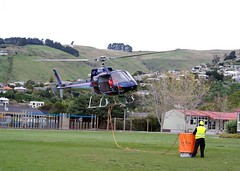
Helicopter flooding off rocks
Images, eqnz.chch.2010
There was a risk of rocks falling off cliffs behind Redcliffs school following Sept 4th earthquake. A helicopter was used to wash off loose rocks to lower the risk to the school.
Actor co-ordination in the disaster rebuild phase: An explorative case stu…
Research papers, Lincoln University
The coordination of actors has been a major focus for much of the research in the disaster relief humanitarian logistics discipline. While much of this literature focuses on the initial response phase, little has been written on the longer term recover phase. As the response phase transitions into the longer term recover phase the number and types of actors change from predominantly disaster relief NGOs to more commercial entities we argue that humanitarian values should still be part of the rebuild phase. It has been noted that humanitarian actors both cooperate and compete at the same time (Balcik, Beamon, Krejci, Muramatsu and Ramirez, 2010), in a form of behavior that can be described as ‘co-opetition’ (Nalebuff and Brandenburger, 1996). We use a case study approach to examine an organizational model used to coordinate civil and commercial actors for the rebuild of the civil infrastructure for Christchurch, New Zealand following a series of devastating earthquakes in 2010/11. For the rebuild phase we argue that ‘co-opetition’ is a key behaviour that allows the blending of humanitarian and commercial values to help communities rebuild to a new normal. While at this early stage our contribution is limited, we eventually hope to fully elaborate on an organisational model that has been created specifically for the tight coordination of commercial actors and its relevance to the rebuild phase of a disaster. Examining the behaviour of co-opetition and the structures that incentivise this behaviour offers insights for the humanitarian logistic field.
Early disaster recovery: a guide for communities
Research papers, Lincoln University
On September the 4th 2010 and February 22nd 2011 the Canterbury region of New Zealand was shaken by two massive earthquakes. This paper is set broadly within the civil defence and emergency management literature and informed by recent work on community participation and social capital in the building of resilient cities. Work in this area indicates a need to recognise both the formal institutional response to the earthquakes as well as the substantive role communities play in their own recovery. The range of factors that facilitate or hinder community involvement also needs to be better understood. This paper interrogates the assumption that recovery agencies and officials are both willing and able to engage communities who are themselves willing and able to be engaged in accordance with recovery best practice. Case studies of three community groups – CanCERN, Greening the Rubble and Gap Filler – illustrate some of the difficulties associated with becoming a community during the disaster recovery phase. Based on my own observations and experiences, combined with data from approximately 50 in-depth interviews with Christchurch residents and representatives from community groups, the Christchurch City Council, the Earthquake Commission and so on, this paper outlines some practical strategies emerging communities may use in the early disaster recovery phase that then strengthens their ability to ‘participate’ in the recovery process.
Avonside Girls', Shirley Boys' high schools move to new campus
Audio, Radio New Zealand
After years of disruption caused by the Christchurch earthquakes, two schools have finally started moving into their new state of the art facilities. Avonside Girls' High School and Shirley Boys' High School have begun moving students into their new shared but separate campus on the grounds of the old QEII Park in north New Brighton. Some of the features include, a moveable gym, bike stands with spanners and air pumps, and a rock climbing wall. It will be the first time in New Zealand two single-sex schools have been on the same site. Guyon Espiner speaks to Avonside Girls' High principal Sue Hume and Shirley Boys' High School principal John Laurenson.
Gap Filler Gap Hunt Booklet
Articles, UC QuakeStudies
The Gap Hunt booklet put together by Gap Filler in collaboration with KidsFest for the school holidays. The booklet challenged school children to find and enjoy Gap Filler projects around the central city.
The Marlborough Express Image: Hamish Coleman-Ross 2010:09:13 (01)
Images, UC QuakeStudies
Photograph captioned by Fairfax, "Matthew Rogers (11) Jordan Young (8) Elaine Hague (10) Aarleah Tangaroa (11) and Hannah Anderson (7) from Banks Avenue School in Dallington. First day back to school after 'quake-break'".
Christchurch Press Infographic: 14 October 2010 (3), Part 2
Images, UC QuakeStudies
A special liftout for schools, on earthquake causes and effects.
Christchurch Press Infographic: 18 July 2012 (4)
Images, UC QuakeStudies
A graphic giving statistics on detailed engineering evaluations of schools.
Christchurch Press Infographic: 25 October 2012 (2), key dates
Images, UC QuakeStudies
A graphic giving key dates for school closures and mergers.
Christchurch Press Infographic: 29 September 2012 (4)
Images, UC QuakeStudies
A timeline for the consultation on changes to Christchurch schools.
Christchurch Press Infographic: 25 October 2012 (2), Unlimited Paenga Tawh…
Images, UC QuakeStudies
A graphic giving the status of Unlimited Paenga Tawhiti School.
Christchurch Press Infographic: 15 September 2012 (8)
Images, UC QuakeStudies
A page banner promoting an article titled, "Schools shake-up".
Christchurch Press Infographic: 14 October 2010 (3), Part 1
Images, UC QuakeStudies
A special liftout for schools, on earthquake causes and effects.
Christchurch Press Infographic: 14 September 2012 (3)
Images, UC QuakeStudies
A timeline for the consultation on changes to Christchurch schools.
Christchurch Press Infographic: 2 April 2012 (2)
Images, UC QuakeStudies
A chart giving statistics on NCEA results for Canterbury schools.
Fairfax Video, September 2012 (13)
Videos, UC QuakeStudies
A video of a protest at the Hagley Park netball courts against the Canterbury school reforms. 57 schools will be affected by the reforms, with 13 set to close and 25 undergoing some form of merger. The video includes speeches from Reverend Mike Coleman, Richard Chambers (Principal at Manning Intermediate), Jelena (a student at Greenpark School), Jennifer O'Lerry (Principal at Branston Intermediate), Eugenie Sage (Green Party MP), and Mia Harrison.
Redcliffs school moves to new site nine years after quakes
Audio, Radio New Zealand
A Christchurch primary school is moving into its permanent new home today, nine years after cliffs behind it collapsed during the city's earthquakes. Redcliffs School subsequently moved to a temporary location in the suburb of Sumner, but the new location will mean the school will return home to Redcliffs, after a land swap with the local park. The move comes after in 2016, the then National Government, overturned its own decision to close the school. Christchurch reporter Anan Zaki spoke to principal Rose McInerney ahead of today's move.
The impacts of the Canterbury earthquakes on educational inequalities and …
Research papers, University of Canterbury Library
During 2010 and 2011, major earthquakes caused widespread damage and the deaths of 185 people in the city of Christchurch. Damaged school buildings resulted in state intervention which required amendment of the Education Act of 1989, and the development of ‘site sharing agreements’ in undamaged schools to cater for the needs of students whose schools had closed. An effective plan was also developed for student assessment through establishing an earthquake impaired derived grade process. Previous research into traditional explanations of educational inequalities in the United Kingdom, the United States of America, and New Zealand were reviewed through various processes within three educational inputs: the student, the school and the state. Research into the impacts of urban natural disasters on education and education inequalities found literature on post disaster education systems but nothing could be found that included performance data. The impacts of the Canterbury earthquakes on educational inequalities and achievement were analysed over 2009-2012. The baseline year was 2009, the year before the first earthquake, while 2012 is seen as the recovery year as no schools closed due to seismic events and there was no state intervention into the education of the region. National Certificate of Educational Achievement (NCEA) results levels 1-3 from thirty-four secondary schools in the greater Christchurch region were graphed and analysed. Regression analysis indicates; in 2009, educational inequalities existed with a strong positive relationship between a school’s decile rating and NCEA achievement. When schools were grouped into decile rankings (1-10) and their 2010 NCEA levels 1-3 results were compared with the previous year, the percentage of change indicates an overall lower NCEA achievement in 2010 across all deciles, but particularly in lower decile schools. By contrast, when 2011 NCEA results were compared with those of 2009, as a percentage of change, lower decile schools fared better. Non site sharing schools also achieved higher results than site sharing schools. State interventions, had however contributed towards student’s achieving national examinations and entry to university in 2011. When NCEA results for 2012 were compared to 2009 educational inequalities still exist, however in 2012 the positive relationship between decile rating and achievement is marginally weaker than in 2009. Human ethics approval was required to survey one Christchurch secondary school community of students (aged between 12 and 18), teachers and staff, parents and caregivers during October 2011. Participation was voluntary and without incentives, 154 completed questionnaires were received. The Canterbury earthquakes and aftershocks changed the lives of the research participants. This school community was displaced to another school due to the Christchurch earthquake on 22 February 2011. Research results are grouped under four geographical perspectives; spatial impacts, socio-economic impacts, displacement, and health and wellbeing. Further research possibilities include researching the lag effects from the Canterbury earthquakes on school age children.
Christchurch Press Image: Robyn Edie 2010:09:10 14:40:45
Images, UC QuakeStudies
Photograph captioned by Fairfax, "Gorge Road School held a 'Red & Black' themed dress day and a gold coin donation (which they made into a coin trail) to raise funds for earthquake-stricken Canterbury. Pictured with their coins are Logan Marshall (5) on the left and Aaron Hart (6), with school pupils in behind. The fifty-pupil school managed to raise $136.00".
Clutha Leader Image: Sam Morton 2010:09:10 11:39:11
Images, UC QuakeStudies
Photograph captioned by Fairfax, "Wacky support. Clinton Primary School pupils (from left) Jess Kendall and Kayla Monique-Kamana turn on the style at their school's Wacky Hair Day to raise money for the Christchurch Earthquake Appeal".
Christchurch Press Infographic: 30 October 2012 (4)
Images, UC QuakeStudies
A logo for a feature titled, "Schools facing closure or merger".
Christchurch Press Infographic: 14 November 2012
Images, UC QuakeStudies
Incomplete logos for a feature titled, "What makes our schools special".
Canterbury Earthquake - Paul Norris
Audio, Radio New Zealand
Paul Norris is from The New Zealand Broadcasting School at CPIT.
Photograph number UC 11-0507-01
Images, UC QuakeStudies
Historical images of the Engineering School,taken from above circa 1962.
Christchurch Press Infographic: 14 July 2012 (3)
Images, UC QuakeStudies
A graphic showing the proposed redevelopment of Rangi Ruru Girls' School.
Christchurch Press Infographic: 26 September 2012 (2)
Images, UC QuakeStudies
Graphs showing the results of a survey on proposed school closures.
“It’s about the most needy children”: A Foucauldian analysis of school soc…
Research papers, University of Canterbury Library
INTRODUCTION: After the 2011 Canterbury earthquake, the provision of school social work was extended into a larger number of schools in the greater Christchurch region to support discussions of their practice priorities and responses in post-earthquake schools. FINDINGS: Two main interpretations of need are reflected in the school social workers’ accounts of their work with children and families. Firstly, hardship-focused need, which represented children as adversely influenced by their home circumstances; the interventions were primarily with parents. These families were mainly from schools in low socioeconomic areas. Secondly, anxiety-based need, a newer practice response, which emphasised children who were considered particularly susceptible to the impacts of the disaster event. This article considers how these practitioners conceptualised and responded to the needs of the children and their families in this context. METHOD: A qualitative study examining recovery policy and school social work practice following the earthquakes including 12 semi-structured interviews with school social workers. This article provides a Foucauldian analysis of the social worker participants’ perspectives on emotional and psychological issues for children, particularly those from middle-class families; the main interventions were direct therapeutic work with children themselves. Embedded within these practice accounts are moments in which the social workers contested the predominant, individualising conceptualisations of need to enable more open-ended, negotiable, interconnected relationships in post-earthquake schools. IMPLICATIONS: In the aftermath of disasters, school social workers can reflect on their preferred practice responses and institutional influences in schools to offer children and families opportunities to reject the prevalent norms of risk and vulnerability.