

Search
found 245 results
Images for Christchurch's; more images...
What is SCIRT?
Articles, UC QuakeStudies
An article that explains the innovative work of SCIRT in a post-disaster environment.
SCIRT's awards roll call
Articles, UC QuakeStudies
A document which lists the awards won by SCIRT.
Civil Contractors' Environmental Guide
Articles, UC QuakeStudies
A document which provides simple, easy to understand environmental advice and guidance for civil construction contractors.
Business systems power rebuild
Articles, UC QuakeStudies
A document which describes SCIRT's approach to creating business systems to aid the rebuild of horizontal infrastructure.
Tic TOC: Time is money for SCIRT estimates
Articles, UC QuakeStudies
A document which describes the SCIRT estimates process and outcomes.
Innovative commercial model delivers value for money
Articles, UC QuakeStudies
A document which describes development and success of the SCIRT commercial model.
Best in show: Retain and gain for Sumner Road
Articles, UC QuakeStudies
A document which describes the process that SCIRT took to repair the Sumner Road retaining wall - stage 4.
Developing a Civil Trade Certification
Articles, UC QuakeStudies
A document which describes the process that SCIRT took to work with industry organisations to develop a civil trade qualification.
Considerable benefits of pipe lining
Articles, UC QuakeStudies
A document which describes SCIRT's experience with the trenchless technology of pipe lining.
Chch councillor Raf Manji to take on Gerry Brownlee in Ilam
Audio, Radio New Zealand
Christchurch councillor Raf Manji announces plans to stand against Earthquake Minister Gerry Brownlee in Ilam at the general election. He tells John Campbell why he is standing as an independent.
Heathcote family say EQC failed them
Audio, Radio New Zealand
A Christchurch family have found themselves stuck with a house that is too unsafe to live in after a fire revealed earthquake damage, which EQC admits it failed to identify.
Before/after : the governance of urban tourist spaces in the context of th…
Research papers, University of Canterbury Library
Research in the governance of urban tourist spaces is characterized by a lack of argumentative inquiry and scant use of critical theory. This is evident, particularly, in the study of tourism and post-disaster urban recovery, with very few contributions assessing the phenomenon from a social theory perspective. This thesis examines the complex phenomenon of planning and governance for urban tourism spaces in contexts facing physical recovery from natural disasters. It does so by looking at the governance dynamics and the mechanism of decision- making put in place before and after triggering events like earthquakes and tsunamis. This thesis provides evidence from Christchurch, New Zealand, by focusing on the policies and strategies for the regeneration of the city centre put in place before and after the disruptive earthquakes of 2010 and 2011. The thesis looks at power relations, structures and ideologies through a Lukesian appraisal of pre-and-post disaster governance from two relevant urban tourist spaces located in the Christchurch central city area: the Arts Centre of Christchurch and the Town Hall and Performing Arts Precinct. The research strategy adopted for the study combined archival research, interviews with key stakeholders and fieldwork notes over a period of two years. The research deployed a comparative case study methodology that focuses on projects taking place within a spatially defined area of the city centre where special legislation was enacted as result of the earthquakes. The findings from the interviews and their triangulation with documents retrieved from national and local authorities suggest that the earthquakes affected the engagement among stakeholders and the mechanisms of decision-making. Also, the findings show patterns of disaster capitalism in post-earthquake governance for urban tourist spaces in the Christchurch CBD, with episodes of exclusion, lobbying and amendment of rules and legislation that directly benefited the interests of a narrow group of privileged stakeholders. Overall, the study shows that the earthquakes of 2010 and 2011 accelerated neoliberal practices of site development in Christchurch, with the seismic events used as a pretext to implement market-oriented site projects in the CBD area.
Digital Photograph: Brass Band at the Canterbury Earthquake Memorial Servi…
Images, Canterbury Museum
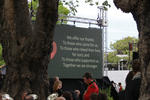
One landscape colour digital photograph taken 22 February 2017 showing brass band members at the Canterbury Earthquake Memorial Service. Behind the band is a digital screen showing words of thanks from survivors.
Digital Photograph: Guests Arriving at the Canterbury Earthquake Memorial …
Images, Canterbury Museum
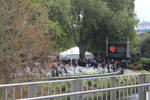
One landscape colour digital photograph taken 22 February 2017 showing guests being seated prior to the Canterbury Earthquake Memorial Service.
Digital Photograph: First Responders at the Canterbury Earthquake Memorial…
Images, Canterbury Museum
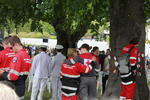
One landscape colour digital photograph taken 22 February 2017 showing first responders at the Canterbury Earthquake Memorial Service.
Digital Photograph: Brass Band at the Canterbury Earthquake Memorial Servi…
Images, Canterbury Museum
One landscape colour digital photograph taken 22 February 2017 showing brass band members at the Canterbury Earthquake Memorial Service. Behind the band is a digital screen showing an image of flowers floating in the Avon River.
Digital Photograph: Members of the Media at the Canterbury Earthquake Memo…
Images, Canterbury Museum
One landscape colour digital photograph taken 22 February 2017 showing cameramen and journalists at the Canterbury Earthquake Memorial Service.
Digital Photograph: Media Viewing Area at the Canterbury Earthquake Memori…
Images, Canterbury Museum
One landscape colour digital photograph taken 22 February 2017 showing the appointed media viewing area at the Canterbury Earthquake Memorial Service.
Digital Photograph: First Responders and Public Viewing Areas at the Cante…
Images, Canterbury Museum
One landscape colour digital photograph taken 22 February 2017 showing the appointed first responders and public viewing areas at the Canterbury Earthquake Memorial Service.
Digital Photograph: First Responders Laying Wreaths at the Canterbury Eart…
Images, Canterbury Museum
One landscape colour digital photograph taken 22 February 2017 showing first responders laying wreaths at the Canterbury Earthquake Memorial Service.
Digital Photograph: Commemoration Board at the Canterbury Earthquake Memor…
Images, Canterbury Museum
One landscape colour digital photograph taken 22 February 2017 showing a gentleman reading messages on a commemoration board at the Canterbury Earthquake Memorial Service.
Digital Photograph: Flowers Floating in the Avon River
Images, Canterbury Museum
One landscape colour digital photograph taken 22 February 2017 showing flowers floating in the Avon River as part of the Canterbury Earthquake Memorial Service.
Digital Photograph: Sunflower Atop a Road Works Cone
Images, Canterbury Museum
One landscape colour digital photograph taken 22 February 2017 showing a sunflower sitting atop a road works cone as part of the Canterbury Earthquake Memorial Service.
Digital Photograph: Earthquake Memorial Trellis
Images, Canterbury Museum
One landscape colour digital photograph taken 22 February 2017 showing an earthquake memorial trellis at the site of the former Canterbury Television building.
Digital Photograph: Commemorative Note to Andrew Bishop
Images, Canterbury Museum
One landscape colour digital photograph taken 22 February 2017 showing a commemorative note to, and photograph of, Andrew Bishop attached to an earthquake memorial trellis at the site of the former Canterbury Television building.
Digital Photograph: Flowers on an Earthquake Memorial Trellis
Images, Canterbury Museum
One landscape colour digital photograph taken 22 February 2017 showing a bouquet of flowers and a note attached to an earthquake memorial trellis at the site of the former Canterbury Television building.
Digital Photograph: Earthquake Memorial Trellis
Images, Canterbury Museum
One landscape colour digital photograph taken 22 February 2017 showing an earthquake memorial trellis at the site of the former Canterbury Television building.
Digital Photograph: Karen Bishop at an Earthquake Memorial Trellis
Images, Canterbury Museum
One landscape colour digital photograph taken 22 February 2017 showing Karen Bishop attaching a windmill to an earthquake memorial trellis in memory of her son Andrew Bishop at the site of the former Canterbury Television building.
Digital Photograph: Windmill Attached to an Earthquake Memorial Trellis
Images, Canterbury Museum
One landscape colour digital photograph taken 22 February 2017 showing a windmill attached to an earthquake memorial trellis by Karen Bishop in memory of her son Andrew Bishop at the site of the former Canterbury Television building.
Digital Photograph: Flowers at the Site of the Former Canterbury Televisio…
Images, Canterbury Museum
One landscape colour digital photograph taken 22 February 2017 showing a bouquet of flowers left at the site of the former Canterbury Television building by the Toyama Language School in memory of earthquake victims.