
Search
found 14117 results
Images for christchurch earthquake; more images...


A technical and economic feasibility study for the integration of GSHP tec…
Research papers, University of Canterbury Library
Mr Wayne Tobeck, Director of Southrim Group (SRG), sponsored this 2013 MEM Project titled; A Technical and Economic Feasibility Study for the Integration of GSHP Technology in the Christchurch Rebuild. Following the recent Christchurch earthquakes, a significant amount of land has become too unstable to support traditional building foundations. This creates an opportunity to implement new and unique foundation designs previously unconsidered due to high costs compared to traditional methods. One such design proposes that an Injection Micro-Piling technique could be used. This can also be coupled with HVAC technology to create a Ground Source Heat Pump (GSHP) arrangement in both new buildings and as retrofits for building requiring foundation repair. The purpose of this study was to complete a feasibility study on the merits of SRG pursuing this proposed product. A significant market for such a product was found to exist, while the product was also found to be technically and legally feasible. However, the proposed product was found to not be economically feasible with respect to Air Source Heat Pumps due to the significantly higher capital and installation costs required. Further analysis suggests GSHPs may become more economically attractive in operating temperatures lower than -9oC, though the existence of markets with this climate in NZ has not been studied. It is therefore suggested that SRG do not proceed with plans to develop a GSHP coupled foundation solution for the Christchurch rebuild.
Leo Bensemann: A Fantastic Art Venture
Research papers, The University of Auckland Library
This exhibition, eight years in the planning, had the misfortune to open one week before the 22 February 2011 Christchurch earthquake; the exhibition was immediately taken down and never went up again – the Christchurch Art Gallery has still not reopened. Although in my book Fantastica: The World of Leo Bensemann (NRO1) I covered the whole of Bensemann’s career, in the exhibition I took responsibility for the paintings (portraits and landscapes) , while Dr. Noel Waite (University of Otago) looked after Bensemann’s graphic work, book design and printing. This was the most extensive exhibition of Bensemann’s work ever mounted and together with Fantastica will compel a major reassessment of his place in New Zealand culture. Art New Zealand wrote of it: ‘The exhibition (including more than 100 items) is significant in bringing together what has in the past appeared disparate and unrelated; here Bensemann's entire oeuvre - the output of a painter, illustrator, calligrapher, typographer, designer and publisher is given equal billing. Although this exhibition is an important re-assessment and valuable for a new generation unfamiliar with his work, a national touring show would have precipitated an even greater awareness’.
Gun emplacements restored so history not forgotten
Audio, Radio New Zealand
A heritage advocate says he is over the moon to see a special piece of this country's history restored for future generations to enjoy. Three second world war era gun emplacements have been officially opened at Godley Head near Christchurch. The concrete bunkers and network of tunnels were badly damaged in the 2011 earthquakes and have only now been repaired and had screeds of graffiti removed. At the height of the war, the guns at the entry to Lyttelton Harbour were home to two thousand army personnel. They were the main defence from an anticipated Japanese invasion. The Godley Heads Heritage Trust chair, Peter Wilkins, told Conan Young the restored emplacements will ensure this history is never forgotten.
Manu Korihi News for 5 September 2012
Audio, Radio New Zealand
The Maori King has called a national hui for iwi and hapu to discuss water rights after the government refused to call one; A member of the Iwi Chairs Forum says it might be time for the Maori Council to step aside from the water rights debate; The Whanganui River Maori Trust Board says it's satisfied with how its Treaty of Waitangi negotiations with the Crown are progressing, saying the Government's taking into account the iwi's unique circumstances; A Maori broadcaster who was living in Christchurch during many of the earthquakes says she tried hard to put whanau at ease while she was on-air, but admits it was tough remaining calm during the many aftershocks.
Manu Korihi News for 5 September 2012
Audio, Radio New Zealand
The Maori King has called a national hui for iwi and hapu to discuss water rights after the government refused to call one; A member of the Iwi Chairs Forum says it might be time for the Maori Council to step aside from the water rights debate; The Whanganui River Maori Trust Board says it's satisfied with how its Treaty of Waitangi negotiations with the Crown are progressing, saying the Government's taking into account the iwi's unique circumstances; A Maori broadcaster who was living in Christchurch during many of the earthquakes says she tried hard to put whanau at ease while she was on-air, but admits it was tough remaining calm during the many aftershocks.
Ideas for 1 September 2013
Audio, Radio New Zealand
UAVs or Unmanned Aerial Vehicles, or drones as they’re commonly known, are suddenly everywhere. Conservationists and academics are using them to map our rivers; engineers surveyed the interior of the earthquake damaged Christchurch Cathedral with one; and then, of course, there's the military drones used to such lethal affect in Pakistan and Yemen. Ideas visits Palmerston North's Skycam UAV – New Zealand's leading manufacture of UAVs; talks to the interim president of the Association of Unmanned Operations – a union of US drone pilots; and Professor James Cavallaro tells us about the findings of a report he co-authored: 'Living Under Drones: Death, Injury, and Trauma to Civilians from US Drone Practices in Pakistan'.
The Panel with Tony Doe and Josie McNaught (Part 2)
Audio, Radio New Zealand
Topics - The Gettysburg address, the short speech given by Abraham Lincoln 150 years ago today, the finest short speech in the English language, and one of the great political utterances of all time. A strong earthquake that hit Christchurch last night has been upgraded by GNS Science to a magnitude 4.6. It was also shallower than first believed, with GNS reporting it was 8km deep rather than 11km. Wallabies rugby coach Ewen McKenzie has made no apologies for suspending six of his players in what's been described as "a hard-line move designed to set the standards required to win the 2015 World Cup".
The Naked Baker
Audio, Radio New Zealand
One Christchurch business has found just the right ingredients to rise again."The Naked Baker"gave away all of their cakes and buns and baked goods to the people of North Brighton after the earthquake on February 22nd. Co-owners Darren Carlaw and Andrew Snee started the bakery, coffee roastery and mobile food business 8 years ago. The cafe had to shut for more than 2 weeks to clean up all the damage . They didn't know what to expect when the business re-opened. What they discovered is that business is up by 30% thanks in part to their ability to bring their coffee and cakes to the many offices that have moved out of the center of town.
Best of the Week- 17th June 2011
Audio, Radio New Zealand
Highlights from Radio New Zealand National's programmes for the week ending Friday 17th June. This week..........barely two weeks after Canterbury was warned of a one in four chance of a big earthquake striking within a year, Christchurch residents are dealing with the effects of two major aftershocks that hit the region on Monday, and homeowners in the city are calling for the government to reveal which quake hit suburbs will be abandoned, Mediawatch looks at the "sideshow syndrome" that exists in media coverage of politics , the life-forms that exist in the seemingly barren ice in antarctica, and a photographer who'se taken portaits of some of the most powerful men on the planet.
Manu Korihi News for 21 February 2012
Audio, Radio New Zealand
Members of a King Country iwi occupying one of the Crafar farms near Benneydale say they fear the Government may offer them back Landcorp farms, which have absolutely no connection to the iwi; The Chairman of Bay of Plenty's Economic Development organisation wants to see concrete results in two to three years, from a strategy which aims to develop Maori assets in the region; The Minister of Maori Affairs, Dr Pita Sharples, says he pushed to have a Maori presence at the Rugby World Cup - because tangata whenua didn't even get a look in during the America's Cup in 2000; Almost a year since the Christchurch earthquake, the Nagi Tahui leader is urging locals to continue sticking together.
Manu Korihi News for 7 March 2012
Audio, Radio New Zealand
The Devonport-Takapuna Local Board in Auckland wants Parliament to amend a Treaty Settlement Bill for Ngati Whatua o Orakei, to exclude what's called the Tamaki block of just over three hectares of land at Narrow Neck; Taranaki Maori are being called to a Treaty Update hui this weekend - to keep abreast of tribal claims against the Crown; Maori Wardens have fronted up to a researcher looking at how the Christchurch earthquake has affected emergency workers; The winner of the Golden Shears Open Women's Title for 2012 says she's keen to keep competiting for a few more years yet and hopes she can inspire more wool handlers to get to her level and to prove that it is achievable.
Best of the Week - 6 March 2012
Audio, Radio New Zealand
Highlights from Radio New Zealand National's programmes for the week ending Friday 6th April. This week... we look at the commercial deals some media personalities are making these days, a documentary on the history of New Zealand's psychiatric hospitals, a new social phenomenon - the increasing number of people who choose to live alone, a new book and interesting findings about our national icon the kiwi, With the aid of advanced functional MRI scanners, scientists are getting closer to being able to read your mind, the opening of a public art project by the Christchurch Art Gallery to try and ensure art continues to have a presence in the earthquake hit city.
Government sets up package for Southern Response claimants
Audio, Radio New Zealand
A lawyer acting for Christchurch home-owners short changed in earthquake settlements says a new plan announced by the government is likely to run into trouble. Last year in a landmark case, the High Court found the government's claim settlement agency, Southern Response, misled and deceived Karl and Alison Dodds. It ordered the government to pay the couple nearly $180,000. The government has now set up a package for other Southern Response claimants who settled before October 2014. Its estimated about 3000 people will be eligible to benefit. But most of them are already taking part in a class action led by Brendan and Colleen Ross. Their lawyer Grant Cameron speaks to Corin Dann.
Isabelle Weston - The re-imagining of Britten Stables
Audio, Radio New Zealand
In 1978 world-class motorcycle designer John Britten bought a derelict stable block in Christchurch and painstakingly converted it into a home where he raised his family and built his revolutionary V1000 motorbike. The family continued to live there after his death in 1995, but were forced to abandon it when it sustained serious damage during the 2011 Canterbury earthquakes. After sitting broken and empty for six years, Isabelle Weston, John's eldest daughter, and her husband Tim undertook to restore and revamp the house with a view to running it as a B&B. The story of their epic project features in the first episode of Grand Designs New Zealand series four, which premieres on TV3, on October 3..
Avonside Girls', Shirley Boys' high schools move to new campus
Audio, Radio New Zealand
After years of disruption caused by the Christchurch earthquakes, two schools have finally started moving into their new state of the art facilities. Avonside Girls' High School and Shirley Boys' High School have begun moving students into their new shared but separate campus on the grounds of the old QEII Park in north New Brighton. Some of the features include, a moveable gym, bike stands with spanners and air pumps, and a rock climbing wall. It will be the first time in New Zealand two single-sex schools have been on the same site. Guyon Espiner speaks to Avonside Girls' High principal Sue Hume and Shirley Boys' High School principal John Laurenson.
National disaster survivors pleased with new guidelines
Audio, Radio New Zealand
Survivors of our biggest national disasters say new guidelines will better supporting families in the wake of future tragedies. The new "Public Service Commission Model Standards" - to be released at parliament today - addresses what survivors say have been consistent shortcomings in the treatment by government agencies of those most closely affected by disaster. The standards were co-authored by the Pike River Families Group after consulting with families of survivors caught up with events such as the earthquake and mosque shootings in Christchurch, the Aramoana massacre, the Cave Creek platform collapse and the Whakaari White Island eruption. Sonya Rockhouse, who lost her son Ben in the Pike River mine explosion 12 years ago, spoke to Corin Dann.
How to cope with disaster - from a world-leading expert
Audio, Radio New Zealand
Professor Lucy Easthope is one of the world's foremost disaster planners. Her first major job in emergency planning was responding to 9/11 and since then, her career has covered almost every major disaster; the Boxing Day tsunami, the London bombings, the Christchurch earthquakes, the Fukushima nuclear disaster, Malaysia Airlines Flight 17 shot down over Ukraine, the Grenfell Tower fire, Covid-19 and many more. It's her job to help get the bodies identified, repatriate survivors, return personal effects, look after the bereaved, and advise governments for the future. She speaks to Kathryn about her memoir, When the Dust Settles: Stories of Love, Loss and Hope from an Expert in Disaster.
Shaken But Not Deterred
Images, UC QuakeStudies
The sign for Perry's Cafe has had "Shaken but not deterred" added under the name of the cafe. One of the iconic figures of two workmen painted on the side of the building, which have regularly-changed speech bubbles commenting humorously on topical subjects, are saying "Is my crack showing?" The paint has peeled from the other speech bubble, obscuring the reply. The photographer comments, "After the numerous earthquakes in Christchurch a lot of buildings were damaged and made off limits. This affected a lot of cafes and take aways, so if you were open you needed to make it known. The words missing from the speech bubble are 'Don't be silly'".
Mark Lincoln Photograph 188
Images, UC QuakeStudies
The temporary ASB branch in the Re:Start mall. The photographer comments, "The new temporary city mall has been open in Christchurch now for a week. Buildings damaged in the earthquake have been demolished and replaced with cargo containers to create a new, temporary, Cashel Mall. I visited the mall yesterday and was quite impressed with what they have done. The cargo containers have been nicely converted, brightly painted and smartly branded to create some good looking stores ... ASB is the only bank to grab a container, which is fair enough seeing as they appear to be a large sponsor of the mall. The 'Re:START' Cashel Mall signs also display the tag line 'Supported by ASB'".
EQC ill-prepared to handle Canterbury repairs - Dame Silvia Cartwright
Audio, Radio New Zealand
EQC was ill-prepared to deal with the wide spread damage of the Christchurch Earthquakes and as a consequence its reputation been left in tatters with many seeing the commission as uncaring, miserly and inefficient. That is according to the findings of the inquiry into EQC and its handling of quake claims in Canterbury and Kaikōura. Inquiry Chair Dame Silvia Cartwright lays out a raft of inadequacies including EQC not being equiped to handle a mass scale managed repair programme - leading to multiple mistakes, poor staffing decisions and inadequate quality control. Damage assessments were the root of claimants disputes time and time again. Dame Silvia Cartwright described to Checkpoint the way claimants have been treated by EQC.
The Panel with David Farrar and Garry Moore (Part 1)
Audio, Radio New Zealand
Topics - The Parole Board has decided that Teina Pora should be released from prison. Pora has served 21 years of a life sentence for murdering and raping Susan Burdett in Auckland in 1992. He continues to protest his innocence, and he'll appear before the Privy Council in London at the end of the year in an effort to clear his name. A coroner's report criticises almost every aspect of the Fire Service's response to the CTV building collapse that killed 115 people in the February 2011 Christchurch earthquake. Gordon Matenga says more people, more resources, better communication and a better structure might have improved the chances of saving more lives that day.
The Panel with Brian Edwards and Michele Boag (Part 1)
Audio, Radio New Zealand
Topics - Official statistics released today show New Zealand's population has increased by 214,000 people in the seven years since the last census. The census, usually held every five years, was delayed in 2011 due to the Christchurch earthquakes. In what has been described as a "stealthy assault" in Somalia - and also in a raid in Libya's capital - US special forces have struck out against Islamic extremists who carried out terrorist attacks in East Africa. The commandos snatched a Libyan al-Qaida leader allegedly involved in the bombings of US embassies 15 years ago - but aborted a mission to capture a terrorist suspect linked to last month's Nairobi shopping mall attack after a fierce firefight.
Leading in a Post-disaster Setting: Guidance for Human Resource Practition…
Research papers, University of Canterbury Library
Based on a qualitative study of four organisations involving 47 respondents following the extensive 2010 – 2011 earthquakes in Christchurch, New Zealand, this paper presents some guidance for human resource practitioners dealing with post-disaster recovery. A key issue is the need for the human resource function to reframe its practices in a post-disaster context, developing a specific focus on understanding and addressing changing employee needs, and monitoring the leadership behaviour of supervisors. This article highlights the importance of flexible organisational responses based around a set of key principles concerning communication and employee perceptions of company support.
20130915_3534_1D3-24 Cardboard Cathedral
Images, eqnz.chch.2010
A couple of city blocks away from the now damaged Cathedral a temporary $4million cathedral has been built using large cardboard tubes and sheeting.
20130610_7556_EOS M-22 HireQuip toilet (Day 161/365)
Images, eqnz.chch.2010
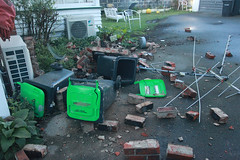
Sitting on the concrete in front of what was my model railway room - a single car garage at the rear of our house in Pacific Park. Reason it is here - one of the houses behind my old house is going to be trucked out. See previous photo.
Between Grey and Green: Ecological Resilience in Urban Landscapes
Research papers, The University of Auckland Library
This paper analyses the city of Christchurch, New Zealand, which has been through dramatic changes since it was struck by a series of earthquakes of different intensities between 2010 and 2011. The objective is to develop a deeper understanding of resilience by looking at changes in green and grey infrastructures. The study can be helpful to reveal a way of doing comparative analysis using resilience as a theoretical framework. In this way, it might be possible to assess the blueprint of future master plans by considering how important the interplay between green and grey infrastructure is for the resilience capacity of cities.
Urban Trauma: The contemporary square and the New Urbanist city - Reintegr…
Research papers, Victoria University of Wellington
This topic was chosen in response to the devastation caused to Cathedral Square, Christchurch, New Zealand following earthquakes in 2010 and 2011. Working amongst the demolition bought to attention questions about how to re-conceive the square within the rebuilt city. In particular, it raised questions as to how a central square could be better integrated and experienced as a contemporary addition to Christchurch city. This thesis seeks to investigate the ways in which central squares can be better integrated with the contemporary city and how New Urbanist design principles can contribute toward this union. The research principally focuses on the physical and spatial integration of the square with the contemporary city. A drawing-based analysis of select precedent case studies helped to determine early on that overall integration of the contemporary square could be attributed to several interdependent criteria. The detailed studies are supplemented further with literature-based research that narrowed the criteria to five integrative properties. These are: identity, scale and proportion, use, connectivity and natural landscape. These were synthesised, in part, from the integrative New Urbanist movement and the emerging integrative side of the more contemporary Post Urbanist movement. The literature-based research revealed that a more inclusive approach toward New Urbanist and Post Urbanist design methodologies may also produce a more integrated and contemporary square. Three design case studies, using the redesign of Cathedral Square, were undertaken to test this hypothesis. The case studies found that overall, integration was reliant on a harmonious balance between the five integrative properties, concluding that squares can be better integrated with the contemporary city. Further testing of the third concept, which embraced an allied New Urbanist / Post Urbanist approach to design, found that New Urbanism was limited in its contribution toward the integration of the square.
Post-catastrophe insurance supply and demand: theory and evidence
Research papers, University of Canterbury Library
In September 2010 and February 2011, the Canterbury region experienced devastating earthquakes with an estimated economic cost of over NZ$40 billion (Parker and Steenkamp, 2012; Timar et al., 2014; Potter et al., 2015). The insurance market played an important role in rebuilding the Canterbury region after the earthquakes. Homeowners, insurance and reinsurance markets and New Zealand government agencies faced a difficult task to manage the rebuild process. From an empirical and theoretic research viewpoint, the Christchurch disaster calls for an assessment of how the insurance market deals with such disasters in the future. Previous studies have investigated market responses to losses in global catastrophes by focusing on the insurance supply-side. This study investigates both demand-side and supply-side insurance market responses to the Christchurch earthquakes. Despite the fact that New Zealand is prone to seismic activities, there are scant previous studies in the area of earthquake insurance. This study does offer a unique opportunity to examine and document the New Zealand insurance market response to catastrophe risk, providing results critical for understanding market responses after major loss events in general. A review of previous studies shows higher premiums suppress demand, but how higher premiums and a higher probability of risk affect demand is still largely unknown. According to previous studies, the supply of disaster coverage is curtailed unless the market is subsidised, however, there is still unsettled discussion on why demand decreases with time from the previous disaster even when the supply of coverage is subsidised by the government. Natural disaster risks pose a set of challenges for insurance market players because of substantial ambiguity associated with the probability of such events occurring and high spatial correlation of catastrophe losses. Private insurance market inefficiencies due to high premiums and spatially concentrated risks calls for government intervention in the provision of natural disaster insurance to avert situations of noninsurance and underinsurance. Political economy considerations make it more likely for government support to be called for if many people are uninsured than if few people are uninsured. However, emergency assistance for property owners after catastrophe events can encourage most property owners to not buy insurance against natural disaster and develop adverse selection behaviour, generating larger future risks for homeowners and governments. On the demand-side, this study has developed an intertemporal model to examine how demand for insurance changes post-catastrophe, and how to model it theoretically. In this intertemporal model, insurance can be sought in two sequential periods of time, and at the second period, it is known whether or not a loss event happened in period one. The results show that period one demand for insurance increases relative to the standard single period model when the second period is taken into consideration, period two insurance demand is higher post-loss, higher than both the period one demand and the period two demand without a period one loss. To investigate policyholders experience from the demand-side perspective, a total of 1600 survey questionnaires were administered, and responses from 254 participants received representing a 16 percent response rate. Survey data was gathered from four institutions in Canterbury and is probably not representative of the entire population. The results of the survey show that the change from full replacement value policy to nominated replacement value policy is a key determinant of the direction of change in the level of insurance coverage after the earthquakes. The earthquakes also highlighted the plight of those who were underinsured, prompting policyholders to update their insurance coverage to reflect the estimated cost of re-building their property. The survey has added further evidence to the existing literature, such as those who have had a recent experience with disaster loss report increased risk perception if a similar event happens in future with females reporting a higher risk perception than males. Of the demographic variables, only gender has a relationship with changes in household cover. On the supply-side, this study has built a risk-based pricing model suitable to generate a competitive premium rate for natural disaster insurance cover. Using illustrative data from the Christchurch Red-zone suburbs, the model generates competitive premium rates for catastrophe risk. When the proposed model incorporates the new RMS high-definition New Zealand Earthquake Model, for example, insurers can find the model useful to identify losses at a granular level so as to calculate the competitive premium. This study observes that the key to the success of the New Zealand dual insurance system despite the high prevalence of catastrophe losses are; firstly the EQC’s flat-rate pricing structure keeps private insurance premiums affordable and very high nationwide homeowner take-up rates of natural disaster insurance. Secondly, private insurers and the EQC have an elaborate reinsurance arrangement in place. By efficiently transferring risk to the reinsurer, the cost of writing primary insurance is considerably reduced ultimately expanding primary insurance capacity and supply of insurance coverage.
Resilient shorelines : earthquake effects on sea levels and their implicat…
Research papers, University of Canterbury Library
Coastal margins are exposed to rising sea levels that present challenging circumstances for natural resource management. This study investigates a rare example of tectonic displacement caused by earthquakes that generated rapid sea-level change in a tidal lagoon system typical of many worldwide. This thesis begins by evaluating the coastal squeeze effects caused by interactions between relative sea-level (RSL) rise and the built environment of Christchurch, New Zealand, and also examples of release from similar effects in areas of uplift where land reclamations were already present. Quantification of area gains and losses demonstrated the importance of natural lagoon expansion into areas of suitable elevation under conditions of RSL rise and showed that they may be necessary to offset coastal squeeze losses experienced elsewhere. Implications of these spatial effects include the need to provide accommodation space for natural ecosystems under RSL rise, yet other land-uses are likely to be present in the areas required. Consequently, the resilience of these environments depends on facilitating transitions between human land-uses either proactively or in response to disaster events. Principles illustrated by co-seismic sea-level change are generally applicable to climate change adaptation due to the similarity of inundation effects. Furthermore, they highlight the potential role of non-climatic factors in determining the overall trajectory of change. Chapter 2 quantifies impacts on riparian wetland ecosystems over an eight year period post- quake. Coastal wetlands were overwhelmed by RSL rise and recovery trajectories were surprisingly slow. Four risk factors were identified from the observed changes: 1) the encroachment of anthropogenic land-uses, 2) connectivity losses between areas of suitable elevation, 3) the disproportionate effect of larger wetland vulnerabilities, and 4) the need to protect new areas to address the future movement of ecosystems. Chapter 3 evaluates the unique context of shoreline management on a barrier sandspit under sea-level rise. A linked scenario approach was used to evaluate changes on the open coast and estuarine shorelines simultaneously and consider combined effects. The results show dune loss from a third of the study area using a sea-level rise scenario of 1 m over 100 years and with continuation of current land-uses. Increased exposure to natural hazards and accompanying demand for seawalls is a likely consequence unless natural alternatives can be progressed. In contrast, an example of managed retreat following earthquake-induced subsidence of the backshore presents a new opportunity to restart saltmarsh accretion processes seaward of coastal defences with the potential to reverse decades of degradation and build sea-level rise resilience. Considering both shorelines simultaneously highlights the existence of pinch-points from opposing forces that result in small land volumes above the tidal range. Societal adaptation is delicately poised between the paradigms of resisting or accommodating nature and challenged by the long perimeter and confined nature of the sandspit feature. The remaining chapters address the potential for salinity effects caused by tidal prism changes with a focus on the conservation of īnanga (Galaxias maculatus), a culturally important fish that supports New Zealand‘s whitebait fishery. Methodologies were developed to test the hypothesis that RSL changes would drive a shift in the distribution of spawning sites with implications for their management. Chapter 4 describes a new practical methodology for quantifying the total productivity and spatiotemporal variability of spawning sites at catchment scale. Chapter 5 describes the novel use of artificial habitats as a detection tools to help overcome field survey limitations in degraded environments where egg mortality can be high. The results showed that RSL changes resulted in major shifts in spawning locations and these were associated with new patterns of vulnerability due to the continuation of pre-disturbance land-uses. Unexpected findings includes an improved understanding of the spatial relationship between salinity and spawning habitat, and identification of an invasive plant species as important spawning habitat, both with practical management implications. To conclude, the design of legal protection mechanisms was evaluated in relation to the observed habitat shifts and with a focus on two new planning initiatives that identified relatively large protected areas (PAs) in the lower river corridors. Although the larger PAs were better able to accommodate the observed habitat shifts inefficiencies were also apparent due to spatial disparities between PA boundaries and the values requiring protection. To reduce unnecessary trade-offs with other land-uses, PAs of sufficient size to cover the observable spatiotemporal variability and coupled with adaptive capacity to address future change may offer a high effectiveness from a network of smaller PAs. The latter may be informed by both monitoring and modelling of future shifts and these are expected to include upstream habitat migration driven by the identified salinity relationships and eustatic sea-level rise. The thesis concludes with a summary of the knowledge gained from this research that can assist the development of a new paradigm of environmental sustainability incorporating conservation and climate change adaptation. Several promising directions for future research identified within this project are also discussed.
Structure, seismicity and tectonics of the Porter's Pass-Amberley fault zo…
Research papers, University of Canterbury Library
The Porter's Pass-Amberley Fault Zone (PPAFZ) is a complex zone of anastomosing faults and folds bounding the south-eastern edge of the transition from subducting Pacific Plate to continental collision on the Australia Plate boundary. This study combines mapping of a 2000 km2 zone from the Southern Alps northeast to the coast near Amberley, 40 km north of metropolitan Christchurch, with an analysis of seismicity and a revision of regional seismic hazard. Three structural styles: 1) a western strike-slip, and 2) a more easterly thrust and reverse domain, pass into 3) a northwest verging fold belt on the northern Canterbury Plains, reflecting the structural levels exposed and the evolving west to east propagation. Basal remnants of a Late Cretaceous-Cenozoic, largely marine sedimentary cover sequence are preserved as outliers that unconformably overlie Mesozoic basement (greywacke and argillite of the Torlesse terrain) in the mountains of the PPAFZ and are underlain by a deeply leached zone which is widely preserved. Structure contouring of the unconformity surface indicates maximum, differential uplift of c.2600 m in the southwest, decreasing to c.1200 m in the coastal fold belt to the northeast. Much lower rates (or reversal) of uplift are evident a few kilometres southeast of the PPAFZ range-front escarpment. The youngest elements of the cover sequence are basement-derived conglomerates of Plio-Pleistocene age preserved on the SE margin. The source is more distant than the intervening mountains of the PPAFZ, probably from the Southern Alps, to the west and northwest. The absence of another regional unconformity on Mesozoic basement, older than Pleistocene, indicates that this uplift is post-Pliocene. Late Pleistocene(<100 kyr) differential uplift rates of c.0.5-2.7 m/kyr from uplifted marine terraces at the east coast, and rates of 2.5-3.3 m/kyr for tectonically-induced river-down cutting further west, suggest that uplift commenced locally during the last 1 Ma, and possibly within the last 0.5 Ma, if average rates are assumed to be uniform over time. Analysis of seismicity, recorded during a 10 week regional survey of micro earthquakes in 1990, identified two seismic zones beneath North Canterbury: 1) a sub-horizontal zone of activity restricted to the upper crust (≤12 km); and 2) a seismic zone in the lower crust (below a ceiling of ≤17 km), that broadens vertically to the north and northwest to a depth of c.40 km, with a bottom edge which dips 10°N and 15°NW, respectively. No events were recorded at depths between 12 km and 17 km, which is interpreted as a relatively aseismic, mid-crustal ductile layer. Marked differences (up to 60°) in the trend of strain axes for events above and below the inferred ductile layer are observed only north of the PPAFZ. A fundamental, north-to-south increase in the Wave-length of major geological structures occurs across the PPAFZ, and is interpreted as evidence that the upper crust beneath the Canterbury Plains is coupled to the lower crust, whereas the upper crust further north is not. Most of the recorded micro earthquakes <12 km deep beneath the PPAFZ have strike-slip mechanisms. It is probable that faults splay upward into the thrusts and folds at the surface as an evolving transpression zone in response to deep shear in basement. There have been no historic surface ruptures of the PPAFZ, but the zone has been characterised historically by frequent small earthquakes. Paleoseismic data (dated landslides and surface ruptures) compiled in this study, indicate a return period of 1500-1900 years between the last two M>7-7.5 earthquakes, and 500-700 years have elapsed since the last. The magnitudes of these events are estimated at c.M7.5, which represents a probable maximum magnitude for the PPAFZ. There are insufficient data to determine whether or not the frequency of large earthquakes conforms to a recognised model of behaviour, but comparison of the paleoseismic data with the historic record of smaller earthquakes, suggests that the magnitudes of the largest earthquakes in this zone are not exponentially distributed. A seismicity model for the PPAFZ (Elder et al., 1991) is reviewed, and a b-value of 1.0 is found to be consistent with the newly acquired paleoseismic data. This b-value reduces the predicted frequency of large earthquakes (M≥7.0) in this zone by a factor of 3.5, while retaining a conservative margin that allows for temporal variations in the frequency of large events and the possibility that the geological database is incomplete, suggesting grounds for revising the hazard model for Christchurch.