
Search
found 1386 results
Images for 2010-2011 Christchurch earthquakes; more images...


Geotechnical Aspects of the 22 February 2011 Christchurch earthquake
Research papers, University of Canterbury Library
The 22 February 2011, Mw6.2-6.3 Christchurch earthquake is the most costly earthquake to affect New Zealand, causing 181 fatalities and severely damaging thousands of residential and commercial buildings, and most of the city lifelines and infrastructure. This manuscript presents an overview of observed geotechnical aspects of this earthquake as well as some of the completed and on-going research investigations. A unique aspect, which is particularly emphasized, is the severity and spatial extent of liquefaction occurring in native soils. Overall, both the spatial extent and severity of liquefaction in the city was greater than in the preceding 4th September 2010 Darfield earthquake, including numerous areas that liquefied in both events. Liquefaction and lateral spreading, variable over both large and short spatial scales, affected commercial structures in the Central Business District (CBD) in a variety of ways including: total and differential settlements and tilting; punching settlements of structures with shallow foundations; differential movements of components of complex structures; and interaction of adjacent structures via common foundation soils. Liquefaction was most severe in residential areas located to the east of the CBD as a result of stronger ground shaking due to the proximity to the causative fault, a high water table approximately 1m from the surface, and soils with composition and states of high susceptibility and potential for liquefaction. Total and differential settlements, and lateral movements, due to liquefaction and lateral spreading is estimated to have severely compromised 15,000 residential structures, the majority of which otherwise sustained only minor to moderate damage directly due to inertial loading from ground shaking. Liquefaction also had a profound effect on lifelines and other infrastructure, particularly bridge structures, and underground services. Minor damage was also observed at flood stop banks to the north of the city, which were more severely impacted in the 4th September 2010 Darfield earthquake. Due to the large high-frequency ground motion in the Port hills numerous rock falls and landslides also occurred, resulting in several fatalities and rendering some residential areas uninhabitable.
Slane, Christopher, 1957-: "A level playing field, excellent. Now we can l…
Images, Alexander Turnbull Library
ACT leader Rodney Hide stands alone in the middle of a blasted plain that was once the 'Christchurch CBD' and says 'A level playing field, excellent. Now we can leave the rest to the market'. Context - Christchurch after the earthquakes of 4 September 2010 and 22 February 2011. ACT explicitly promotes a free market philosophy - a (literal) level playing field in the Christchurch CBD sounds like an excellent opportunity to test the powers of the free market. Quantity: 1 digital cartoon(s).
Mike Cameron WEMO Photograph 21
Images, UC QuakeStudies
A photograph of the earthquake damage to the Chinese Methodist Church on Papanui Road. The bricks at the top of the tower have crumbled, and the wooden bracing is hanging half off the building. The spire of the tower can be seen to the left where it was moved to following the 4 September 2010 earthquake.
Nisbet, Alistair, 1958- :"My god! not another aftershock!" ... 8 September…
Images, Alexander Turnbull Library
A couple are woken by loud thuds, rumbles and crashes. A woman leaps up in bed in a panic saying 'My God! Not another aftershock!' Her husband says 'Nah! Another flamin' haka!' A newspaper on the bed has a headline that reads 'World Cup in full swing.' Context: The World Cup began on Friday 9th September and ends on 23 October. People in Christchurch are still regularly jolted by aftershocks to the earthquakes of September 2010 and February and June 2011. Quantity: 1 digital cartoon(s).
My Photographic Visualisation of the Christchurch Earthquake
Images, UC QuakeStudies
A motion-blurred photograph of houses, with the Port Hills in the background. The photographer comments, "This I hope gives you a feel of what it feels like in an earthquake. When you spend your whole life thinking that you and your home are built on solid ground, it can be quite a shock when you find it is not. You can feel the house shaking like a dog with a toy, rising up violently underneath you or the most gentle form which is when the ground moves gently like a wave moving under a rowing boat. It is not just the movement, you often get a rumbling sound which can precede a violent shake or can result in no movement at all. This means that some vehicles can sound like the rumbling initially and in the early days would get your heart racing. Another form of stress is when big excavators as heavy as a tank move as you can feel the ground shake from streets away, but you do not always hear the engine. For most of us the problem when the shaking starts, is wondering if this is the start of an extremely violent earthquake or will it peter out".
Near-source strong ground motions observed in the 22 February 2011 Christc…
Research papers, University of Canterbury Library
This manuscript provides a critical examination of the ground motions recorded in the near-source region resulting from the 22 February 2011 Christchurch earthquake. Particular attention is given to reconciling the observed spatial distribution of ground motions in terms of physical phenomena related to source, path and site effects. The large number of near-source observed strong ground motions show clear evidence of: forward-directivity, basin generated surface waves, liquefaction and other significant nonlinear site response. The pseudo-acceleration response spectra (SA) amplitudes and significant duration of strong motions agree well with empirical prediction models, except at long vibration periods where the influence of basin-generated surface waves and nonlinear site response are significant and not adequately accounted for in empirical SA models. Pseudo-acceleration response spectra are also compared with those observed in the 4 September 2010 Darfield earthquake and routine design response spectra used in order to emphasise the amplitude of ground shaking and elucidate the importance of local geotechnical characteristics on surface ground motions. The characteristics of the observed vertical component accelerations are shown to be strongly dependent on source-to-site distance and are comparable with those from the 4 September 2010 Darfield earthquake, implying the large amplitudes observed are simply a result of many observations at close distances rather than a peculiar source effect.
Scott, Thomas, 1947- : "Bob darling, the chances of a news crew bursting i…
Images, Alexander Turnbull Library
The cartoon shows Christchurch mayor Bob Parker and his wife in bed. Bob Parker's wife says 'Bob darling, the chances of a news crew bursting in here at this time of night are virtually nil, so please take that bloody jacket off...' Context - Bob Parker, it is true, seems to be wearing the same trendy orange and black 'site manager's jacket for the very many photo opportunities afforded post earthquake of 22 February 2011. Quantity: 1 digital cartoon(s).
Winter, Mark 1958- :"I promise ... not to promise again." 5 September 2011
Images, Alexander Turnbull Library
The title is 'Gerry BrownLie?' and the cartoon shows the Minister for Earthquake recovery, Gerry Brownlee, saying 'I promise not to promise again'. The words 'Red Zone' appear beneath with the word 'faced' inserted between them. Context: The 'Red Zone' is the earthquake area in which houses cannot be rebuilt. Earthquake Minister Gerry Brownlee has apologised for falsely promising red zone homeowners they would be paid out for improvements to their house. Brownlee promised in June that, in some cases, home improvements like new kitchens would be included in the government settlement offer for red zone houses. But the offer is only valid if the improvement has added to the footprint of the house. (Press - 4 September 2011) Alternate version of DCDL-0018757 Quantity: 1 digital cartoon(s).
Observatory Tower Photograph 07
Images, UC QuakeStudies
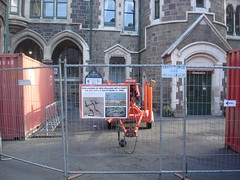
A photograph of the Observatory tower at the Christchurch Arts Centre. There are cracks in the masonry of the tower near where the two storeys join. The cracks formed as a result of the 4 September 2010 earthquake. Wire fencing has been placed at the entrance to the courtyard in front as a cordon.
Nisbet, Alastair, 1958-: "Now remember... try to work together!" 31 March …
Images, Alexander Turnbull Library
The cartoon shows Prime Minister John Key as a surgeon in a blood-spattered white coat; he has just created a Frankenstein monster which has resulted in the Minister for Earthquake Recovery Gerry Brownlee and Mayor of Christchurch Bob Parker joined together in a single body named 'CERA". Gerry Brownlee clutches a huge spiked mallet and Bob Parker a paintbrush. Context - a new bill is being rushed through parliament to establish the Canterbury Earthquake Recovery Authority (Cera); it empowers it to lead reconstruction efforts in Christchurch. It gives Cera specific powers to get information from any source, to requisition and build on land and to carry out demolitions. It can also take over local authorities if they are not working effectively on recovery work. The monster suggests distinctly differing philosophies on how the work of rebuilding Christchurch should proceed. Quantity: 1 digital cartoon(s).
Evans, Malcolm Paul, 1945- :Gambling on the rise in Christchurch, where th…
Images, Alexander Turnbull Library
The title is 'Gambling on the rise in Christchurch'. Several vignettes show two men running in the 'Porta-loo stakes (runs)'; people betting on the 'size of the next shake'; people betting on 'who will have the last chimney standing'; a man sitting over a pot on a little gas ring wondering 'How long will it take to boil a 3 minute egg... when it's minus 10 in the kitchen'; someone in a car wondering 'Whose street can wipe out the most engine sumps'; and someone wondering 'Which power company will be first to put people before profits'. Context: The way of things following the earthquakes of September 4 2010, 22 February 2011 and 13 June 2011. The Problem Gambling Foundation says it is concerned more Christchurch people are turning to gambling to combat stress from earthquakes. It says spending on pokie machines in Christchurch has risen by almost $4 million, going against a downward national trend. The foundation says the data released by the Department of Internal Affairs shows spending on gaming machines rose by more than $3,800,000 in Christchurch city to almost $23 million. (Radio NZ News 26 July 2011) Colour and black and white versions available Quantity: 2 digital cartoon(s).
Scott, Thomas, 1947- : "In order to get Christchurch back on its feet agai…
Images, Alexander Turnbull Library
Minister for Christchurch Recovery, Gerry Brownlee drives a huge tractor among debris that spells out 'Due Process' and says 'In order to get Christchurch back on its feet again we have to bring parliament to its knees. Context - The minister says he is happy with the speed of the work being done, as he wants tomake sure those involved in the rebuild portion of the recovery effort are well prepared. The bill establishes the Canterbury Earthquake Recovery Authority (Cera) and empowers it to lead reconstruction efforts in Christchurch. It gives Cera specific powers to get information from any source, to requisition and build on land and to carry out demolitions. It can also take over local authorities if they are not working effectively on recovery work. Quantity: 1 digital cartoon(s).
Walker, Malcolm, 1950- :"The following suburbs and my hopes of a reputatio…
Images, Alexander Turnbull Library
The cartoon shows the Minister for Earthquake Recovery, Gerry Brownlee, who wears a jacket with 'CERA' printed on it, reading from the 'Doomsday Book'. He reads 'The following suburbs and my hopes of a reputation as an effective minister, are now officially listed as munted...' Context - On 23rd June Prime Minister, John Key, officially announced which streets and suburbs in earthquake-ravaged Christchurch would be abandoned. For many residents, there has been too much delay and too little information regarding progress towards resolving questions about which land can or cannot be used for rebuilding for Gerry Brownlee's reputation to remain unsullied. Quantity: 1 digital cartoon(s).
Nisbet, Alistair, 1958-:Main faultline to be probed... 25 January 2011
Images, Alexander Turnbull Library
The title is 'Main faultline to be probed'. The cartoon shows an image of Maori Party MP Hone Harawira with two small firemen on his shoulder squirting water into one ear so that it explodes out of the other. One of the firemen says 'I tell ya now the next quake will be an eight point four!' Context - The problem of criticism of his own party by maverick Maori Party MP Hone Harawira. Harawira says that many Maori believe the party has not been able to be an independent voice because of its government partnership and so Mr Harawira is calling for his party to consider its options at the next election. Mr Harawira said that the problem was exacerbated because when the Maori Party was going into coalition with National, the whole world was going into recession and when this happens their choice (National) is to help the rich guy, help the big business, on the basis that they will stay here and keep their business here and everybody will get a job He said the Maori Party needed to get back to supporting basic social policies to help the poor. There is a reference to the Christchurch earthquake of 4 September 2010 and the many strange ways of trying to predict the earthquakes and aftershocks that Christchurch has been experiencing.. (Stuff 18 January 2011) Quantity: 1 digital cartoon(s).
Fletcher, David 1952- : "These emergency powers they've given the minister…
Images, Alexander Turnbull Library
'The Politician' cartoon strip. A member of the government staff reads in a newspaper 'These emergency powers they've given the minister are the equivalent of war powers' and he adds 'and he's making the most of them!' The second frame shows a minister wearing a military uniform with cap that includes copious braiding and medals; he is sitting behind a desk labelled 'Minister General'. Context - Canterbury Earthquake Recovery Authority (CERA) will be established as a stand-alone government department to enable an effective, timely and co-ordinated rebuilding and recovery effort in Canterbury. The controversial bill empowers the new Canterbury Earthquake Recovery Authority (Cera) to take control of councils it believes are failing on reconstruction work. Quantity: 1 digital cartoon(s).
Emergency management planning: Waimakariri District Council response and r…
Research papers, Lincoln University
The New Zealand Kellogg Rural Leaders Programme develops emerging agribusiness leaders to help shape the future of New Zealand agribusiness and rural affairs. Lincoln University has been involved with this leaders programme since 1979 when it was launched with a grant from the Kellogg Foundation, USA.At 4.35am on 4th September 2010, Canterbury was hit by an earthquake measuring 7.1 on the Richter scale. On 22nd February 2011 and 13th June 2011 a separate fault line approximately 35km from the first, ruptured to inflict two further earthquakes measuring 6.3 and 6.0 respectively. As a direct result of the February earthquake, 181 people lost their lives. Some commentators have described this series of earthquakes as the most expensive global insurance event of all time. These earthquakes and the more than 7000 associated aftershocks have had a significant physical impact on parts of Canterbury and virtually none on others. The economic, social and emotional impacts of these quakes spread across Canterbury and beyond. Waimakariri district, north of Christchurch, has reflected a similar pattern, with over 1400 houses requiring rebuild or substantial repair, millions of dollars of damage to infrastructure, and significant social issues as a result. The physical damage in Waimakiriri District was predominately in parts of Kaiapoi, and two small beach settlements, The Pines and Kairaki Beach with pockets elsewhere in the district. While the balance of the district is largely physically untouched, the economic, social, and emotional shockwaves have spread across the district. Waimakariri district consists of two main towns, Rangiora and Kaiapoi, a number of smaller urban areas and a larger rural area. It is considered mid-size in the New Zealand local government landscape. This paper will explore the actions and plans of Waimakiriri District Council (WDC) in the Emergency Management Recovery programme to provide context to allow a more detailed examination of the planning processes prior to, and subsequent to the earthquakes. This study looked at documentation produced by WDC, applicable legislation and New Zealand Emergency Management resources and other sources. Key managers and elected representatives in the WOC were interviewed, along with a selection of governmental and nongovernmental agency representatives. The interview responses enable understanding of how central Government and other local authorities can benefit from these lessons and apply them to their own planning. It is intended that this paper will assist local government organisations in New Zealand to evaluate their planning processes in light of the events of 2010/11 in Canterbury and the lessons from WDC.
Hubbard, James, 1949- : Quake may cost insurance co's up to $16B. 6 March …
Images, Alexander Turnbull Library
A man representing New Zealand reads a newspaper whose headline is ''Quake may cost insurance co's up to $16B'. Above him is an enormous mosquito that represents 'increased premiums' and that is about to suck the blood out of him; it casts a huge menacing shadow in which the man stands. Context - Insurance companies have experienced massive losses after the Canterbury earthquake. This may ultimately result in higher premiums as insurance companies try to recoup from their loss. According to Chris Ryan, Insurance Council chief executive, "The quake would probably result in foreign reinsurance companies increasing the premiums they charged local insurers." (Stuff 9 Sep 2010) Quantity: 1 digital cartoon(s).
Question Time for 15 March 2011
Audio, Radio New Zealand
Questions to Ministers 1. AMY ADAMS to the Minister of Finance: How many claims does the Earthquake Commission expect to receive as a result of the earthquakes in Canterbury since 4 September 2010? 2. Hon PHIL GOFF to the Prime Minister: Does he stand by his statement that "rebuilding Christchurch is a key priority for the Government this year"; if so, what rebuilding plans are currently in place? 3. METIRIA TUREI to the Minister for Social Development and Employment: Does she stand by her statement that state support is for "people to fall back on when they really need it"? 4. Hon ANNETTE KING to the Prime Minister: Does he stand by his statement that New Zealanders were "more than compensated" for last year's increase in GST? 5. NICKY WAGNER to the Minister for Social Development and Employment: How is her Ministry responding to support the Christchurch recovery following last month's earthquake? 6. JACINDA ARDERN to the Prime Minister: Does he stand by his answers to Oral Question number one on 8 March 2011; if not, why not? 7. AARON GILMORE to the Minister of Corrections: What support has the Department of Corrections provided to the people of Christchurch following last month's earthquake? 8. Dr KENNEDY GRAHAM to the Minister of Finance: How much has he budgeted to raise from the Christchurch Earthquake Appeal and has this figure been revised in light of the Japanese earthquake? 9. JO GOODHEW to the Minister of Internal Affairs: What work will the New Zealand Urban Search and Rescue team be carrying out in Japan? 10. Hon SHANE JONES to the Minister of Transport: Does he stand by his statement that the $300 million bill for restoring the Christchurch road network won't be causing any "dramatic issues" and what is his timeframe for the completion of this work? 11. COLIN KING to the Minister of Transport: What work has been done to repair and reopen Christchurch's roads and highways following the 22 February earthquake? 12. Hon STEVE CHADWICK to the Minister for Arts, Culture and Heritage: Has he had any discussions with the Minister for Canterbury Earthquake Recovery about heritage buildings or recovering cultural artefacts from buildings damaged by the earthquake on 22 February; if so, what did he say to the Minister?
Body, Guy Keverne, 1967-:'Unfortunately, this is a North Canterbury collap…
Images, Alexander Turnbull Library
A man representing 'EQC' (Earthquake Commission) talks to a couple outside their collapsed house. He says 'Unfortunately, this is a NORTH Canterbury collapse - so you'll only get your first $100,000 back.' Context: This refers both to the collapse of the South Canterbury Finance Company and to the problems that people are having with insurance companies in North Canterbury after the first Christchurch earthquake on September 4th 2010. Quantity: 1 digital cartoon(s).
The Housing Slump
Images, UC QuakeStudies
Two images of a house, taken before and after the earthquakes. In the after photograph the chimneys are gone, a column supporting the car port has partly collapsed, windows are broken, and the previously neat lawn and driveway are overgrown. The photographer comments, "This was a house that I was selling up to the September 2010 earthquake in Christchurch. It was on Avonside Drive, which was an area that has been badly hit in every earthquake that has hit the area. In the September quake parts of the house moved in different directions and one of the upstairs doors had to be smashed open to release one of the sons from his bedroom. This occurred in the dark with numerous aftershocks shaking the house. Liquefaction poured up through the floor and flowed down the drive. Everyone got out OK, but soon after the house was red stickered meaning it was dangerous to enter. The house was looted many times even though there was constant police patrols. When the most violent earthquake occurred on 22 February 2012 both the tall heavy chimneys came crashing through into the living areas. Subsequent earthquakes and aftershocks have caused one of the brick fence pillars to fall and the front garage pillar to break up and twist. The family's troubles did not end there. They moved into the home of one of their parents and this mansion of a home was so badly affected by the February earthquake that no one could enter to collect any of their or their parents' belongings. They now own a new home, which they are fond of except when the ground shakes yet again. There has been to date 10,712 earthquakes and aftershocks since 4 September 2010".
Considerations on the seismic performance of pre-1970s RC buildings in the…
Research papers, University of Canterbury Library
The 4th of September 2010 Mw 7.1 Darfield (Canterbury) earthquake had generated significant ground shaking within the Christchurch Central Business District (CBD). Despite the apparently significant shaking, the observed structural damage for pre-1970s reinforced concrete (RC) buildings was indeed limited and lower than what was expected for such typology of buildings. This paper explores analytically and qualitatively the different aspects of the "apparent‟ good seismic performance of the pre-1970s RC buildings in the Christchurch CBD, following the earthquake reconnaissance survey by the authors. Damage and building parameters survey result, based on a previously established inventory of building stock of these non-ductile RC buildings, is briefly reported. From an inventory of 75 buildings, one building was selected as a numerical case-study to correlate the observed damage with the non-linear analyses. The result shows that the pre-1970s RC frame buildings performed as expected given the intensity of the ground motion shaking during the Canterbury earthquake. Given the brittle nature of this type of structure, it was demonstrated that more significant structural damage and higher probability of collapse could occur when the buildings were subjected to alternative input signals with different frequency content and duration characteristics and still compatible to the seismicity hazard for Christchurch CBD.
Evans, Malcolm Paul, 1945-:Reserve Bank governor moves to restore confiden…
Images, Alexander Turnbull Library
Governor of the Reserve Bank Allan Bollard holds a spade over his shoulder and a roll of toilet paper in his hand. Text reads 'Reserve Bank governor moves to restore confidence after the quake -' and Bollard says '..past the silver beet, left at the last of the beans and it's right by the caulis!' The little Evans man says 'What a relief!' Context - Two earthquakes and hundreds of aftershocks have hit Christchurch, the first on 4 September 2010 and a second more devastating one on 22 February 2011. Toilets have been a real problem after the earthquakes with thousands of chemical toilets and portaloos being shipped in - some people, however, use the old kiwi method of digging a long-drop in the back garden. The Reserve Bank has made a relatively large 50-point cut in its benchmark interest rate, the Official Cash Rate (from 3% to 2.5 per cent). Critics say that inflation is already running unacceptably high and there is a threat of much higher inflation in a year or two when the rebuilding of Christchurch begins to put pressure on limited resources. The Reserve Bank acknowledged these factors, but it has chosen instead to focus on the immediate impact of the earthquake on the economy and particularly on all-important business and consumer sentiment. (Press editorial 12 March 2011) Colour and black and white versions available Quantity: 2 digital cartoon(s).
Evans, Malcolm Paul, 1945-: Christchurch Council website invites ideas for…
Images, Alexander Turnbull Library
Christchurch City has to be rebuilt after the earthquakes of 4 September 2010 and 22 February 2011. People are being invited to contribute ideas about how to rebuild on a city council website. A group of people look at ideas on computers; a boy comments that 'this one looks just like the old city' and his father comments 'but built fifty miles up the road!' A woman looks at what appears to be pre European Maori pa site and says 'Hone Harawira wants something pre-European!' Another woman looks at a map of the middle of the South Island and says 'Rodney Hide doesn't care as long as Christchurch combines with Timaru and Westport!' Context - Former ACT leader Rodney Hide in his role as Minister for Local Government likes 'supercities' and Hone Harawira has left the Maori Party, fed up with the compromises he believes they have to make to suit their coalition agreement with the National government. He seems to prefer a city that will reflect simpler pre-European times. Colour and black and white versions available Quantity: 2 digital cartoon(s).
Early disaster recovery: a guide for communities
Research papers, Lincoln University
On September the 4th 2010 and February 22nd 2011 the Canterbury region of New Zealand was shaken by two massive earthquakes. This paper is set broadly within the civil defence and emergency management literature and informed by recent work on community participation and social capital in the building of resilient cities. Work in this area indicates a need to recognise both the formal institutional response to the earthquakes as well as the substantive role communities play in their own recovery. The range of factors that facilitate or hinder community involvement also needs to be better understood. This paper interrogates the assumption that recovery agencies and officials are both willing and able to engage communities who are themselves willing and able to be engaged in accordance with recovery best practice. Case studies of three community groups – CanCERN, Greening the Rubble and Gap Filler – illustrate some of the difficulties associated with becoming a community during the disaster recovery phase. Based on my own observations and experiences, combined with data from approximately 50 in-depth interviews with Christchurch residents and representatives from community groups, the Christchurch City Council, the Earthquake Commission and so on, this paper outlines some practical strategies emerging communities may use in the early disaster recovery phase that then strengthens their ability to ‘participate’ in the recovery process.
20111229_7210_1D3-195 Bexley Wetlands and Pacific Park
Images, eqnz.chch.2010
The flooded Bexley Wetlands, now about 1 - 1.5metre below pre earthquake level. The short length of fence (mid ground) was on the "river track" that the council closed about three years ago. The whole track in this view is now under about 500mm water at high tide. The main track in front of the houses was, prior to earthquakes, below the leve...
Hubbard, James, 1949- :"Now I know why those things are called BULLdozers.…
Images, Alexander Turnbull Library
In the foreground PM John Key drives a bulldozer over Christchurch; in the background two engineers read a newspaper report that says 'P.M. gives false demolition number, PM gives false World Cup hope' and one of them says 'Now I know why those things are called BULLdozers..' Context - Prime Minister John Key is sticking to a government estimate that 10,000 Christchurch homes will need to be razed despite criticism that he should wait for official figures; he also stated that 100,000 homes may need repairs, despite Civil Defence saying it has only checked 70,000 homes so far. John Key was also insisting that there was a chance of keeping World Cup rugby games in Christchurch but an official announcement on 16 March dashed those hopes. Quantity: 1 digital cartoon(s).
Animal welfare impact following the 4 September 2010 Canterbury (Darfield)…
Research papers, University of Canterbury Library
At 4.35am on Saturday 4 September 2010, a magnitude 7.1 earthquake struck near the township of Darfield in Canterbury leading to widespread damage in Christchurch and the wider central Canterbury region. Though it was reported no lives were lost, that was not entirely correct. Over 3,000 animals perished as a result of the earthquake and 99% of these deaths would have been avoidable if appropriate mitigation measures had been in place. Deaths were predominantly due to zoological vulnerability of birds in captive production farms. Other problems included lack of provision of animal welfare at evacuation centres, issues associated with multiple lost and found pet services, evacuation failure due to pet separation and stress impact on dairy herds and associated milk production. The Canterbury Earthquake has highlighted concerns over a lack of animal emergency welfare planning and capacity in New Zealand, an issue that is being progressed by the National Animal Welfare Emergency Management Group. As animal emergency management becomes better understood by emergency management and veterinary professionals, it is more likely that both sectors will have greater demands placed upon them by national guidelines and community expectations to ensure provisions are made to afford protection of animals in times of disaster. A subsequent and more devastating earthquake struck the region on Monday 22 February 2011; this article however is primarily focused on the events pertaining to the September 4 event.
Community, resilience and recovery: building or burning bridges?
Research papers, Lincoln University
There is a critical strand of literature suggesting that there are no ‘natural’ disasters (Abramovitz, 2001; Anderson and Woodrow, 1998; Clarke, 2008; Hinchliffe, 2004). There are only those that leave us – the people - more or less shaken and disturbed. There may be some substance to this; for example, how many readers recall the 7.8 magnitude earthquake centred in Fiordland in July 2009? Because it was so far away from a major centre and very few people suffered any consequences, the number is likely to be far fewer than those who remember (all too vividly) the relatively smaller 7.1 magnitude Canterbury quake of September 4th 2010 and the more recent 6.3 magnitude February 22nd 2011 event. One implication of this construction of disasters is that seismic events, like those in Canterbury, are as much socio-political as they are geological. Yet, as this paper shows, the temptation in recovery is to tick boxes and rebuild rather than recover, and to focus on hard infrastructure rather than civic expertise and community involvement. In this paper I draw upon different models of community engagement and use Putnam’s (1995) notion of ‘social capital’ to frame the argument that ‘building bridges’ after a disaster is a complex blend of engineering, communication and collaboration. I then present the results of a qualitative research project undertaken after the September 4th earthquake. This research helps to illustrate the important connections between technical rebuilding, social capital, recovery processes and overall urban resilience.
Tremain, Garrick 1941-: "I'm bereft of ideas for the economy..." 31 March …
Images, Alexander Turnbull Library
In six small cameos Prime Minister John Key ponders over things economic and ends up dancing; he says 'I'm bereft of ideas for the economy gambling the lives of our troops in the Afghanistan mess I'm presiding over the biggest budget deficit in our history borrowing $300m a week to cushion our slide into oblivion Using lots of World Cup piffle to distract from the real issues Yet I'm still rating miles higher than Goff so how hopeless is he??? A little man in the last frame comments 'Spoiled for choice eh?' Context - New Zealand's rather dire economic situation made so much worse by the Christchurch earthquakes of 4 September 2010 and 22 February 2011, the consistently high poll rating of John Key and the series of disasters suffered by the Labour Party in the run up to the 2011 election in November. Quantity: 1 digital cartoon(s).
Question time for 17 May 2011
Audio, Radio New Zealand
Questions to Ministers 1. CRAIG FOSS to the Minister of Finance: What challenges does the Government face in putting together Budget 2011? 2. Dr RUSSEL NORMAN to the Prime Minister: Does he stand by his pre-Budget statement "The key sector which is not saving right now is the Government"; if so, what steps has he taken to increase government revenue? 3. Dr RUSSEL NORMAN to the Prime Minister: Does he stand by his statement "…we can use this time to transform the economy to make us stronger…"; if so, does this transformation involve an economy that uses fewer natural resources and produces less pollution? 4. Hon PHIL GOFF to the Prime Minister: Does he stand by all his statements on KiwiSaver? 5. NICKY WAGNER to the Minister for Canterbury Earthquake Recovery: What reports has he received on progress made to provide winter heating for residents affected by the Canterbury earthquakes? 6. Hon ANNETTE KING to the Prime Minister: What advice did he receive from the most recent food bank he visited about the current cost of living? 7. JACQUI DEAN to the Minister for the Environment: What practical initiatives is the Government taking in preparation for Rugby World Cup 2011 to protect the environment and New Zealand's important clean green brand? 8. Hon DAVID CUNLIFFE to the Minister of Finance: What was the annual rate of GDP growth for the year ended December 2010 projected in Budget 2010, and what was the actual rate of growth for that period according to Statistics New Zealand? 9. AARON GILMORE to the Minister of Education: What recent decisions have been made regarding schooling in Christchurch? 10. SUE MORONEY to the Minister of Education: When was construction completed on the new early childhood education centre at Weymouth Primary School and why is the centre empty? 11. COLIN KING to the Minister of Agriculture: What steps has the Government recently taken to support innovation in the Manuka honey industry? 12. CARMEL SEPULONI to the Minister of Justice: Does he stand by his statement "This Government is committed to ensuring that everyone…has access to justice"?