
Search
found 14117 results
Images for christchurch earthquake; more images...


A Quake Shake
Images, UC QuakeStudies
Two aluminium drink cans which have split open. The photographer comments, "We had around 24 cans of diet coke in the top of the fridge when the devastating 6.1 earthquake hit Christchurch in New Zealand. The shaking caused one of the front feet of the fridge to fold, which made the fridge tip forward and causing the door to open. After all the shaking the cans had already when they flew out and hit the ground a lot of them exploded. These two cans show the explosive pressure that occurred best".
Drug Overdose
Images, UC QuakeStudies
A digitally manipulated image of a shop window. A vase is visible in the window, and the sillhouette of a mannequin in the background. The photographer comments, "The title came from the pot and the E on the window. This is a building that has been off limits since the Christchurch earthquake. The E was sprayed on the window by rescue teams after searching the building and finding it was empty. This is a very old wooden building that looks OK from the front, but terrible from the side as the previously adjoined building has been demolished.
Too Big For Its Bridges
Images, UC QuakeStudies
An earthquake-damaged bridge, the approach to which has slumped. The photographer comments, "Due to lateral spread and the land slumping the road leading to this bridge has moved down greatly. Just imagine making the street lamps upright and how much that section of road would rise up at the end. When you go over bridges in the east side of Christchurch it is quite a climb up and a big drop down on the other side. The bridges in most cases coped very well, but not so the land leading to them".
Obrero documentary run-through
Videos, UC QuakeStudies
A video run-through of the interactive documentary Obrero. Obrero ('worker') is an independent multi-platform documentary project. It tells the stories of Filipino rebuild workers temporarily migrating to Christchurch, Aotearoa New Zealand after the earthquake in 2011. The interactive documentary can be explored at https://www.obrerofilm.com/. Norman Zafra is a Filipino journalist-documentary maker and currently a doctoral candidate at the University of Auckland's Media and Communication Department. He has worked as producer, writer, and director of award-winning Philippine TV documentary programmes such as Reporter’s Notebook and I-Witness.
EQC boss knew of repair problems for a year
Audio, Radio New Zealand
Christchurch Regeneration Minister Megan Woods says it could take 18 months to decide who is liable for the repairs for 660 home-owners caught in legal limbo. They've bought homes where they thought all the earthquake damage had been repaired - and now find more problems have emerged. Ms Woods told us it's not clear who is liable for these repairs - and it could take as long as 18 months to resolve that basic liability issue. EQC's chief executive Sid Miller has already apologised. He tells Susie Ferguson it's an issue he's been aware of in the year he has been with EQC.
1940s bike-athon
Audio, Radio New Zealand
Back in 2011, a slightly rusty three speed bike abandoned after the September earthquake on a demolition site in Christchurch caught the attention of John Smithies. He's 72, only slightly older than the bike, and he decided it would be just the bicycle to take on a epic, 2000 kilometre journey from Cape Reinga to Bluff. He started in September and expects to reach Bluff on Friday. He's making the epic journey in memory of his wife, Alison who died two years ago of a form of non-Hodgkin lymphoma. The ride down State Highway One is raising money for leukemia and blood cancer.
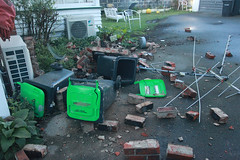
20130524_7209_1D3-65 Table thrown away in Culver Place.
Images, eqnz.chch.2010
All red zoned and it looked like no one is living anywhere in Culver Place. All awaiting demolition.
20120805_7446_1D3-600 Newstalk ZB building starting to go down 11
Images, eqnz.chch.2010
None
20130524_7197_1D3-24 Seaview Road drainage repairs
Images, eqnz.chch.2010
None
20130524_7201_1D3-32 Demolition of houses in Bexley is ongoing
Images, eqnz.chch.2010
None
20120805_7456_1D3-600 Newstalk ZB building starting to go down 21
Images, eqnz.chch.2010
None
20120805_7451_1D3-600 Newstalk ZB building starting to go down 16
Images, eqnz.chch.2010
None
20120805_7461_1D3-600 Newstalk ZB building starting to go down 26
Images, eqnz.chch.2010
None
Warnings house and contents insurance overpriced
Audio, Radio New Zealand
New Zealanders are paying too much for house and contents insurance, according to a new survey. Consumer NZ's price comparison survey shows climate and natural hazard risk is being factored in, and is more expensive than ever. Quotes for a large house differed by more than $3,000 across Auckland, Hamilton, Wellington, Christchurch, and Dunedin, and there's a more than $2,000 difference between the cheapest and most expensive policies on offer for a standard-sized house. If you live somewhere with a higher chance of earthquakes - such as Wellington or Christchurch - you'll be charged more for insurance. The cost of house and contents insurance has risen by 5.6% this year, over the past ten years it's gone up 150%. Kathryn is joined by Consumer NZ's Gemma Rasmussen and Katrina Shanks Chief Executive of Financial Advice New Zealand, which represents independent and professional financial advisors.
Gerry Brownlee defends EQC assessors
Audio, Radio New Zealand
The former Earthquake Commission minister, Gerry Brownlee, is defending EQC over claims its assessors in Christchurch were not properly qualified. A growing number of homeowners in the city are discovering EQC assessors have completely missed quake damage including broken foundations costing hundreds of thousands to repair. That's been disastrous for people who've bought homes with hidden damage who are sometimes finding private insurers unwilling to cover the cost of putting right mistakes made by EQC. The company hired by EQC to carry out repairs was Fletcher Construction. Its chief executive at the time, Mark Binns, told Checkpoint that EQC probably hired unqualified people to assess quake damaged homes. Gerry Brownlee refused to be drawn on the comments from Mr Binns. But when asked by RNZ Christchurch reporter, Conan Young, if it was acceptable to have retired policemen, school principals and vacuum cleaner salesmen carrying out assessments for EQC, he admitted finding enough people to do the job was a challenge.
Anna Leask - Behind bars
Audio, Radio New Zealand
Anna Leask has worked for the New Zealand Herald since 2008 and is currently a senior reporter, covering crime and justice for the daily newspaper as well as for the Weekend Herald and Herald on Sunday. Notably she's reported on the re-investigation of Arthur Allan Thomas, 43 years after the double murders for which he served nine years in prison before being pardoned, and the Christchurch 'House of Horrors' murderer Jason Somerville, who killed his wife and buried her under his East Christchurch house a year after doing the same to his neighbour Tisha Lowery. Leask covered the Pike River Mine disaster in 2010, the 2011 Canterbury earthquakes, Fiji's Cyclone Winston in early 2016 and travelled to Gallipoli in 2015 to cover the centenary of the Anzac landings. She won a Canon Media Award for crime and justice reporting in 2014. Her first book, Behind Bars: Real-life stories from inside New Zealand prisons has just been released.
WEMO ERT Set 4 - March 2011 - Photograph 11
Images, UC QuakeStudies
A photograph of a sign taped to a window. The sign includes a bullet pointed list of humorous observations about Christchurch following the February 2011 earthquake. The sign reads, "You know you're from Christchurch when: you use the term 'liquefaction' and 'seismic design' in casual conversation; digging a hole and shitting in your garden is no longer weird; your mayor describes the city as munted. If he means FUBARed, you agree; weaving through car size potholes on the street is no longer weird; a shower is heaven; you have a preference of which kind of silt you'd rather shovel, dry or wet; you see tanks...driving around town; you are always noting what you are under; due to frequent aftershocks during the night, you sleep like a baby - every 10 minutes you wake up and shit yourself".
Author Fleur Beale on her new work, Lyla
Audio, Radio New Zealand
Fleur Beale is one of New Zealand's most prolific authors and the winner of many awards for children and young adult books. Her latest work is a novel that tells the story of a young girl who experienced the February 2011 Christchurch earthquake. It's part of an international series called Through my Eyes - Natural Disaster Zones, which is a series written by different authors focusing on war zones and disasters throughout the world. Fleur's book is based on real accounts of what happened in Christchurch told through the eyes of a young girl, Lyla. Fleur, who has won the Margaret Mahy Medal for her outstanding contribution to children's writing, and was awarded the New Zealand Order of Merit for services to literature, joins Kathryn to talk about her latest work, and why young adult fiction is the best and the process of getting a story right.
MARYROSE CROOK, PURPLE PILGRIMS, THJE
Images, UC QuakeStudies
A poster advertising performers Maryrose Crook, Purple Pilgrims and Thje. The photographer comments, "Maryrose Crook, Purple Pilgrims, Thje. Saturday 26 Feb (2011). HSP 9PM $5. HSP stands for High Street Project. Here is the introduction for her concert 'Maryrose Crook's spectral voice and calenture tunes float through New Zealand giants, The Renderers' psychic country-punk and splatter rock, and emerge in her solo encounters with horripilated grace and filigree menace. Purple pilgrims' wraithish hymns evolve through a braided field of curled nautical drone and distant littoral roar, abstract thrums and change-rung celestial rustle'. She was supposed to perform on 26 February, but I am guessing the concert was cancelled due to the major earthquake in Christchurch on the 22nd. The horrendous quake made the venue at 84 Lichfield Street out of limits due to it being in the dangerous earthquake red zone. It looks like she next performed on the 17 May at the Loons in Lyttelton".
Developing a Client/Server Architecture for a Mobile AR Urban Design Appli…
Research papers, University of Canterbury Library
This thesis describes research into developing a client/server ar- chitecture for a mobile Augmented Reality (AR) application. Following the earthquakes that have rocked Christchurch the city is now changed forever. CityViewAR is an existing mobile AR application designed to show how the city used to look before the earthquakes. In CityViewAR 3D virtual building models are overlaid onto video captured by a smartphone camera. However the current version of CityViewAR only allows users to browse information stored on the mobile device. In this research the author extends the CityViewAR application to a client-server model so that anyone can upload models and annotations to a server and have this information viewable on any smartphone running the application. In this thesis we describe related work on AR browser architectures, the system we developed, a user evaluation of the prototype system and directions for future work.
A CPT-based effective stress analysis procedure for liquefaction assessment
Research papers, University of Canterbury Library
There is a growing awareness of the need for the earthquake engineering practice to incorporate in addition to empirical approaches in evaluation of liquefaction hazards advanced methods which can more realistically represent soil behaviour during earthquakes. Currently, this implementation is hindered by a number of challenges mainly associated with the amount of data and user-experience required for such advanced methods. In this study, we present key steps of an advanced seismic effective-stress analysis procedure, which on the one hand can be fully automated and, on the other hand, requires no additional input (at least for preliminary applications) compared to simplified cone penetration test (CPT)-based liquefaction procedures. In this way, effective-stress analysis can be routinely applied for quick, yet more robust estimations of liquefaction hazards, in a similar fashion to the simplified procedures. Important insights regarding the dynamic interactions in liquefying soils and the actual system response of a deposit can be gained from such analyses, as illustrated with the application to two sites from Christchurch, New Zealand.
"Hey Phil... It's a 'Dear John' letter..." 8 September 2010
Images, Alexander Turnbull Library
The Queen tells Prince Philip that she has received a 'Dear John' letter from PM John Key and that it 'seems the earth has moved for him back in NZ'. Text above reads 'Keynote'. In a second version the queen says that John Key 'preferred to stay at home 'cos the earth moved'. A third version refers to the decision of the PM to remain in New Zealand because of the Christchurch earthquake instead of going on a trip to Europe with his wife during which they were to have stayed at the invitation of the Queen at Balmoral Castle in Scotland. Quantity: 3 digital cartoon(s).
Low-damage gravity rocking connection for multi-storey moment frame buildi…
Research papers, The University of Auckland Library
A review of the literature showed the lack of a truly effective damage avoidance solution for timber or hybrid timber moment resisting frames (MRFs). Full system damage avoidance selfcentring behaviour is difficult to achieve with existing systems due to damage to the floor slab caused by beam-elongation. A novel gravity rocking, self-centring beam-column joint with inherent and supplemental friction energy dissipation is proposed for low-medium rise buildings in all seismic zones where earthquake actions are greater than wind. Steel columns and timber beams are used in the hybrid MRF such that both the beam and column are continuous thus avoiding beam-elongation altogether. Corbels on the columns support the beams and generate resistance and self-centring through rocking under the influence of gravity. Supplemental friction sliders at the top of the beams resist sliding of the floor whilst dissipating energy as the floor lifts on the corbels and returns. 1:20 scale tests of 3-storey one-by-two bay building based on an earlier iteration of the proposed concept served as proof-of-concept and highlighted areas for improvement. A 1:5 scale 3-storey one-by-one bay building was subsequently designed. Sub-assembly tests of the beam-top asymmetric friction sliders demonstrated repeatable hysteresis. Quasi-static tests of the full building demonstrated a ‘flat bottomed’ flag-shaped hysteresis. Shake table tests to a suite of seven earthquakes scaled for Wellington with site soil type D to the serviceability limit state (SLS), ultimate limit state (ULS) and maximum credible event (MCE) intensity corresponding to an average return period of 25, 500 and 2500 years respectively were conducted. Additional earthquake records from the 22 February 2011 Christchurch earthquakes we included. A peak drift of 0.6%, 2.5% and 3.8% was reached for the worst SLS, ULS and MCE earthquake respectively whereas a peak drift of 4.5% was reached for the worst Christchurch record for tests in the plane of the MRF. Bi-directional tests were also conducted with the building oriented at 45 degrees on the shake table and the excitation factored by 1.41 to maintain the component in the direction of the MRF. Shear walls with friction slider hold-downs which reached similar drifts to the MRF were provided in the orthogonal direction. Similar peak drifts were reached by the MRF in the bi-directional tests, when the excitation was amplified as intended. The building self-centred with a maximum residual drift of 0.06% in the dynamic tests and demonstrated no significant damage. The member actions were magnified by up to 100% due to impact upon return of the floor after uplift when the peak drift reached 4.5%. Nonetheless, all of the members and connections remained essentially linearelastic. The shake table was able to produce a limited peak velocity of 0.275 m/s and this limited the severity of several of the ULS, MCE and Christchurch earthquakes, especially the near-field records with a large velocity pulse. The full earthquakes with uncapped velocity were simulated in a numerical model developed in SAP2000. The corbel supports were modelled with the friction isolator link element and the top sliders were modelled with a multi-linear plastic link element in parallel with a friction spring damper. The friction spring damper simulated the increase in resistance with increasing joint rotation and a near zero return stiffness, as exhibited by the 1:5 scale test building. A good match was achieved between the test quasi-static global force-displacement response and the numerical model, except a less flat unloading curve in the numerical model. The peak drift from the shake table tests also matched well. Simulations were also run for the full velocity earthquakes, including vertical ground acceleration and different floor imposed load scenarios. Excessive drift was predicted by the numerical model for the full velocity near-field earthquakes at the MCE intensity and a rubber stiffener for increasing the post joint-opening stiffness was found to limit the drift to 4.8%. Vertical ground acceleration had little effect on the global response. The system generates most of its lateral resistance from the floor weight, therefore increasing the floor imposed load increased the peak drift, but less than it would if the resistance of the system did not increase due to the additional floor load. A seismic design procedure was discussed under the framework of the existing direct displacement-based design method. An expression for calculating the area-based equivalent viscous damping (EVD) was derived and a conservative correction factor of 0.8 was suggested. A high EVD of up to about 15% can be achieved with the proposed system at high displacement ductility levels if the resistance of the top friction sliders is maximised without compromising reliable return of the floor after uplift. Uniform strength joints with an equal corbel length up the height of the building and similar inter-storey drifts result in minimal relative inter-floor uplift, except between the first floor and ground. Guidelines for detailing the joint for damage avoidance including bi-directional movement were also developed.
Evans, Malcolm Paul, 1945- :"John! - there's been a bad reaction to us tak…
Images, Alexander Turnbull Library
In the top frame someone unseen (Murray McCully) in the Beehive says 'John! - There's been a bad reaction to us taking special powers to fix problems in Auckland!' Prime Minister John Key says 'What Murray?' In the lower frame Minister for the Rugby World Cup, Murray McCully, says 'The worst hit parts of Christchurch have declared themselves Fan Zones!' and the PM says 'Oh S..t!' The little Evans man says 'Sounds better than Red Zone!' Context: Refers to the chaos over transport and crowd control in the fanzone when much larger numbers of people flocked to the Rugby World Cup opening and revelry than expected. The government used special powers to take over the management of Queens Wharf fanzone spaces previously managed by an Auckland Council group, thus rather undermining the Mayor, Len Brown and the Auckland City Council. A new plan was signed off under special powers by Murray McCully directly after the fiasco. The Christchurch comment refers to the areas worst hit by the earhquakes. Colour and black and white versions available Quantity: 2 digital cartoon(s).
Observations from the 2010/2011 Canterbury Earthquakes and Subsequent Expe…
Research papers, The University of Auckland Library
The connections between walls of unreinforced masonry (URM) buildings and flexible timber diaphragms are critical building components that must perform adequately before desirable earthquake response of URM buildings may be achieved. Field observations made during the initial reconnaissance and the subsequent damage surveys of clay brick URM buildings following the 2010/2011 Canterbury, New Zealand earthquakes revealed numerous cases where anchor connections joining masonry walls or parapets with roof or floor diaphragms appeared to have failed prematurely. These observations were more frequent for adhesive anchor connections than for through-bolt connections (i.e. anchorages having plates on the exterior façade of the masonry walls). Subsequently, an in-field test program was undertaken in an attempt to evaluate the performance of adhesive anchor connections between unreinforced clay brick URM walls and roof or floor diaphragms. The study consisted of a total of almost 400 anchor tests conducted in eleven existing URM buildings located in Christchurch, Whanganui and Auckland. Specific objectives of the study included the identification of failure modes of adhesive anchors in existing URM walls and the influence of the following variables on anchor load-displacement response: adhesive type, strength of the masonry materials (brick and mortar), anchor embedment depth, anchor rod diameter, overburden level, anchor rod type, quality of installation and the use of metal mesh sleeve. In addition, the comparative performance of bent anchors (installed at an angle of minimum 22.5o to the perpendicular projection from the wall surface) and anchors positioned horizontally was investigated. Observations on the performance of wall-to-diaphragm connections in the 2010/2011 Canterbury earthquakes, a snapshot of the performed experimental program and the test results and a preliminary proposed pull-out capacity of adhesive anchors are presented herein.
Experimental pull-out test program of wall-to-diaphragm adhesive connectio…
Research papers, The University of Auckland Library
The connections between walls of unreinforced masonry (URM) buildings and flexible timber diaphragms are critical building components that must perform adequately before desirable earthquake response of URM buildings may be achieved. Field observations made during the initial reconnaissance and the subsequent damage surveys of clay brick URM buildings following the 2010/2011 Canterbury, New Zealand earthquakes revealed numerous cases where anchor connections joining masonry walls or parapets with roof or floor diaphragms appeared to have failed prematurely. These observations were more frequent for adhesive anchor connections than for through-bolt connections (i.e. anchorages having plates on the exterior façade of the masonry walls). Subsequently, an in-field test program was undertaken in an attempt to evaluate the performance of adhesive anchor connections between unreinforced clay brick URM walls and roof or floor diaphragm. The study consisted of a total of almost 400 anchor tests conducted in eleven existing URM buildings located in Christchurch, Whanganui and Auckland. Specific objectives of the study included the identification of failure modes of adhesive anchors in existing URM walls and the influence of the following variables on anchor load-displacement response: adhesive type, strength of the masonry materials (brick and mortar), anchor embedment depth, anchor rod diameter, overburden level, anchor rod type, quality of installation and the use of metal mesh sleeve. In addition, the comparative performance of bent anchors (installed at an angle of minimum 22.5o to the perpendicular projection from the wall surface) and anchors positioned horizontally was investigated. Observations on the performance of wall-to-diaphragm connections in the 2010/2011 Canterbury earthquakes, a snapshot of the performed experimental program and the test results and a preliminary proposed pull-out capacity of adhesive anchors are presented herein. http://www.confer.co.nz/nzsee/ VoR - Version of Record
The Decision-Making Behaviour of Property Owners (Investors and Developers…
Research papers, The University of Auckland Library
This study is a qualitative investigation into the decision-making behaviour of commercial property owners (investors and developers) who are rebuilding in a city centre after a major disaster. In 2010/2011, Christchurch, the largest city in the South Island of New Zealand, was a site of numerous earthquakes. The stronger earthquakes destroyed many buildings and public infrastructure in the commercial inner city. As a result, affected property owners lost all or most of their buildings, a significant proportion of which were old and in the last phase of their life span. They had to negotiate pay-outs with insurance companies and decide, once paid out, whether they should rebuild in Christchurch or sell up and invest elsewhere. The clear majority of those who decided to reinvest in and rebuild the city are ‘locals’, almost all of whom had no prior experience of property development. Thus, in a post-disaster environment, most of these property owners have transitioned from being just being passive investors to active property developers. Their experience was interpreted using primary data gathered from in-depth and semi-structured interviews with twenty-one “informed property people” who included commercial property owners; property agents or consultants; representatives of public-sector agencies and financial institutions. The study findings showed that the decision-making behaviour of property investors and developers rebuilding after a major disaster did not necessarily follow a strict financial or profit motive as prescribed in the mainstream or neo-classical economics property literature. Rather, their decision-making behaviour has been largely shaped by emotional connections and external factors associated with their immediate environment. The theoretical proposition emerging from this study is that after a major disaster, local urban property owners are faced with two choices “to stay” or “to go”. Those who decide to stay and rebuild are typically very committed individuals who have a feeling of ownership, belonging and attachment to the city in which they live and work. These are people who will often take the lead in commercial property development, proactively making decisions and seeking positive investment outcomes for themselves which in turn result in revitalised commercial urban precincts.
The right tools at the right time : encouraging community involvement in t…
Research papers, University of Canterbury Library
In 2010/11 Christchurch, New Zealand suffered a series of major earthquakes that resulted in significant damage to the physical and social environment. The majority of buildings suffered some type of damage, with an estimated 11% of homes requiring demolition. The total cost of rebuilding the city has been estimated at $31bn; equivalent to 17% of NZ’s annual GDP. The social impacts of the disaster are ongoing and difficult to estimate, with continuing social displacement throughout the city and metropolitan area. These impacts will continue to have a significant impact on community recovery and resilience for some time to come. This paper introduces the Greening the Greyfields research project, which aims to develop and implement of a number of tools to aid urban planning decision-making with an overt focus on community and stakeholder engagement in the post-disaster reconstruction of Christchurch. The research was initially developed in two Australian metropolitan areas (Perth and Melbourne) and has been extended to New Zealand, to help facilitate the reconstruction process in Christchurch. The project has developed a geospatial toolkit designed to help produce best reconstruction options, by identifying potential redevelopment precincts, and simulating different scenarios in a 3D visualisation environment. The implementation of the project in Christchurch includes direct feedback from different stakeholders, in order to get buy-in and make the reconstruction process more sustainable and community-inclusive. This paper will briefly outline the methodology comprising the tools, and how it encourages community and stakeholder involvement in the post-disaster reconstruction of Christchurch.
Recent research to improve the seismic performance of lightly reinforced a…
Research papers, The University of Auckland Library
The Canterbury earthquakes in New Zealand caused significant damage to a number of reinforced concrete (RC) walls and subsequent research that has been conducted to investigate the design provisions for lightly reinforced RC walls and precast concrete wall connection details is presented. A combination of numerical modelling and large-scale tests were conducted to investigate the seismic behaviour of lightly RC walls. The model and test results confirmed the observed behaviour of an RC wall building in Christchurch that exhibited a single flexural crack and also raised questions regarding the ability of current minimum reinforcement requirements to prevent the concentration of inelastic deformation at a small number of flexural cracks. These findings have led to changes to the minimum vertical reinforcement limits for RC walls in in the Concrete Structures Standard (NZS 3101:2006), with increased vertical reinforcement required in the end region of ductile RC walls. An additional series of wall tests were conducted to investigate the seismic behaviour of panel-to-foundation connections in singly reinforced precast concrete panels that often lack robustness. Both in-plane and out-of-plane panel tests were conducted to assess both grouted connections and dowel connections that use shallow embedded inserts. The initial test results have confirmed some of the previously identified vulnerabilities and tests are ongoing to refine the connection designs. http://www.aees.org.au/downloads/conference-papers/2015-2/
Prognostic modelling of sea level rise for the Christchurch coastal enviro…
Research papers, Lincoln University
Prognostic modelling provides an efficient means to analyse the coastal environment and provide effective knowledge for long term urban planning. This paper outlines how the use of SWAN and Xbeach numerical models within the ESRI ArcGIS interface can simulate geomorphological evolution through hydrodynamic forcing for the Greater Christchurch coastal environment. This research followed the data integration techniques of Silva and Taborda (2012) and utilises their beach morphological modelling tool (BeachMM tool). The statutory requirements outlined in the New Zealand Coastal Policy Statement 2010 were examined to determine whether these requirements are currently being complied with when applying the recent sea level rise predictions by the Intergovernmental Panel on Climate Change (2013), and it would appear that it does not meet those requirements. This is because coastal hazard risk has not been thoroughly quantified by the installation of the Canterbury Earthquake Recovery Authority (CERA) residential red zone. However, the Christchurch City Council’s (CCC) flood management area does provide an extent to which managed coastal retreat is a real option. This research assessed the effectiveness of the prognostic models, forecasted a coastline for 100 years from now, and simulated the physical effects of extreme events such as storm surge given these future predictions. The results of this research suggest that progradation will continue to occur along the Christchurch foreshore due to the net sediment flux retaining an onshore direction and the current hydrodynamic activity not being strong enough to move sediment offshore. However, inundation during periods of storm surge poses a risk to human habitation on low lying areas around the Avon-Heathcote Estuary and the Brooklands lagoon similar to the CCC’s flood management area. There are complex interactions at the Waimakariri River mouth with very high rates of accretion and erosion within a small spatial scale due to the river discharge. There is domination of the marine environment over the river system determined by the lack of generation of a distinct river delta, and river channel has not formed within the intertidal zone clearly. The Avon-Heathcote ebb tidal delta aggrades on the innner fan and erodes on the outer fan due to wave domination. The BeachMM tool facilitates the role of spatial and temporal analysis effectively and the efficiency of that performance is determined by the computational operating system.