
Search
found 14117 results
Images for christchurch earthquake; more images...


Greening the rubble in Christchurch: Civic ecological reclamation efforts …
Research papers, Lincoln University
Within four weeks of the September 4 2010 Canterbury Earthquake a new, loosely-knit community group appeared in Christchurch under the banner of “Greening the Rubble.” The general aim of those who attended the first few meetings was to do something to help plug the holes that had already appeared or were likely to appear over the coming weeks in the city fabric with some temporary landscaping and planting projects. This article charts the first eighteen months of Greening the Rubble and places the initiative in a broader context to argue that although seismic events in Christchurch acted as a “call to palms,” so to speak, the city was already in need of some remedial greening. It concludes with a reflection on lessons learned to date by GTR and commentary on the likely issues ahead for this new mini-social-environmental movement in the context of a quake-affected and still quake-prone major New Zealand city. One of the key lessons for GTR and all of those involved in Christchurch recovery activities to date is that the city is still very much in the middle of the event and is to some extent a laboratory for seismic and agency management studies alike.
Repaired Reinforced Concrete Walls and Lower-Damage Modifications
Research papers, University of Canterbury Library
As a result of the Canterbury earthquakes, over 60% of the concrete buildings in the Christchurch Central Business District have been demolished. This experience has highlighted the need to provide guidance on the residual capacity and repairability of earthquake-damaged concrete buildings. Experience from 2010 Chile indicates that it is possible to repair severely damaged concrete elements (see photo at right), although limited testing has been performed on such repaired components. The first phase of this project is focused on the performance of two lightly-reinforced concrete walls that are being repaired and re-tested after damage sustained during previous testing.
Coroner rules rescuers didn't contribute to deaths at CTV
Audio, Radio New Zealand
The coroner has ruled the search and rescue effort at Christchurch's CTV building did not contribute to the deaths of eight people who survived the initial collapse. However Gordon Matenga criticised nearly every aspect of the fire service's response to the tragedy that claimed 115 of the 185 lives lost in the February 2011 earthquake.
Hundreds spend a cold night after power cut
Audio, Radio New Zealand
With many in Christchurch still living in earthquake damaged houses, the cold snap has prompted a call for temporary emergency shelters. Daphne Lewis-Mannix lives in a quake-damaged home in New Brighton. Her power was out last night, and she's been shivering overnight, already sick with a cold before the storm hit.
Checkpoint Top Stories for Thursday 7 July 2011
Audio, Radio New Zealand
Regional civil defence says listen to national centre, not pacific; Pacific Tsunami Warning Centre - "warning" too confusing; Union plans legal action against Earthquake Commission; Auckland DHB avoids possible legal action over smoking complaint; 7.6 quake triggered near Kermadec Islands; NIWA says National Oceans Strategy urgently needed; and 27 Christchurch bakers lose their jobs.
Top Stories for Monday 22 July 2013
Audio, Radio New Zealand
The latest news and updates on last night's earthquake; a former resident of a Christchurch complex, where a woman was found dead over the weekend, says altercations are common; NZ says law change on asylum seekers justified; doubts Kiwisaver tweaks would help first home buyers; and veterans want answers about exposure to radiation.
The Vault - Cathedral Square
Audio, Radio New Zealand
Thirty-four years ago, Spectrum producer Jack Perkins recorded his award-winning documentary capturing the life, the sounds and the personalities of Cathedral square in Christchurch. In this edition of The Vault, Deborah Nation parallels that experience with the sounds of 2011 as she is escorted through the earthquake Red Zone into the square as it is today.
Submissions on Chch schools call for less competition
Audio, Radio New Zealand
The government has been told to rein in competition between Christchurch schools and create hubs where they can cooperate. The call comes in some of the 230 submissions the government has received to help it draw up a plan for the renewal of education in the city in the wake of February's devastating earthquake.
QuakeStory Photo 319
Images, UC QuakeStudies
A photograph submitted by Raymond Morris to the QuakeStories website. The description reads, "The New Zealand Express Co. Ltd. building (Manchester Courts) built in 1906 on the corner of Manchester and Hereford Sts. In its time it was Christchurch’s tallest office building. This painting is from the Raymond Morris Collection of earthquake demolished buildings.".
Merivale Retirement Village displaced residents
Audio, Radio New Zealand
Displaced residents of Merivale Retirement village in Christchurch were told that they need to move out by April 1. A new facility that has replaced the earthquake damaged one won't have enough beds for everyone. The CEO of Age Concern Canterbury Simon Templeton talks about what measures are in place to look after these vulnerable elderly people.
Bold, new plan for quake-hit Kaiapoi
Audio, Radio New Zealand
Kaiapoi, just north of Christchurch, has unveiled a bold new plan for the parts of the town wiped off the map in the Canterbury earthquakes. The plan proposes having house boats on the river that runs through the town, there'll be a place for campervans to park up and a covered sports facility is on the cards.
Late Edition for Monday 31 March 2014
Audio, Radio New Zealand
The Fire Service responds to the Coroner's criticisms over the CTV building collapse in the Christchurch Earthquakes, Teina Pora will be released on parole after 21 years inside prison for crimes he says he did'nt commit, and in Dateline Pacific, A newly elected leader in Fiji issues a challenge to Rear Admiral Franf Bainimarama.
Model: Liquefaction Volcano
Images, Canterbury Museum
Plastic and wood model of three liquefaction volcanoes. The working model pumps water over the grey surface which is decorated with a basket of laundry, a bucket of pegs and a football. The model is surrounded by artificial green grass and rests atop a black wooden base.
Wounded
Images, eqnz.chch.2010
A magnitude 7.1 earthquake occurred at 4:35 am on September 4, 2010 here in Christchurch. There was damage and destruction to buildings but no loss of life. Five months later (22nd Feb, 2011) the city was struck by another quake. This time we weren't so lucky. 185 people lost their lives. Many people lost homes and businesses. The central b...
the day after
Images, eqnz.chch.2010
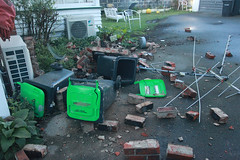
Cleaning up the silt and sand from Hoon Hay properties. Here Laura, Robbie, and Ronny are part of the clean-up crew on Wyn Street.
An inventory of unreinforced masonry churches in New Zealand
Research papers, The University of Auckland Library
Churches are an important part of New Zealand's historical and architectural heritage. Various earthquakes around the world have highlighted the significant seismic vulnerability of religious buildings, with the extensive damage that occurred to stone and clay-brick unreinforced masonry churches after the 2010-2011 Canterbury earthquakes emphasising the necessity to better understand this structural type. Consequently, a country-wide inventory of unreinforced masonry churches is here identified. After a bibliographic and archival investigation, and a 10 000 km field trip, it is estimated that currently 297 unreinforced masonry churches are present throughout New Zealand, excluding 12 churches demolished in Christchurch because of heavy damage sustained during the Canterbury earthquake sequence. The compiled database includes general information about the buildings, their architectural features and structural characteristics, and any architectural and structural transformations that have occurred in the past. Statistics about the occurrence of each feature are provided and preliminary interpretations of their role on seismic vulnerability are discussed. The list of identified churches is reported in annexes, supporting their identification and providing their address.
Sam Butcher's LEGO Cathedral, Photograph 51
Images, UC QuakeStudies
A photograph of components of a model of the ChristChurch Cathedral being built from LEGO by Sam Butcher. Sam comments "Fixing a large variety of bits that were wrong/annoying/cheating (not purist) about the last model. The new one is set AFTER the Feb 22 earthquake. This newer, and much stronger model is also completely modular for easier transport. Obviously still a WIP, I'm currently waiting for a pretty large bricklink order at the moment, and will probably need to place a couple more after that too. First few modules in place".
Sam Butcher's LEGO Cathedral, Photograph 50
Images, UC QuakeStudies
A photograph of components of a model of the ChristChurch Cathedral being built from LEGO by Sam Butcher. Sam comments "Fixing a large variety of bits that were wrong/annoying/cheating (not purist) about the last model. The new one is set AFTER the Feb 22 earthquake. This newer, and much stronger model is also completely modular for easier transport. Obviously still a WIP, I'm currently waiting for a pretty large bricklink order at the moment, and will probably need to place a couple more after that too. Modules ready to be pinned together".
Christchurch Cathedral of the Blessed Sacrament: Lessons Learnt on the Sta…
Research papers, The University of Auckland Library
The Catholic Cathedral of the Blessed Sacrament is a category 1 listed heritage building constructed largely of unreinforced stone masonry, and was significantly damaged in the recent Canterbury earthquakes. The building experienced ground shaking in excess of its capacity leading to block failures and partial collapse of parts of the building, which left the building standing but still posing a significant hazard. In this paper we discuss the approach to securing the building, and the interaction of the structural, heritage and safety demands involved in a dynamic seismic risk environment. We briefly cover the types of failures observed and the behaviour of the structure, and investigate the performance of both strengthened and un-strengthened parts of the building. Seismic strengthening options are investigated at a conceptual level. We draw conclusions as to how the building performed in the earthquakes, comment on the effectiveness of the strengthening and securing work and discuss the potential seismic strengthening methods.
Residual Capacity and Repairability of Reinforced Concrete Frame Buildings
Research papers, The University of Auckland Library
Reinforced concrete (RC) frame buildings designed according to modern design standards achieved life-safety objectives during the Canterbury earthquakes in 2010-11 and the Kaikōura earthquake in 2016. These buildings formed ductile plastic hinges as intended and partial or total building collapse was prevented. However, despite the fact that the damage level of these buildings was relatively low to moderate, over 60% of multi-storey RC buildings in the Christchurch central business district were demolished due to insufficient insurance coverage and significant uncertainty in the residual capacity and repairability of those buildings. This observation emphasized an imperative need to improve understanding in evaluating the post-earthquake performance of earthquake-damaged buildings and to develop relevant post-earthquake assessment guidelines. This thesis focuses on improving the understanding of the residual capacity and repairability of RC frame buildings. A large-scale five-storey RC moment-resisting frame building was tested to investigate the behaviour of earthquake-damaged and repaired buildings. The original test building was tested with four ground motions, including two repeated design-level ground motions. Subsequently, the test building was repaired using epoxy injection and mortar patching and re-tested with three ground motions. The test building was assessed using key concepts of the ATC-145 post-earthquake assessment guideline to validate its assessment procedures and highlight potential limitations. Numerical models were developed to simulate the peak storey drift demand and identify damage locations. Additionally, fatigue assessment of steel reinforcement was conducted using methodologies as per ATC-145. The residual capacity of earthquake-strained steel reinforcement was experimentally investigated in terms of the residual fatigue capacity and the residual ultimate strain capacity. In addition to studying the fatigue capacity of steel reinforcement, the fatigue damage demand was estimated using 972 ground motion records. The deformation limit of RC beams and columns for damage control was explored to achieve a low likelihood of requiring performance-critical repair. A frame component test database was developed, and the deformation capacity at the initiation of lateral strength loss was examined in terms of the chord rotation, plastic rotation and curvature ductility capacity. Furthermore, the proposed curvature ductility capacity was discussed with the current design curvature ductility limits as per NZS 3101:2006.
Fairfax Video, August 2012 (5)
Videos, UC QuakeStudies
A video about the reopening of the city branch of the Punting on the Avon route, which has been closed since the 22 February 2011 earthquake. The video includes an interview with Mayor Bob Parker about tourism in Christchurch. He mentions that Australia has updated its travel advisory on Christchurch to say that it is as safe as the other cities in New Zealand. The video also includes footage of Parker poling a punt.
What Light Through Yonder Window Breaks?
Images, UC QuakeStudies
Broken stained glass in a window of the ChristChurch Cathedral. The photographer comments, "I only managed to get one picture of the badly earthquake damaged Christchurch Cathedral and I did not want to get the buttresses holding it up like some Medieval siege engine, so I thought this one was perfect. Looking through the window notice that the adjacent wall has gone and the blue windows belong to an office block across the road".
Scott, Thomas, 1947- :Liquifaction... Stupifaction... 27 December 2011
Images, Alexander Turnbull Library
The cartoon shows two images of cars nose-down in ditches, the first is caused by 'liquifaction' and the second by 'stupifaction'. Context: there was another large aftershock on Boxing Day in Christchurch which resulted in quite a lot of liquefaction. There is always concern over the Christmas holidays about drinking while driving. Other Titles - Liquefaction Quantity: 1 digital cartoon(s).
Seismic hazard associated with the Springbank Fault, North Canterbury Plans
Research papers, University of Canterbury Library
This study contains an evaluation of the seismic hazard associated with the Springbank Fault, a blind structure discovered in 1998 close to Christchurch. The assessment of the seismic hazard is approached as a deterministic process in which it is necessary to establish: 1) fault characteristics; 2) the maximum earthquake that the fault is capable of producing and 3) ground motions estimations. Due to the blind nature of the fault, conventional techniques used to establish the basic fault characteristics for seismic hazard assessments could not be applied. Alternative methods are used including global positioning system (GPS) surveys, morphometric analyses along rivers, shallow seismic reflection surveys and computer modelling. These were supplemented by using multiple empirical equations relating fault attributes to earthquake magnitude, and attenuation relationships to estimate ground motions in the near-fault zone. The analyses indicated that the Springbank Fault is a reverse structure located approximately 30 km to the northwest of Christchurch, along a strike length of approximately 16 km between the Eyre and Ashley River. The fault does not reach the surface, buy it is associated with a broad anticline whose maximum topographic expression offers close to the mid-length of the fault. Two other reverse faults, the Eyrewell and Sefton Faults, are inferred in the study area. These faults, together with the Springbank and Hororata Faults and interpreted as part of a sys of trust/reverse faults propagating from a decollement located at mid-crustal depths of approximately 14 km beneath the Canterbury Plains Within this fault system, the Springbank Fault is considered to behave in a seismically independent way, with a fault slip rate of ~0.2 mm/yr, and the capacity of producing a reverse-slip earthquake of moment magnitude ~6.4, with an earthquake recurrence of 3,000 years. An earthquake of the above characteristics represents a significant seismic hazard for various urban centres in the near-fault zone including Christchurch, Rangiora, Oxford, Amberley, Kaiapoi, Darfield, Rollestion and Cust. Estimated peak ground accelerations for these towns range between 0.14 g to 0.5 g.
Cyclic strength of Christchurch sands with undisturbed samples
Research papers, University of Canterbury Library
Novel Gel-push sampling was employed to obtain high quality samples of Christchurch sands from the Central Business District, at sites where liquefaction was observed in 22 February 2011, and 13 June 2011 earthquakes. The results of cyclic triaxial testing on selected undisturbed specimens of typical Christchurch sands are presented and compared to empirical procedures used by practitioners. This comparison suggests cyclic triaxial data may be conservative, and the Magnitude Scaling Factor used in empirical procedures may be unconservative for highly compressible soils during near source moderate to low magnitude events. Comparison to empirical triggering curves suggests the empirical method generally estimates the cyclic strength of Christchurch sands within a reasonable degree of accuracy as a screening evaluation tool for liquefaction hazard, however for sands with moderate to high fines content it may be significantly unconservative, highlighting the need for high quality sampling and testing on important projects where seismic performance is critical.
20130627_8878_1D3-28 We need the Pot of Gold!!
Images, eqnz.chch.2010
On the day the the government and council jointly announced who will fund what, for the Christchurch rebuild, a rainbow appears over the rebuild of the Latimer Hotel. For the central city the figures are: NZ$4.9 billion with $2.9 billion coming from central government and $1.9 billion coming from the local city council (us ratepayers in Christc...
Transcending chaos: spirituality and coping in post-earthquake Canterbury,…
Research papers, Lincoln University
When an “I thought I was going to die quake” occurs amidst four additional major earthquakes and 15,000 aftershocks during a sixteen-month period, it challenges people’s ability to cope and recover. Residents of Canterbury, New Zealand endured this extended, chaotic state in 2010/11; and continue to deal with lingering effects on their devastated central city, Christchurch. Stress and coping theory suggests that finding meaning in such situations can help people recover, and that religion and spirituality often play a role in post-disaster resilience. Despite this, there is very little research literature examining this phenomenon and even less that considers spirituality separate from religion. This research focuses on this underrepresented area by considering the personal spiritual or meaningful experiences of people in post-earthquake Canterbury. Data from sixteen in-depth, minimally directed interviews were thematically analyzed to understand each individual’s meaning construction and coping/recovery process and identify connective themes and patterns amongst their experiences. Four core elements of acceptance, clarity and choice, connection, and transcendence emerged from the thematic analysis to conceptualize a model of transcendent coping. Transcendent coping represents an additional type of coping in the transactional model of stress and coping, which serves to support the previous denoted problem-, emotion-, and meaning-focused coping approaches. Transcendent coping offers openness, empowerment, comfort and expansion not necessarily reliant upon theistic or religious beliefs and practices. Rather, this secular spiritual coping is inherent in everyday, mundane practices such as being in the moment, aligning to and acting from personal values, connecting to that and those who bring comfort, and experiencing transcendence in moments of awe and expansion. This research contributes to the growing interest in spirituality as an important facet of human nature that can support wellbeing in the face of stress.
Belonging and Disaster Recovery: Refugee-Background Communities and the Ca…
Research papers, The University of Auckland Library
The role of belonging in post-disaster environments remains an under-theorised concept, particularly regarding refugee populations. This paper presents a qualitative study with 101 refugee-background participants from varying communities living in Christchurch, New Zealand, about their perspectives and responses to the Canterbury earthquakes of 2010–11. Participants spoke of how a sense of belonging as individuals and as a wider community was important in the recovery effort, and highlighted the multiple ways in which they understood this concept. Their comments demonstrate how belonging can have contextual, chronological and gendered dimensions that can help inform effective and resonant disaster responses with culturally and linguistically diverse populations. This analysis also illustrates how the participants' perspectives of belonging shifted over time, and discusses the corresponding role of social work in supporting post-disaster recovery through the concepts of civic, ethno and ethnic-based belonging. AM - Accepted Manuscript
Early disaster recovery: a guide for communities
Research papers, Lincoln University
On September the 4th 2010 and February 22nd 2011 the Canterbury region of New Zealand was shaken by two massive earthquakes. This paper is set broadly within the civil defence and emergency management literature and informed by recent work on community participation and social capital in the building of resilient cities. Work in this area indicates a need to recognise both the formal institutional response to the earthquakes as well as the substantive role communities play in their own recovery. The range of factors that facilitate or hinder community involvement also needs to be better understood. This paper interrogates the assumption that recovery agencies and officials are both willing and able to engage communities who are themselves willing and able to be engaged in accordance with recovery best practice. Case studies of three community groups – CanCERN, Greening the Rubble and Gap Filler – illustrate some of the difficulties associated with becoming a community during the disaster recovery phase. Based on my own observations and experiences, combined with data from approximately 50 in-depth interviews with Christchurch residents and representatives from community groups, the Christchurch City Council, the Earthquake Commission and so on, this paper outlines some practical strategies emerging communities may use in the early disaster recovery phase that then strengthens their ability to ‘participate’ in the recovery process.
Sink or swim? The planner’s predicament in a changing Christchurch
Research papers, Lincoln University
The world is constantly changing. Christchurch, New Zealand, has recently experienced drastic changes after earthquakes struck the city. The earthquakes caused the city to physically shake, and the land to sink in some places and rise in others. Now further change is forcast and parts of Christchurch could be under water by 2115 according to experts. Climate change induced sea level rise is recognised as a international issue with potential impacts for coastal communities all over the world. The Chrischtchurch City Council is required to have a 100-year planning horizon for sea level rise and this means planning for at least one meter, and possibly up to two meters, of sea level rise by 2115. This dissertation investigates the planning response to slow onset disasters, change, and uncertainty, using the example of sea-level rise in Christchurch, and it examines the role of public participation in this. To achieve this, the ways in which planning theory and practice acknowledge uncertainty, and cope with change, were critically analysed along with the Christchurch City Council’s response to the Tonkin and Taylor predictions and modelling. Semi-structured interviews with professionals in natural hazards risk reduction, policy, and planning were conducted, and the previous and proposed Christchurch City District Plans were compared. Planning for sea level rise in Christchurch provides an example of how planners may cope with slow onset change. The results of this dissertation suggests that the favoured risk reduction strategy for coastal communities in Christchurch is an adaptation strategy, and at present there is no sign of managed retreat being employed. The results also suggests using a planning approach that involves public participation for best results when planning for change, uncertainty or slow onset disasters.