
Search
found 14117 results
Images for christchurch earthquake; more images...


Economics of disaster recovery and earthquake insurance: Five essays on Ne…
Research papers, Victoria University of Wellington
The Canterbury earthquake sequence (2010-2011) was the most devastating catastrophe in New Zealand‘s modern history. Fortunately, in 2011 New Zealand had a high insurance penetration ratio, with more than 95% of residences being insured for these earthquakes. This dissertation sheds light on the functions of disaster insurance schemes and their role in economic recovery post-earthquakes. The first chapter describes the demand and supply for earthquake insurance and provides insights about different public-private partnership earthquake insurance schemes around the world. In the second chapter, we concentrate on three public earthquake insurance schemes in California, Japan, and New Zealand. The chapter examines what would have been the outcome had the system of insurance in Christchurch been different in the aftermath of the Canterbury earthquake sequence (CES). We focus on the California Earthquake Authority insurance program, and the Japanese Earthquake Reinsurance scheme. Overall, the aggregate cost of the earthquake to the New Zealand public insurer (the Earthquake Commission) was USD 6.2 billion. If a similar-sized disaster event had occurred in Japan and California, homeowners would have received only around USD 1.6 billion and USD 0.7 billion from the Japanese and Californian schemes, respectively. We further describe the spatial and distributive aspects of these scenarios and discuss some of the policy questions that emerge from this comparison. The third chapter measures the longer-term effect of the CES on the local economy, using night-time light intensity measured from space, and focus on the role of insurance payments for damaged residential property during the local recovery process. Uniquely for this event, more than 95% of residential housing units were covered by insurance and almost all incurred some damage. However, insurance payments were staggered over 5 years, enabling us to identify their local impact. We find that night-time luminosity can capture the process of recovery; and that insurance payments contributed significantly to the process of local economic recovery after the earthquake. Yet, delayed payments were less affective in assisting recovery and cash settlement of claims were more effective than insurance-managed repairs. After the Christchurch earthquakes, the government declared about 8000 houses as Red Zoned, prohibiting further developments in these properties, and offering the owners to buy them out. The government provided two options for owners: the first was full payment for both land and dwelling at the 2007 property evaluation, the second was payment for land, and the rest to be paid by the owner‘s insurance. Most people chose the second option. Using data from LINZ combined with data from Stats NZ, the fourth chapter empirically investigates what led people to choose this second option, and how peer effect influenced the homeowners‘ choices. Due to climate change, public disclosure of coastal hazard information through maps and property reports have been used more frequently by local government. This is expected to raise awareness about disaster risks in local community and help potential property owners to make informed locational decision. However, media outlets and business sector argue that public hazard disclosure will cause a negative effect on property value. Despite this opposition, some district councils in New Zealand have attempted to implement improved disclosure. Kapiti Coast district in the Wellington region serves as a case study for this research. In the fifth chapter, we utilize the residential property sale data and coastal hazard maps from the local district council. This study employs a difference-in-difference hedonic property price approach to examine the effect of hazard disclosure on coastal property values. We also apply spatial hedonic regression methods, controlling for coastal amenities, as our robustness check. Our findings suggest that hazard designation has a statistically and economically insignificant impact on property values. Overall, the risk perception about coastal hazards should be more emphasized in communities.
Brother of quake victim says 10th anniversary is an emotional, but importa…
Audio, Radio New Zealand
At 12.51pm it will be 10 years since a devastating 6.2 earthquake struck Ōtautahi Christchurch, bringing down buildings and killing 185 people. A National service will get underway at half-past-12 at the city's Canterbury Earthquake Memorial site, to mark the anniversary. Maurice Gardiner's sister, Donna Manning, died in the CTV building collapse. Mr Gardiner told Māni Dunlop that at the Avonhead Cemetery this morning, he and his family joined others who have whānau buried there for a private service, where they remembered those they lost 10 years ago.
Photograph by Jocelyn Kinghorn 2614
Images, UC QuakeStudies
A notice on the cordon fence around the site where the CTV building once was. It says 'Please respect this site. In recognition of the special significance this site holds for the people of our city and all those affect by the earthquakes, the Christchurch City Council is working with Canterbury Museum to preserve aspects of our remembering. Tributes may be left at this site. Older tributes will be removed from archiving by the Canterbury Museum to become part of the city's memory of the Canterbury Earthquakes. Organic materials will be composted and used in the city's gardens'.
Seismic sustainability assessment of structural systems: A preliminary cas…
Research papers, University of Canterbury Library
The University of Canterbury has initialized a research program focusing on the seismic sustainability of structures. As part of this program, the relative seismic sustainability of various structures will be assessed to identify those with the highest sustainability for the Christchurch rebuild and general use in New Zealand. This preliminary case study assesses one reinforced concrete (RC) frame structure and one RC wall structure. The scenario loss is evaluated for two earthquake records considering direct losses only in order to explain and illustrate the methodology.
20130524_7208_1D3-50 Earthquake damage to a Hulverstone Drive "red zone" h…
Images, eqnz.chch.2010
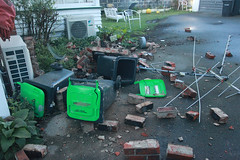
Awaiting demolition. Blue pipes are water supply to anyone still living on Hulverstone Drive.
Reviewing the uncertainties in seismic experimentation following the unexp…
Research papers, University of Canterbury Library
The performance of conventionally designed reinforced concrete (RC) structures during the 2011 Christchurch earthquake has demonstrated that there is greater uncertainty in the seismic performance of RC components than previously understood. RC frame and wall structures in the Christchurch central business district were observed to form undesirable cracks patterns in the plastic hinge region while yield penetration either side of cracks, and into development zones, were less than theoretical predictions. The implications of this unexpected behaviour: (i) significantly less available ductility; (ii) less hysteretic energy dissipation; and (iii) the localization of peak reinforcement strains, results in considerable doubt for the residual capacity of RC structures. The significance of these consequences has prompted a review of potential sources of uncertainty in seismic experimentation with the intention to improve the current confidence level for newly designed conventional RC structures. This paper attempts to revisit the principles of RC mechanics, in particular, to consider the influence of loading history, concrete tensile strength, and reinforcement ratio on the performance of ‘real’ RC structures compared to experimental test specimens.
Deformation response of adhesive anchors in retrofitted masonry structures…
Research papers, The University of Auckland Library
Between September 4, 2010 and December 23, 2011, a series of earthquakes struck the South Island of New Zealand including the city of Christchurch producing heavy damage. During the strongest shaking, the unreinforced masonry (URM) building stock in Christchurch was subjected to seismic loading equal to approximately 150-200% of code values. Post-earthquake reconnaissance suggested numerous failures of adhesive anchors used for retrofit connection of roof and floor diaphragms to masonry walls. A team of researchers from the Universities of Auckland (NZ) and Minnesota (USA) conducted a field investigation on the performance of new adhesive anchors installed in existing masonry walls. Variables included adhesive type, anchor diameter, embedment length, anchor inclination, and masonry quality. Buildings were selected that had been slated for demolition but which featured exterior walls that had not been damaged. A summary of the deformation response measured during the field tests are presented. AM - Accepted Manuscript
Water water everywhere! (Day 84/365)
Images, eqnz.chch.2010
20130325_1112_EOS M-25 Water water everywhere! (Day 84/365) While the whole of the North Island is under drought conditions and parts of the South Island likely to follow suit, I doubt it will happen in Christchurch. With hundreds of earthquake road, water and sewer repairs underway many are spilling hundreds of litres of water per minute, like...
Exploring the concept of Christchurch as a ‘super city’ from a sustainabil…
Research papers, Lincoln University
Group case study report prepared for lecturers Ton Buhrs and Roy Montgomery by students of ERST 635 at Lincoln University, 2013.The New Zealand Government’s decision to establish a unitary authority in the Auckland Region has provided much of the context and impetus for this review of current governance arrangements in the Canterbury region, to determine whether or not they are optimal for taking the communities of greater Christchurch into the future. A number of local governance academics, as well as several respected political pundits, have prophesised that the Auckland ‘Super City’ reforms of 2009 will have serious implications and ramifications for local governance arrangements in other major cities, particularly Wellington and Christchurch. Wellington councils have already responded to the possibility of change by undertaking a series of reports on local governance arrangements, as well as a major review led by Sir Geoffrey Palmer, to investigate options for governance reform. Alongside these developments, the Christchurch earthquakes beginning in September 2010 have raised a myriad of new and complex governance issues, which may or may not be able to be addressed under the status quo, while the replacement of Regional Councillors’ with centrally-appointed Commissioners is suggestive of government dissatisfaction with current arrangements. With these things in mind, the research group has considered local government in Canterbury and the greater Christchurch area in the wider governance context. It does not limit discussion to only the structure of local government in Canterbury but rather, as the brief (Appendix 1) indicates, considers more broadly the relationship between central, regional, and local tiers of government, as well as the relationship between local government and local communities.
The Housing Slump
Images, UC QuakeStudies
Two images of a house, taken before and after the earthquakes. In the after photograph the chimneys are gone, a column supporting the car port has partly collapsed, windows are broken, and the previously neat lawn and driveway are overgrown. The photographer comments, "This was a house that I was selling up to the September 2010 earthquake in Christchurch. It was on Avonside Drive, which was an area that has been badly hit in every earthquake that has hit the area. In the September quake parts of the house moved in different directions and one of the upstairs doors had to be smashed open to release one of the sons from his bedroom. This occurred in the dark with numerous aftershocks shaking the house. Liquefaction poured up through the floor and flowed down the drive. Everyone got out OK, but soon after the house was red stickered meaning it was dangerous to enter. The house was looted many times even though there was constant police patrols. When the most violent earthquake occurred on 22 February 2012 both the tall heavy chimneys came crashing through into the living areas. Subsequent earthquakes and aftershocks have caused one of the brick fence pillars to fall and the front garage pillar to break up and twist. The family's troubles did not end there. They moved into the home of one of their parents and this mansion of a home was so badly affected by the February earthquake that no one could enter to collect any of their or their parents' belongings. They now own a new home, which they are fond of except when the ground shakes yet again. There has been to date 10,712 earthquakes and aftershocks since 4 September 2010".
Cost-Effective Consideration Of Non-Structural Elements: Lessons From The …
Research papers, University of Canterbury Library
By closely examining the performance of a 22-storey steel framed building in Christchurch subject to various earthquakes over the past seven years, it is shown that a number of lessons can be learnt regarding the cost-effective consideration of non-structural elements. The first point in this work is that non-structural elements significantly affected the costs associated with repairing steel eccentrically braced frame (EBF) links. The decommissioning or rerouting of non-structural elements in the vicinity of damaged links in the case study building attributed to approximately half the total cost of their repair. Such costs could be significantly reduced if the original positioning of non-structural elements took account of the potential need to repair the EBF links. The second point highlighted is the role that pre-cast cladding apparently played on the distribution and type of damage in the building. Loss estimates obtained following the FEMA P-58 framework vary considerably when cladding is or isnt modelled, both because of changes to drift demands up the height of the building and because certain types of subsequent damage are likely to be cheaper to repair than others. Finally, costly repairs to non-structural partition walls were required not only after the moment magnitude 7.1 earthquake in 2010 but also in multiple aftershocks in the years that followed. Repair costs associated with aftershock events exceeded those from the main event, emphasizing the need to consider aftershocks within modern performance-based earthquake engineering and also the opportunity that exists to make more cost-effective repair strategies following damaging earthquakes.
Quake-strengthening legislation may hurt provincial towns
Audio, Radio New Zealand
Provincial towns and rural communities around the country say they will be financially ruined under proposals to strengthen buildings following the Christchurch earthquakes. Dale Williams is Mayor of Otorohanga, Dave Cull is Mayor of Dunedin and Lawrence Yule is Mayor of Hastings and president of Local Government NZ.
Ethics in the engineering profession in the spotlight
Audio, Radio New Zealand
Ethics in the engineering profession is under scrutiny following the Christchurch earthquakes and Pike River disaster. We hear from Professor John Uff, an international arbitrator specialising in professional negligence. He has led many public inquiries including the Southall Rail Crash in London which killed 7 people and injured 150.
The Panel with Anna Chinn and Matt Nippert (Part 1)
Audio, Radio New Zealand
Topic 1: The Minister for Earthquake Recovery, Gerry Brownlee, was quick to apologise to the Christchurch Mayor Bob Parker for calling him a clown. Topic 2: The Electoral Commission says John Key's hour-long pre-election radio show gave him the chance to raise his personal profile unchallenged.
Court Theatre set to reopen in a shed in Addington
Audio, Radio New Zealand
In Christchurch the Court Theatre is about to reopen, more than nine months after the earthquake ruined its inner city premises. The country's most successful professional theatre, which used to be in the 19th century gothic style Arts Centre, has moved to a shed in the suburbs.
Faith Knows No Boundaries
Images, UC QuakeStudies
The word 'faith' has been formed by flowers on the cordon fence beside St John the Baptist Church on Latimer Square. The photographer comments, "If I remember correctly this has been on the fence surrounding the Christchurch earthquake red zone for quite a while and looks remarkably pristine".
New Zealand Defence Force photograph 674
Images, UC QuakeStudies
A member of the Los Angeles County Fire Department Search and Rescue Team with an Australian Police Officer outside the US Aid tent in Latimer Square. After the 22 February 2011 earthquake, emergency service agencies set up their headquarters in Latimer Square.
Management of Complex Cultural Heritage Projects: UC CEISMIC Earthquake Ar…
Research papers, University of Canterbury Library
The UC CEISMIC Canterbury Earthquakes Digital Archive contains tens of thousands of high value cultural heritage items related to a long series of earthquakes that hit Canterbury, New Zealand, from 2010 - 2012. The archive was built by a Digital Humanities team located at the center of the disaster in New Zealand's second largest city, Christchurch. The project quickly became complex, not only in its technical aspects but in its governance and general management. This talk will provide insight into the national and international management and governance frameworks used to successfully build and deliver the archive into operation. Issues that needed to be managed included human ethics, research ethics, stakeholder management, communications, risk management, curation and ingestion policy, copyright and content licensing, and project governance. The team drew heavily on industry-standard project management methods for the basic approach, but built their ecosystem and stakeholder trust on principles derived directly form the global digital humanities community.
Rebuild of Christchurch: supporting resilient staff while responding with …
Research papers, Lincoln University
4th September 2010 a 7.1 magnitude earthquake strikes near Christchurch, New Zealand’s second largest city of approximately 370,000 people. This is followed by a 6.3 magnitude quake on 22nd February 2011 and a 6.4 on 13th June. In February 181 people died and a state of national emergency was declared from 23 February to 30th April. Urban Search and Rescue teams with 150 personnel from New Zealand and 429 from overseas worked tirelessly in addition to Army, Police and Fire services. Within the central business district 1,000 buildings (of 4,000) are expected to be demolished. An estimated 10,000 houses require demolition and over 100,000 were damaged. Meanwhile the over 7,000 aftershocks have become part of the “new normal” for us all. During this time how have libraries supported their staff? What changes have been made to services? What are the resourcing opportunities? This presentation will provide a personal view from Lincoln University, Te Whare Wanaka o Aoraki, Library Teaching and Learning. Lincoln is New Zealand's third oldest university having been founded in 1878. Publicly owned and operated it is New Zealand's specialist land-based university. Lincoln is based on the Canterbury Plains, 22 kilometres south of Christchurch. On campus there was mostly minor damage to buildings while in the Library 200,000 volumes were thrown from the shelves. I will focus on the experiences of the Disaster Team and on our experiences with hosting temporarily displaced staff and students from the Christchurch Polytechnic Institute of Technology, Library, Learning & Information Services. Experiences from two other institutions will be highlighted: Christchurch City Libraries, Ngā Kete Wānanga-o-Ōtautahi. Focusing on the Māori Services Team and the Ngā Pounamu Māori and Ngāi Tahu collections. The Central library located within the red zone cordon has been closed since February, the Central library held the Ngā Pounamu Māori and Ngai Tahu collections, the largest Māori collections in the Christchurch public library network. The lack of access to these collections changed the way the Māori Services Team, part of the larger Programmes, Events and Learning Team at Christchurch City Libraries were able to provide services to their community resulting in new innovative outreach programmes and a focus on promotion of online resources. On 19th December the “temporary” new and smaller Central library Peterborough opened. The retrieved Ngā Pounamu Māori and Ngai Tahu collections "Ngā rakau teitei e iwa”, have since been re-housed and are once again available for use by the public. Te Rūnanga o Ngāi Tahu. This organisation, established by the Te Rūnanga o Ngāi Tahu Act 1996, services the statutory rights for the people of Ngāi Tahu descent and ensures that the benefits of their Treaty Claim Settlement are enjoyed by Ngāi Tahu now and in the future. Ngāi Tahu are the indigenous Māori people of the southern islands of New Zealand - Te Waipounamu. The iwi (people) hold the rangatiratanga or tribal authority to over 80 per cent of the South Island. With their headquarters based in the central business they have also had to be relocated to temporary facilities. This included their library/archive collection of print resources, art works and taonga (cultural treasures).
The Vault - Cathedral Square
Audio, Radio New Zealand
In 1987, Jack Perkins recorded an award-winning documentary capturing the life, the sounds and the personalities of Cathedral Square in Christchurch. Thirty years on, Deborah Nation parallels that experience with the sounds of September 2011 as engineer Gabrielle Parker escorts her Shrough the earthquake Red Zone into the square as it is today.
Mother waits for news of rescued son
Audio, Radio New Zealand
One of the defining images of the Christchurch earthquake has been the photo of an ash covered Shane Tomlin, pulled alive from a bakery in Cashel Mall. His mother Doreen Tomlin, says she only realised her son had been rescued when she saw his photo on the front page of The Press.
Southern Story with Katy Gosset
Audio, Radio New Zealand
Our Christchurch features producer, Kary Gosset has a story from one of the worst affected areas from the Feb 22 earthquake. Sumner has frequently been in the news with images of its crumbled cliffs, and Sumner is where Katy Gosset lives. This is her latest snapshot at where her suburb is at.
Survivor tells of rescue from Pyne Gould building
Audio, Radio New Zealand
Survivor Nick Walls, who was pulled from the rubble of the Pyne Gould Corporation building, says his life will change as a result of the earthquake. From his bedside in the Christchurch hospital's orthopeadic ward he explained to our reporter Lorna Perry what he was doing when the earth shook.
Survivor tells of rescue from Pyne Gould building
Audio, Radio New Zealand
Survivor Nick Walls, who was pulled from the rubble of the Pyne Gould Corporation building, says his life will change as a result of the earthquake. From his bedside in the Christchurch hospital's orthopeadic ward he explained to our reporter Lorna Perry what he was doing when the earth shook.
Top Stories for Thursday 17 November 2011
Audio, Radio New Zealand
National says campaign on track despite focus on Key; Radio New Zealand political editor discusses campaign; Don Brash says his leadership is solid; Pike River anniversary service 'will be non-political'; Auckland protesters may receive trespass notices today; Martin Johnson quits as England rugby coach; Earthquake documentary opens in Christchurch cinemas.
Quake Mossies
Audio, Radio New Zealand
As if the crumbling ceilings, broken sewage pipes and torn up roads weren't enough for the people of North Christchurch to deal with, now there's a new problem that may be caused by the September earthquake: Mosquitoes. Pines Beach and Kairaki residents say black clouds of mosquitoes are descending on them at dusk and dawn.
Canterbury flooding: Student Volunteer Army out and about
Audio, Radio New Zealand
The Student Volunteer Army (SVA) are pulling together their troops to assist in the Canterbury clean-up . SVA chief executive Sam Johnson has been putting out the call to arms. He says it's time to help the region's farmers who helped Christchurch after the earthquakes. Sam Johnson spoke to Susie Ferguson.
Top Stories for Monday 22 February 2021
Audio, Radio New Zealand
The Tiwai Point Aluminium Smelter has stockpiled a thousand tonnes of hazardous waste near an eroding beach, A court ruling finds inmates at Auckland Women's Prison were treated in a cruel and degrading manner,We speak to some of those affected by the devastating earthquake that struck Christchurch ten years ago today.
Koen Broekema's Photograph 088
Images, UC QuakeStudies
Members of the public view the damaged tower of Christ Church Cathedral. Bracing has been placed on the front wall to the right to limit further damage. In the centre of the crowd stands a wire cage filled with stones. After the earthquake, love notes to Christchurch were written on the stones.
Fairfax Media Auckland Bureau Image: John Selkirk 2010:12:18 12:38:30
Images, UC QuakeStudies
Photograph captioned by Fairfax, "Four year old Kahu Guthrie, clutching his presents, waves goodbye to Santa (played by Peter Leitch, the Mad Butcher, as he leaves in the police helicopter from Motuihe Island where Kahu and 30 other disadvantaged earthquake victims from Christchurch spent the day courtesy of Westpac)".