
Search
found 14117 results
Images for christchurch earthquake; more images...


Observatory Tower Photograph 33
Images, UC QuakeStudies
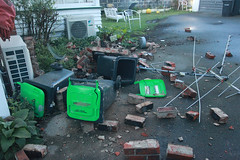
A photograph of the rubble of the Observatory tower in the South Quad of the Christchurch Arts Centre. The tower collapsed during the 22 February 2011 earthquake. A digger was used to clear the rubble away from the building. Scaffolding constructed around the tower has also collapsed and is amongst the rubble. In the background is the damaged tower with a tarpaulin draped over the top.
Observatory Tower Photograph 15
Images, UC QuakeStudies
A photograph of the rubble of the Observatory tower in the South Quad of the Christchurch Arts Centre. The tower collapsed during the 22 February 2011 earthquake and a digger was used to clear the rubble away from the building. Scaffolding constructed around the tower has also collapsed and is amongst the rubble. In the background is the damaged tower with a tarpaulin draped over the top.
Biggest indoor sport and aquatics centre in the country prepares to open
Audio, Radio New Zealand
Finishing touches are getting added to the country's biggest indoor sport and aquatics centre, which opens to the public in central Christchurch in less than a fortnight. The long-delayed $500 million building, Parakiore, has a 50-metre competition pool and five hydroslides, as well as nine sports courts and a High Performance Sport New Zealand training base. It replaces the much-missed QEII park facilities destroyed in the 2011 Christchurch earthquake. Anna Sargent reports.
Performance of posttensioned seismic retrofit of two stone masonry buildin…
Research papers, The University of Auckland Library
Seismic retrofitting of unreinforced masonry buildings using posttensioning has been the topic of many recent experimental research projects. However, the performance of such retrofit designs in actual design level earthquakes has previously been poorly documented. In 1984 two stone masonry buildings within The Arts Centre of Christchurch received posttensioned seismic retrofits, which were subsequently subjected to design level seismic loads during the 2010/2011 Canterbury earthquake sequence. These 26 year old retrofits were part of a global scheme to strengthen and secure the historic building complex and were subject to considerable budgetary constraints. Given the limited resources available at the time of construction and the current degraded state of the steel posttension tendons, the posttensioned retrofits performed well in preventing major damage to the overall structure of the two buildings in the Canterbury earthquakes. When compared to other similar unretrofitted structures within The Arts Centre, it is demonstrated that the posttensioning significantly improved the in-plane and out-of-plane wall strength and the ability to limit residual wall displacements. The history of The Arts Centre buildings and the details of the Canterbury earthquakes is discussed, followed by examination of the performance of the posttension retrofits and the suitability of this technique for future retrofitting of other historic unreinforced masonry buildings. http://www.aees.org.au/downloads/conference-papers/2013-2/
Geologic expressions of contemporary and paleo-liquefaction: Insights into…
Research papers, University of Canterbury Library
Recurrent liquefaction in Christchurch during the 2010-2011 Canterbury earthquake sequence created a wealth of shallow subsurface intrusions with geometries and orientations governed by (1) strong ground motion severity and duration, and (2) intrinsic site characteristics including liquefaction susceptibility, lateral spreading severity, geomorphic setting, host sediment heterogeneity, and anthropogenic soil modifications. We present a suite of case studies that demonstrate how each of these characteristics influenced the geologic expressions of contemporary liquefaction in the shallow subsurface. We compare contemporary features with paleo-features to show how geologic investigations of recurrent liquefaction can provide novel insights into the shaking characteristics of modern and paleo-earthquakes, the influence of geomorphology on liquefaction vulnerability, and the possible controls of anthropogenic activity on the geologic record. We conclude that (a) sites of paleo-liquefaction in the last 1000-2000 years corresponded with most severe liquefaction during the Canterbury earthquake sequence, (b) less vulnerable sites that only liquefied in the strongest and most proximal contemporary earthquakes are unlikely to have liquefied in the last 1000-2000 years or more, (c) proximal strong earthquakes with large vertical accelerations favoured sill formation at some locations, (d) contemporary liquefaction was more severe than paleoliquefaction at all study sites, and (e) stratigraphic records of successive dike formation were more complete at sites with severe lateral spreading, (f) anthropogenic fill suppressed surface liquefaction features and altered subsurface liquefaction architecture.
Mandatory seismic retrofitting : A case study of the land use impacts on a…
Research papers, Lincoln University
As a result of the Christchurch Earthquake that occurred on 22nd February 2011 and the resultant loss of life and widespread damage, a Royal Commission of Enquiry was convened in April 2011. The Royal Commission recommended a number of significant changes to the regulation of earthquake prone building in New Zealand. Earthquake prone buildings are buildings that are deemed to be of insufficient strength to perform adequately in a moderate earthquake. In response to the Royal Commission recommendations the New Zealand Government carried out a consultative process before announcing proposed changes to the building regulations in August 2013. One of the most significant changes is the imposition of mandatory strengthening requirements for earthquake prone buildings on a national basis. This will have a significant impact on the urban fabric of most New Zealand towns and cities. The type of traditional cost benefit study carried out to date fails to measure these impacts and this paper proposes an alternative methodology based on the analysis of land use data and rating valuations. This methodology was developed and applied to a small provincial town in the form of a case study. The results of this case study and the methodology used are discussed in this paper.
Liquefaction features produced by the 2010-2011 Canterbury earthquake sequ…
Research papers, Lincoln University
Liquefaction features and the geologic environment in which they formed were carefully studied at two sites near Lincoln in southwest Christchurch. We undertook geomorphic mapping, excavated trenches, and obtained hand cores in areas with surficial evidence for liquefaction and areas where no surficial evidence for liquefaction was present at two sites (Hardwick and Marchand). The liquefaction features identified include (1) sand blows (singular and aligned along linear fissures), (2) blisters or injections of subhorizontal dikes into the topsoil, (3) dikes related to the blows and blisters, and (4) a collapse structure. The spatial distribution of these surface liquefaction features correlates strongly with the ridges of scroll bars in meander settings. In addition, we discovered paleoliquefaction features, including several dikes and a sand blow, in excavations at the sites of modern liquefaction. The paleoliquefaction event at the Hardwick site is dated at A.D. 908-1336, and the one at the Marchand site is dated at A.D. 1017-1840 (95% confidence intervals of probability density functions obtained by Bayesian analysis). If both events are the same, given proximity of the sites, the time of the event is A.D. 1019-1337. If they are not, the one at the Marchand site could have been much younger. Taking into account a preliminary liquefaction-triggering threshold of equivalent peak ground acceleration for an Mw 7.5 event (PGA7:5) of 0:07g, existing magnitude-bounded relations for paleoliquefaction, and the timing of the paleoearthquakes and the potential PGA7:5 estimated for regional faults, we propose that the Porters Pass fault, Alpine fault, or the subduction zone faults are the most likely sources that could have triggered liquefaction at the study sites. There are other nearby regional faults that may have been the source, but there is no paleoseismic data with which to make the temporal link.
20130814_2441_1D3-58 Cranes (Day 226/365)
Images, eqnz.chch.2010
Work is continuing on the earthquake damaged South New Brighton bridge. Avon River to the left, Avon-Heathcote Estuary the other side of the bridge.
Nisbet, Alistair, 1958- :"Well, we work behind a veil and STILL have jobs.…
Images, Alexander Turnbull Library
Text across the top reads 'Wearing burqas and veils could limit job prospects...' The cartoon shows a crowd of people hidden under a huge burqa-like cloth. A man peers from both ends of the crowd and one of them says 'Well, we work behind a veil and STILL have jobs... And so do all our mates!' The man at the other end gives a cheerful thumbs up. There is a great deal of whispering about 'jobs for the...' and 'split contracts'. Above is a notice that reads 'Council job contract meeting'. Context - Complaints have been laid with the Auditor-General's Office about the Christchurch City Council's handling of consultants' contracts (to do with the rebuilding of the city after the earthquakes). City councillors have been questioning the council's awarding of more than $2.8 million of contracts to consultants. The burqa has been in the news lately with bus-drivers refusing to accept women in burqas on their buses. Quantity: 1 digital cartoon(s).
Fairfax Video October 2012 (9)
Videos, UC QuakeStudies
A video of an interview with Arts Centre CEO Andre Lovatt about the restoration of the Arts Centre after the 22 February 2011 earthquake. The video also includes a tour of the Arts Centre, including the Boys' High School swimming pool and gymnasium which was exposed after another building was demolished.
Decision support framework for post-earthquake restoration of sewerage pip…
Research papers, University of Canterbury Library
Sewerage systems convey sewage, or wastewater, from residential or commercial buildings through complex reticulation networks to treatment plants. During seismic events both transient ground motion and permanent ground deformation can induce physical damage to sewerage system components, limiting or impeding the operability of the whole system. The malfunction of municipal sewerage systems can result in the pollution of nearby waterways through discharge of untreated sewage, pose a public health threat by preventing the use of appropriate sanitation facilities, and cause serious inconvenience for rescuers and residents. Christchurch, the second largest city in New Zealand, was seriously affected by the Canterbury Earthquake Sequence (CES) in 2010-2011. The CES imposed widespread damage to the Christchurch sewerage system (CSS), causing a significant loss of functionality and serviceability to the system. The Christchurch City Council (CCC) relied heavily on temporary sewerage services for several months following the CES. The temporary services were supported by use of chemical and portable toilets to supplement the damaged wastewater system. The rebuild delivery agency -Stronger Christchurch Infrastructure Rebuild Team (SCIRT) was created to be responsible for repair of 85 % of the damaged horizontal infrastructure (i.e., water, wastewater, stormwater systems, and roads) in Christchurch. Numerous initiatives to create platforms/tools aiming to, on the one hand, support the understanding, management and mitigation of seismic risk for infrastructure prior to disasters, and on the other hand, to support the decision-making for post-disaster reconstruction and recovery, have been promoted worldwide. Despite this, the CES in New Zealand highlighted that none of the existing platforms/tools are either accessible and/or readable or usable by emergency managers and decision makers for restoring the CSS. Furthermore, the majority of existing tools have a sole focus on the engineering perspective, while the holistic process of formulating recovery decisions is based on system-wide approach, where a variety of factors in addition to technical considerations are involved. Lastly, there is a paucity of studies focused on the tools and frameworks for supporting decision-making specifically on sewerage system restoration after earthquakes. This thesis develops a decision support framework for sewerage pipe and system restoration after earthquakes, building on the experience and learning of the organisations involved in recovering the CSS following the CES in 2010-2011. The proposed decision support framework includes three modules: 1) Physical Damage Module (PDM); 2) Functional Impact Module (FIM); 3) Pipeline Restoration Module (PRM). The PDM provides seismic fragility matrices and functions for sewer gravity and pressure pipelines for predicting earthquake-induced physical damage, categorised by pipe materials and liquefaction zones. The FIM demonstrates a set of performance indicators that are categorised in five domains: structural, hydraulic, environmental, social and economic domains. These performance indicators are used to assess loss of wastewater system service and the induced functional impacts in three different phases: emergency response, short-term recovery and long-term restoration. Based on the knowledge of the physical and functional status-quo of the sewerage systems post-earthquake captured through the PDM and FIM, the PRM estimates restoration time of sewer networks by use of restoration models developed using a Random Forest technique and graphically represented in terms of restoration curves. The development of a decision support framework for sewer recovery after earthquakes enables decision makers to assess physical damage, evaluate functional impacts relating to hydraulic, environmental, structural, economic and social contexts, and to predict restoration time of sewerage systems. Furthermore, the decision support framework can be potentially employed to underpin system maintenance and upgrade by guiding system rehabilitation and to monitor system behaviours during business-as-usual time. In conjunction with expert judgement and best practices, this framework can be moreover applied to assist asset managers in targeting the inclusion of system resilience as part of asset maintenance programmes.
Portable Toilet: Thunder Down Under
Images, Canterbury Museum
One portable toilet comprising of a black toilet seat and lid attached to a grey bucket; sticky label on the front features an image of the toilet, lightning and text including 'Thunder Down Under / Portable Toilet'; manufacturer's mark on lid reads 'Elemental'. Residents who owned commercially produced portable toilets like this ‘Thunder Down ...
Four Person Emergency Kit: After Shake
Images, Canterbury Museum
One comprehensive emergency kit contained within a 68 litre heavy duty plastic storage case; includes four personal essentials packs, a survival first aid kit, an After Shake base pack and two 20 litre water storage canisters. Designed by the company After Shake to support a four person household following an emergency. This comprehensive emerg...
Four Person Emergency Kit: After Shake
Images, Canterbury Museum
One comprehensive emergency kit contained within a 68 litre heavy duty plastic storage case; includes four personal essentials packs, a survival first aid kit, an After Shake base pack and two 20 litre water storage canisters. Designed by the company After Shake to support a four person household following an emergency. This comprehensive emerg...
slumping of bridge approach - River Road & Banks Ave
Images, eqnz.chch.2010
The bridge on River Road just before the Banks Ave turn off. The bridge approach to the left subsided. Temporary repairs have been carried out but you can still see evidence of the amount of subsidence by the traffic island in the middle of the road.
Slumping alongside bridge - River Road and Banks Ave
Images, eqnz.chch.2010
The bridge on River Road just before the Banks Ave turn off. Looking down at the Avon River side of the Shirley Stream bridge showing how much the ground has slumped by - notice the unpainted concrete now exposed.
WEMO ERT Set 1 - February 2011 - Photograph 54
Images, UC QuakeStudies
A photograph of the earthquake-damaged Canterbury Provincial Chambers on Durham Street. The roof and upper walls of the Stone Chamber have collapsed, the masonry falling onto the footpath below. The building has been cordoned off with wire fencing.
WEMO ERT Set 1 - February 2011 - Photograph 58
Images, UC QuakeStudies
A photograph of the earthquake-damaged Canterbury Provincial Chambers on Durham Street. The roof and upper walls of the Stone Chamber have collapsed, the masonry falling onto the footpath below. The building has been cordoned off with wire fencing.
Ground-motion selection for scenario ruptures using the generalized condit…
Research papers, University of Canterbury Library
Generalized conditional intensity measure (GCIM) method is extended to ground motion selection for scenario ruptures. Using different rupture scenarios and site conditions, various aspects of the GCIM methodology are scrutinized, including: (i) implementation of different weight vectors and the composition of the IM vector; (ii) quantifying the importance of replicate selections for different number of desired ground motions; and (iii) the effect of considering bounds on the implicit causal parameters of the prospective ground motions. Using the extended methodology, representative ground motion ensembles for several major earthquake scenarios in New Zealand are developed. Cases considered include representative ground motions for the occurrence of Alpine, Hope, and Porters Pass earthquakes in Christchurch city, and the occurrence of Wellington, Wairarapa, and Ohariu fault ruptures in Wellington city. Challenges in the development of ground motion ensembles for subduction zone earthquakes are also highlighted. The selected scenario-based ground motion sets can be used to complement ground motions which are often selected in conjunction with probabilistic seismic hazard analysis, in order to understand the performance of structures for the question “what if this fault ruptures?”
Ground-motion selection for scenario ruptures using the generalized condit…
Research papers, University of Canterbury Library
Generalized conditional intensity measure (GCIM) method is extended to ground motion selection for scenario ruptures. Using different rupture scenarios and site conditions, various aspects of the GCIM methodology are scrutinized, including: (i) implementation of different weight vectors and the composition of the IM vector; (ii) quantifying the importance of replicate selections for different number of desired ground motions; and (iii) the effect of considering bounds on the implicit causal parameters of the prospective ground motions. Using the extended methodology, representative ground motion ensembles for several major earthquake scenarios in New Zealand are developed. Cases considered include representative ground motions for the occurrence of Alpine, Hope, and Porters Pass earthquakes in Christchurch city, and the occurrence of Wellington, Wairarapa, and Ohariu fault ruptures in Wellington city. Challenges in the development of ground motion ensembles for subduction zone earthquakes are also highlighted. The selected scenario-based ground motion sets can be used to complement ground motions which are often selected in conjunction with probabilistic seismic hazard analysis, in order to understand the performance of structures for the question “what if this fault ruptures?”
Nisbet, Alastair, 1958- :'Looks like drought on the landscape!' 9 March 20…
Images, Alexander Turnbull Library
The New Zealand public contemplate a dead drought stricken landscape. As well as lack of water, there is a lack of moderate pay scales for CEOs, satisfaction with EQC, quality TV, generous insurance companies, brilliant Solid Energy management, the integrity of John Banks (and by implication that of other MPs), quality education ministers, worthwhile overseas trips by the Prime Minister, 'clever' NZ First MPs and a boost for the West Coast among others. Considered from a Canterbury perspective, the drought of early 2013 becomes a symbol for many of the recent political and social ailments afflicting the land. Quantity: 1 digital cartoon(s).
Predicting Seismic Damage and Loss for Residential Buildings using Data Sc…
Research papers, The University of Auckland Library
This thesis presents the application of data science techniques, especially machine learning, for the development of seismic damage and loss prediction models for residential buildings. Current post-earthquake building damage evaluation forms are developed for a particular country in mind. The lack of consistency hinders the comparison of building damage between different regions. A new paper form has been developed to address the need for a global universal methodology for post-earthquake building damage assessment. The form was successfully trialled in the street ‘La Morena’ in Mexico City following the 2017 Puebla earthquake. Aside from developing a framework for better input data for performance based earthquake engineering, this project also extended current techniques to derive insights from post-earthquake observations. Machine learning (ML) was applied to seismic damage data of residential buildings in Mexico City following the 2017 Puebla earthquake and in Christchurch following the 2010-2011 Canterbury earthquake sequence (CES). The experience showcased that it is readily possible to develop empirical data only driven models that can successfully identify key damage drivers and hidden underlying correlations without prior engineering knowledge. With adequate maintenance, such models have the potential to be rapidly and easily updated to allow improved damage and loss prediction accuracy and greater ability for models to be generalised. For ML models developed for the key events of the CES, the model trained using data from the 22 February 2011 event generalised the best for loss prediction. This is thought to be because of the large number of instances available for this event and the relatively limited class imbalance between the categories of the target attribute. For the CES, ML highlighted the importance of peak ground acceleration (PGA), building age, building size, liquefaction occurrence, and soil conditions as main factors which affected the losses in residential buildings in Christchurch. ML also highlighted the influence of liquefaction on the buildings losses related to the 22 February 2011 event. Further to the ML model development, the application of post-hoc methodologies was shown to be an effective way to derive insights for ML algorithms that are not intrinsically interpretable. Overall, these provide a basis for the development of ‘greybox’ ML models.
'I was using six watts when you Received me...'
Audio, Radio New Zealand
Maddie Leach and Jem Noble, collaborators on I was using six watts when you Received me... The broadcast of sounds that are special to the city but were lost after the earthquakes are part of the SCAPE Public Art Biennial which starts in Christchurch this Friday.
Image 3 - Defence Medical Personnel Use Their Expertise
Images, UC QuakeStudies
An image from a Army News March 2011 article titled, "Defence Medical Personnel Use Their Expertise". In the image, New Zealand Navy, Air Force, and Army personnel are checking on a rest home resident who was being evacuated from Christchurch after the 22 February 2011 earthquake.
The Panel with Michelle Boag and Brian Edwards (part 2)
Audio, Radio New Zealand
Male mammals don't stay monogamous to produce fitter offspring, instead they do it for love and to protect their partner; Edward Snowden granted temporary asylum in Russia; Parking companies in central Wellington increase fees after earthquakes; and tours of Christchurch's Red Zone started this week.
The Panel with Sir Bruce Slane and David Slack (part 1)
Audio, Radio New Zealand
Naval blockade: Greenpeace say its activists are willing to get arrested over their protest against a Brazilian oil company surveying off East Cape. Royal Commission: Legal experts are in agreement ... the purpose of the Royal Commission into February's earthquake in Christchurch is to investigate - not to incriminate.
Top Stories for Wednesday 13 April 2011
Audio, Radio New Zealand
Legal aid changes incense legal fraternity, No eftpos available at Rugby World Cup, Japan says radiation declining but crisis matches Chernobyl, Government budgets $8.5 billion to rebuild Christchurch, Unanimous support over earthquake powers breaks down, and Maori Party MP says using police in oil protest extreme.
Top Stories for Friday 10 February 2012
Audio, Radio New Zealand
After a damning report into the CTV building, how many other Christchurch buildings had faults when the earthquake struck? Police investigate the tragic death of a five year old and when so many businesses are struggling, how did the country's big banks increase profits by a quarter?
WEMO ERT Set 1 - March 2011 - Photograph 15
Images, UC QuakeStudies
A photograph of the earthquake damage to a house in Christchurch. The front and side of the house has collapsed, the bricks and other rubble spilling onto the garden, exposing the rooms inside. Emergency tape has been draped across the front of the property as a cordon.
WEMO ERT Set 1 - March 2011 - Photograph 81
Images, UC QuakeStudies
A photograph of the earthquake damage to a building in central Christchurch. The basement of the building has collapsed and the concrete blocks have broken away from each other. The left corner of the building has also suffered damage, with many of the concrete blocks shaking loose.