
Search
found 13086 results
Images for New; more images...


sand volcano
Images, eqnz.chch.2010
Laura, Nicola, and Debra watch a sand volcano build in the Wyn Street gutter.
Destruction
Images, eqnz.chch.2010
Rolleston/Burnham, South Island, NZ This used to be a perfectly straight and flat road!
Probabilistic seismic performance and loss assessment of a bridge–foundati…
Research papers, University of Canterbury Library
This paper presents the probabilistic seismic performance and loss assessment of an actual bridge– foundation–soil system, the Fitzgerald Avenue twin bridges in Christchurch, New Zealand. A two-dimensional finite element model of the longitudinal direction of the system is modelled using advanced soil and structural constitutive models. Ground motions at multiple levels of intensity are selected based on the seismic hazard deaggregation at the site. Based on rigorous examination of several deterministic analyses, engineering demand parameters (EDP’s), which capture the global and local demand, and consequent damage to the bridge and foundation are determined. A probabilistic seismic loss assessment of the structure considering both direct repair and loss of functionality consequences was performed to holistically assess the seismi risk of the system. It was found that the non-horizontal stratification of the soils, liquefaction, and soil–structure interaction had pronounced effects on the seismic demand distribution of the bridge components, of which the north abutment piles and central pier were critical in the systems seismic performance. The consequences due to loss of functionality of the bridge during repair were significantly larger than the direct repair costs, with over a 2% in 50 year probability of the total loss exceeding twice the book-value of the structure.
Site-specific and spatially distributed estimation of ground motion intens…
Research papers, University of Canterbury Library
This paper presents site-specific and spatially-distributed ground-motion intensity estimates which have been utilized in the aftermath of the 2010-2011 Canterbury, New Zealand earthquakes. The methodology underpinning the ground motion intensity estimation makes use of both prediction models for ground motion intensity and its within-event spatial correlation. A key benefit of the methodology is that the estimated ground motion intensity at a given location is not a single value but a distribution of values. The distribution is comprised of both a mean and standard deviation, with the standard deviation being a function of the distance to nearby observations at strong motion stations. The methodology is illustrated for two applications. Firstly, maps of conditional peak ground acceleration (PGA) have been developed for the major events in the Canterbury earthquake sequence, which among other things, have been utilized for assessing liquefaction triggering susceptibility of land in residential areas. Secondly, the conditional distribution of response spectral ordinates is obtained at the location of the Canterbury Television building (CTV), which catastrophically collapsed in the 22 February 2011 earthquake. The conditional response spectra provide insight for the selection of ground motion records for use in forensic seismic response analyses of important structures at locations where direct recordings are absent.
Quake Damage
Images, eqnz.chch.2010
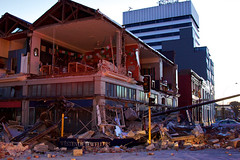
When I lived in Christchurch back in 2004-2005, this was a building I went past on the bus every day to get to and from work in the city. After the big quake on 04/09/10 (7.1 magnitude), its been seriously damaged. As have many more of the shops in this area. Thankfully no lives were lost in the quake, and I'm glad I wasnt there to feel it eith...
ChCh quake
Images, eqnz.chch.2010
The Christchurch Methodist Church van takes a hit from the falling gable end of the church.
Canterbury Earthquake 7.1
Images, eqnz.chch.2010
Rolleston/Burnham, South Island, NZ It's been a busy few weeks! Was away on geology fieldtrips all the previous two weeks, then on Saturday morning 4th September 2010 at 4.35 am we got woken in Westport to a reasonable but very long earthquake. My husband was back in Christchurch at the time and texted me saying "are you ok?". I replied, "yes!"...
ChCh quake (Explore #84 04/09/10) & Flickrblog
Images, eqnz.chch.2010
A local resident walks to the nearest dairy for essentials after the 7.1 magnitude quake, that has caused major infrastructure damage to Christchurch City.
Rock 'n roll... 19 October 2010
Images, Alexander Turnbull Library
The cartoon shows the name 'Christchurch' shaking so that bits fly off it; the letters 'H', 'I', and 'T' spelling 'hit' are the only ones not shaking. A second version has the words 'Rock'n Roll' as a title. Refers to the earthquake of 4th September 2010 and its hundreds of aftershocks which continue on now into November. Two versions of this cartoon are available Quantity: 1 digital cartoon(s).
AFTERSHOCK$$$$$$$$$$ $2 Billion/ $4 Billion. [Canterbury earthquake]. 9 Se…
Images, Alexander Turnbull Library
Text reads 'AFTERSHOCK$$$$$$$$$$$ $2 billion $4 billion'. Refers to the estimated costs resulting from the Canterbury earthquake of 4th September 2010 - The '2' is crossed out and the 'Treasury' pen writes '4' in its place. Quantity: 1 digital cartoon(s).
SIZE-mic does matter. 7.1 on the richter scale. $2 billion on the WRECKter…
Images, Alexander Turnbull Library
A graph shows an earthquake registering 7.1 on the Richter scale and $2 billion on the 'Wreckter' scale. An arrow shoots upwards from the $2 billion anticipating that the cost will rise higher. Text above reads 'SIZE-mic does matter'. Refers to the Christchurch earthquake of Saturday 4th September 2010 and the cost of the damage. No-one was killed. Quantity: 1 digital cartoon(s).
2010 [Canterbury earthquake]. 31 December 2010
Images, Alexander Turnbull Library
The title reads 'All shook up.... The cartoon shows the year '2010' shaking and dropping bits off the ends of the numbers. A second version has pupils inside the two zeros so that they look like eyes. Context - The Christchurch earthquake of 4 September 2010 and aftershocks which are continuing into 2011. 'All shook up' is the name of a song made famous by Elvis Presley. Quantity: 2 digital cartoon(s).
2010 [Canterbury earthquake]. 31 December 2010
Images, Alexander Turnbull Library
Shows singer Elvis Presley wearing '2010' dark glasses and singing 'I'm all shook up!' Context - The Christchurch earthquake of 4 September 2010 and aftershocks which are continuing into 2011. Quantity: 1 digital cartoon(s).
Rebuilding Christchurch.
Other, National Library of New Zealand
Blog of James Dann on Sept. 2010 Christchurch earthquake and rebuilding Christchurch.
Recovercanterbury.co.nz.
Other, National Library of New Zealand
Website provides practical advice and information for business recovery following the Canterbury earthquake.
Canterbury earthquake : response information…
Other, National Library of New Zealand
Information and advice from official sources for Christchurch residents in the aftermath of the 22 February earthquake (aftershock).
EQ-IQ Earthquake Commission.
Other, National Library of New Zealand
Information on the Earthquake Commission and how to prepare for earthquakes and other natural disasters such as tsunami, landslips, volcanic eruptions and hydrothermal activity.
Kete Christchurch : Canterbury earthquakes 2010 2011.
Other, National Library of New Zealand
Digital 'basket' for collecting the community's stories, photos, and experiences of the Canterbury earthquake on Sept. 4, 2010, and the Christchurch earthquake on February 22, 2011.
Help Canterbury : special offers for those recovering from the Christchurc…
Other, National Library of New Zealand
A directory of discounts and free services to help those affected by the Christchurch earthquake, including accommodation, counselling services, volunteer work, tradespeople, and concerts.
Moata’s blog idle.
Other, National Library of New Zealand
Blog describing the thoughts and travels of Christchurch librarian Moata Tamaira, the winner of Stuff.co.nz's inaugural Blog Idol competition. Earthquake related information can be found in the archived instances from September 2010-
Kete Waimakariri : Canterbury Earthquake 2010.
Other, National Library of New Zealand
The Waimakariri District Libraries site. Collects material about the damaged landmarks in Kaiapoi - their history and future and a collection of stories about the earthquake and share memories and photos.
Goodbye Blue Monday.
Other, National Library of New Zealand
A blog about the Family-owned and run bar in Poplar Lanes, Christchurch - home of live entertainment with bands and DJs, every Thursday to Saturday. Archived instances cover the Canterbury Earthquake when the bar had to close down due to damage.
Healthfirst : the Canterbury District Health Board’s gateway to health inf…
Other, National Library of New Zealand
Administers most of the public funding of health and disability services for Canterbury. Works with other organisations to provide improved health for Canterbury people and runs the public hospitals and other services.
S.K.I.P : strategies with kids, information for parents.
Other, National Library of New Zealand
SKIP is a government funded initiative that supports parents and whanau to guide their children's behaviour in a positive way. Earthquake related information can be found in the archived instances from September 2010-
2010 Canterbury earthquake : from Wikipedia, the free encyclopedia.
Other, National Library of New Zealand
Provides a map, the geological background, describes the effects, both in Christchurch and its surrounding areas, the damage to notable buildings, the financial exposure, the emergency response and relief efforts and the media coverage of the earthquake.
Canterbury and Christchurch earthquake stories by school children.
Other, National Library of New Zealand
An interactive site in which primary and intermediate school children provide descriptions of their experiences, sometimes with pictures. The descriptions are listed in chronological order of posting and can also be accessed by the name of the school.
Earthquake-shakeup.
Other, National Library of New Zealand
A public wiki where schools, students and experts from around the world can share thoughts and experiences around earthquakes, with a particular focus on the Canterbury 2010 earthquake. Website content has been archived, but is not currently viewing in the browser.
UC progressive re-start.
Other, National Library of New Zealand
Provides information for students and staff of University of Canterbury in relation to the Canterbury earthquake of 22nd February 2011. Contains re-start timetable, transport options, latest announcements, FAQs, video and photo galleries, messages of support and sections devoted to the Library and the College of Education.
Morning report earthquake special / with Mary Wilson and Kim Hill.
Other, National Library of New Zealand
Interviews with various people including radio reporters, the Christchurch mayor, police, and civil defence, on Saturday 4 Sept. 2010 after the Canterbury earthquake. Use Internet Explorer to listen to the archived MP3s. The streaming video (Ogg Vorbis) has not been archived.
Earthquake damage - Bridge Street.
Images, eqnz.chch.2010
Aftermath of September 4th Earthquake in Canterbury NZ. Bridge Street, South Brighton, Christchurch.