
Search
found 13189 results
Images for earthquakes; more images...
Effect of lateral confining reinforcement on the ductile behaviour of rein…
Research papers, University of Canterbury Library
This thesis is concerned with the effects of lateral confining reinforcement on the ductile behaviour of reinforced concrete columns. The contents of the chapters are summarized as follows. In Chapter one, the general problems in seismic design are discussed and earthquake design methods based on the ductile design approach are described. Japanese, New Zealand and United States design codes are compared. Finally, the scope of this research project is outlined. In Chapter two, after reviewing previous research on confined concrete, the factors which affect the effectiveness of lateral confinement are discussed. Especially the effects of the yield strength of transverse reinforcement, the compressive strength of plain concrete and the strain gradient in the column section due to bending are discussed based on tests which were conducted by the author et al at Kyoto University and Akashi Technological College, Japan. In the axial compression tests on spirally reinforced concrete cylinders (150 mm in diameter by 300 mm in height), the yield strength of transverse reinforcement and the compressive strength of plain concrete were varied from 161 MPa to 1352 MPa and from 17 MPa to 60 MPa, respectively, as experimental parameters. It is found that, when high strength spirals are used as confining reinforcement, the strength and ductility of the confined core concrete are remarkably enhanced but need to be estimated assuming several failure modes which could occur. These are based on the observations that concrete cylinders with high strength spirals suddenly failed at a concrete compressive strain of 2 to 3.5 % due to explosive crushing of the core concrete between the spiral bars or due to bearing failure of the core concrete immediately beneath the spiral bars, while the concrete cylinders with ordinary strength spirals failed in a gentle manner normally observed. In addition, eccentric loading tests were conducted on concrete columns with 200 mm square section confined by square spirals. It is found that the effectiveness of confining reinforcement is reduced by the presence of the strain gradient along the transverse section of column. In Chapter three, the effectiveness of transverse reinforcement with various types of anchorage details which simplify the fabrication of reinforcing cages are investigated. Eight reinforced concrete columns, with either 400 mm or 550 mm square cross sections, were tested subjected to axial compression loading and cyclic lateral loading which simulated a severe earthquake. The transverse reinforcement consisted of arrangements of square perimeter hoops with 135° end hooks, cross ties with 90° and 135° or 180° end hooks, and 'U' and 'J' shaped cross ties and perimeter hoops with tension splices. Conclusions are reached with regard to the effectiveness of the tested anchorage details in the plastic hinge regions of columns designed for earthquake resistance. In Chapter four, the effectiveness of interlocking spirals as transverse reinforcement is studied. Firstly, the general aspects and the related problems of interlocking spirals to provide adequate ductility in the potential plastic hinge region of columns are discussed, referring to the provisions in the New Zealand code,the CALTRANS (California Transportation Authority) code and other related codes. Secondly, based on those discussions, a design method to securely interlock the spirals is proposed. Thirdly, the effectiveness of interlocking spirals is assessed based on column tests conducted as part of this study. Three columns with interlocking spirals and, for comparison, one rectangular column with rectangular hoopsandcross ties, were tested under cyclic horizontal loading which simulated a severe earthquake. The sections of those columns were 400 mm by 600 mm. In Chapter five, analytical models to investigate the buckling behaviour of longitudinal reinforcement restrained by cross ties with 90° and 135° end hooks and by peripheral hoops are proposed. The analyzed results using the proposed models compare well with the experimental observations described in Chapter three. Using those proposed models, a method to check the effectiveness of cross ties with 90° and 135° end hooks is proposed for practical design purposes. In Chapter six, a theory for the prediction of the ultimate longitudinal compressive concrete strain at the stage of first hoop fracture referred to as the "Energy Balance Theory", which has been developed by Mander, Priestley and Park at University of Canterbury, is introduced. After discussing the problems in the "Energy Balance Theory", a modified theory for the prediction of the ultimate longitudinal compressive concrete strain at the stage of first hoop fracture is proposed. The predictions from the modified theory are found to compare well with previous experimental results.
Seismic performance assessment and improvement of unitized glazing systems
Research papers, University of Canterbury Library
Recent seismic events, such as the 2010-2011 Canterbury earthquakes and the 2016 Kaikōura earthquakes, have shed light on issues with the seismic performance of glazing systems. This is attributed to the limited amount of research and consideration of glazing systems in design and assessments. Previous research and evidence from post-earthquake reconnaissance have shown that glazing systems pose a hazard due to falling glass. As such, it is vital to ensure that glazing systems are designed with the necessary levels of seismic performance. Furthermore, the post-earthquake repair of glass facades can be costly and time-consuming. Some previous research has been conducted to highlight the seismic performance and fragility of glazing systems. However, most prior research only focussed on life-safety issues of glazing systems and rarely on the serviceability of glazing systems. The serviceability of glazing systems, such as water-tightness, is a vital aspect of glazing systems as a low serviceability capacity will increase the likelihood of further damage which will increase economic losses. This is the aim of this research, to provide insight towards the seismic performance of glazing systems considering both the serviceability and ultimate limit state by generating insight into the behaviour of glazing systems and developing tools for the consideration of glazing systems in design and assessment. This will allow a value proposition for seismic detailing of glazing to be evaluated. In order to provide insight into the behaviour of glazing systems and a means for evaluating their seismic performance, this research firstly develops an applicable experimental testing procedure that allows for serviceability limit state tests on glazing units. This experimental testing procedure is used to obtain data on the vulnerability of general New Zealand glazing systems’ performance, specifically unitised glazing systems that are commonly used as commercial shopfront glazing system types. These glazing systems typically realised using aluminium framing with gaskets connecting the frame to the glass. After the experimental testing, numerical analyses calibrated to the experimental testing results are conducted to enable robust analyses of glazing systems’ fragility. Finally, a value proposition for glazing systems with seismic detailing is made by comparing the performance of glazing systems with seismic detailing and conventional glazing systems. This comparison is done using the PEER-PBEE method and the economic implications of each glazing system is shown. Suggestions for designers and stakeholders aimed at reducing costs related to the seismic performance of glazing systems is also shown. Using the novel experimental method developed in this research, three different full-scale glazing systems were tested. A total of 10 unitised glazing specimens were tested; three with standard detailing, three with seismic detailing and four that were structurally glazed. These tests evaluated three damage states (DS): loss of water-tightness (DS1), gasket damage (DS2), and glass or framing failure (DS3). The experimental method that was adopted is considered to be more desirable than the optional procedures set out in New Zealand glazing standards. The method does not require high-speed testing equipment and is easy to replicate by the industry. The test results show that water-tightness was lost at low drift levels, with the first leakage occurring at just 0.15% drift for one specimen, while a standard glazing system had a median drift capacity of 0.35%. In contrast, seismic glazing systems detailed to better accommodate in-plane movements, demonstrated a significantly higher median drift capacity of 1.88%. The numerical approach proposed in this research has shown that it is possible to numerically model the glazing-gasket interaction to conservatively predict the water-leakage drift (damage state 1). The modelling approach still needs further development if it were to be used for damage states DS2 and DS3. The last part of the research considered the value proposition for seismic glazing systems. This was achieved by applying the FEMA P-58 performance assessment framework to a number of case study buldings that are typical of New Zealand design. The results suggest that it may not be economically worthwhile to use well-detailed seismic glazing systems despite the considerably larger drift capacity they possess relative to standard systems. However, as the cost of seismic glazing systems reduces, and more information on repair costs for different damage states is obtained, the value proposition may change.
The Panel with Barry Corbett and David Slack (Part 2)
Audio, Radio New Zealand
Topics - If you like a quiet time, head for the Spanish city of Seville. Seville's silent summer, they're calling this. They've banned outdoor noise. Seville's been noisy; flamenco singers, old men playing dominoes, bar patrons chatting. The city councillors have now banned most of this, and they seem to have support. Gerry Brownlee the Earthquake Recovery Minister will have the final say over what happens to a piece of land near Christchurch airport, on the corner of Memorial Ave and Russley Road. It's currently zoned as rural, but industrial development could be on the cards. The NYT wonders why with so much violence in movies and games, the big Comic-con pop entertainment convention in San Diego is so peaceful. John Banks snapped phone-driving, we saw at the weekend. John Banks accused of breaking the law again, this time for using a cellphone while driving.
Warnings house and contents insurance overpriced
Audio, Radio New Zealand
New Zealanders are paying too much for house and contents insurance, according to a new survey. Consumer NZ's price comparison survey shows climate and natural hazard risk is being factored in, and is more expensive than ever. Quotes for a large house differed by more than $3,000 across Auckland, Hamilton, Wellington, Christchurch, and Dunedin, and there's a more than $2,000 difference between the cheapest and most expensive policies on offer for a standard-sized house. If you live somewhere with a higher chance of earthquakes - such as Wellington or Christchurch - you'll be charged more for insurance. The cost of house and contents insurance has risen by 5.6% this year, over the past ten years it's gone up 150%. Kathryn is joined by Consumer NZ's Gemma Rasmussen and Katrina Shanks Chief Executive of Financial Advice New Zealand, which represents independent and professional financial advisors.
Gerry Brownlee defends EQC assessors
Audio, Radio New Zealand
The former Earthquake Commission minister, Gerry Brownlee, is defending EQC over claims its assessors in Christchurch were not properly qualified. A growing number of homeowners in the city are discovering EQC assessors have completely missed quake damage including broken foundations costing hundreds of thousands to repair. That's been disastrous for people who've bought homes with hidden damage who are sometimes finding private insurers unwilling to cover the cost of putting right mistakes made by EQC. The company hired by EQC to carry out repairs was Fletcher Construction. Its chief executive at the time, Mark Binns, told Checkpoint that EQC probably hired unqualified people to assess quake damaged homes. Gerry Brownlee refused to be drawn on the comments from Mr Binns. But when asked by RNZ Christchurch reporter, Conan Young, if it was acceptable to have retired policemen, school principals and vacuum cleaner salesmen carrying out assessments for EQC, he admitted finding enough people to do the job was a challenge.
The Panel with Lisa Scott and David Cormack (Part 1)
Audio, Radio New Zealand
A fault line on Dunedin's doorstep could cause an earthquake as destructive as 2010's Canterbury quake. Microbiologist Siouxsie Wiles explains why the new superbug CPE is a serious threat. A New Zealand Medical Journal article warns a group of bacteria known as Carbapenem-resistant Enterobacteriaceae pose an enormous risk to people in intensive care, or having bone marrow or lung or liver transplants. Mercedes-Benz has successfully trialled a new app called Croove, CROOVE, which will let Mercedes owners rent out their cars. Now it's being officially rolled out. The panellists discuss the sign outside a pub in New Brighton reading "Vegan buffet. Just kidding now get away from our sign - you pansy." Is this just a joke or is it deeply offensive? The Kentucky doctor dragged off a United Airlines flight from Chicago earlier this month has received a financial settlement from the airline.
Anna Leask - Behind bars
Audio, Radio New Zealand
Anna Leask has worked for the New Zealand Herald since 2008 and is currently a senior reporter, covering crime and justice for the daily newspaper as well as for the Weekend Herald and Herald on Sunday. Notably she's reported on the re-investigation of Arthur Allan Thomas, 43 years after the double murders for which he served nine years in prison before being pardoned, and the Christchurch 'House of Horrors' murderer Jason Somerville, who killed his wife and buried her under his East Christchurch house a year after doing the same to his neighbour Tisha Lowery. Leask covered the Pike River Mine disaster in 2010, the 2011 Canterbury earthquakes, Fiji's Cyclone Winston in early 2016 and travelled to Gallipoli in 2015 to cover the centenary of the Anzac landings. She won a Canon Media Award for crime and justice reporting in 2014. Her first book, Behind Bars: Real-life stories from inside New Zealand prisons has just been released.
Fairfax Video, September 2011 (1)
Videos, UC QuakeStudies
A video of Lianne Dalziel speaking to a public gathering about her reasons for standing for the mayoralty of Christchurch. Dalziel talks about starting her mayoralty where Share an Idea left off, making the Council a high performing team, and getting the community involved in the decisions about the future of the city. The video also includes footage of Dalziel taking a tour of the Christchurch central city. Dalziel visits the ChristChurch Cathedral, pointing out a sign which reads, "The earthquakes stopped us, but inept procedures are killing us". She also visits the new Westende Jewellers building, which she notes was the first rebuild in the Christchurch central city but will come down as part of CERA's Transport Plan. Dalziel is shown socialising with members of the public and watching the Christchurch Wizard bless New Regent Street.
This was a Two Storey House
Images, UC QuakeStudies
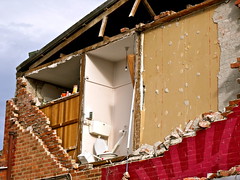
People stand in front of a damaged house in New Brighton. The upper storey at the front of the house has collapsed onto the floor below. The photographer comments, "This house at 158 Marine Parade, New Brighton, Christchurch was owned by the man leaning on the fence. He lived next door and his daughter lived here. During the earthquake the 2nd storey stayed mainly whole, but the 1st collapsed. Luckily the daughter was in the top storey. She was rescued from the building by neighbours, by climbing out of the window and down a ladder. Another piece of luck is that most of the belongings were stored in boxes in the garage at the front. Though the garage also collapsed the boxes appear intact. The owner had tried to sell it previously without success".
Top Stories for Friday 25 August 2017
Audio, Radio New Zealand
Police have arrested Rollie James Heke after a two-week nationwide manhunt. The government's come up with a radical new plan to tackle Auckland's critical teacher shortage offering thousands of dollars to any new graduate prepared to stay at any city school for at least three years. The All Blacks and the Wallabies will observe a minute's silence at Saturday's Bledisloe Cup match in Dunedin. The government has confirmed speed limits on some of the main expressways will be lifted to 110km/h. National's MP for Kaikoura, Stuart Smith, has leaked when State Highway 1 north of Kaikoura will be re-opened - on December 15. The country's building regulator admits it needs a major overhaul after years scrambling just to react to leaky homes and the Canterbury and Kaikoura earthquakes. Peter Dunne's shock exit this week has forced both National and Labour to completely re-evaluate their strategies in the contest for the Ohariu electorate.
Author Fleur Beale on her new work, Lyla
Audio, Radio New Zealand
Fleur Beale is one of New Zealand's most prolific authors and the winner of many awards for children and young adult books. Her latest work is a novel that tells the story of a young girl who experienced the February 2011 Christchurch earthquake. It's part of an international series called Through my Eyes - Natural Disaster Zones, which is a series written by different authors focusing on war zones and disasters throughout the world. Fleur's book is based on real accounts of what happened in Christchurch told through the eyes of a young girl, Lyla. Fleur, who has won the Margaret Mahy Medal for her outstanding contribution to children's writing, and was awarded the New Zealand Order of Merit for services to literature, joins Kathryn to talk about her latest work, and why young adult fiction is the best and the process of getting a story right.
Arihia Bennett : from social worker to CEO of Ngāi Tahu
Audio, Radio New Zealand
As Chief Executive of Te Runanga o Ngāi Tahu, Arihia Bennett leads a whanau of more than 78,000 iwi members, including their near-$2b worth of assets. She's been in the role for 11 years, overseeing all of Ngāi Tahu's operations, including farming, seafood, tourism and investment. She has also served as Canterbury Earthquake Recovery Commissioner, been on the board of Barnardos NZ and the Christchurch Women's Refuge (now known as Aviva). She is a current member of the Global Women's Network and the Tuahiwi Maori Women's Welfare League. In 2008, she was made a Member of the New Zealand Order of Merit for services to Maori and the community. Arihia Bennett is a social worker by profession, from a whanau steeped in community service. She talks to Susie Ferguson about her leadership style, her vision for Ngāi Tahu and her love of vintage clothes.
Do You, Don't You, Want my Trauma?: Some Issues Facing Post-Disaster Memor…
Research papers, University of Canterbury Library
The last few years have seen the emergence of a range of Digital Humanities projects concerned with archiving material related to traumatic events and disasters. The 9/11 Digital Archive, The Hurricane Memory Bank and the CEISMIC Canterbury Earthquakes Digital Archive are a few such projects committed to collecting, curating and making available disaster-related images, stories and media for the purposes of commemoration, teaching and research. In this paper Paul Millar 1. examines the value of such projects in preserving post-disaster memories, 2. explores some differences between passive and active digital memory projects, and 3. asks whether even the most determinedly open and inclusive digital memory project can preserve its values when issues of race, class, gender, politics and economics impact upon its activities.
The Harcourts Building : A 'seismic' shift?
Research papers, Lincoln University
Purpose - The purpose of this paper is to identify through the application of Actor Network Theory (ANT) the issues and impediments to the implementation of mandatory seismic retrofitting policies proposed by the New Zealand Government. In particular the tension between the heritage protection objectives contained in the Resource Management Act 1991 and the earthquake mitigation measures contained in the Building Act 2004 are examined. Design/methodology/approach - The paper uses a case study approach based on the Harcourts Building in Wellington New Zealand and the case law relating to attempts to demolish this particular building. Use is made of ANT as a 'lens' to identify and study the controversies around mandatory seismic retrofitting of heritage buildings. The concept of translation is used to draw network diagrams.
20130627_8878_1D3-28 We need the Pot of Gold!!
Images, eqnz.chch.2010
On the day the the government and council jointly announced who will fund what, for the Christchurch rebuild, a rainbow appears over the rebuild of the Latimer Hotel. For the central city the figures are: NZ$4.9 billion with $2.9 billion coming from central government and $1.9 billion coming from the local city council (us ratepayers in Christc...
20130312_0935_EOS M-18 T-Rex (Day 71/365)
Images, eqnz.chch.2010
Went for a drive down to South New Brighton/Southshore after work today to see what interesting birds I could find on the Estuary (godwits, skuas, terns etc), but passing Jellico Street, I saw this. T-Rex the seismic survey truck from the University of Texas that is visiting the city (first time out of USA). Weighs 30 tonne and from the marks o...
19 Velsheda Street
Images, eqnz.chch.2010
20130613_7580_1D3-24 19 Velsheda Street The two nice trees in the front of my old property on the right (now owned by the government) have been cut down so the main section of the house behind could be trucked down the drive. The truck must have been up against the fence to get the height above the house to the left (15 Velsheda Street). Down t...
It has started!
Images, eqnz.chch.2010
20140521_1080_1D3-24 It has started! Removal of the double-glazed windows is underway at my "red zone" house, now owned by the Government of New Zealand. Sold to CERA (the government agency) in October 2012 and has remained empty since, despite having little damage, apart from the tilt to the front from the land damage that occurred during the...
An engineering geological evaluation of non-engineered loess fill and airf…
Research papers, University of Canterbury Library
Following the 22nd February 2011, Mw 6.2 earthquake located along a previously unknown fault beneath the Port Hills of Christchurch, surface cracking was identified in contour parallel locations within fill material at Quarry Road on the lower slopes of Mount Pleasant. GNS Science, in the role of advisor to the Christchurch City Council, concluded that these cracks were a part of a potential rotational mass movement (named zone 11A) within the fill and airfall loess material present. However, a lack of field evidence for slope instability and an absence of laboratory geotechnical data on which slope stability analysis was based, suggested this conclusion is potentially incorrect. It was hypothesised that ground cracking was in fact due to earthquake shaking, and not mass movement within the slope, thus forming the basis of this study. Three soil units were identified during surface and subsurface investigations at Quarry Road: fill derived from quarry operations in the adjacent St. Andrews Quarry (between 1893 and 1913), a buried topsoil, and underlying in-situ airfall loess. The fill material was identified by the presence of organic-rich topsoil “clods” that were irregular in both size (∼10 – 200 mm) and shape, with variable thicknesses of 1 – 10 m. Maximum thickness, as indicated by drill holes and geophysical survey lines, was identified below 6 Quarry Road and 7 The Brae where it is thought to infill a pre-existing gully formed in the underlying airfall loess. Bearing strength of the fill consistently exceeded 300 kPa ultimate below ∼500 mm depth. The buried topsoil was 200 – 300 mm thick, and normally displayed a lower bearing strength when encountered, but not below 300 kPa ultimate (3 – 11 blows per 100mm or ≥100 kPa allowable). In-situ airfall loess stood vertically in outcrop due to its characteristic high dry strength and also showed Scala penetrometer values of 6 – 20+ blows per 100 mm (450 – ≥1000 kPa ultimate). All soils were described as being moist to dry during subsurface investigations, with no groundwater table identified during any investigation into volcanic bedrock. In-situ moisture contents were established using bulk disturbed samples from hand augers and test pitting. Average moisture contents were low at 9% within the fill, 11 % within the buried topsoil, and 8% within the airfall loess: all were below the associated average plastic limit of 17, 15, and 16, respectively, determined during Atterberg limit analysis. Particle size distributions, identified using the sieve and pipette method, were similar between the three soil units with 11 – 20 % clay, 62 – 78 % silt, and 11 – 20 % fine sand. Using these results and the NZGS soil classification, the loess derived fill and in-situ airfall loess are termed SILT with some clay and sand, and the buried topsoil is SILT with minor clay and sand. Dispersivity of the units was found using the Emerson crumb test, which established that the fill can be non- to completely dispersive (score 0 – 4). The buried topsoil was always non-dispersive (score 0), and airfall loess completely dispersive (score 4). Values for cohesion (c) and internal friction angle (φ) of the three soil units were established using the direct shear box at field moisture contents. Results showed all soil units had high shear strengths at the moisture contents tested (c = 18 – 24 kPa and φ = 42 – 50°), with samples behaving in a brittle fashion. Moisture content was artificially increased to 16% within the buried topsoil, which reduced the shear strength (c = 10 kPa, φ = 18°) and allowed it to behave plastically. Observational information indicating stability at Quarry Road included: shallow, discontinuous, cracks that do not display vertical offset; no scarp features or compressional zones typical of landsliding; no tilted or deformed structures; no movement in inclinometers; no basal shear zone identified in logged core to 20 m depth; low field moisture contents; no groundwater table; and high soil strength using Scala penetrometers. Limit equilibrium analysis of the slope was conducted using Rocscience software Slide 5.0 to verify the slope stability identified by observational methods. Friction, cohesion, and density values determined during laboratory were input into the two slope models investigated. Results gave minimum static factor of safety values for translational (along buried topsoil) and rotational (in the fill) slides of 2.4 – 4.2. Sensitivity of the slope to reduced shear strength parameters was analysed using c = 10 kPa and φ = 18° for the translational buried topsoil plane, and a cohesion of 0 kPa within the fill for the rotational plane. The only situation that gave a factor of safety <1.0 was in nonengineered fill at 0.5 m depth. Pseudostatic analysis based on previous peak ground acceleration (PGA) values for the Canterbury Earthquake Sequence, and predicted PGAs for future Alpine Fault and Hope Fault earthquakes established minimum factor of safety values between 1.2 and 3.3. Yield acceleration PGAs were computed to be between 0.8g and 1.6g. Based on all information gathered, the cracking at Quarry Road is considered to be shallow deformation in response to earthquake shaking, and not due to deep-seated landsliding. It is recommended that the currently bare site be managed by smoothing the land, installing contour drainage, and bioremediation of the surface soils to reduce surface water infiltration and runoff. Extensive earthworks, including removal of the fill, are considered unnecessary. Any future replacement of housing would be subject to site-specific investigations, and careful foundation design based on those results.
Slane, Christopher, 1957- :"Hey everyone - look up there!" 9 September 2011
Images, Alexander Turnbull Library
A crowd of rather sad people queue for jobs and work at the Christchurch rebuild; all around them are signs that read 'Pike River', 'leaky buildings', 'Chch quake rebuild', 'EQC levy hike', '200,000 children in poverty', 'food prices up', 'deficit', and 'GST hike'. Prime Minister John Key in the centre of the crowd yells 'Hey everyone - look up there!' as he kicks a rugby ball into the sky. Context: John Key attempts to divert the attention of people from New Zealand's current woes. Quantity: 1 digital cartoon(s).
Coexistence, dynamics and disturbance history of mixed conifer, beech, and…
Research papers, Lincoln University
Mixed conifer, beech and hardwood forests are relatively common in Aotearoa/New Zealand, but are not well studied. This thesis investigates the coexistence, regeneration dynamics and disturbance history of a mixed species forest across an environmental gradient of drainage and soil development in north Westland. The aim was to investigate whether conifers, beech and non-beech hardwood species were able to coexist on surfaces that differed in their underlying edaphic conditions, and if so to understand the mechanisms that influenced their regeneration on both poorly drained and well drained soils. The site selected was an area of high tree species diversity on a lowland 0.8 km² post-glacial terrace at the base of Mount Harata in the Grey River Valley. My approach was to use forest stand history reconstruction at two spatial scales: an intensive within-plot study of stand dynamics (chapter 1) and a whole-landform approach (chapter 2) that examined whether the dynamics identified at the smaller within-plot scale reflected larger patterns across the terrace. In chapter 1, three large permanent plots (0.3-0.7 ha) were placed at different points along the drainage gradient, one plot situated in each of the mainly well-drained, poorly drained and very poorly drained areas along the terrace. Information was gathered on species age and size structures, spatial distributions of tree ages, species interactions, microsite establishment preferences, patterns of stand mortality, and disturbance history in each plot. There were differences in stand structure, composition and relative abundance of species found between the well drained plot and the two poorer drained plots. On the well drained site conifers were scarce, the beeches Nothofagus fusca and N. menziesii dominated the canopy, and in the subcanopy the hardwood species Weinmannia racemosa and Quintinia acutifolia were abundant. As drainage became progressively poorer, the conifers Dacrydium cupressinum and Dacrycarpus dacrydioides became more abundant and occupied the emergent tier over a beech canopy. The hardwoods W. racemosa and Q. acutifolia became gradually less abundant in the subcanopy, whereas the hardwood Elaeocarpus hookerianus became more so. In the well drained plot, gap partitioning for light between beeches and hardwoods enabled coexistence in response to a range of different sized openings resulting from disturbances of different extent. In the two more poorly drained plots, species also coexisted by partitioning microsite establishment sites according to drainage. There were several distinct periods where synchronous establishment of different species occurred in different plots, suggesting there were large disturbances: c. 100yrs, 190-200 yrs, 275-300 yrs and 375-425 yrs ago. Generally after the same disturbance, different species regenerated in different plots reflecting the underlying drainage gradient. However, at the same site after different disturbances, different sets of species regenerated, suggesting the type and extent of disturbances and the conditions left behind influenced species regeneration at some times but not others. The regeneration of some species (e.g., N. fusca in the well-drained plot, and Dacrydium in the poorer drained plots) was periodic and appeared to be closely linked to these events. In the intervals between these disturbances, less extensive disturbances resulted in the more frequent N. menziesii and especially hardwood regeneration. The type of tree death caused by different disturbances favoured different species, with dead standing tree death favouring the more shade-tolerant N. menziesii and hardwoods, whereas uprooting created a mosaic of microsite conditions and larger gap sizes that enabled Dacrycarpus, N. fusca and E. hookerianus to maintain themselves in the poorly drained areas. In chapter 2, 10 circular plots (c. 0.12 ha) were placed in well drained areas and 10 circular plots (c. 0.2 ha) in poorly drained plots to collect information on species population structures and microsite preferences. The aims were to reconstruct species' regeneration responses to a range of disturbances of different type and extent across the whole terrace, and to examine whether there were important differences in the effects of these disturbances. At this landform scale, the composition and relative abundances of species across the drainage gradient reflected those found in chapter 1. There were few scattered conifers in well drained areas, despite many potential regeneration opportunities created from a range of different stand destroying and smaller scale disturbances. Three of the four periods identified in chapter 1 reflected distinct terrace-wide periods of regeneration 75-100 yrs, 200-275 yrs and 350-450 yrs ago, providing strong evidence of periodic large, infrequent disturbances that occurred at intervals of 100-200 yrs. These large, infrequent disturbances have had a substantial influence in determining forest history, and have had long term effects on forest structure and successional processes. Different large, infrequent disturbances had different effects across the terrace, with the variability in conditions that resulted enabling different species to regenerate at different times. For example, the regeneration of distinct even-aged Dacrydium cohorts in poorly drained areas was linked to historical Alpine Fault earthquakes, but not to more recent storms. The variation in the intensity of different large, infrequent disturbances at different points along the environmental drainage gradient, was a key factor influencing the scale of impacts. In effect, the underlying edaphic conditions influenced species composition along the drainage gradient and disturbance history regulated the relative abundances of species. The results presented here further emphasise the importance of large scale disturbances as a mechanism that allows coexistence of different tree species in mixed forest, in particular for the conifers Dacrydium, Dacrycarpus and the beech N. fusca, by creating much of the environmental variation to which these species responded. This study adds to our understanding of the effects of historical earthquakes in the relatively complex forests of north Westland, and further illustrates their importance in the Westland forest landscape as the major influential disturbance on forest pattern and history. These results also further develop the 'two-component' model used to describe conifer/angiosperm dynamics, by identifying qualitative differences in the impacts of different large, infrequent disturbances across an environmental gradient that allowed for coexistence of different species. In poorer drained areas, these forests may even be thought of as 'three-component' systems with conifers, beeches and hardwoods exhibiting key differences in their regeneration patterns after disturbances of different type and extent, and in their microsite preferences.
Community-led planning in post-disaster recovery: a Diamond Harbour case s…
Research papers, Lincoln University
There is strong consensus in the civil defence and emergency management literature that public participation is essential for a 'good' recovery. However, there is a paucity of research detailing how this community-led planning should be carried out in the real world. There are few processes or timelines for communities to follow when wanting to plan for themselves, nor is there a great deal of advice for communities who want to plan for their own recovery. In short, despite this consensus that community involvement is desireable, there is very little information available as to the nature of this involvement or how communities might facilitate this. It is simply assumed that communities are willing and able to participate in the recovery process and that recovery authorities will welcome, encourage, and enable this participation. This is not always the case, and the result is that community groups can be left feeling lost and ineffective when trying to plan for their own recovery. In attempting to address this gap, my study contributes to a better understanding of community involvement in recovery planning, based on research with on particular a community group (SPRIG), who has undertaken their own form of community-led planning in a post-disaster environment. Through group observations and in-depth interviews with members of SPRIG, I was able to identify various roles for such groups in the post-disaster recovery process. My research also contributes to an enhanced understanding of the process a community group might follow to implement their own form of post-disaster recovery planning, with the main point being that any planning should be done side by side with local authorities. Finally, I discovered that a community group will face organisational, community and institutional challenges when trying to plan for their area; however, despite these challenges, opportunities exist, such as the chance to build a better future.
High-density shallow shear wave velocity characterisation of the urban Chr…
Research papers, University of Canterbury Library
This report summarizes the development of a region-wide surficial soil shear wave velocity (Vs ) model based on the unique combination of a large high-spatial-density database of cone penetration test (CPT) logs in the greater Christchurch urban area (> 15, 000 logs as of 1 February 2014) and the Christchurch-specific empirical correlation between soil Vs and CPT data developed by McGann et al. [1, 2]. This model has applications for site characterization efforts via maps of time-averaged Vs over specific depths (e.g. Vs30, Vs10), and for numerical modeling efforts via the identification of typical Vs profiles for different regions and soil behaviour types within Christchurch. In addition, the Vs model can be used to constrain the near-surface velocities for the 3D seismic velocity model of the Canterbury basin [3] currently being developed for the purpose of broadband ground motion simulation. The general development of these region-wide near-surface Vs models includes the following general phases, with each discussed in separate chapters of this report. • An evaluation of the available CPT dataset for suitability, and the definition of other datasets and assumptions necessary to characterize the surficial sediments of the region to 30 m depth. • The development of time-averaged shear wave velocity (Vsz) surfaces for the Christchurch area from the adopted CPT dataset (and supplementary data/assumptions) using spatial interpolation. The Vsz surfaces are used to explore the characteristics of the near-surface soils in the regions and are shown to correspond well with known features of the local geology, the historical ecosystems of the area, and observations made following the 2010- 2011 Canterbury earthquakes. • A detailed analysis of the Vs profiles in eight subregions of Christchurch is performed to assess the variablity in the soil profiles for regions with similar Vsz values and to assess Vsz as a predictive metric for local site response. It is shown that the distrubution of soil shear wave velocity in the Christchurch regions is highly variable both spatially (horizontally) and with depth (vertically) due to the varied geological histories for different parts of the area, and the highly stratified nature of the nearsurface deposits. This variability is not considered to be greatly significant in terms of current simplified site classification systems; based on computed Vs30 values, all considered regions can be categorized as NEHRP sites class D (180 < Vs < 360 m/s) or E (Vs < 180 m/s), however, detailed analysis of the shear wave velocity profiles in different subregions of Christchurch show that the expected surficial site response can vary quite a bit across the region despite the relative similarity in Vs30
Tree regeneration in a New Zealand rain forest influenced by disturbance a…
Research papers, Lincoln University
Question: Does canopy tree regeneration response to different large disturbances vary with soil drainage? Location: Old-growth conifer (Dacrydium and Dacrycarpus), angiosperm (Nothofagus and Weinmannia) rain forest, Mount Harata, South Island, New Zealand. Methods: Trees were aged (1056 cores) to reconstruct stand history in 20 (0.12 - 0.2 ha) plots with different underlying drainage. Spatial analyses of an additional 805 tree ages collected from two (0.3 - 0.7 ha) plots were conducted to detect patchiness for five canopy tree species. Microsite preferences for trees and saplings were determined. Results: There were clear differences in species regeneration patterns on soils with different drainage. Conifer recruitment occurred infrequently in even-aged patches (> 1000 m²) and only on poorly drained soils. Periodic Nothofagus fusca and N. menziesii recruitment occurred more frequently in different sized canopy openings on all soils. Weinmannia recruitment was more continuous on all soils reflecting their greater relative shade-tolerance. Distinct periods of recruitment that occurred in the last 400 years matched known large disturbances in the region. These events affected species differently as soil drainage varied. Following earthquakes, both conifers and N. menziesii regenerated on poorly drained soils, while Nothofagus species and Weinmannia regenerated on well-drained soils. However, Dacrydium failed to regenerate after patchy storm damage in the wetter forest interior; instead faster-growing N. fusca captured elevated microsites caused by uprooting. Conclusions: Underlying drainage influenced species composition, while variation in the impacts of large disturbance regulated relative species abundances on different soils.
Housing in Post-Quake Canterbury: Human Rights Fault Lines
Research papers, University of Canterbury Library
The 2010–2011 Canterbury earthquakes and their aftermath have been described by the Human Rights Commission as one of New Zealand's greatest contemporary human rights challenges. This article documents the shortcomings in the realisation of the right to housing in post-quake Canterbury for homeowners, tenants and the homeless. The article then considers what these shortcomings tell us about New Zealand's overall human rights framework, suggesting that the ongoing and seemingly intractable nature of these issues and the apparent inability to resolve them indicate an underlying fragility implicit in New Zealand's framework for dealing with the consequences of a large-scale natural disaster. The article concludes that there is a need for a comprehensive human rights-based approach to disaster preparedness, response and recovery in New Zealand.
Question Time for 13 July 2011
Audio, Radio New Zealand
Questions to Ministers 1. Hon PHIL GOFF to the Prime Minister: Does he stand by all his statements on the privatisation of New Zealand State-owned power companies? 2. MICHAEL WOODHOUSE to the Minister of Finance: What progress has the Government made in making the tax system fairer? 3. Hon ANNETTE KING to the Prime Minister: At recent meetings he has had with Grey Power, have they raised with him their concerns about the sell-off of state assets? 4. Dr CAM CALDER to the Minister of Corrections: Has she received any reports on the rate of escape from New Zealand prisons? 5. Hon DAVID CUNLIFFE to the Minister of Finance: Why doesn't his Budget's net debt track take into account lost dividends from SOEs and sales costs arising from his policy of privatising state assets? 6. KEVIN HAGUE to the Minister of Labour: Is underground mining safe in New Zealand? 7. COLIN KING to the Minister of Transport: What progress has been made on the Christchurch Southern Motorway Road of National Significance following the earthquakes in the city? 8. Hon CLAYTON COSGROVE to the Minister for Canterbury Earthquake Recovery: How many of the 5,100 properties in the red zone have been deemed to be uneconomic to repair by the insurer and how many of those, approximately, had unimproved land valuations of less than $150,000? 9. JOHN BOSCAWEN to the Minister of Māori Affairs: Does he stand by all of his recent statements? 10. Hon TREVOR MALLARD to the Prime Minister: Further to his answers to Oral Question No 1 yesterday on the purchase of state assets by foreigners, what percentage of Contact shares are currently held by foreigners or corporations? 11. RAHUI KATENE to the Minister for the Environment: Does he agree with the statement in Ko Aotearoa Tēnei, that "direct infusion of indigenous values into mainstream environmental regulation may well be unique in the world"; if so, how will he advance the opportunities for Māori to take more positive and proactive roles in environmental decision-making? 12. NICKY WAGNER to the Minister for Social Development and Employment: What reports has she seen on the Canterbury unemployment figures?
Question Time for 20 March 2013
Audio, Radio New Zealand
DAVID SHEARER to the Minister for State Owned Enterprises: Has the Government met the five criteria the Prime Minister laid out for proceeding with asset sales? Dr RUSSEL NORMAN to the Minister of Finance: Will New Zealanders have money taken from their bank accounts to fund a bank bailout under his proposed Open Bank Resolution scheme? TODD McCLAY to the Minister of Finance: What reports has he received on New Zealand's balance of payments? Hon ANNETTE KING to the Minister of Health: Does he stand by all his statements regarding "Better, Sooner, More Convenient" health care; if not, why not? MARK MITCHELL to the Minister of Police: What reports has she received from Police on the success of pre-charge warnings? PHIL TWYFORD to the Minister of Housing: Why did he tell the House that, even if the Auckland plan took effect in September, new subdivisions would not be available until 2016-17, when the advice he tabled from Roger Blakely of Auckland Council shows that if the unitary plan takes effect in September new land would be available two years earlier? ALFRED NGARO to the Minister for Social Development: How will the Social Security (Benefit Categories and Work Focus) Amendment Bill back people off welfare and into work? GRANT ROBERTSON to the Prime Minister: Does he stand by all his statements on the actions and involvement of the Department of the Prime Minister and Cabinet and the Government Communications and Security Bureau in Operation Debut? SCOTT SIMPSON to the Minister of Health: What is the Government doing to extend access to free flu vaccines? METIRIA TUREI to the Minister for Social Development: Does she have an obligation, as Social Development Minister, to ensure all policy she is responsible for will be good for children and their families? Hon KATE WILKINSON to the Minister for Primary Industries: What announcement has he made on the drought in New Zealand? Rt Hon WINSTON PETERS to the Minister for Canterbury Earthquake Recovery: Have allegations of fraud and corruption involving Canterbury earthquake recovery and rebuild contracts been raised with him as Minister; if so, what specific steps has he taken to address them?
Question Time for 21 February 2013
Audio, Radio New Zealand
Questions to Ministers 1. TODD McCLAY to the Minister of Finance: What reports has he received on the Government's financial position? 2. DAVID SHEARER to the Prime Minister: Does he stand by all his statements? 3. METIRIA TUREI to the Prime Minister: Does he stand by his reported statement that "anyone expecting details of a 'cosy sort of little deal' would be disappointed" by the Deputy Auditor-General's report into the SkyCity Convention Centre negotiations. 4. DENIS O'ROURKE to the Minister for Canterbury Earthquake Recovery: What criteria did he use in deciding that owners of vacant sections in the red zone of Christchurch should only be compensated at half of the sections' most recent rateable value? 5. KANWALJIT SINGH BAKSHI to the Minister for Economic Development: What economic opportunities will a new convention centre bring for Auckland? 6. Hon DAVID PARKER to the Prime Minister: Did he or his office receive the 12 November 2009 report from Ministry officials to the Department of Prime Minister and Cabinet, summarising the process with SkyCity for the building of a convention centre; if so, did he read it? 7. MIKE SABIN to the Associate Minister for Social Development: What steps is the Government taking to reduce welfare fraud? 8. Hon CLAYTON COSGROVE to the Minister for State Owned Enterprises: What contingency plans, if any, does the Government have in place regarding its asset sale programme should the Tiwai Point aluminium smelter reduce production? 9. KEVIN HAGUE to the Minister of Trade: Will New Zealand support Australia's objection to signing up to investor-state dispute provisions in the Trans-Pacific Partnership agreement; if not, why not? 10. Hon LIANNE DALZIEL to the Minister for Canterbury Earthquake Recovery: Why is he offering only 50 percent of rating valuation for commercial or bare land in the residential red zone where the land could not be insured? 11. MARK MITCHELL to the Minister of Corrections: What announcements has she made on improving prisoner employment training in New Zealand prisons? 12. CHRIS HIPKINS to the Minister of Education: Does she stand by all her decisions in relation to schools in Christchurch?
Question Time for 20 February 2013
Audio, Radio New Zealand
Questions to Ministers 1. TODD McCLAY to the Minister of Finance: What reports has he received on the Government's financial position? 2. DAVID SHEARER to the Prime Minister: Does he stand by all his statements? 3. METIRIA TUREI to the Prime Minister: Does he stand by his reported statement that "anyone expecting details of a 'cosy sort of little deal' would be disappointed" by the Deputy Auditor-General's report into the SkyCity Convention Centre negotiations. 4. DENIS O'ROURKE to the Minister for Canterbury Earthquake Recovery: What criteria did he use in deciding that owners of vacant sections in the red zone of Christchurch should only be compensated at half of the sections' most recent rateable value? 5. KANWALJIT SINGH BAKSHI to the Minister for Economic Development: What economic opportunities will a new convention centre bring for Auckland? 6. Hon DAVID PARKER to the Prime Minister: Did he or his office receive the 12 November 2009 report from Ministry officials to the Department of Prime Minister and Cabinet, summarising the process with SkyCity for the building of a convention centre; if so, did he read it? 7. MIKE SABIN to the Associate Minister for Social Development: What steps is the Government taking to reduce welfare fraud? 8. Hon CLAYTON COSGROVE to the Minister for State Owned Enterprises: What contingency plans, if any, does the Government have in place regarding its asset sale programme should the Tiwai Point aluminium smelter reduce production? 9. KEVIN HAGUE to the Minister of Trade: Will New Zealand support Australia's objection to signing up to investor-state dispute provisions in the Trans-Pacific Partnership agreement; if not, why not? 10. Hon LIANNE DALZIEL to the Minister for Canterbury Earthquake Recovery: Why is he offering only 50 percent of rating valuation for commercial or bare land in the residential red zone where the land could not be insured? 11. MARK MITCHELL to the Minister of Corrections: What announcements has she made on improving prisoner employment training in New Zealand prisons? 12. CHRIS HIPKINS to the Minister of Education: Does she stand by all her decisions in relation to schools in Christchurch?
Question Time for 9 February 2012
Audio, Radio New Zealand
Questions to Ministers 1. GARETH HUGHES to the Minister for Primary Industries: Will he extend the Taranaki set net ban after the recent death of a Maui's dolphin in a fishing net? 2. DAVID BENNETT to the Minister for Economic Development: What actions is the Government taking to boost economic linkages with China? 3. GRANT ROBERTSON to the Prime Minister: Does he stand by his statement that his hour-long show on Radio Live on 30 September 2011 was an "election free zone"? 4. Dr PAUL HUTCHISON to the Minister of Health: What improvements, if any, have been made to the Government's national health targets? 5. Hon LIANNE DALZIEL to the Minister for Canterbury Earthquake Recovery: Did he discuss with the Christchurch City Mayor reported claims that there had been overtures from within The Treasury that there was scope for the city's rates to be increased or for assets to be sold to pay for the quake recovery, and that this could be done under the Canterbury Earthquake Recovery Act before he called him a clown; if not, why not? 6. JACQUI DEAN to the Minister of Local Government: What reports has he received on increases in local government council debt since the Local Government Act 2002 was enacted? 7. DARIEN FENTON to the Minister of Labour: Does she stand by her statement that the new minimum wage announced yesterday "strikes the right balance between protecting low paid workers and ensuring that jobs are not lost."? 8. PESETA SAM LOTU-IIGA to the Minister of Consumer Affairs: What recent announcements has the Government made on protecting consumers from loan sharks? 9. CLARE CURRAN to the Minister of Broadcasting: Is he aware that Stephen McElrea is part of a working group within NZ On Air, which includes a representative of MediaWorks, and which is determining details of a documentary about Whānau Ora? 10. TIM MACINDOE to the Minister for the Community and Voluntary Sector: What recent announcement has she made in her portfolio that will benefit communities? 11. HOLLY WALKER to the Minister for Social Development: Does she consider low family incomes to be a major contributor to childhood vulnerability? 12. Rt Hon WINSTON PETERS to the Prime Minister: Does he still have confidence in all his Ministers?