
Search
found 13189 results
Images for earthquakes; more images...
A community-led, science-informed conversation around the future use of th…
Research papers, Lincoln University
Lincoln University was commissioned by the Avon-Otakaro Network (AvON) to estimate the value of the benefits of a ‘recreation reserve’ or ‘river park’ in the Avon River Residential Red Zone (ARRRZ). This research has demonstrated significant public desire and support for the development of a recreation reserve in the Avon River Residential Red Zone. Support is strongest for a unique natural environment with native fauna and flora, healthy wetlands and rivers, and recreational opportunities that align with this vision, such as walking, cycling and water-based sporting and leisure activities. The research also showed support for a reserve that promotes and enables community interaction and wellbeing, and is evident in respondents’ desires for community gardens, regular festivals and markets, and the physical linking of the CBD with eastern suburbs through a green corridor. There is less support for children’s playgrounds, sports fields or open grassed areas, all of which could be considered as more typical of an urban park development. Benefits (willing to pay) to Christchurch residents (excluding tourists) of a recreation reserve could be as high as $35 million each year. Savings to public health costs could be as high as $50.3 million each year. The incorporation or restoration of various ecosystems services, including water quality improvements, flood mitigation and storm water management could yield a further $8.8 million ($19, 600) per hectare/year at 450 ha). Combined annual benefits of a recreational reserve in the ARRRZ are approximately $94.1 million per annum but this figure does not include potentially significant benefits from, for example, tourism, property equity gains in areas adjacent to the reserve, or the effects of economic rejuvenation in the East. Although we were not able to provide costing estimates for park attributes, this study does make available the value of benefits, which can be used as a guide to the scope of expenditure on development of each park attribute.
Question Time for 27 March 2013
Audio, Radio New Zealand
Dr RUSSEL NORMAN to the Prime Minister: Does he have confidence in all his Ministers? DAVID SHEARER to the Prime Minister: Does he stand by all his statements? MAGGIE BARRY to the Minister of Finance: What measures is the Government taking to help increase national savings? Rt Hon WINSTON PETERS to the Minister for Canterbury Earthquake Recovery: What reports has he received about the extent of fraud allegations in the Christchurch rebuild? Hon ANNETTE KING to the Minister of Health: Is he confident that the Government's initiative to provide "Better, Sooner, More Convenient" health care, is meeting his expectations; if not, why not? MARK MITCHELL to the Minister for Economic Development: What progress is being made in encouraging firms to invest in New Zealand through the Business Growth Agenda? PHIL TWYFORD to the Prime Minister: Does he stand by all his statements? DAVID BENNETT to the Associate Minister of Transport: What recent announcements has he made on transport safety? Hon LIANNE DALZIEL to the Minister for Canterbury Earthquake Recovery: Will he extend the deadline for residential red zone property owners who have been offered only 50 percent of rating valuation for their land? SCOTT SIMPSON to the Minister of Justice: What recent report has she received showing that crime is falling under this Government? METIRIA TUREI to the Minister of Education: Will she wait until the Chief Ombudsman's investigation of the Ministry of Education's processes on school closures is complete before making a final decision on the Salisbury and Christchurch school closures? GRANT ROBERTSON to the Minister responsible for the GCSB: Did GCSB Director Ian Fletcher attend the three briefings he received from GCSB in February 2012; if not, which, if any, of the briefings did Ian Fletcher attend?
Seismic Anisotropy and Stress of the Canterbury Plains
Research papers, Victoria University of Wellington
The Mѡ=7.1 Darfield (Canterbury) earthquake struck on 4 September 2010, approximately 45 km west of Christchurch, New Zealand. It revealed a previously unknown fault (the Greendale fault) and caused billions of dollars of damage due to high peak ground velocities and extensive liquefaction. It also triggered the Mw=6.3 Christchurch earthquake on 22 February 2011, which caused further damage and the loss of 185 lives. The objective of this research was to determine the relationship between stress and seismic properties in a seismically active region using manually-picked P and S wave arrival times from the aftershock sequence between 8 September 2010-13 January 2011 to estimate shear-wave splitting (SWS) parameters, VP =VS-ratios, anisotropy (delay-time tomography), focal mechanisms, and tectonic stress on the Canterbury plains. The maximum horizontal stress direction was highly consistent in the plains, with an average value of SHmax=116 18 . However, the estimates showed variation in SHmax near the fault, with one estimate rotating by as much as 30° counter-clockwise. This suggests heterogeneity of stress at the fault, though the cause remains unclear. Orientations of the principal stresses predominantly indicate a strike-slip regime, but there are possible thrust regimes to the west and north/east of the fault. The SWS fast directions (ø) on the plains show alignment with SHmax at the majority of stations, indicating stress controlled anisotropy. However, structural effects appear more dominant in the neighbouring regions of the Southern Alps and Banks Peninsula.
Experimental and numerical validation of selective weakening retrofit for …
Research papers, University of Canterbury Library
The development of cheap, whilst effective and relatively non-invasive structural retrofit techniques for existing non-ductile reinforced concrete (RC) structures still remains the most challenging issue for a wide implementation on a macro scale. Seismic retrofit is too often being confused as purely structural strengthening. As part of a six-years national project on “Seismic retrofit solutions for NZ multi-storey building”, focus has been given at the University of Canterbury on the development of a counter-intuitive retrofit strategy for earthquake vulnerable existing rc frame, based on a “selective weakening” (SW) approach. After an overview of the SW concept, this paper presents the experimental and numerical validation of a SW retrofit strategy for earthquake vulnerable existing RC frame with particular focus on the exterior beam-column (b-c) joints. The exterior b-c joint is a critically vulnerable region in many existing pre-1970s RC frames. By selectively weakening the beam by cutting the bottom longitudinal reinforcements and/or adding external pre-stressing to the b-c joint, a more desirable inelastic mechanism can be attained, leading to improved global seismic performance. The so-called SW retrofit is implemented on four 2/3-scaled exterior RC b-c joint subassemblies, tested under quasi-static cyclic loading at the University of Canterbury. Complemented by refined 3D Finite Element (FE) models and dynamic time-history analyses results, the experimental results have shown the potential of a simple and cost-effective yet structurally efficient structural rehabilitation technique. The research also demonstrated the potential of advanced 3D fracture-mechanics-based microplane concrete modelling for refined FE analysis of non-ductile RC b-c joints.
Dynamic response of post-tensioned timber frame buildings
Research papers, University of Canterbury Library
An extensive research program is on-going at the University of Canterbury, New Zealand to develop new technologies to permit the construction of multi-storey timber buildings in earthquake prone areas. The system combines engineered timber beams, columns and walls with ductile moment resisting connections using post-tensioned tendons and eventually energy dissipaters. The extensive experimental testing on post-tensioned timber building systems has proved a remarkable lateral response of the proposed solutions. A wide number of post-tensioned timber subassemblies, including beam-column connections, single or coupled walls and column-foundation connections, have been analysed in static or quasi-static tests. This contribution presents the results of the first dynamic tests carried out with a shake-table. Model frame buildings (3-storey and 5-storey) on one-quarter scale were tested on the shake-table to quantify the response of post-tensioned timber frames during real-time earthquake loading. Equivalent viscous damping values were computed for post-tensioned timber frames in order to properly predict their response using numerical models. The dynamic tests were then complemented with quasi-static push and pull tests performed to a 3-storey post-tensioned timber frame. Numerical models were included to compare empirical estimations versus dynamic and quasi-static experimental results. Different techniques to model the dynamic behaviour of post-tensioned timber frames were explored. A sensitivity analysis of alternative damping models and an examination of the influence of designer choices for the post-tensioning force and utilization of column armouring were made. The design procedure for post-tensioned timber frames was summarized and it was applied to two examples. Inter-storey drift, base shear and overturning moments were compared between numerical modelling and predicted/targeted design values.
Seismic performance of a 9-storey pre-1970's reinforced concrete wall buil…
Research papers, University of Canterbury Library
Reconnaissance reports have highlighted the poor performance of non-ductile reinforced concrete buildings during the 2010-11 Canterbury earthquakes. These buildings are widely expected to result in significant losses under future earthquakes due to their seismic vulnerability and prevalence in densely populated urban areas. Wellington, for example, contains more than 70 pre-1970s multi-storey reinforced concrete buildings, ranging in height from 5 to 18 storeys. This study seeks to characterise the seismic performance and evaluate the likely failure modes of a typical pre-1970s reinforced concrete building in Wellington, by conducting advanced numerical simulations to evaluate its 3D nonlinear dynamic response. A representative 9-storey office building constructed in 1951 is chosen for this study and modelled in the finite element analysis programme DIANA, using a previously developed and validated approach to predict the failure modes of doubly reinforced walls with confined boundary regions. The structure consists of long walls and robust framing elements resulting in a stiff lateral load resisting system. Barbell-shaped walls are flanked by stiff columns with sufficient transverse reinforcement to serve as boundary regions. Curved shell elements are used to model the walls and their boundary columns, for which the steel reinforcement is explicitly modelled. Line elements are used to model the frame elements. The steel reinforcement in each member is explicitly modelled. The floor slabs are modelled using elastic shell elements. The model is analysed under short and long duration ground motions selected to match site specific targets in Wellington at the DBE and MCE intensity levels. The observed response of the building including drift profiles at each intesity level, strain localization effects around wall openings, and the influence of bidirectional loading are discussed.
The once and future cathedral
Research papers, University of Canterbury Library
This is an ethnographic case study, tracking the course of arguments about the future of a city’s central iconic building, damaged following a major earthquake sequence. The thesis plots this as a social drama and examines the central discourses of the controversy. The focus of the drama is the Anglican neo-Gothic Christ Church Cathedral, which stands in the central square of Christchurch, New Zealand. A series of major earthquakes in 2010/2011 devastated much of the inner city, destroying many heritage-listed buildings. The Cathedral was severely damaged and was declared by Government officials in 2011 to be a dangerous building, which needed to be demolished. The owners are the Church Property Trustees, chaired by Bishop Victoria Matthews, a Canadian appointed in 2008. In March 2012 Matthews announced that the Cathedral, because of safety and economic factors, would be deconstructed. Important artefacts were to be salvaged and a new Cathedral built, incorporating the old and new. This decision provoked a major controversy, led by those who claimed that the building could and should be restored. Discourses of history and heritage, memory, place and identity, ownership, economics and power are all identified, along with the various actors, because of their significance. However, the thesis is primarily concerned with the differing meanings given to the Cathedral. The major argument centres on the symbolic interaction between material objects and human subjects and the various ways these are interpreted. At the end of the research period, December 2015, the Christ Church Cathedral stands as a deteriorating wreck, inhabited by pigeons and rats and shielded by protective, colourfully decorated wooden fences. The decision about its future remains unresolved at the time of writing.
Increasing the uptake of building-scale water sensitive urban design storm…
Research papers, University of Canterbury Library
Christchurch Ōtautahi, New Zealand, is a city of myriad waterways and springs. Māori, the indigenous people of New Zealand, have water quality at the core of their cultural values. The city’s rivers include the Avon/Ōtākaro, central to the city centre’s aesthetic appeal since early settlement, and the Heathcote/Ōpāwaho. Both have been degraded with increasing urbanisation. The destructive earthquake sequence that occurred during 2010/11 presented an opportunity to rebuild significant areas of the city. Public consultation identified enthusiasm to rebuild a sustainable city. A sustainable water sensitive city is one where development is constructed with the water environment in mind. Water sensitive urban design applies at all scales and is a holistic concept. In Christchurch larger-scale multi-value stormwater management solutions were incorporated into rapidly developed greenfield sites on the city’s outskirts and in satellite towns, as they had been pre-earthquake. Individual properties on greenfield sites and within the city, however, continued to be constructed without water sensitive features such as rainwater tanks or living roofs. This research uses semi-structured interviews, policy analysis, and findings from local and international studies to investigate the benefits of building-scale WSUD and the barriers that have resulted in their absence. Although several inter-related barriers became apparent, cost, commonly cited as a barrier to sustainable development in general, was strongly represented. However, it is argued that the issue is one of mindset rather than cost. Solutions are proposed, based on international and national experience, that will demonstrate the benefits of adopting water sensitive urban design principles including at the building scale, and thereby build public and political support. The research is timely - there is still much development to occur, and increasing pressures from urban densification, population growth and climate change to mitigate.
Christchurch: Creating a World-Class Cycling Network in a Transition City
Research papers, University of Canterbury Library
The New Zealand city of Christchurch suffered a series of devastating earthquakes in 2010-11 that changed the urban landscape forever. A new rebuilt city is now underway, largely based on the expressed wishes of the populace to see Christchurch return to being a more people-oriented, cycle-friendly city that it was known for in decades past. Currently 7% of commuters cycle to work, supported by a 200km network of mostly conventional on-road painted cycle lanes and off-road shared paths. The new "Major Cycleways" plan aims to develop approximately 100km of high-quality cycling routes throughout the city in 5-7 years. The target audience is an unaccompanied 10-year-old cycling, which requires more separated cycleways and low-volume/speed "neighbourhood greenways" to meet this standard. This presentation summarises the steps undertaken to date to start delivering this network. Various pieces of research have helped to identify the types of infrastructure preferred by those currently not regularly cycling, as well as helping to assess the merits of different route choices. Conceptual cycleway guidelines have now been translated into detailed design principles for the different types of infrastructure being planned. While much of this work is based on successful designs from overseas, including professional advice from Dutch practitioners, an interesting challenge has been to adapt these designs as required to suit local road environments and road user expectations. The first parts of the new network are being rolled out now, with the hope that this will produce an attractive and resilient network for the future population that leads to cycling being a major part of the local way of life.
Assessment of liquefaction evaluation procedures and severity index framew…
Research papers, The University of Auckland Library
The objective of the study presented herein is to assess three commonly used CPT-based liquefaction evaluation procedures and three liquefaction severity index frameworks using data from the 2010–2011 Canterbury earthquake sequence. Specifically, post-event field observations, ground motion recordings, and results from a recently completed extensive geotechnical site investigation programme at selected strong motion stations (SMSs) in the city of Christchurch and surrounding towns are used herein. Unlike similar studies that used data from free-field sites, accelerogram characteristics at the SMS locations can be used to assess the performance of liquefaction evaluation procedures prior to their use in the computation of surficial manifestation severity indices. Results from this study indicate that for cases with evidence of liquefaction triggering in the accelerograms, the majority of liquefaction evaluation procedures yielded correct predictions, regardless of whether surficial manifestation of liquefaction was evident or not. For cases with no evidence of liquefaction in the accelerograms (and no observed surficial evidence of liquefaction triggering), the majority of liquefaction evaluation procedures predicted liquefaction was triggered. When all cases are used to assess the performance of liquefaction severity index frameworks, a poor correlation is shown between the observed severity of liquefaction surface manifestation and the calculated severity indices. However, only using those cases where the liquefaction evaluation procedures yielded correct predictions, there is an improvement in the correlation, with the Liquefaction Severity Number (LSN) being the best performing of the frameworks investigated herein. However scatter in the relationship between the observed and calculated surficial manifestation still remains for all liquefaction severity index frameworks.
Structure and canopy tree species regeneration requirements in indigenous …
Research papers, Lincoln University
This report reviews the literature on regeneration requirements of main canopy tree species in Westland. Forests managed for production purposes have to be harvested in an ecologically sustainable way; to maintain their natural character, harvesting should facilitate regeneration of target species and ensure that their recruitment is in proportion to the extent of extraction. The reasons for species establishing at any point in time are unclear; however, they are probably related to the availability of suitable microsites for establishment, the size of the canopy openings formed by disturbance, and whether or not seeds are available at or around the time of the disturbance. Age structures from throughout Westland show that extensive, similar-aged, post-earthquake cohorts of trees are a feature of the region. This suggests that infrequent, massive earthquakes are the dominant coarse-scale disturbance agent, triggering episodes of major erosion and sedimentation and leaving a strong imprint in the forest structure. In other forests, flooding and catastrophic windthrow are major forms of disturbance. The findings suggest that, in general, large disturbances are required for conifer regeneration. This has implications for any sustained yield management of these forests if conifers are to remain an important component. Any harvesting should recognise the importance for tree establishment of: forest floor microsites, such as fallen logs and tree tip-up mounds; and the variable way in which canopy gaps are formed. Harvesting should maintain the 'patchy' nature of the natural forest—large patches of dense conifers interspersed with more heterogeneous patches of mixed species.This is a client report commissioned by West Coast Conservancy and funded from the Unprogrammed Science Advice fund.
Seismic performance of concrete wall-steel beam connections
Research papers, The University of Auckland Library
The increasing prevalence of mixed-material buildings that combine concrete walls and steel frames in New Zealand, coupled with a lack of specific design and detailing guidelines for concrete wall-steel beam connections, underscores the need for comprehensive research to ensure that these structures behave as intended during earthquakes. Bolted web plate connections, commonly found in steel framing systems, are typically used to connect steel beams to concrete walls. These connections are idealised as pinned during design. However, research on steel framing systems has shown that these connections can develop significant stiffness and moment resistance when subjected to large rotations during seismic loading, potentially leading to brittle failure when used in concrete wall to steel beam applications. This thesis was written to understand the seismic performance of concrete wall-steel beam bolted web plate connections, providing experimental evidence, numerical modelling insights, and design recommendations to address critical gaps in current design practices. The study is divided into three phases. First, a review of 50 concrete wall-steel frame buildings in Auckland and Christchurch was conducted to understand current design practices and typical connection details. The findings revealed significant variation in design and detailing practices and a lack of specific guidelines for concrete wall-steel beam connections. Second, an experimental programme was conducted on four full-scale concrete wall-steel beam sub-assemblages, each incorporating variations in connection detailing. The tests were designed to quantify the rotation capacity of concrete wall-steel beam connections, identify failure modes and investigate the effectiveness of potential connection improvements. Results demonstrated that concrete wall-steel beam bolted web plate connections designed using current design standards and following existing practices are vulnerable to non-ductile failure characterised by concrete breakout. However, using slotted holes in the web plate and bent reinforcing bar anchors instead of headed stud anchors improved connection rotation capacity. Third, a numerical model of a case study building was developed on OpenSeesPy, with different connection conditions assumed based on the experimental results. Pushover and time history analyses were conducted to evaluate the implications of different connection conditions (pinned vs non-pinned) on global building response and local member demands. The findings revealed that using non-pinned connection conditions does not significantly affect the global building response and shear and bending moment demands on lateral load-resisting elements. However, doing so generates overstrength moments on the connections that induce different actions on out-of-plane concrete walls connected to steel beams. Synthesising findings from all three phases, this thesis concludes with a proposed design procedure for concrete wall-steel beam connections based on a capacity design approach to ensure ductile failure modes and suppress brittle ones. Key recommendations include selecting appropriate bolt hole geometry and anchorage, providing sufficient rotation capacity, and accounting for connection overstrength in global analyses.
Seismic performance of suspended ceilings
Research papers, University of Canterbury Library
Non-structural elements (NSEs) have frequently proven to contribute to significant losses sustained from earthquakes in the form of damage, downtime, injury and death. In New Zealand (NZ), the 2010 and 2011 Canterbury Earthquake Sequence (CES), the 2013 Seddon and Cook Strait earthquake sequence and the 2016 Kaikoura earthquake were major milestones in this regard as significant damage to building NSEs both highlighted and further reinforced the importance of NSE seismic performance to the resilience of urban centres. Extensive damage in suspended ceilings, partition walls, façades and building services following the CES was reported to be partly due to erroneous seismic design or installation or caused by intervening elements. Moreover, the low-damage solutions developed for structural systems sometimes allow for relatively large inter-story drifts -compared to conventional designs- which may not have been considered in the seismic design of NSEs. Having observed these shortcomings, this study on suspended ceilings was carried out with five main goals: i) Understanding the seismic performance of the system commonly used in NZ; ii) Understanding the transfer of seismic design actions through different suspended ceiling components, iii) Investigating potential low-damage solutions; iii) Evaluating the compatibility of the current ceiling system with other low-damage NSEs; and iv) Investigating the application of numerical analysis to simulate the response of ceiling systems. The first phase of the study followed a joint research work between the University of Canterbury (UC) in NZ, and the Politecnico Di Milano, in Italy. The experimental ceiling component fragility curves obtained in this existing study were employed to produce analytical fragility curves for a perimeter-fixed ceiling of a given size and weight, with grid acceleration as the intensity measure. The validity of the method was proven through comparisons between this proposed analytical approach with the recommended procedures in proprietary products design guidelines, as well as experimental fragility curves from other studies. For application to engineering design practice, and using fragility curves for a range of ceiling lengths and weights, design curves were produced for estimating the allowable grid lengths for a given demand level. In the second phase of this study, three specimens of perimeter-fixed ceilings were tested on a shake table under both sinusoidal and random floor motion input. The experiments considered the relationship between the floor acceleration, acceleration of the ceiling grid, the axial force induced in the grid members, and the effect of boundary conditions on the transfer of these axial forces. A direct correlation was observed between the axial force (recorded via load cells) and the horizontal acceleration measured on the ceiling grid. Moreover, the amplification of floor acceleration, as transferred through ceiling components, was examined and found (in several tests) to be greater than the recommended factor for the design of ceilings provided in the NZ earthquake loadings standard NZS1170.5. However, this amplification was found to be influenced by the pounding interactions between the ceiling grid members and the tiles, and this amplification diminished considerably when the high frequency content was filtered out from the output time histories. The experiments ended with damage in the ceiling grid connection at an axial force similar to the capacity of these joints previously measured through static tests in phase one. The observation of common forms of damage in ceilings in earthquakes triggered the monotonic experiments carried out in the third phase of this research with the objective of investigating a simple and easily applicable mitigation strategy for existing or new suspended ceilings. The tests focused on the possibility of using proprietary cross-shaped clip elements ordinarily used to provide seismic gap as a strengthening solution for the weak components of a ceiling. The results showed that the solution was effective under both tension and compression loads through increasing load bearing capacity and ductility in grid connections. The feasibility of a novel type of suspended ceiling called fully-floating ceiling system was investigated through shaking table tests in the next phase of this study with the main goal of isolating the ceiling from the surrounding structure; thereby arresting the transfer of associated seismic forces from the structure to the ceiling. The fully-floating ceiling specimen was freely hung from the floor above lacking any lateral bracing and connections with the perimeter. Throughout different tests, a satisfactory agreement between the fully-floating ceiling response and simple pendulum theory was demonstrated. The addition of isolation material in perimeter gaps was found effective in inducing extra damping and protecting the ceiling from pounding impact; resulting in much reduced ceiling displacements and accelerations. The only form of damage observed throughout the random floor motion tests and the sinusoidal tests was a panel dislodgement observed in a test due to successive poundings between the ceiling specimen and the surrounding beams at resonant frequencies. Partition walls as the first effective NSE in direct interaction with ceilings were the topic of the final experimental phase. Low-damage drywall partitions proposed in a previous study in the UC were tested with two common forms of suspended ceiling: braced and perimeter-fixed. The experiments investigated the in-plane and out-of-plane performance of the low-damage drywall partitions, as well as displacement compatibility between these walls and the suspended ceilings. In the braced ceiling experiment, where no connection was made between ceiling grids and surrounding walls no damage in the grid system or partitions was observed. However, at high drift values panel dislodgement was observed on corners of the ceiling where the free ends of grids were not restrained against spreading. This could be prevented by framing the grid ends using a perimeter angle that is riveted only to the grid members while keeping sufficient clearance from the perimeter walls. In the next set of tests with the perimeter-fixed ceiling, no damage was observed in the ceiling system or the drywalls. Based on the results of the experiments it was concluded that the tested ceiling had enough flexibility to accommodate the relative displacement between two perpendicular walls up to the inter-storey drifts achieved. The experiments on perimeter-fixed ceilings were followed by numerical simulations of the performance of these ceilings in a finite element model developed in the structural analysis software, SAP2000. This model was relatively simple and easy to develop and was able to replicate the experimental results to a reasonable degree. Filtering was applied to the experimental output to exclude the effect of high frequency noise and tile-grid impact. The developed model generally simulated the acceleration responses well but underestimated the peak ceiling grid accelerations. This was possibly because the peak values in time histories were affected by impact occurring at very short periods. The model overestimated the axial forces in ceiling grids which was assumed to be caused by the initial assumptions made about the tributary area or constant acceleration associated with each grid line in the direction of excitation. Otherwise, the overall success of the numerical modelling in replicating the experimental results implies that numerical modelling using conventional structural analysis software could be used in engineering practice to analyse alternative ceiling geometries proposed for application to varying structural systems. This however, needs to be confirmed through similar analyses on other ceiling examples from existing instrumented buildings during real earthquakes. As the concluding part of this research the final phase addressed the issues raised following the review of existing ceiling standards and guidelines. The applicability of the research findings to current practice and their implications were discussed. Finally, an example was provided for the design of a suspended ceiling utilising the new knowledge acquired in this research.
EQC report 'nothing new' - embattled Christchurch homeowner
Audio, Radio New Zealand
A Christchurch homeowner in a five year battle with the Earthquake Commission over the damaged house she unwittingly bought says a critical new report about EQC tells her nothing new. The 27 page review by Independent Ministerial Advisor Christine Stevenson looks at how to resolve the 3,600 claims that still haven't been settled after the 2010 and 2011 quakes. The recommendations include getting the Commission to hire more staff and to stop forcing people to use the Official Information Act to get their files. It also suggests giving EQC more power to settle the on-sold claims where people bought houses under the impression all damage had been identified and fixed. Georgina Hannafin has a home that needs $260,000 worth of repairs but EQC has offered her just $48,000.
Manu Korihi News for 4 September 2012
Audio, Radio New Zealand
A member of the Iwi Chairs Forum says right now iwi and hapu with interests in water that is used by Mighty River Power should talk directly with the government; A constitutional Advisory Panel member, Professor Ranginui Walker, says many Maori are worried the Treaty of Waitangi could one day be forgotten; A former Christchurch woman says she's still overwhelmed by the aroha and support shown, not only by Maori organisations, but also the general public, since the first earthquake hit Canterbury two years ago today; An Auckland hapu which has recently settled its Treaty of Waitangi claim with the Crown is planning to create new educational opportunities for young Maori; An Auckland hapu which has recently settled its Treaty of Waitangi claim with the Crown is planning to create new educational opportunities for young Maori.
The Week in Review - week ending 6 December 2013
Audio, Radio New Zealand
A selection of the week's news including a former New Zealand cricketer demanding answers over how his name has been linked an investigation into match-fixing, the Act Party leader announces he is quitting as party leader and will leave parliament next year, the biggest drug haul in New Zealand history, the Auditor General apologises to Mangawhai locals for Audit New Zealand's failure to identify a 60 million-plus waste-water debacle, the Labour Party says its victory in the Christchurch East by-election is an indictment of the Government's response to the earthquakes, we hear from the author of a book about the building blocks of our words and literature and the national champion who will proudly represent New Zealand at an international competition in Perth.
The Week in Review - week ending 20 April 2012
Audio, Radio New Zealand
A review of the week's headline news including: 123 jobs at KiwiRail's engineering workshops in Dunedin hang in the balance; SkyCity's Chief Executive is defending gaming options at its Auckland casino; orthopaedic surgeons say they're working hard to determine exactly how many New Zealanders have a hip replacement system that's been recalled; tobacco companies are vowing to fight a government plan to remove branding from cigarette packets; the rebuild of central Christchurch has been taken out of the control of the City Council and will now be managed by a newly formed unit within the Government's Earthquake Recovery Authority (CERA); Trade Me's decision to open up the site to overseas retailers is ruffling a few feathers and; Hamilton singer Kimbra's hit number one in the US.
Sam Crofskey and Joseph Hullen: thriving in Christchurch
Audio, Radio New Zealand
Kim Hill talks to Sam Crofskey, the owner of C1 Espresso in the Christchurch CBD, which reopened in 2012 after the Canterbury earthquakes and will celebrate its twentieth anniversary this year. He spoke on the WORD Christchurch panel, How Are We Doing, Christchurch?, and this week launched Let's Take a Walk, a pop-up book for children about the quakes that he created with his wife Fleur and illustrator Hannah Beehre. He is joined by Joseph Hullen (Ngai Tuahuriri, Ngai Tahu), a hunter gatherer, fisherman, explorer, kaitiaki and storyteller who has spent a lifetime gathering traditional kai and listening to stories about his hapu. He is a whakapapa researcher for Te Runanga o Ngai Tahu, and is leading three sold-out walking tours during WORD Christchurch along the banks of the Otakaro (Avon River), uncovering the city's history.
How long does it take to make a friend?
Audio, Radio New Zealand
An experiment to see if the cast of a play can make friends with their audience in just an hour is the latest project by the country's only theatre company involving people who are - or have been - homeless. As part of the Auckland Fringe Festival, the Hobson Street Theatre Company is working with the Street Choir on That's What Friends Are For.: It's directed by Dr Peter O'Connor from the University of Auckland. He's worked with survivors of natural disasters like the Christchurch earthquakes to help people - especially children - work through the trauma. Lynn Freeman talks with Peter, and with one of the actors, Richard. That's What Friends Are For premieres on Tuesday at the Basement Theatre as part of the Auckland Fringe, before heading to the fringe festivals in Wellington and Dunedin.
Fairfax Video, May 2014 (2)
Videos, UC QuakeStudies
A video of a press conference with Christchurch Mayor Lianne Dalziel and Raf Manji, Chair of the Christchurch City Council Finance Committee, about the KordaMentha report. KordaMentha is an independent auditing firm which specialises in insolvencies and corporate recovery. The report analysed the Christchurch City Council's three year budgeting plan and the financial strategies that lay behind it. Much of this budget dealt with the challenges in Christchurch caused by the 2010 and 2011 earthquakes. Dalziel talks about the cost of mending Christchurch's infrastructure, the Council's insurance settlement, and the need to address the findings in the report. Manji talks about the Council's financial options following the report.
Fairfax Video, February 2011 (4)
Videos, UC QuakeStudies
Aerial footage of Christchurch recorded the day after the 22 February 2011 earthquake. The footage shows damage to the Smith City car park, the Cathedral of the Blessed Sacrament, the CTV Building, the PGC Building, the Durham Street Methodist Church, the Lyttelton Timeball Station, the roads alongside the Avon River, and the ChristChurch Cathedral. It also shows New Zealand Army road blocks outside the hospital, crushed buses on Colombo Street, a Royal New Zealand Navy vessel in Lyttelton Harbour, rock fall on the Summit Road, collapsed cliffs in Sumner and Redcliffs, tents set up in a park, flooding in New Brighton, and liquefaction in QEII Park.
Brenda Woolley on training search and rescue dogs
Audio, Radio New Zealand
Urban Search and Rescue's lead dog trainer, Brenda Woolley talks about her 17 years of training dogs to step up in dangerous and chaotic situations - including in the aftermath of the 2011 Christchurch earthquakes. Her lifelong ability to build rapport with dogs, and spot which ones have potential to do the tough jobs, led to Brenda working in animal control for the Christchurch City Council - she and her husband Rex have run the Council's dog shelter for 29 years - before she got into Land Search and Rescue and later, Urban SAR. She has a QSM for services to Urban Search and Rescue. If you think your dog fits the requirements Brenda outlines in this interview, and you're keen to register your interest with Urban Search and Rescue, you can visit the team's website, http://www.usardogs.org.nz/
When Are They Going to Reveal the Secret?
Images, UC QuakeStudies
The dome of the Isaac Theatre Royal covered in sheeting and suspended in the backstage area. In the foreground, a small digger sits on the bed of a truck, and a crane is visible to the left. The photographer comments, "This is the 'dome' of the Isaac Theatre Royal's heritage stage. The front section of the theatre has stayed and so has the back, but the middle has been completely demolished. The best way to hide a secret is in plain sight. Could this really be an ancient UFO stored secretly in the old theatre for decades and now exposed by the earthquake? Is the waiting crane and transporter ready to whip it away to another secret location in the dead of night?".
Close the Schools and Build the Jails
Images, UC QuakeStudies
A protest sign painted on a fence shows a bulldozer labelled "Govt." driven by a woman (presumably representing Education Minister Hekia Parata) running over a sheep labelled "Chch schools", next to the words "Every time you close a school you have to build a jail - Mark Twain." The photographer comments, "Due to the earthquakes in Christchurch and parents leaving the area to give their children a quieter and more education friendly life a lot of the local schools especially in the East of Christchurch are to be closed or amalgamated. This was a decision by the government without consultation with any other authorities. Mark Twain actually said 'Every time you stop a school, you will have to build a jail'".
A Giant Sized Game of Monopoly
Images, UC QuakeStudies
A digitally manipulated image of the Gap Filler Monopoly board square on Manchester Street. The photographer comments, "On the site of a demolished earthquake damaged building in Christchurch, New Zealand is a Monopoly game square for giants. The Gap Filler Project makes the bare land where once a building once stood into something both interesting and unique and this time they created a massive Monopoly board square. In the game of Monopoly you move your player with a dog, shoe or maybe the hat, but as the most common thing in the City are diggers they have the placed one on the square. There are also two houses on Manchester Street, which is priced at $240".
Keeping a Sense of Normality
Images, UC QuakeStudies
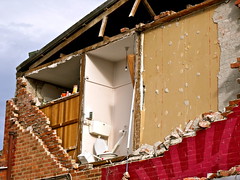
Part of Mike Hewson's installation 'Homage To Lost Spaces' in the Cramner Courts building, a photograph of a young man working at a desk has been inserted into a gap in the building. The photographer comments, "Cranmer Courts in Christchurch, New Zealand was very badly damaged in the earthquakes that have rocked the City for the past two years. Mike Hewson thought he would try to bring life back into the buildings by putting photographs into the spaces where the doors and windows were. There was a month or so when no one seemed to know or admit who had put the pictures up, but it was done officially. It seems that though very badly damaged the buildings may get restored".
Southern Response in court contesting class action
Audio, Radio New Zealand
Southern Response is back in court today - this time having a final go at arguing that a class action against it should not be an 'opt-out'. Christchurch residents Brendan and Colleen Ross say the state insurer deliberately withheld the true cost of repairing their home which was damaged in the Canterbury earthquakes. They are now among 3000 people represented in a class action led by Christchurch lawyer Grant Cameron. In September last year the Court of Appeal decided the class action could proceed on an 'opt-out' basis - which means it would cover more people and potentially cost the state-owned insurer more money if it loses. Southern Response is challenging that decision in the Supreme Court, a two day hearing wrapped up on Tuesday. Checkpoint reporter Logan Church was there.
The Week In Review for week ending Fri May 5 2017
Audio, Radio New Zealand
A review of the week's news including... New questions are raised by leaked video footage showing a robot and two workers inside the Pike River mine just months after the 2010 disaster, fresh happy faces in the newly announced Labour list line up, the country's two biggest media companies have been given a strong message from the regions after their proposed merger is knocked back, a full biosecurity operation launched in Kerikeri, Wellington house prices soar, a helicopter pilot describes his crash north of Wellington as 'frightening', women in the Mongrel Mob say there is now less violence towards women, a review of the Kaikoura earthquake reveals it generated a tsunami of nearly 7 metres, the most annoying driving habits on Christchurch roads and one half of a champion rowing crew is surprised by the other half's retirement announcement.
Riding the seismic waves: Re-blending teacher education in response to cha…
Research papers, University of Canterbury Library
Blended learning plays an important role in many tertiary institutions but little has been written about the implementation of blended learning in times of adversity, natural disaster or crisis. This paper describes how, in the wake of the 22 February Canterbury earthquake, five teacher educators responded to crisis-driven changing demands and changing directions. Our narratives describe how blended learning provided students in initial teacher education programmes with some certainty and continuity during a time of civil emergency. The professional learning generated from our experiences provides valuable insights for designing and preparing for blended learning in times of crisis, as well as developing resilient blended learning programmes for the future.
Innovative seismic solutions for multi-storey LVL timber buildings
Research papers, University of Canterbury Library
Describes an extensive experimental program at the University of Canterbury, for the development of new structural systems and connections for multi-storey laminated veneer lumber (LVL) timber buildings in earthquake-prone areas. The proposed innovative ductile timber connections are conceptually similar to recent seismic solutions successfully developed for precast concrete multi- storey buildings. The paper gives an overview of the research program, and the results of quasi-static cyclic tests on frame subassemblies, including exterior beam-column joints and cantilever columns, as well as pseudo-dynamic tests on cantilever columns. The experimental results showed significant dissipation of hysteretic energy, good self-centering capacity and no appreciable damage of the structural elements, confirming the expected enhanced performance of the proposed structural systems.