
Search
found 14117 results
Images for christchurch earthquake; more images...


20130130_1876_1D3-24 Park Royal (Crowne Plaza) site
Images, eqnz.chch.2010
None
20130130_1887_1D3-80 Not what we normally call a Pallet Fire
Images, eqnz.chch.2010
None
20131231_8503_EOS M-22 From Cashel Street
Images, eqnz.chch.2010
20131231_8503_EOS M-22 From Cashel Street Another city walk around, this time with my brother-in-law from Auckland. Also went to the Quake City exhibition in the city organised by the Canterbury Museum. First fine day for a while. #4504
20130130_1882_1D3-24 Pallet Pavilion on Park Royal site
Images, eqnz.chch.2010
None
20130130_1897_1D3-105 Bridge on crack - Bridge of Rememberance
Images, eqnz.chch.2010
None
20130130_1892_1D3-90 Coffee on the old Santarini site - Gloucester Street
Images, eqnz.chch.2010
None
20130130_1859_1D3-105 St Lukes in the City - stone memorial
Images, eqnz.chch.2010
None
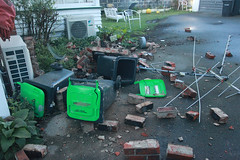
20130130_1884_1D3-60 Jaws in the Door!
Images, eqnz.chch.2010
Former Salvation Army Citadel on Durham Street.
20130130_1873_1D3-75 Thai (rock) takeaways
Images, eqnz.chch.2010
Corner of Durham and Kilmore.
Estimated seismic performance of a standard NZS3101:2006 RC office buildin…
Research papers, University of Canterbury Library
This paper discusses the seismic performance of the standard RC office building in Christchurch that is given as a structural design example in NZS3101, the concrete structures seismic standard in New Zealand. Firstly the push-over analysis was carried out to evaluate the lateral load carrying capacity of the RC building and then to compare that carrying capacity with the Japanese standard law. The estimated figures showed that the carrying capacity of the New Zealand standard RC office building of NZS3101:2006 was about one third of Japanese demanded carrying capacity. Secondly, time history analysis of the multi-mass system was performed to estimate the maximum response story drift angle using recorded ground motions. Finally, a three-dimensional analysis was carried out to estimate the response of the building to the 22nd February, 2011 Canterbury earthquake. The following outcomes were obtained. 1) The fundamental period of the example RC building is more than twice that of Japanese simplified calculation, 2) The example building’s maximum storey drift angle reached 2.5% under the recorded ground motions. The main purpose of this work is to provide background information of seismic design practice for the reconstruction of Christchurch.
Question Time for 15 November 2016
Audio, Radio New Zealand
ANDREW LITTLE to the Prime Minister: What are the priorities for the Government in assisting communities affected by yesterday’s earthquake? MATT DOOCEY to the Minister of Finance: What advice has he received about the economic impact of the Kaikōura earthquake? EUGENIE SAGE to the Minister of Transport: What updates can he give on the transport sector’s response to earthquake damage to State Highway 1 and the rail line between Seddon and Cheviot? GRANT ROBERTSON to the Minister of Finance: What is his initial assessment of the fiscal impact of yesterday morning’s earthquake and what, if any, new or changed Budget allocations is he considering in response to the earthquake? PAUL FOSTER-BELL to the Minister of Civil Defence: How is the Government supporting people affected by the Kaikōura earthquake? RON MARK to the Minister of Civil Defence: Can the Government assure New Zealanders on our level of preparedness for all natural disasters? SUE MORONEY to the Minister of Transport: What roads and public transport services are currently not operational following damage from the earthquake yesterday and when is it expected access and services will be restored? BRETT HUDSON to the Minister of Transport: What action is the Government taking to repair damaged transport infrastructure following the Kaikōura earthquake? GARETH HUGHES to the Minister of Broadcasting: Will she join with me to acknowledge the work of all media in New Zealand, which is so important in times of natural disaster and crisis; if so, will she consider increasing our public broadcaster Radio New Zealand’s funding in Budget 2017? CLAYTON MITCHELL to the Minister of Civil Defence: What progress has been made, if any, on new civil defence legislation which focuses on large and significant events such as the Christchurch and Kaikōura earthquakes? ALASTAIR SCOTT to the Minister of Health: What updates has he received on the Government’s health response to the Kaikōura earthquake? CLARE CURRAN to the Minister of Civil Defence: What actions have been taken by Civil Defence to ensure those people in the areas worst hit by the earthquake have enough food, clothing, water, and shelter?
Key elements of sectoral recovery and resilience after the Canterbury eart…
Research papers, University of Canterbury Library
The Canterbury region of New Zealand experienced four earthquakes greater than MW 6.0 between September 2010 and December 2011. This study employs system dynamics as well as hazard, recovery and organisational literature and brings together data collected via surveys, case studies and interviews with organisations affected by the earthquakes. This is to show how systemic interactions and interdependencies within and between industry and geographic sectors affect their recovery post-disaster. The industry sectors in the study are: construction for its role in the rebuild, information and communication technology which is a regional high-growth industry, trucking for logistics, critical infrastructure, fast moving consumer goods (e.g. supermarkets) and hospitality to track recovery through non-discretionary and discretionary spend respectively. Also in the study are three urban centres including the region’s largest Central Business District, which has been inaccessible since the earthquake of 22 February 2011 to the time of writing in February 2013. This work also highlights how earthquake effects propagated between sectors and how sectors collaborated to mitigate difficulties such as product demand instability. Other interacting factors are identified that influence the recovery trajectories of the different industry sectors. These are resource availability, insurance payments, aid from central government, and timely and quality recovery information. This work demonstrates that in recovering from disaster it is crucial for organisations to identify what interacting factors could affect their operations. Also of importance are efforts to reduce the organisation’s vulnerability and increase their resilience to future crises and in day-to-day operations. Lastly, the multi-disciplinary approach to understanding the recovery and resilience of organisations and industry sectors after disaster, leads to a better understanding of effects as well as more effective recovery policy.
The Week in Review - week ending 4 March 2011
Audio, Radio New Zealand
A review of the week's news including: Christchurch's emergency operation moves from rescue to recovery, two minutes' silence observed nationwide, government announces aid package, Finance Minister outlines cost of quake, a fifth of Christchurch population has fled, inquiry launched into collapse of damaged buildings, many Christchurch schools remain closed and some of their pupils enrol elsewhere, students and farmers roll up their sleeves to help quake victims, rescuers tell stories of survival, hundreds of Wellington buildings expected not to meet earthquake safety standards and time capsule discovered under statue of Christchurch founding father
PM pledges $301m boost for rebuild of Christchurch schools
Audio, Radio New Zealand
The Prime Minister Chris Hipkins today announced an additional three hundred and one million dollar boost for the rebuild of earthquake damaged Christchurch schools, and said the programme in Christchurch may be a template for repairing flood damaged schools in the North Island. Some schools are still waiting to be repaired more than a decade after the devastating quakes. On his first visit to Christchurch since becoming Prime Minister, Chris Hipkins visited one of the schools still in the midst of its rebuild process, and to celebrate the progress being made. Our reporter Rachel Graham and videographer Nate McKinnon went along.
Observatory Tower Photograph 22
Images, UC QuakeStudies
A photograph of the base of the Townsend Telescope, still attached to a piece of rubble. The rubble is from the Observatory tower at the Christchurch Arts Centre. The tower collapsed during the 22 February 2011 earthquake and the rubble spilled into the courtyard in front. A digger was used to clear the rubble away from the building.
Jim Baltaxe WEMO Photograph 122
Images, UC QuakeStudies
A photograph of the earthquake damage to the Christchurch Chinese Methodist Church on Papanui Road. The gable walls have crumbled, bricks spilling onto the ground. The tower has been removed and braced on the ground in front. Cordon fencing has been placed around the building. Parts of the fence have been decorated with hearts and the word 'love'.
Overseas Correspondent - Japan
Audio, Radio New Zealand
Motoko Kakubayashi joins us from Toyko where they are also about to mark a significant anniversary. A few weeks after the 2011 Christchurch earthquake, a magnitude 9.0 earthquake hit the east coast of Japan, triggering a tsunami that destroyed large parts of the coast, including damage to the Fukushima Dai-ichi Nuclear Power Plant. More than 15,000 lives were lost, more than 2000 still remain missing. In one afternoon, half a million people became homeless, and the search for family and friends at evacuation shelters began.
A Modern Day Miracle
Images, UC QuakeStudies
A digitally manipulated image of a statue of the Virgin Mary in a broken window of the Cathedral of the Blessed Sacrament. The photographer comments, "Before the February 2011 earthquake the statue above was facing into the Cathedral looking down a corridor, but after it had turned 180 degrees to point towards the window. The statue of Mary turning like this gave a sign of hope for the people of Christchurch. It was amongst one of the most photographed things after the earthquake until it was removed".
WEMO ERT Set 1 - February 2011 - Photograph 31
Images, UC QuakeStudies
A photograph of a Singapore Rescue Team tent set up in Latimer Square after the 22 February 2011 earthquake. In the foreground there is a group of tents, cordoned off with tape and plastic mesh.
Fairfax Media Auckland Bureau Image: John Selkirk 2010:12:18 12:28:40
Images, UC QuakeStudies
Photograph captioned by Fairfax, "Cartier Guthrie and Jesse Grossi with Santa (played by Peter Leitch, the Mad Butcher, after he arrived in the police helicopter on Motuihe Island where other disadvantaged earthquake victims from Christchurch spent the day courtesy of Westpac)".
Southern Story for 21 April 2011 - Sydenham Shops
Audio, Radio New Zealand
The Christchurch suburb of Sydenham was badly affected by the first earthquake in September and February's quake has struck another blow to the local retail sector. But as Katy Gosset has found, shop owners say they're confident they can rebuild.
Readout of the President's Call to Prime Minister Key of New Zealand
Articles, UC QuakeStudies
A press release from the Office of the Press Secretary in the US White House about President Obama's call to Prime Minister John Key to express his condolences over the 22 February 2011 earthquake in Christchurch and to offer American assistance.
The Southland Times Image: Grant Bryant 2010:11:22 (01)
Images, UC QuakeStudies
Photograph captioned by Fairfax, "Veteran Christchurch art dealer Jonathan Smart at Queenstown's Toi O Tahuna yesterday, where a valuable collection of New Zealand art has found a temporary home after Mr Smart's new gallery was condemned because of earthquake damage".
Tourists forced to stay in marae, arts centre in Wellington
Audio, Radio New Zealand
Hundreds of tourists have spent the night in makeshift accommodation in Wellington after fleeing earthquake hit Christchurch. The tourists were flown to the capital by the Royal New Zealand Airforce, many without passports, money and belongings left behind in hotels.
Lyttelton port hopes to have core services back within week
Audio, Radio New Zealand
Lyttelton Port is still only operating at 40 percent of its full capacity, nine days after the Christchurch earthquake, but the Port company says its core services are all working and within a week it will be almost at full strength.
Rebekah Rogers WEMO Photograph 074
Images, UC QuakeStudies
A photograph of the earthquake damage the brick fence of a house in Christchurch. Bricks from the broken fence have been stacked on the footpath in front. Liquefaction has been piled on the footpath and road cones placed in front.
Rebekah Rogers WEMO Photograph 075
Images, UC QuakeStudies
A photograph of the earthquake damage the brick fence of a house in Christchurch. Bricks from the broken fence have been stacked on the footpath in front. Liquefaction has been piled on the footpath and road cones placed in front.
EQC claimant: 'Nothing could make up for what we've lost'
Audio, Radio New Zealand
EQC claimant Anita explains how she's still battling the Crown agency, years after her home was damaged in the Christchurch earthquakes. She says her floor is still uneven because the scope of works didn't state for it to be "flat".
Rebekah Rogers WEMO Photograph 103
Images, UC QuakeStudies
A photograph of a kitchen in the back of a van parked in Hagley Park. The van was one of many that were used as temporary accommodation for emergency management personnel who travelled to Christchurch after the 22 February 2011 earthquake.
Jim Baltaxe WEMO Photograph 039
Images, UC QuakeStudies
A photograph of an earthquake-damaged house in Christchurch. The walls on the side of the house have crumbled and the bricks have damaged the fence. A red sticker on the front window indicates that the building is unsafe to enter.