
Search
found 14117 results
Images for christchurch earthquake; more images...


BeckerFraserPhotos April 2011 photograph 398
Images, UC QuakeStudies
Moira Fraser standing in front of the 'Passing Time' sculpture on the corner of St Asaph Street and Madras Street. 'Passing Time' was installed outside the CPIT Building for the 6th SCAPE (a contemporary public art programme in Christchurch) a few days prior to the 22 February 2011 earthquake. The work features twisting boxes depicting each year between 1906 (the founding of CPIT) and 2010 (the date of the sculpture's production).
BeckerFraserPhotos April 2011 photograph 401
Images, UC QuakeStudies
Moira Fraser in front of the 'Passing Time' sculpture on the corner of St Asaph Street and Madras Street. 'Passing Time' was installed outside the CPIT Building for the 6th SCAPE (a contemporary public art programme in Christchurch) a few days prior to the 22 February 2011 earthquake. The work features twisting boxes depicting each year between 1906 (the founding of CPIT) and 2010 (the date of the sculpture's production).
Willburn Furniture and Restoration Needs Restoring
Images, UC QuakeStudies
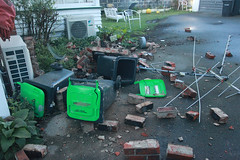
A digitally manipulated image of furniture and machinery. The photographer comments, "This furniture restoration company got caught in the middle of the Christchurch earthquake and lost a whole wall. After constant exposure to the elements everything now needs a bit of restoration. They are now working in a different part of Christchurch, but their past can still be seen".
Hubbard, James, 1949- : Quake may cost insurance co's up to $16B. 6 March …
Images, Alexander Turnbull Library
A man representing New Zealand reads a newspaper whose headline is ''Quake may cost insurance co's up to $16B'. Above him is an enormous mosquito that represents 'increased premiums' and that is about to suck the blood out of him; it casts a huge menacing shadow in which the man stands. Context - Insurance companies have experienced massive losses after the Canterbury earthquake. This may ultimately result in higher premiums as insurance companies try to recoup from their loss. According to Chris Ryan, Insurance Council chief executive, "The quake would probably result in foreign reinsurance companies increasing the premiums they charged local insurers." (Stuff 9 Sep 2010) Quantity: 1 digital cartoon(s).
Neighbours frustrated at rubbish in Christchurch red zone
Audio, Radio New Zealand
TVs, shopping trolleys, beds, mattresses, even a gun. That is just some of the rubbish found by residents surrounding Christchurch's residential red zone. The area used to be filled with houses, but damage after the Canterbury earthquakes forced thousands of homes to be demolished. While many of the old suburban roads remain, the area now resembles a park. But it is now attracting those wanting to dump their rubbish for free - and Land Information NZ, which controls the land, has removed 25 tonnes of trash since January. Residents have had enough as well - with some taking matters into their own hands. Checkpoint reporter Logan Church has the story.
Gulls turning Christchurch's New Regent street into eyesore
Audio, Radio New Zealand
Gulls are well known for swooping in and flogging food off your plate or picnic and now they are making a complete menace of themselves in Christchurch's New Regent street. Local businesses are being over-run by the red and black-billed gulls that are nesting on the rooves of buildings along the street, swooping and pooping all over the place. It's not the first time they've invaded, they started breeding in 2019 in an earthquake damaged building on the corner of Armagh and New Regent streets. The problem is both the red and black-billed gulls are protected. Casey Alderson from Belle Cafe spoke to Lisa Owen.
Where art and philanthropy meet: Ravenscar House, Christchurch
Audio, Radio New Zealand
Ravenscar House Museum holds an extraordinary, previously private art collection. The new building has been gifted to Christchurch by art collectors Susan Wakefield and her late husband Jim. The art remains in the ownership of the Ravenscar Trust. Artists in the collection include Colin McCahon, Bill Sutton and Frances Hodgkins. The treasures were previously in the Wakefield's Christchurch home which suffered irreparable earthquake damage. They're now displayed in the purpose-designed and built Ravenscar House Museum in the city's Arts precinct. The story of the art and artefacts is told in in the book - Ravenscar House: A Biography, written by Christchurch journalist and writer Sally Blundell.
Photograph number UC 11-0372-33
Images, UC QuakeStudies
Silver Awar, presented to Erin Jackson (from Christchurch), she acted as the Big Top manager during student volunteer army operations. Pictured here with Vice-Chancellor Dr Rod Carr, Prime Minister John Key and Minister for Canterbury Earthquake Recovery Gerry Brownlee.
Photograph number UC 11-0372-32
Images, UC QuakeStudies
Silver Award presented to Erin Jackson (from Christchurch), she acted as the Big Top manager during student volunteer army operations. Pictured here with Vice-Chancellor Dr Rod Carr, Prime Minister John Key and Minister for Canterbury Earthquake Recovery Gerry Brownlee.
Checkpoint Top Stories for Thursday 19 May 2011
Audio, Radio New Zealand
Full coverage of the budget and the cuts to kiwisaver, working for families and student loans. Plans to raise between 5 and 7 billion dollars from partial asset sales and a new Earthquake Kiwi Bond to raise money for Christchurch.
On Firmer Ground
Audio, Radio New Zealand
Since the February 22nd earthquake, an influx of displaced Christchurch residents have made North Canterbury their temporary home. Cosmo Kentish-Barnes finds out how some people have coped with this dramatic event and what locals are doing to support them.
Engineers examine CTV site as inquiry continues
Audio, Radio New Zealand
An investigation is continuing into the CTV site, where 115 people died in the Christchurch earthquake five years ago. Dr Maan Alkaisi, whose wife died in the collapse, is keeping a close eye on developments as engineers examine the site.
Photograph by Jennifer Middendorf 281
Images, UC QuakeStudies
A string quartet from Christchurch Girls High School plays on the riverbank before the River of Flowers event held in Riccarton Bush, commemorating the second anniversary of the 22 February earthquake. In the foreground people wait for the event to start.
Top Stories for Wednesday 15 May 2019
Audio, Radio New Zealand
The Prime Minister prepares for the Christchurch Call Summit in Paris saying governments need to protect their citizens from radicalisation, Police investigate who sent a threatening letter to the Earthquake Commission, A powerful 7.5 magnitude quake strikes PNG overnight.
Dateline Pacific evening edition for 29 April 2016
Audio, Radio New Zealand
Secret to Pacific growth is in its increasing working age population; CNMI school group is to challenge court gun ruling; Norfolk Islanders are seeking UN oversight, and; Lessons from the Christchurch earthquakes are being applied in Fiji to help heal.
Photograph by Jennifer Middendorf 294
Images, UC QuakeStudies
A string quartet from Christchurch Girls High School plays on the riverbank before the River of Flowers event held in Riccarton Bush, commemorating the second anniversary of the 22 February earthquake. In the foreground people wait for the event to start.
Helen Devereux Photograph 080
Images, UC QuakeStudies
For the first time in November 2011, Christchurch residents finally had the opportunity to see the earthquake-damaged city centre on the Red Zone bus tours organised by CERA. Damage to the Odeon Theatre can be seen out the window.
Helen Devereux Photograph 081
Images, UC QuakeStudies
For the first time in November 2011, Christchurch residents finally had the opportunity to see the earthquake-damaged city centre on the Red Zone bus tours organised by CERA. Damage to the Odeon Theatre can be seen out the window.
Helen Devereux Photograph 070
Images, UC QuakeStudies
For the first time in November 2011, Christchurch residents finally had the opportunity to see the earthquake-damaged city centre on the Red Zone bus tours organised by CERA. Damage to buildings on Cashel Street can be seen out the window.
Helen Devereux Photograph 096
Images, UC QuakeStudies
For the first time in November 2011, Christchurch residents finally had the opportunity to see the earthquake-damaged city centre on the Red Zone bus tours organised by CERA. The Regent Theatre dome which has been removed from the building.
Helen Devereux Photograph 090
Images, UC QuakeStudies
For the first time in November 2011, Christchurch residents finally had the opportunity to see the earthquake-damaged city centre on the Red Zone bus tours organised by CERA. Looking into Cathedral Square, the Regent Theatre dome can be partially seen.
Photograph by Jocelyn Kinghorn 2345
Images, UC QuakeStudies
On the one year anniversary of the February 22nd, flowers were placed in road cones across Christchurch to remember the earthquake victims. These two cone are next to a road sign that says 'Footpath closed. Please use other site'.
Children struggling in quake-hit Hurunui
Audio, Radio New Zealand
Nearly a year on from November's 7.8 magnitude earthquake, schools in the Hurunui District say children are struggling to cope. And if the experience of Christchurch is anything to go by, it's likely to get worse before it gets better.
Evans, Malcolm Paul, 1945-:The Red Zone Opened. 28 March 2011
Images, Alexander Turnbull Library
A business owner has been allowed into the 'Red Zone' in the Christchurch CBD in order to investigate the damage to his business premises. He is dismayed to discover that he has forgotten his keys; the Civil Defence officer who is with him, looks at him askance as the door is the only part of his premises still standing. Context - Some time after the earthquake of 22 March 2011 business owners were allowed through the cordon to collect belongings and see their premises for themselves. Colour and black and white versions of this cartoon are available Quantity: 2 digital cartoon(s).
Scott, Thomas, 1947- : "Bob darling, the chances of a news crew bursting i…
Images, Alexander Turnbull Library
The cartoon shows Christchurch mayor Bob Parker and his wife in bed. Bob Parker's wife says 'Bob darling, the chances of a news crew bursting in here at this time of night are virtually nil, so please take that bloody jacket off...' Context - Bob Parker, it is true, seems to be wearing the same trendy orange and black 'site manager's jacket for the very many photo opportunities afforded post earthquake of 22 February 2011. Quantity: 1 digital cartoon(s).
Evans, Malcolm Paul, 1945-:Reserve Bank governor moves to restore confiden…
Images, Alexander Turnbull Library
Governor of the Reserve Bank Allan Bollard holds a spade over his shoulder and a roll of toilet paper in his hand. Text reads 'Reserve Bank governor moves to restore confidence after the quake -' and Bollard says '..past the silver beet, left at the last of the beans and it's right by the caulis!' The little Evans man says 'What a relief!' Context - Two earthquakes and hundreds of aftershocks have hit Christchurch, the first on 4 September 2010 and a second more devastating one on 22 February 2011. Toilets have been a real problem after the earthquakes with thousands of chemical toilets and portaloos being shipped in - some people, however, use the old kiwi method of digging a long-drop in the back garden. The Reserve Bank has made a relatively large 50-point cut in its benchmark interest rate, the Official Cash Rate (from 3% to 2.5 per cent). Critics say that inflation is already running unacceptably high and there is a threat of much higher inflation in a year or two when the rebuilding of Christchurch begins to put pressure on limited resources. The Reserve Bank acknowledged these factors, but it has chosen instead to focus on the immediate impact of the earthquake on the economy and particularly on all-important business and consumer sentiment. (Press editorial 12 March 2011) Colour and black and white versions available Quantity: 2 digital cartoon(s).
The consumption of chaos: From the charm of chaos to the tedium of order -…
Research papers, Lincoln University
Prior to the devastating 2010 and 2011 earthquakes, parts of the CBD of Christchurch, New Zealand were undergoing revitalisation incorporating aspects of adaptive reuse and gentrification. Such areas were often characterised by a variety of bars, restaurants, and retail outlets of an “alternative” or “bohemian” style. These early 20th century buildings also exhibited relatively low rents and a somewhat chaotic and loosely planned property development approach by small scale developers. Almost all of these buildings were demolished following the earthquakes and a cordon placed around the CBD for several years. A paper presented at the ERES conference in 2013 presented preliminary results, from observation of post-earthquake public meetings and interviews with displaced CBD retailers. This paper highlighted a strongly held fear that the rebuild of the central city, then about to begin, would result in a very different style and cost structure from that which previously existed. As a result, permanent exclusion from the CBD of the types of businesses that previously characterised the successfully revitalised areas would occur. Five years further on, new CBD retail and office buildings have been constructed, but large areas of land between them remain vacant and the new buildings completed are often having difficulty attracting tenants. This paper reports on the further development of this long-term Christchurch case study and examines if the earlier predictions of the displaced retailers are coming true, in that a new CBD that largely mimics a suburban mall in style and tenancy mix, inherently loses some of its competitive advantage?
Federated Digital Archives and Disaster Recovery: The Role of the Digital …
Research papers, University of Canterbury Library
The University of Canterbury CEISMIC Canterbury Earthquake Digital Archive draws on the example of the Centre for History and New Media’s (CHNM) September 11 Archive, which was used to collect digital artefacts after the bombing of the World Trade Centre buildings in 2001, but has gone significantly further than this project in its development as a federated digital archive. The new University of Canterbury Digital Humanities Programme – initiated to build the archive – has gathered together a Consortium of major national organizations to contribute content to a federated archive based on principles of openness and collaboration derived directly from the international digital humanities community.
Seeking investors to restore iconic Christchurch Dux de Lux pub
Audio, Radio New Zealand
The much loved 'Dux de Lux' pub in Christchurch could be set to open its doors again in the next few years if enough money can be raised to restore it. The building was badly damaged by the earthquake in 2011 and a group looking to rebuild the pub say it could take around 12 million dollars to see it welcoming Cantabrians back. James Stewart of Gemelli Consulting had a yarn with Nathan Rarere about a couple of schemes to raise the money.
Reparability of earthquake damaged Reinforced Concrete walls
Research papers, University of Canterbury Library
The 2010-2011 Christchurch earthquakes generated damage in several Reinforced Concrete (RC) buildings, which had RC walls as the principal resistant element against earthquake demand. Despite the agreement between structural engineers and researchers in an overall successfully performance there was a lack of knowledge about the behaviour of the damaged structures, and even deeper about a repaired structure, which triggers arguments between different parties that remains up to these days. Then, it is necessary to understand the capacity of the buildings after the earthquake and see how simple repairs techniques improve the building performance. This study will assess the residual capacity of ductile slender RC walls according to current standards in New Zealand, NZS 3101.1 2006 A3. First, a Repaired RC walls Database is created trying to gather previous studies and to evaluate them with existing international guidelines. Then, an archetype building is designed, and the wall is extracted and scaled. Four half-scale walls were designed and will be constructed and tested at the Structures Testing Laboratory at The University of Auckland. The overall dimensions are 3 [m] height, 2 [m] length and 0.175 [m] thick. All four walls will be identical, with differences in the loading protocol and the presence or absence of a repair technique. Results are going to be useful to assess the residual capacity of a damaged wall compare to the original behaviour and also the repaired capacity of walls with simpler repair techniques. The expected behaviour is focussed on big changes in stiffness, more evident than in previously tested RC beams found in the literature.