

Search
found 97217 results
Images for Zealand; more images...
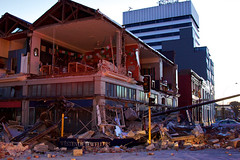


The Vault - Earthquake at Radio New Zealand House
Audio, Radio New Zealand
Deborah Nation recalls how it was in the Sound Archives and Radio New Zealand offices in Christchurch on the day of the February earthquake. The building on the corner of Durham and Chester Street West has been condemned. Please be aware that the first sounds of this report may be upsetting, especially to listenners who experienced the earthquake.
Global insurance industry now wary of New Zealand
Audio, Radio New Zealand
The insurance industry says overseas insurers have become wary of New Zealand after Monday's earthquakes in Christchurch and higher premiums across the country are now almost inevitable.
Liquefaction and Paleo-liquefaction in Christchurch, New Zealand
Research papers, University of Canterbury Library
Liquefaction during the 4th September 2010 Mw 7.1 Darfield earthquake and large aftershocks in 2011 (Canterbury earthquake sequence, CES) caused severe damage to land and infrastructure within Christchurch, New Zealand. Approximately one third of the total CES-induced financial losses were directly attributable to liq- uefaction and thus highlights the need for local and regional authorities to assess liquefaction hazards for present and future developments. This thesis is the first to conduct paleo-liquefaction studies in eastern Christchurch for the purpose of de- termining approximate return times of liquefaction-inducing earthquakes within the region. The research uncovered evidence for pre-CES liquefaction dated by radiocarbon and cross-cutting relationships as post-1660 to pre-1905. Additional paleo-liquefaction investigations within the eastern Christchurch suburb of Avon- dale, and the northern township of Kaiapoi, revealed further evidence for pre-CES liquefaction. Pre-CES liquefaction in Avondale is dated as post-1321 and pre-1901, while the Kaiapoi features likely formed during three distinct episodes: post-1458 and possibly during the 1901 Cheviot earthquake, post-1297 to pre-1901, and pre-1458. Evaluation of the liquefaction potential of active faults within the Can- terbury region indicates that many faults have the potential to cause widespread liquefaction within Avondale and Kaiapoi. The identification of pre-CES liquefac- tion confirms that these areas have previously liquefied, and indicates that residen- tial development in eastern Christchurch between 1860 and 2005 occurred in areas containing geologic evidence for pre-CES liquefaction. Additionally, on the basis of detailed field and GIS-based mapping and geospatial-statistical analysis, the distribution and severity of liquefaction and lateral spreading within the eastern Christchurch suburb of Avonside is shown in this study to be strongly in uenced by geomorphic and topographic variability. This variability is not currently ac- counted for in site-specific liquefaction assessments nor the simplified horizontal displacement models, and accounts for some of the variability between the pre- dicted horizontal displacements and those observed during the CES. This thesis highlights the potential applications of paleo-liquefaction investigations and ge- omorphic mapping to seismic and liquefaction hazard assessments and may aid future land-use planning decisions.
Natural hazards and environmental assessment in New Zealand
Research papers, Lincoln University
Environmental assessment in New Zealand is governed by the provisions of the Resource Management Act (RMA) 1991. The Act requires persons wishing to undertake certain activities to apply for resource consent from their local or regional council - a procedure termed the Resource Consent Process. The key component of a resource consent application is an Assessment of Environmental Effects (AEE) report; a statement of the environmental effects of a proposed activity. Problems arise when environmental assessments are complicated by uncertain and abnormal circumstances such as natural hazards. Natural hazards (including earthquakes, floods, tsunami, and coastal erosion) can be catastrophic to an environment. If hazards are not avoided or successfully mitigated, they can result in serious consequences to proposed development and to the environment which the proposal relates. The aim of this study is to assess the adequacy of the resource consent process (as outlined in the Resource Management Act 1991) for dealing with proposed development affected by natural hazards. This study reviews the context of the resource consent process for dealing with natural hazards to identify potential issues in the assessment process. Guidance criteria for assessing natural hazards (termed Natural Hazard Assessment) are developed to evaluate against two resource consent applications affected by natural hazards. The findings of the consent process review and case study evaluation are discussed to determine the adequacy of the consent process for dealing with natural hazards. From the review of the consent process it was evident that the process has a number of problems for accommodating natural hazards into the assessment. Although many important traits are provided for in the process, such traits are not always reflected in environmental assessments. Evaluation of two resource consent applications against the process of Natural Hazard Assessment (NHA) showed that these consent applications did not adequately detail key information relating to natural hazards. Many problems evident in these applications were not amended by the Consent Authorities in the review process and subsequently consent was granted to information-deficient applications. Problematic issues identified in this study include: • A distinct lack of guidance (legal or otherwise) for the applicant and Consent Authority regarding the boundaries of inclusion of an effect; • Deficiencies in planning documents are reflected in AEE reports, the review of the consent application and in the end-decision; • Under-utilisation of "experts" throughout the consent process; • Minimal identification and account for the degree of uncertainty throughout the consent process; • Resource consents are being granted even though information in consent applications, and the means for assessing the information is deficient. These issues reflect that decisions are not being made based on all elements involved in a potential hazard. Subsequently, the resource consent process is not adequate for dealing with all aspects of natural hazards. The Natural Hazard Assessment process provides educated assessment criteria to assess development affected by natural hazards. By accounting for the problems evident in the consent process, the introduction of a three-tier identification, risk and vulnerability assessment, and evaluation process to account for uncertainties, Natural Hazard Assessment provides a platform for a thorough assessment of natural hazards. The application of the principles of Natural Hazard Assessment to the consent applications affected by natural hazards showed that many key issues were not covered in the assessment under the consent process. The nature of a natural event is that one may not occur in a given region over many lifetimes, however they will occur at some stage and planning and environmental assessment needs to provide for the associated hazards. Implementation of Natural Hazard Assessment is needed to help provide answers for the problems experienced in the resource consent process. Natural Hazard Assessment would allow decision-makers to make informed judgements on the situation at hand, leading to better planning and land-use options. Change to current practice is needed, as following the current path of environmental assessment will be the hazard in the end.
Fairfax Video, September 2010 (16)
Videos, UC QuakeStudies
A video about the New Zealand Police and the New Zealand Army working in Christchurch to keep the city safe following the 4 September 2010 earthquake. The video includes an interview with Senior Sergeant Phillip Dean, Captain Mark Rutledge, Lance Corporal Aaron Tuhi, Lieutenant Dennis Petre, and Second Lieutenant David Pedrosa-Durie. It also includes footage of the New Zealand Military preparing meals at Burnham Camp.
Christchurch Press Infographic: 10 May 2011 (2)
Images, UC QuakeStudies
A graphic comparing healthy behaviours in Christchurch and other New Zealand cities.
Canterbury Earthquake - Monique Devereux
Audio, Radio New Zealand
Monique Devereux is a Christchurch resident and former Radio New Zealand reporter.
Christchurch Earthquake - Karen Neill
Audio, Radio New Zealand
Karen Neill from the Sound Archives at Radio New Zealand's Christchurch office.
Christchurch Press Infographic: 9 December 2011
Images, UC QuakeStudies
A graph comparing the Christchurch price index to the New Zealand index.
Fairfax Video, September 2010 (27)
Videos, UC QuakeStudies
A video of members of the New Zealand Police and the New Zealand Army guarding cordons in the Christchurch central city after the 4 September 2010 earthquake. The video also includes footage of a helicopter flying over the central city.
Canterbury Earthquake - Jessica Maddock
Audio, Radio New Zealand
Radio New Zealand reporter Jessica Maddock reports from the Christchurch Central City cordon.
Canterbury Earthquake - Don Rood
Audio, Radio New Zealand
Radio New Zealand's Head of News, Don Rood, has just arrived in Christchurch.
Canterbury Earthquake - Jessica Maddock
Audio, Radio New Zealand
Radio New Zealand reporter Jessica Maddock has been to a Civil Defense Briefing.
Christchurch Press Infographic: 10 February 2012 (2)
Images, UC QuakeStudies
An infographic comparing unemployment rates in Canterbury to the rest of New Zealand.
Koen Broekema's Photograph 013
Images, UC QuakeStudies
The New Zealand flag flutters above the damaged stonework of Christ Church Cathedral.
Conference uncovered
Articles, Christchurch uncovered
For a change of pace, a group from Underground Overground Archaeology spent last week out of the office, and out of Christchurch at the New Zealand Archaeological Association Conference on Stewart Island. The New Zealand Archaeological Association (known affectionately as … Continue reading →
What we find from the Antipodes
Articles, Christchurch uncovered
‘If you dig a hole through the centre of the Earth, you would arrive in New Zealand’. As Spanish children, we learnt that at school. Spain is the Antipodes of New Zealand. Both countries are at the same time joined … Continue reading →
Christchurch Press Infographic: 31 March 2012 (6)
Images, UC QuakeStudies
A chart comparing electricity price increases in Christchurch to the rest of New Zealand.
Christchurch Press Infographic: 18 January 2012 (4)
Images, UC QuakeStudies
A graph comparing domestic trading activity in Canterbury to the rest of New Zealand.
Register Record for the New Zealand Loan and Mercantile Woolstore, 116-118…
Articles, UC QuakeStudies
Register Record for New Zealand Loan and Mercantile Woolstore, 116-118 Durham Street, Christchurch.
Christchurch Press Infographic: 13 July 2011 (2)
Images, UC QuakeStudies
A graph comparing EFT-POS spending in Canterbury to the rest of New Zealand.
Canterbury Earthquake - Jessica Maddock
Audio, Radio New Zealand
Radio New Zealand reporter Jessica Maddock reports on a briefing by Mayor Bob Parker.
Photograph of 18 Bracken Street
Images, UC QuakeStudies
A photograph taken for Heritage New Zealand of the house at 18 Bracken Street.
Photograph of 15 Keller Street
Images, UC QuakeStudies
A photograph taken for Heritage New Zealand of the house at 15 Keller Street.
Photograph of 12 Bracken Street
Images, UC QuakeStudies
A photograph taken for Heritage New Zealand of the house at 12 Bracken Street.
Photograph of 58 Keller Street
Images, UC QuakeStudies
A photograph taken for Heritage New Zealand of the house at 58 Keller Street.
Vulnerability to Seismic Hazards in Coastal and Riverside Communities, map…
Images, UC QuakeStudies
A map of the tectonic plate boundary of the alpine fault in New Zealand.
Photograph number UC 10-0490-53
Images, UC QuakeStudies
Staff Sergeant Manu from the New Zealand Army helping organise the Student Volunteer Army.
Photograph number UC 10-0490-54
Images, UC QuakeStudies
Staff Sergeant Manu from the New Zealand Army helping organise the Student Volunteer Army.
Put this in your pipe and smoke it!
Articles, Christchurch uncovered
A few weeks ago, there was an interesting interview on Radio New Zealand with historian Jock Phillips, on the history of tobacco use in New Zealand. In the interview, Jock talked about the ways in which people consumed tobacco in … Continue reading →