

Search
found 147 results
Images for September 2010 Canterbury Earthquake; more images...

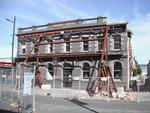

Jim Baltaxe WEMO Photograph 107
Images, UC QuakeStudies
A photograph of the earthquake damage to the Canterbury Provincial Chambers on Durham Street. The top of one of the chambers has crumbled and the masonry has fallen onto the footpath. Scaffolding which was erected after the 4 September 2010 earthquake has also fallen. Wire fences have been placed around the building as a cordon.
Jim Baltaxe WEMO Photograph 108
Images, UC QuakeStudies
A photograph of the earthquake damage to the Canterbury Provincial Chambers on Durham Street. The top of one of the chambers has crumbled and the masonry has fallen onto the footpath. Scaffolding which was erected after the 4 September 2010 earthquake has also fallen. Wire fences have been placed around the building as a cordon.
Nisbet, Alistair, 1958-: NZ city strengthening? 6 March 2011
Images, Alexander Turnbull Library
Text at the top of the cartoon reads 'NZ city strengthening?' A whole city enclosed in a glass dome and balanced on huge springs intended to make it earthquake resistant rocks as another aftershock hits. Context - Two earthquakes and hundreds of aftershocks have hit Christchurch, the first on 4 September 2010 and a second more devastating one on 22 February 2011. There has been great emphasis on making heritage buildings that are rebuilt and all new buildings earthquake resistant. The example in the cartoon is perhaps a Springs-with-damper base isolator. Quantity: 1 digital cartoon(s).
Hawkey, Allan Charles, 1941-:[Christchurch earthquake] 23 February 2011
Images, Alexander Turnbull Library
Shows the face of a man with a large tear rolling down his cheek ; in the tear is the word 'Christchurch'. Context - On 22 February 2011 at 12:51 pm (NZDT), Christchurch experienced a major magnitude 6.3 earthquake, which resulted in severe damage and many casualties. A National State of Emergency has been declared. This followed on from an original magnitude 7.1 earthquake on 4 September 2010 which did far less damage and in which no-one died. Quantity: 1 digital cartoon(s).
Nisbet, Alistair, 1958- :'Well, we're all going batty down here.' 30 Septe…
Images, Alexander Turnbull Library
Batman is abroad in the night in 'Gotham City' and says 'Well we're all going batty down here!' Context: A reference to Christchurch, still struggling to recover from the earthquakes of 2010 and 2011. Quantity: 1 digital cartoon(s).
Evans, Malcolm Paul, 1945-:[Christchurch earthquake] 23 February 2011
Images, Alexander Turnbull Library
Someone holds a bucket with 'Christchurch' printed on it for collecting donations. Context - People need assistance after the devastating earthquake of the 22nd February. On 22 February 2011 at 12:51 pm (NZDT), Christchurch experienced a major magnitude 6.3 earthquake, which resulted in severe damage and many casualties. A National State of Emergency has been declared. This followed on from an original magnitude 7.1 earthquake on 4 September 2010 which did far less damage and in which no-one died. Both colour and black and white versions of this cartoon are available Quantity: 2 digital cartoon(s).
Tremain, Garrick, 1941-:Whole lotta shakin' goin' on. 19 March 2011
Images, Alexander Turnbull Library
A woman sits reading a newspaper with reports about the Japanese earthquake and the latest news on Christchurch post-earthquake. Her husband has just put a Jerry Lee Lewis record on the turntable and the song 'Whole lotta shakin' goin' on' is playing; he says Didn't I always say this guy was ahead of his time?' Context - The Christchurch earthquakes of September 4 2010 and February 22 2011 as well as the Japanese earthquake and tsunami of 11 March 2011. Quantity: 1 digital cartoon(s).
Nisbet, Alistair, 1958- :WHUMP! WHUMP! WHUMP! 15 June 2011
Images, Alexander Turnbull Library
A huge fist representing 'quakes', that is wearing a boxing glove, thumps a man who represents 'CHCH' (Christchurch) 'WHUMP! WHUMP! WHUMP!' The man is knocked out. Context - Magnitude 6.0 and 5.5 earthquakes rocked Christchurch again at 1pm and 2.20pm on 13th June 2011. These quakes follow the first earthquake on September 4th 2010 and the second on February 22nd 2011. (www.stuff.co.nz, 13 June 2011) Quantity: 1 digital cartoon(s).
Winter, Mark, 1958-:[Pulling the pin] 14 March 2011
Images, Alexander Turnbull Library
The globe is depicted as a hand grenade; the skeletal remains of a hand reach out to 'pull the pin'. Context - the fragility of the world from a New Zealand point of view seen in the light of the Christchurch earthquakes of 4 September 2010 and 22 February 2011 and the Japanese earthquake and tsunami of 22 February 2011 and the present threat of a nuclear catastrophe caused by damaged nuclear power plants. Quantity: 1 digital cartoon(s).
Shaken but not Stirred: A University's Resilience in the Face of Adversity…
Research papers, University of Canterbury Library
On 4 September 2010, people in Canterbury were shaken from their beds by a major earthquake. This report tells the story of the University of Canterbury (UC), its staff and its students, as they rose to the many challenges presented by the earthquake. This report however, is intended to do more than just acknowledge their hard work and determination; it also critically reflects on the things that worked well and the aspects of the response that, in hindsight, could have been done better. Luckily major events such as this earthquake do not happen every day. UC has benefited from the many universities around the world that have shared their experiences of previous disasters. We hope that this report serves to pass forward the favour and enables others to benefit from the lessons that we have learnt from this event.
Winter, Mark, 1958-: Good Will/Wills/William. 18 March 2011
Images, Alexander Turnbull Library
The cartoon shows a caricature of Prince William accompanied by the words 'Good Wills'. A second version has the words 'GOOD WILLiam' and the third has the words 'Good Will'. Context - Prince William visited New Zealand, and Christchurch in particular, after the earthquakes of 4 September 2010 and 22 February 2011 in Christchurch. Quantity: 3 digital cartoon(s).
Winter, Mark 1958- :"I promise ... not to promise again." 5 September 2011
Images, Alexander Turnbull Library
The title is 'Gerry BrownLie?' and the cartoon shows the Minister for Earthquake recovery, Gerry Brownlee, saying 'I promise not to promise again'. The words 'Red Zone' appear beneath with the word 'faced' inserted between them. Context: The 'Red Zone' is the earthquake area in which houses cannot be rebuilt. Earthquake Minister Gerry Brownlee has apologised for falsely promising red zone homeowners they would be paid out for improvements to their house. Brownlee promised in June that, in some cases, home improvements like new kitchens would be included in the government settlement offer for red zone houses. But the offer is only valid if the improvement has added to the footprint of the house. (Press - 4 September 2011) Alternate version of DCDL-0018757 Quantity: 1 digital cartoon(s).
Winter, Mark 1958- :More quACHES. 14 June 2011
Images, Alexander Turnbull Library
The cartoon consists of the words 'More quACHES' drawn with a stencil. Context - Two more earthquakes rocked Christchurch on 13th June, following those of 4 September 2010 and 22 February 2011. The first magnitude 5.5 quake struck at 1pm, 10 kilometres east of Christchurch at Taylor's Mistake beach, at a depth of 11 kilometres, and sent people scrambling for cover. It was followed at 2.20pm by a more powerful magnitude 6 quake, centred 10 kilometres southeast of the city and 9km underground. There is a wordplay on 'quakes' and 'aches'. Quantity: 1 digital cartoon(s).
Nisbet, Alistair, 1958- :"My god! not another aftershock!" ... 8 September…
Images, Alexander Turnbull Library
A couple are woken by loud thuds, rumbles and crashes. A woman leaps up in bed in a panic saying 'My God! Not another aftershock!' Her husband says 'Nah! Another flamin' haka!' A newspaper on the bed has a headline that reads 'World Cup in full swing.' Context: The World Cup began on Friday 9th September and ends on 23 October. People in Christchurch are still regularly jolted by aftershocks to the earthquakes of September 2010 and February and June 2011. Quantity: 1 digital cartoon(s).
Fairfax Video, December 2011 (5)
Videos, UC QuakeStudies
A video about Whare, a gift and homeware store which relocated several times after the 4 September 2010 earthquake. Whare originally had two stores, one in Beckenham, and another on Lichfield Street in the central city. Both stores were closed as a result of the 22 February 2011 earthquake. The store reopened temporarily in a garage and then in the Snowride Store on Lincoln Road. This video was part of The Press's 'Up and Running' series which showcases businesses which have stayed up and running despite the challenges posed by the 2010 and 2011 Canterbury earthquakes.
Nisbet, Alistair, 1958- :"Is it my turn yet?" 7 June 2011
Images, Alexander Turnbull Library
Two huge wrestlers, one representing 'Port Hills fault' and the other 'Greendale fault' struggle together over a broken Christchurch. Another wrestler, representing 'Other faults' appears in the distance yelling 'Is it my turn yet?' Context - Christchurch has now had three major earthquakes and thousands of aftershocks. It now appears likely that the Christchurch quakes resulted from activity on a fault extending directly eastward from the Alpine fault that remained unknown until last year, says Roger Musson, a seismologist at the British Geological Survey in Edinburgh. The new fault first came to light last September (4th) when a stronger but less calamitous quake shook Darfield, 40 kilometres west of Christchurch. Musson says the latest quake (Feb 22, 2011) probably resulted from an eastward continuation of activity on the same fault. "It has probably not moved for tens of thousands of years, so lots of strain built up," says Musson. The third major quake happened on 13th June 2011. (New Scientist - February 22, 2011) Quantity: 1 digital cartoon(s).
Evans, Malcolm Paul, 1945-:[Christchurch earthquakes and Pike River Mine] …
Images, Alexander Turnbull Library
The cartoon shows the hands of two people joined in mutual despair and kindness. One represents 'Christchurch' and the other the 'Pike River Mine'. Context - the 7.1 earthquake on 4 September 2010 in Christchurch in which there was a lot of damage but no deaths, the Pike River Mine disaster which occurred on the West Coast on 19 November 2010 and caused the deaths of 29 coal miners and now on 22 February 2011 a 6.3 magnitude earthquake in Christchurch which has probably killed more than 200 people (at this point the number is still not known) and caused much more severe damage. The reason the apparently lesser magnitude quake caused more destruction is because it was very shallow, was in the middle of the day and struck very close to the centre of the city. Colour and black and white versions of this cartoon are available Quantity: 2 digital cartoon(s).
Evans, Malcolm Paul, 1945-:[Christchurch earthquake] 23 February 2011
Images, Alexander Turnbull Library
Someone holds a mobile phone and sends a text 'CH CH WE R ALL IN THS 2 GTHR' (Christchurch we are all in this together). Context - On 22 February 2011 at 12:51 pm (NZDT), Christchurch experienced a major magnitude 6.3 earthquake, which resulted in severe damage and many casualties. A National State of Emergency has been declared. This followed on from an original magnitude 7.1 earthquake on 4 September 2010 which did far less damage and in which no-one died. Both colour and black and white versions of this cartoon are available Quantity: 2 digital cartoon(s).
Evans, Malcolm Paul, 1945-: RWC ticket. 17 March 2011
Images, Alexander Turnbull Library
The cartoon shows a terribly disappointed rugby fan standing in the centre of a devastated Christchurch holding up a 'RWC ticket' and bleating 'BUT...' Context - The decision that there will be no Rugby World Cup games in Christchurch because of the damage caused by the earthquakes of 4 September 2010 and 22 February 2011. Colour and black and white versions of this cartoon are available Quantity: 2 digital cartoon(s).
Walker, Malcolm, 1950-: Always design in context... 15 March 2011
Images, Alexander Turnbull Library
Text across the top of the cartoon reads 'always design in context' There is a globe, small in the context, with a little message reading 'you are here' pointing, perhaps, to New Zealand or even more specifically, Christchurch; the globe is being threatened from all sides by forces of nature represented by the hand of god reaching out of clouds. Context - the Christchurch earthquakes of 4 September 2010 and 22 February 2011 and the idea that buildings must be designed in the context of their environment - NZ being earthquake-prone. Perhaps also the idea of 'design in context' in a broader sense. Quantity: 1 digital cartoon(s).
Library services without a library: post-earthquake use of virtual referen…
Research papers, University of Canterbury Library
Following the September 2010 earthquake and the closure of a number of campus libraries, library staff at the University of Canterbury was forced to rethink how they connected with their users. The established virtual reference service now meant library staff could be contacted regardless of their physical location. After the February earthquake, with University library closures ranging from 3 weeks to indefinite, this service came into its own as a vital communication tool. It facilitated contact between the library and both students and academics, as well as proving invaluable as a means for library staff to locate and communicate with each other. Transcripts from our post-earthquake interactions with users were analyzed using NVivo and will be presented in poster format showing the increase in usage of the service following the earthquakes, who used the service most, and the numbers and types of questions received. Our virtual reference tool was well used in the difficult post-earthquake periods and we can see this usage continuing as university life returns to normal.
Tremain, Garrick 1941- :"You have reached the quake helpline..." 19 June 2…
Images, Alexander Turnbull Library
A man wearing shorts and gumboots stands surrounded by liquefaction beside his collapsing house. He tries to phone the 'Quake helpline' for assistance and gets the response 'You have reached the quake helpline... If you're up to your knees in liquefaction... Press 1. If your house is down around your ears... Press 2. If you're looking for assistance or answers press on'. Context - The increasing frustration and misery of many Christchurch residents who are experiencing huge difficulty getting assistance after months of delays and continuing aftershocks following the Christchurch earthquakes of 4th September, 22 February and the two most recent ones on 13 June. Quantity: 1 digital cartoon(s).
Brockie, Robert Ellison, 1932- :God at his computer. 17 June 2011
Images, Alexander Turnbull Library
The cartoon shows God sitting at his computer with an image of a devastated Christchurch on the screen. He is about to hit the 'smite' key. Text above reads 'God at his computer'. Context - Two more earthquakes rocked Christchurch on 13th June, following those of 4 September 2010 and 22 February 2011. The first magnitude 5.5 quake struck at 1pm, 10 kilometres east of Christchurch at Taylor's Mistake beach, at a depth of 11 kilometres, and sent people scrambling for cover. It was followed at 2.20pm by a more powerful magnitude 6 quake, centred 10 kilometres southeast of the city and 9km underground. Quantity: 1 digital cartoon(s).
Observatory Tower Photograph 07
Images, UC QuakeStudies
A photograph of the Observatory tower at the Christchurch Arts Centre. There are cracks in the masonry of the tower near where the two storeys join. The cracks formed as a result of the 4 September 2010 earthquake. Wire fencing has been placed at the entrance to the courtyard in front as a cordon.
Nisbet, Alistair, 1958- :"Dang! I'm busting again!" 16 June 2011
Images, Alexander Turnbull Library
A man, half shown, sits on a loo and says 'Dang! I'm busting again! as he reaches for the toilet paper which has a different 'quake claim' printed on each section. Context - Magnitude 6.0 and 5.5 earthquakes rocked Christchurch again at 1pm and 2.20pm on 13th June 2011. These quakes follow the first earthquake on September 4th 2010 and the second on February 22nd 2011. (www.stuff.co.nz, 13 June 2011) Each time there is a significant quake more damage is done and so people have to make further insurance claims. Quantity: 1 digital cartoon(s).
Evans, Malcolm Paul, 1945-: [Christchurch milk.] 10 April 2011
Images, Alexander Turnbull Library
In three small frames above the main frame, milk tankers are shown bumping wildly over Christchurch roads made uneven by the earthquakes of September 4 2010 and February 22 2011; and in the large frame below a man is painting out the word 'milk' on a tanker and replacing it with the word 'butter'. Context - the bad roads caused by the erathquakes in Canterbury have turned the milk into butter. Colour and black and white versions available Title from file name Quantity: 2 digital cartoon(s).
Hubbard, James, 1949- :"Has Bill English made any uplifting pronouncements…
Images, Alexander Turnbull Library
Two businessmen emerge from a building wondering whether 'Bill English' has ''Made any uplifting pronouncements on the economy or budget lately?..' On the footpath outside is Finance Minister Bill English wearing a sandwich board that reads 'the end is nigh' and carrying a banner that reads 'We're doomed'. Context - the impact of an already struggling economy of the Christchurch earthquakes of 4 September 2010 and 22 February 2011. Quantity: 1 digital cartoon(s).
Strike-slip ground-surface rupture (Greendale Fault) associated with the 4…
Research papers, University of Canterbury Library
This paper provides a photographic tour of the ground-surface rupture features of the Greendale Fault, formed during the 4th September 2010 Darfield Earthquake. The fault, previously unknown, produced at least 29.5 km of strike-slip surface deformation of right-lateral (dextral) sense. Deformation, spread over a zone between 30 and 300 m wide, consisted mostly of horizontal flexure with subsidiary discrete shears, the latter only prominent where overall displacement across the zone exceeded about 1.5 m. A remarkable feature of this event was its location in an intensively farmed landscape, where a multitude of straight markers, such as fences, roads and ditches, allowed precise measurements of offsets, and permitted well-defined limits to be placed on the length and widths of the surface rupture deformation.
Earthquake News “Geotechnical Damage due to the 2011 Christchurch, New Zea…
Research papers, University of Canterbury Library
On 22 February 2011,a magnitude Mw 6.3 earthquake occurred with an epicenter located near Lyttelton at about 10km from Christchurch in Canterbury region on the South Island of New Zealand (Figure 1). Since this earthquake occurred in the midst of the aftershock activity which had continued since the 4 September 2010 Darfield Earthquake occurrence, it was considered to be an aftershock of the initial earthquake. Because of the short distance to the city and the shallower depth of the epicenter, this earthquake caused more significant damage to pipelines, traffic facilities, residential houses/properties and multi-story buildings in the central business district than the September 2010 Darfield Earthquake in spite of its smaller earthquake magnitude. Unfortunately, this earthquake resulted in significant number of casualties due to the collapse of multi-story buildings and unreinforced masonry structures in the city center of Christchurch. As of 4 April, 172 casualties were reported and the final death toll is expected to be 181. While it is extremely regrettable that Christchurch suffered a terrible number of victims, civil and geotechnical engineers have this hard-to-find opportunity to learn the response of real ground from two gigantic earthquakes which occurred in less than six months from each other. From geotechnical engineering point of view, it is interesting to discuss the widespread liquefaction in natural sediments, repeated liquefaction within short period and further damage to earth structures which have been damaged in the previous earthquake. Following the earthquake, an intensive geotechnical reconnaissance was conducted to capture evidence and perishable data from this event. The team included the following members: Misko Cubrinovski (University of Canterbury, NZ, Team Leader), Susumu Yasuda (Tokyo Denki University, Japan, JGS Team Leader), Rolando Orense (University of Auckland, NZ), Kohji Tokimatsu (Tokyo Institute of Technology, Japan), Ryosuke Uzuoka (Tokushima University, Japan), Takashi Kiyota (University of Tokyo, Japan), Yasuyo Hosono (Toyohashi University of Technology, Japan) and Suguru Yamada (University of Tokyo, Japan).
Bromhead, Peter, 1933-:The reminder again...[Disaster kits] 24 February 20…
Images, Alexander Turnbull Library
Text across the top of the cartoon reads 'The reminder again' and shows a disaster kit in a box labeled 'Your B-Ready Disaster Kit'. Nearby are newspapers recording the text 'no power', 'shortage of blankets', 'boil water'. Context - a warning for everyone to prepare disaster kits brought home by the Christchurch earthquake of 22 February 2011. On 22 February 2011 at 12:51 pm (NZDT), Christchurch experienced a major magnitude 6.3 earthquake, which resulted in severe damage and many casualties. A National State of Emergency has been declared. This followed on from an original magnitude 7.1 earthquake on 4 September 2010 which did far less damage and in which no-one died. Quantity: 1 digital cartoon(s).