
Search
found 1290 results
Images for September 2010 Canterbury Earthquake; more images...


UC Civil and Natural Resources Engineering Photograph 023
Images, UC QuakeStudies
A photograph of people examining a section of road lying on the Greendale Fault line which has large cracks caused by the 4 September 2010 earthquake. Police tape and cones have been used to close off the road.
Nisbet, Alastair, 1958- :Parts of Canterbury still moving and settling...5…
Images, Alexander Turnbull Library
Under the caption, young people carrying their baggage flutter into the air, away from Canterbury and toward 'Oz'. In September GNS Earth Sciences reported that after the earthquakes, the Greendale and associated faults were still moving as they settled into a new configuration. At the same time the young were leaving Canterbury (and New Zealand) for a better future in Australia. The population of New Zealand was moving into a new configuration. Quantity: 1 digital cartoon(s).
Best of the Week - 17 September 2010
Audio, Radio New Zealand
Highlights from Radio New Zealand National's programmes for the week ending Friday 17 September. This week........criticism of some media over coverage of the Canterbury earthquake, the French five hour working week exposed, Sir Keith Park's legacy 70 years after the Battle of Britain, Cold - a new book explores this temperature good and bad and fond memories shared of the Monde Marie coffee shop in Wellington.
Ground Motion Comparison of the 2011 Tohoku, Japan and 2010-2011 Canterbur…
Research papers, University of Canterbury Library
This paper provides a comparison between the strong ground motions observed in the Christchurch central business district in the 4 September 2010 Mw7.1 Darfield, and 22 February 2011 Mw6.3 Christchurch earthquakes with those observed in Tokyo during the 11 March 2011 Mw9.0 Tohoku earthquake. Despite Tokyo being located approximately 110km from the nearest part of the causative rupture, the ground motions observed from the Tohoku earthquake were strong enough to cause structural damage in Tokyo and also significant liquefaction to loose reclaimed soils in Tokyo bay. Comparisons include the strong motion time histories, response spectra, significant durations and arias intensity. The implications for large earthquakes in New Zealand are also briefly discussed.
Liquefaction impacts in residential areas in the 2010-2011 Christchurch ea…
Research papers, University of Canterbury Library
In the period between September 2010 and December 2011, Christchurch (New Zealand) and its surroundings were hit by a series of strong earthquakes including six significant events, all generated by local faults in proximity to the city: 4 September 2010 (Mw=7.1), 22 February 2011 (Mw=6.2), 13 June 2011 (Mw=5.3 and Mw=6.0) and 23 December 2011 (M=5.8 and (M=5.9) earthquakes. As shown in Figure 1, the causative faults of the earthquakes were very close to or within the city boundaries thus generating very strong ground motions and causing tremendous damage throughout the city. Christchurch is shown as a lighter colour area, and its Central Business District (CBD) is marked with a white square area in the figure. Note that the sequence of earthquakes started to the west of the city and then propagated to the south, south-east and east of the city through a set of separate but apparently interacting faults. Because of their strength and proximity to the city, the earthquakes caused tremendous physical damage and impacts on the people, natural and built environments of Christchurch. The 22 February 2011 earthquake was particularly devastating. The ground motions generated by this earthquake were intense and in many parts of Christchurch substantially above the ground motions used to design the buildings in Christchurch. The earthquake caused 182 fatalities, collapse of two multi-storey reinforced concrete buildings, collapse or partial collapse of many unreinforced masonry structures including the historic Christchurch Cathedral. The Central Business District (CBD) of Christchurch, which is the central heart of the city just east of Hagley Park, was practically lost with majority of its 3,000 buildings being damaged beyond repair. Widespread liquefaction in the suburbs of Christchurch, as well as rock falls and slope/cliff instabilities in the Port Hills affected tens of thousands of residential buildings and properties, and shattered the lifelines and infrastructure over approximately one third of the city area. The total economic loss caused by the 2010-2011 Christchurch earthquakes is currently estimated to be in the range between 25 and 30 billion NZ dollars (or 15% to 18% of New Zealand’s GDP). After each major earthquake, comprehensive field investigations and inspections were conducted to document the liquefaction-induced land damage, lateral spreading displacements and their impacts on buildings and infrastructure. In addition, the ground motions produced by the earthquakes were recorded by approximately 15 strong motion stations within (close to) the city boundaries providing and impressive wealth of data, records and observations of the performance of ground and various types of structures during this unusual sequence of strong local earthquakes affecting a city. This paper discusses the liquefaction in residential areas and focuses on its impacts on dwellings (residential houses) and potable water system in the Christchurch suburbs. The ground conditions of Christchurch including the depositional history of soils, their composition, age and groundwater regime are first discussed. Detailed liquefaction maps illustrating the extent and severity of liquefaction across Christchurch triggered by the sequence of earthquakes including multiple episodes of severe re-liquefaction are next presented. Characteristic liquefaction-induced damage to residential houses is then described focussing on the performance of typical house foundations in areas affected by liquefaction. Liquefaction impacts on the potable water system of Christchurch is also briefly summarized including correlation between the damage to the system, liquefaction severity, and the performance of different pipe materials. Finally, the characteristics of Christchurch liquefaction and its impacts on built environment are discussed in relation to the liquefaction-induced damage in Japan during the 11 March 2011 Great East Japan Earthquake.
Nisbet, Alistair, 1958- :'Well, we're all going batty down here.' 30 Septe…
Images, Alexander Turnbull Library
Batman is abroad in the night in 'Gotham City' and says 'Well we're all going batty down here!' Context: A reference to Christchurch, still struggling to recover from the earthquakes of 2010 and 2011. Quantity: 1 digital cartoon(s).
"This can't be repaired, it needs to be condemned..." 20 September 2010
Images, Alexander Turnbull Library
Maori Party MP for Te Tai Tonga, Rahui Katene' is buried up to her neck in earthquake rubble as she reads a newspaper headline referring to her statement that the aftermath of the earthquake has demonstrated 'racism and ethnic profiling'. Rahui Katene's head is disintegrating and two engineers who are examining the damage decide that 'This can't be repaired, it needs to be condemned'. Rahui Katene says the authorities, who kicked a Christchurch family out of a welfare centre that was set up after the Christchurch earthquake that struck on the 4th September, should apologise for judging them too early and shaming them publicly. Mrs Katene was also concerned about claims that Maori youth were being targeted by police. "I've heard from whanau that in one particular area rangatahi who were volunteering in their community and helping their whanau were accused by police of theft. The whanau are trying to work these issues through with the police, but I'm growing concerned about what appears to be ethnic profiling." Quantity: 1 digital cartoon(s).
"Here's me helping Christchurch people hurt by the quake. ... In fact I've…
Images, Alexander Turnbull Library
In a series of five out of six caricatures Christchurch Mayor Bob Parker shows photographs of himself helping people hurt by the 4th September earthquake and helping Christchurch after the earthquake. In the sixth caricature he disingenuously smirks and says that he has been so busy helping Christchurch that he forgot about the Mayoral election; he then affects a philosophical stance about his chances. Refers to the advantage that the earthquake of 4th September has given the incumbent mayor Bob Parker in the local body elections of 9th October. Black and white and colour versions of this cartoon are available Quantity: 2 digital cartoon(s).
Evans, Malcolm Paul, 1945-:[Christchurch earthquake] 23 February 2011
Images, Alexander Turnbull Library
Someone holds a bucket with 'Christchurch' printed on it for collecting donations. Context - People need assistance after the devastating earthquake of the 22nd February. On 22 February 2011 at 12:51 pm (NZDT), Christchurch experienced a major magnitude 6.3 earthquake, which resulted in severe damage and many casualties. A National State of Emergency has been declared. This followed on from an original magnitude 7.1 earthquake on 4 September 2010 which did far less damage and in which no-one died. Both colour and black and white versions of this cartoon are available Quantity: 2 digital cartoon(s).
Tremain, Garrick, 1941-:Whole lotta shakin' goin' on. 19 March 2011
Images, Alexander Turnbull Library
A woman sits reading a newspaper with reports about the Japanese earthquake and the latest news on Christchurch post-earthquake. Her husband has just put a Jerry Lee Lewis record on the turntable and the song 'Whole lotta shakin' goin' on' is playing; he says Didn't I always say this guy was ahead of his time?' Context - The Christchurch earthquakes of September 4 2010 and February 22 2011 as well as the Japanese earthquake and tsunami of 11 March 2011. Quantity: 1 digital cartoon(s).
Emergency Management Policy: Policy Statements and Delegations
Articles, UC QuakeStudies
A document outlining the Emergency Management Policy at the University of Canterbury in the time between the 4 September 2010 and 22 February 2011 earthquake. This policy was developed to provide a mandate for decisions that need to be taken to most appropriately and expeditiously respond to a planned event or unforeseen critical incident at the University of Canterbury.
Resilience framework and guidelines for practice
Research papers, University of Canterbury Library
The Canterbury earthquakes are unique in that the there have been a series of major earthquakes, each with their own subsequent aftershock pattern. These have extended from the first large earthquake in September 2010 to currently, at the time of writing, two years later. The last significant earthquake of over magnitude 5.0 on the Richter scale was in May on 2012, and the total number of aftershocks has exceeded 12,000. The consequences, in addition to the loss of life, significant injury and widespread damage, have been far reaching and long term, with detrimental effects and still uncertain effects for many. This provides unique challenges for individuals, communities, organisations and institutions within Canterbury. This document reviews research-based understandings of the concept of resilience. A conceptual model is developed which identifies a number of the factors that influence individual and household resilience. Guided by the model, a series of recommendations are developed for practices that will support individual and household resilience in Canterbury in the aftermath of the 2010-2011 earthquakes.
Nisbet, Alistair, 1958- :WHUMP! WHUMP! WHUMP! 15 June 2011
Images, Alexander Turnbull Library
A huge fist representing 'quakes', that is wearing a boxing glove, thumps a man who represents 'CHCH' (Christchurch) 'WHUMP! WHUMP! WHUMP!' The man is knocked out. Context - Magnitude 6.0 and 5.5 earthquakes rocked Christchurch again at 1pm and 2.20pm on 13th June 2011. These quakes follow the first earthquake on September 4th 2010 and the second on February 22nd 2011. (www.stuff.co.nz, 13 June 2011) Quantity: 1 digital cartoon(s).
UC Civil and Natural Resources Engineering Photograph 018
Images, UC QuakeStudies
A photograph of a section of road lying on the Greendale Fault line which has shifted considerably and cracked due to the 4 September 2010 earthquake. In the distance, police tape and cones have been used to close off the road.
Executive Summary: Damage and Rehabilitation Survey of "On-Fault" Farms Af…
Articles, UC QuakeStudies
A report by Thomas Wilson, Peter Almond, Derrick Moot, Zach Whitman, Rose Turnbull, et al summarising a reconnaissance survey of farms on the Greendale fault. The purpose of the report was to inform farm and societal recovery. It was presented at a Rural Recovery Group meeting on 13 September 2010.
Winter, Mark, 1958-:[Pulling the pin] 14 March 2011
Images, Alexander Turnbull Library
The globe is depicted as a hand grenade; the skeletal remains of a hand reach out to 'pull the pin'. Context - the fragility of the world from a New Zealand point of view seen in the light of the Christchurch earthquakes of 4 September 2010 and 22 February 2011 and the Japanese earthquake and tsunami of 22 February 2011 and the present threat of a nuclear catastrophe caused by damaged nuclear power plants. Quantity: 1 digital cartoon(s).
The Effects of the Earthquakes on the Classical Musical Life of Christchur…
Research papers, University of Canterbury Library
As part of the Canterbury Earthquake Digital Archive, this thesis documents the effects of the earthquakes on the musical life of Christchurch. It concentrates, primarily, on the classical music scene. The thesis examines the difficulties experienced by musical organisations, individual musicians, and teachers as they sought to bring music to the broken city, together with the measures that were necessary in order to overcome those difficulties. It examines how those organisations have worked to re-establish themselves in their particular musical fields. It charts the progress made, to date, along the path to recovery and offers suggestions regarding precautionary measures which, if instituted, could reduce the after-effects of a future disaster. Recognising that not all of the difficulties encountered were directly related to the earthquakes, this thesis also examines the effects on music and musicians, of decision making associated with the recovery effort. The thesis also demonstrates how a destructive event can provide the inspiration for creativity. It recognises the importance of music in maintaining a sense of normality for people, whether they realise it or not, as well as its influences in providing emotional relief in times of stress. Hopefully, it may become a useful guide to which other cities that may be faced with some natural disaster, could refer.
Outcomes of the Canterbury Earthquake Sequence for Tourism Businesses
Research papers, University of Canterbury Library
The Christchurch earthquake sequence has been on-going since September 4th 2010. The largest two earthquakes, magnitude (M) 7.1 on September 4th and the M 6.3 on February 22nd 2011 caused immediate and significant damage to the city of Christchurch. As a consequence of the earthquakes, the tourism sector in the Canterbury region has been heavily impacted, with broader impacts being felt throughout the South Island. Resilient Organisations and the University of Canterbury began a series of quantitative investigations into the recovery and response of key business sectors to the earthquakes. The purpose of this study was to build on this work by exploring the outcomes of the earthquakes on the tourism sector, a critical economic driver in the region. Two postal surveys were sent to 719 tourism business managers; the first to businesses in the ‘Impact Zone’ defined as areas that experienced Modified Mercalli intensities greater than 6. The second survey was sent to the remaining businesses throughout the Canterbury region (‘Rest of Canterbury’). Response rates were 46% response for the Impact Zone, and 29% for the Rest of Canterbury. Key findings:
Observed Ground Motions in the 4 September 2010 Darfield and 22 February 2…
Research papers, University of Canterbury Library
This paper provides an overview of the salient aspects of the dense array of ground motions observed in the 4 September 2010 Darfield and 22 February 2011 Christchurch earthquakes. Particular attention is given to inferred physical reasons for the observed ground motions, which include: (i) source features such as forward directivity effects; (ii) The effects of the Canterbury Plains sedimentary basin on basin-generated surface waves, and waveguide effects through the region; and (iii) the importance of local site response as evidenced by observations of large long period amplification and liquefaction. The significance of vertical ground motion intensity is also examined.
Darroch, Bob, 1940- :"Try me" 30 September 2010
Images, Alexander Turnbull Library
It is the middle of the night and a man wearing his dressing-gown runs out of his house towards a portaloo clutching a toilet roll and saying 'Try me'. The neighbourhood is wrecked by earthquakes. On the ground is a newspaper with a headline that reads 'New Delhi athletes substandard accomodation facilities'. A second newspaper reads 'Given the choice many prefer to stay home'. Context: The first Christchurch earthquake shook the city on early morning of the 4th September 2010. The destruction of sewage infrastructure has meant portaloos and long-drops have become de rigeur as a consequence. There was a desperate rush to get the village ready for the influx of athletes before the opening of the Commonwealth Games on 3rd October 2010 and there was a fear that unsatisfactory sanitation systems might cause health and safety problems. Quantity: 1 digital cartoon(s).
The Performance of House Foundations in the Canterbury Earthquakes
Research papers, University of Canterbury Library
The Canterbury Earthquakes of 2010-2011, in particular the 4th September 2010 Darfield earthquake and the 22nd February 2011 Christchurch earthquake, produced severe and widespread liquefaction in Christchurch and surrounding areas. The scale of the liquefaction was unprecedented, and caused extensive damage to a variety of man-made structures, including residential houses. Around 20,000 residential houses suffered serious damage as a direct result of the effects of liquefaction, and this resulted in approximately 7000 houses in the worst-hit areas being abandoned. Despite the good performance of light timber-framed houses under the inertial loads of the earthquake, these structures could not withstand the large loads and deformations associated with liquefaction, resulting in significant damage. The key structural component of houses subjected to liquefaction effects was found to be their foundations, as these are in direct contact with the ground. The performance of house foundations directly influenced the performance of the structure as a whole. Because of this, and due to the lack of research in this area, it was decided to investigate the performance of houses and in particular their foundations when subjected to the effects of liquefaction. The data from the inspections of approximately 500 houses conducted by a University of Canterbury summer research team following the 4th September 2010 earthquake in the worst-hit areas of Christchurch were analysed to determine the general performance of residential houses when subjected to high liquefaction loads. This was followed by the detailed inspection of around 170 houses with four different foundation types common to Christchurch and New Zealand: Concrete perimeter with short piers constructed to NZS3604, concrete slab-on-grade also to NZS3604, RibRaft slabs designed by Firth Industries and driven pile foundations. With a focus on foundations, floor levels and slopes were measured, and the damage to all areas of the house and property were recorded. Seven invasive inspections were also conducted on houses being demolished, to examine in more detail the deformation modes and the causes of damage in severely affected houses. The simplified modelling of concrete perimeter sections subjected to a variety of liquefaction-related scenarios was also performed, to examine the comparative performance of foundations built in different periods, and the loads generated under various bearing loss and lateral spreading cases. It was found that the level of foundation damage is directly related to the level of liquefaction experienced, and that foundation damage and liquefaction severity in turn influence the performance of the superstructure. Concrete perimeter foundations were found to have performed most poorly, suffering high local floor slopes and being likely to require foundation repairs even when liquefaction was low enough that no surface ejecta was seen. This was due to their weak, flexible foundation structure, which cannot withstand liquefaction loads without deforming. The vulnerability of concrete perimeter foundations was confirmed through modelling. Slab-on-grade foundations performed better, and were unlikely to require repairs at low levels of liquefaction. Ribraft and piled foundations performed the best, with repairs unlikely up to moderate levels of liquefaction. However, all foundation types were susceptible to significant damage at higher levels of liquefaction, with maximum differential settlements of 474mm, 202mm, 182mm and 250mm found for concrete perimeter, slab-on-grade, ribraft and piled foundations respectively when subjected to significant lateral spreading, the most severe loading scenario caused by liquefaction. It was found through the analysis of the data that the type of exterior wall cladding, either heavy or light, and the number of storeys, did not affect the performance of foundations. This was also shown through modelling for concrete perimeter foundations, and is due to the increased foundation strengths provided for heavily cladded and two-storey houses. Heavy roof claddings were found to increase the demands on foundations, worsening their performance. Pre-1930 concrete perimeter foundations were also found to be very vulnerable to damage under liquefaction loads, due to their weak and brittle construction.
Shaken but not Stirred: A University's Resilience in the Face of Adversity…
Research papers, University of Canterbury Library
On 4 September 2010, people in Canterbury were shaken from their beds by a major earthquake. This report tells the story of the University of Canterbury (UC), its staff and its students, as they rose to the many challenges presented by the earthquake. This report however, is intended to do more than just acknowledge their hard work and determination; it also critically reflects on the things that worked well and the aspects of the response that, in hindsight, could have been done better. Luckily major events such as this earthquake do not happen every day. UC has benefited from the many universities around the world that have shared their experiences of previous disasters. We hope that this report serves to pass forward the favour and enables others to benefit from the lessons that we have learnt from this event.
SEISMIC UPHEAVAL. "I feel your pain, Bill" 10 September 2010
Images, Alexander Turnbull Library
The cartoon is entitled 'seismic upheaval'. Prime Minister John Key and Finance Minister Bill English stand near great seismic cracks in the ground and stare sadly at a huge wallet, 'Bill's boodle', belonging to Bill English. Vast quantities of banknotes spill out of the cash pocket in the wallet which also contains a 'travel card', a 'house card' and an 'expenses card'. The various cards in the wallet refer to expense account embarrassments relating to Bill English. Etched in the ground are the words 'Christchurch quake' and 'South Canterbury Finance'. The cartoon refers to two major events in the Canterbury area in recent times that have incurred huge government costs; these are the collapse of the South Canterbury Finance Company and the earthquake that struck early Saturday morning 4th September. The South Canterbury Finance Company has been taken into receivership by the government which has guaranteed that all 30,000 fortunate high-risk investors will be paid out $1.6b thanks to the taxpayer. Treasury is assuming that the cost of the earthquake will reach $4 billion, including $2 billion worth of estimated damage to private dwellings and their contents, $1 billion of damage to commercial property, and $1 billion worth of damage to public infrastructure. Quantity: 1 digital cartoon(s).
"Christchurch quake has affected some more than others" 30 September 2010
Images, Alexander Turnbull Library
Christchurch Mayor Bob Parker smiles smugly from the top of a cliff while Jim Anderton, his chief rival for mayor in the local body elections to be held on 9th October 2010, lands with a bump as the ground on which he was standing, collapses. Refers to the unexpected and advantageous public exposure gained by the incumbent mayor because of the Christchurch earthquake of the 4th September. Quantity: 2 digital cartoon(s).
Where will homeless earthquake victims stay?... "Perfect! And the only pot…
Images, Alexander Turnbull Library
Homeless earthquake victims arrive in Hobbiton with their bags when it seems that New Zealand is going to lose The Hobbit to another country. Refers to the dispute between Warner Brothers, represented by Peter Jackson, and NZ Actors Equity over a union demand for negotiations over the terms and conditions offered in the contracts for actors and others working on the film very nearly caused the film to be made somewhere else. The battle, which was eventually resolved successfully after meetings between PM John Key and Warner Brothers representatives, divided New Zealanders. Refers also to the Canterbury earthquake of 4th September and its aftershocks that have left many houses uninhabitable. Quantity: 1 digital cartoon(s).
Smith, Ashley W, 1948- :[Bob Parker and Jim Anderton]. 20 September 2010
Images, Alexander Turnbull Library
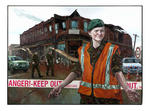
Depicts Christchurch Mayor Bob Parker striking a pose under a spotlight while standing astride broken masonry. He is being interviewed by media. On the right of frame, Progressive Party leader and MP Jim Anderton is under dark clouds and caught under the Beehive. Refers to the 2010 Christchurch mayoral elections in which Parker won over Anderton. Prior to the 2010 Canterbury earthquake, Anderton was ahead in the polls. The quake devastation was said to have given Parker a bigger profile than Anderton and been a factor in his win (TV3 9 October 2010). Quantity: 1 digital cartoon(s).
Winter, Mark 1958- :"I promise ... not to promise again." 5 September 2011
Images, Alexander Turnbull Library
The title is 'Gerry BrownLie?' and the cartoon shows the Minister for Earthquake recovery, Gerry Brownlee, saying 'I promise not to promise again'. The words 'Red Zone' appear beneath with the word 'faced' inserted between them. Context: The 'Red Zone' is the earthquake area in which houses cannot be rebuilt. Earthquake Minister Gerry Brownlee has apologised for falsely promising red zone homeowners they would be paid out for improvements to their house. Brownlee promised in June that, in some cases, home improvements like new kitchens would be included in the government settlement offer for red zone houses. But the offer is only valid if the improvement has added to the footprint of the house. (Press - 4 September 2011) Alternate version of DCDL-0018757 Quantity: 1 digital cartoon(s).
An inventory of community-led and non-governmental organisations and initi…
Research papers, Lincoln University
The impact of the Canterbury earthquake sequence of 2010-12 and its aftermath has been enormous. This inventory lists some of the thousands of community-led groups and initiatives across the region that have developed or evolved as a result of the quake. This inventory is the third such inventory to have been produced. The Christchurch Earthquake Activity Inventory was released by Landcare Research in May 2011, three months after the devastating 22 February 2011 earthquake. The second inventory, entitled An Inventory of Community-led Recovery Initiatives in Canterbury, was collated by Bailey Peryman and Dr Suzanne Vallance (Lincoln University) approximately one year after the February earthquake. The research for this third inventory was undertaken over a four month period from June to September 2013, and was conducted primarily through online searches.This research was undertaken with funding support from the Natural Hazards Platform and GNS, New Zealand.
Winter, Mark, 1958-: Good Will/Wills/William. 18 March 2011
Images, Alexander Turnbull Library
The cartoon shows a caricature of Prince William accompanied by the words 'Good Wills'. A second version has the words 'GOOD WILLiam' and the third has the words 'Good Will'. Context - Prince William visited New Zealand, and Christchurch in particular, after the earthquakes of 4 September 2010 and 22 February 2011 in Christchurch. Quantity: 3 digital cartoon(s).
"I can't get hold of anyone at Treasury! I wanted to ask them how they wer…
Images, Alexander Turnbull Library
The minister wants to ask people at Treasury how they are getting on with all the unexpected expenses but cannot get them on his cellphone. His adviser tells him that they are all out holding garage sales and sausage sizzles. Quantity: 1 digital cartoon(s).