

Search
found 6669 results
Images for damage; more images...


Three Leaf Clover
Images, UC QuakeStudies
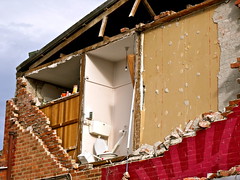
Graffiti on a damaged building. The photographer comments, "They should have painted four leaf clover, if they wanted this tagging to survive the demolition of the earthquake damaged Ozone in Christchurch
Close Up of the Damage
Images, UC QuakeStudies
Detail of damage to the Cathedral of the Blessed Sacrament. Large cracks can be seen in the stonework of the walls and above the columns.
Photograph by Jocelyn Kinghorn 2174
Images, UC QuakeStudies
Damage to residential properties. In the background is a damaged brick property.
Alpine Fault quake would severely damage Canterbury
Audio, Radio New Zealand
New research says Canterbury would suffer severe damage in an Alpine Fault earthquake.
Living in an Earthquake Zone Can Be Unreal
Images, UC QuakeStudies
A photograph of a damaged house has been reflected in the lower part of the image and digitally manipulated.
Photograph by Jocelyn Kinghorn 073
Images, UC QuakeStudies
Steel bracing erected against the wall of a damaged building to prevent any further damage.
Repairs to quake-damaged homes start today
Audio, Radio New Zealand
The first permanent repairs to Canterbury homes damaged in September's earthquake will start today.
Ruth Gardner's Blog 11/07/2013: Dangerous Demolition?
Articles, UC QuakeStudies
An entry from Ruth Gardner's blog for 11 July 2013 entitled, "Dangerous Demolition?".
Ruth Gardner's Blog 20/05/2012: Cloven Clocktower
Articles, UC QuakeStudies
An entry from Ruth Gardner's blog for 20 May 2012 entitled, "Cloven Clocktower".
Ruth Gardner's Blog 05/08/2012: Immense Implosion
Articles, UC QuakeStudies
An entry from Ruth Gardner's blog for 5 August 2012 entitled, "Immense Implosion".
Ruth Gardner's Blog 30/12/2012: Swimming at Sumner
Articles, UC QuakeStudies
An entry from Ruth Gardner's blog for 30 December 2012 entitled, "Swimming at Sumner".
Ruth Gardner's Blog 26/12/2012: Wet Weather
Articles, UC QuakeStudies
An entry from Ruth Gardner's blog for 26 December 2012 entitled, "Wet Weather".
Ruth Gardner's Blog 23/06/2014: Parting with the Pool
Articles, UC QuakeStudies
An entry from Ruth Gardner's Blog for 23 June 2014 entitled, "Parting with the Pool".
Roz Johnson's Blog 19/06/2012: Christchurch Container this Winter
Articles, UC QuakeStudies
An entry from Roz Johnson's blog for 19 June 2012 entitled, "Christchurch Container this Winter".
Photograph by Jocelyn Kinghorn 674
Images, UC QuakeStudies
Detail of a damaged house that has sunk to one side, showing damage to the roof tiles.
Koen Broekema's Photograph 058
Images, UC QuakeStudies
Damage to the front of Christ Church Cathedral. The tower has been damaged and bracing has been placed on the front wall (right) to limit further damage. A walkway from Gloucester Street to the Square was opened up for a few days to allow the public a closer look.
Fairfax Video, October 2010 (12)
Videos, UC QuakeStudies
Part seven of a video series about the first stage of the Tonkin & Taylor Geotechnical Land Damage Assessment and Reinstatement Report. The report was prepared for the Earthquake Commission after the 4 September 2010 earthquake.
Fairfax Video, October 2010 (7)
Videos, UC QuakeStudies
Part two of a video series about the first stage of the Tonkin & Taylor Geotechnical Land Damage Assessment and Reinstatement Report. The report was prepared for the Earthquake Commission after the 4 September 2010 earthquake.
Fairfax Video, October 2010 (11)
Videos, UC QuakeStudies
Part six of a video series about the first stage of the Tonkin & Taylor Geotechnical Land Damage Assessment and Reinstatement Report. The report was prepared for the Earthquake Commission after the 4 September 2010 earthquake.
Fairfax Video, October 2010 (10)
Videos, UC QuakeStudies
Part five of a video series about the first stage of the Tonkin & Taylor Geotechnical Land Damage Assessment and Reinstatement Report. The report was prepared for the Earthquake Commission after the 4 September 2010 earthquake.
Fairfax Video, October 2010 (9)
Videos, UC QuakeStudies
Part four of a video series about the first stage of the Tonkin & Taylor Geotechnical Land Damage Assessment and Reinstatement Report. The report was prepared for the Earthquake Commission after the 4 September 2010 earthquake.
Fairfax Video, October 2010 (8)
Videos, UC QuakeStudies
Part three of a video series about the first stage of the Tonkin & Taylor Geotechnical Land Damage Assessment and Reinstatement Report. The report was prepared for the Earthquake Commission after the 4 September 2010 earthquake.
Sunset over a damaged city
Images, eqnz.chch.2010
Overlooking McCormacks bay out across the city with the Southern Alps as a backdrop. There is still a strong effect from the July 11, 2011 Volcanic erruption (Puyehue) in Chile. Ash made it over to New Zealand causing very strong colours at sunset. The colours have not been artificially changed and its not a mash up. The parts of the city (and...
Photo of damage in Kaiapoi, taken by Dean Smith
Images, UC QuakeStudies
Photo of damage in Kaiapoi, taken by Dean Smith.
Photo of damage in Canterbury, taken by John Weeber
Images, UC QuakeStudies
Photo of damage in Canterbury, taken by John Weeber.
Photo of damage in Canterbury, taken by Rad Gulliver
Images, UC QuakeStudies
Photo of damage in Canterbury, taken by Rad Gulliver.
Pigeon poo damaging Christchurch Cathedral
Audio, Radio New Zealand
The Cathedral has been in a state of limbo since the Christchurch earthquakes. Now roosting pigeons are adding to the damage.
Structural damage evaluation of multi-story timber-steel hybrid structures…
Research papers, University of Canterbury Library
Timber-based hybrid structures provide a prospective solution for utilizing environmentally friendly timber material in the construction of mid-rise or high-rise structures. This study mainly focuses on structural damage evaluation for a type of timber-steel hybrid structures, which incorporate prefabricated light wood frame shear walls into steel moment-resisting frames (SMRFs). The structural damage of such a hybrid structure was evaluated through shake table tests on a four-story large-scale timber-steel hybrid structure. Four ground motion records (i.e., Wenchuan earthquake, Canterbury earthquake, El-Centro earthquake, and Kobe earthquake) were chosen for the tests, with the consideration of three different probability levels (i.e., minor, moderate and major earthquakes) for each record. During the shake table tests, the hybrid structure performed quite well with visual damage only to wood shear walls. No visual damage in SMRF and the frame-to-wall connections was observed. The correlation of visual damage to seismic intensity, modal-based damage index and inter-story drift was discussed. The reported work provided a basis of knowledge for performance-based seismic design (PBSD) for such timber-based hybrid structures.
Analysis of damage data collected for wine storage tanks following the 201…
Research papers, Lincoln University
The 2013 Seddon earthquake (Mw 6.5), the 2013 Lake Grassmere earthquake (Mw 6.6), and the 2016 Kaikōura earthquake (Mw 7.8) provided an opportunity to assemble the most extensive damage database to wine storage tanks ever compiled worldwide. An overview of this damage database is presented herein based on the in-field post-earthquake damage data collected for 2058 wine storage tanks (1512 legged tanks and 546 flat-based tanks) following the 2013 earthquakes and 1401 wine storage tanks (599 legged tanks and 802 flat-based tanks) following the 2016 earthquake. Critique of the earthquake damage database revealed that in 2013, 39% and 47% of the flat-based wine tanks sustained damage to their base shells and anchors respectively, while due to resilience measures implemented following the 2013 earthquakes, in the 2016 earthquake the damage to tank base shells and tank anchors of flat-based wine tanks was reduced to 32% and 23% respectively and instead damage to tank barrels (54%) and tank cones (43%) was identified as the two most frequently occurring damage modes for this type of tank. Analysis of damage data for legged wine tanks revealed that the frame-legs of legged wine tanks sustained the greatest damage percentage among different parts of legged tanks in both the 2013 earthquakes (40%) and in the 2016 earthquake (44%). Analysis of damage data and socio-economic findings highlight the need for industry-wide standards, which may have socio-economic implications for wineries.
Fairfax Video, October 2010 (6)
Videos, UC QuakeStudies
Part one of a video series about the first stage of the Tonkin & Taylor Geotechnical Land Damage Assessment and Reinstatement Report. The report was prepared for the Earthquake Commission after the 4 September 2010 earthquake.