

Search
found 152 results
Images for NEW-ZEALAND; more images...
CH Earthquake:CTV victims' families continue push for justice
Audio, Radio New Zealand
The families of those who died in the CTV building's collapse during the Christchurch Earthquake in February of 2011 are vowing to continue their Fight For Justice after The Independent Police Conduct Authority rejected their complaint about the Police Investigation . The Police decided 3 years ago not to lay charges against the building's designer. Yesterday the families announced that the IPCA, the body that advised the Police, had told them that it had no jurisdiction over Crown Law. Families spokesperson, Maan Alkaisi, told reporter Conan Young that they will continue to push for somebody to be held to account. He wants a retired judge to take another look at the decision not to prosecute.
Government sets up package for Southern Response claimants
Audio, Radio New Zealand
A lawyer acting for Christchurch home-owners short changed in earthquake settlements says a new plan announced by the government is likely to run into trouble. Last year in a landmark case, the High Court found the government's claim settlement agency, Southern Response, misled and deceived Karl and Alison Dodds. It ordered the government to pay the couple nearly $180,000. The government has now set up a package for other Southern Response claimants who settled before October 2014. Its estimated about 3000 people will be eligible to benefit. But most of them are already taking part in a class action led by Brendan and Colleen Ross. Their lawyer Grant Cameron speaks to Corin Dann.
Christ Church Cathedral restoration: Massive steel frame being installed t…
Audio, Radio New Zealand
Moves towards returning the famed rose window to Christ Church Cathedral begin today. An eighteen-tonne steel frame is being installed onto the cathedral's west facade as part of restoration work. It will eventually housing the rose window. The cathedral was critically damaged in the Christchurch earthquake of 2011. Project director Keith Paterson is in Cathedral Square. He speaks to Susie Ferguson.
Digital Photograph: Cathedral of the Blessed Sacrament exterior angels sal…
Images, Canterbury Museum
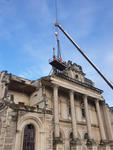
One digital photograph showing a crane arm and workers in a cage during the salvage of the exterior angels from atop the Cathedral of the Blessed Sacrament. The large intact columns at the entrance of the Cathedral can be seen in the photograph. Taken by the Catholic Diocese of Christchurch in September 2020.
Digital Photograph: Cathedral of the Blessed Sacrament being demolished
Images, Canterbury Museum
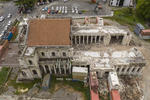
One digital photograph taken by drone showing the Cathedral of the Blessed Sacrament partially demolished. Taken by the Catholic Diocese of Christchurch in 2020.
Digital Photograph: Cathedral of the Blessed Sacrament partially demolished
Images, Canterbury Museum
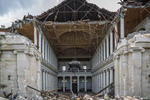
One digital photograph showing the Cathedral of the Blessed Sacrament partially demolished. The interior is visible and lined with intact columns. Taken by photographer Helen McLeod in October 2020.
Digital Photograph: Cathedral of the Blessed Sacrament being demolished by…
Images, Canterbury Museum
One digital photograph showing the Cathedral of the Blessed Sacrament being demolished with a yellow digger. Taken by photographer Helen McLeod in September 2020.
Digital Photograph: Cathedral of the Blessed Sacrament interior during dem…
Images, Canterbury Museum
One digital photograph showing the Cathedral of the Blessed Sacrament interior during demolition. The nave columns are still intact but debris lines the floor. Taken by photographer Helen McLeod in November 2020.
Digital Photograph: Cathedral of the Blessed Sacrament during demolition b…
Images, Canterbury Museum
One digital photograph showing the Cathedral of the Blessed Sacrament during demolition. A yellow digger arm and nibbler claw can be seen along with stone falling from an exterior wall. Taken by photographer Helen McLeod in December 2020.
Digital Photograph: Cathedral of the Blessed Sacrament exterior angels
Images, Canterbury Museum
One digital photograph showing the two angels atop the Cathedral of the Blessed Sacrament. The plinth that supports the cross stands empty between the angels. Taken by the Catholic Diocese of Christchurch in August 2020 before the angels were salvaged from the building.
Digital Photograph: Cathedral of the Blessed Sacrament exterior angels sal…
Images, Canterbury Museum
One digital photograph showing a crane and workers in a cage during the salvage of the exterior angels from atop the Cathedral of the Blessed Sacrament. Taken by the Catholic Diocese of Christchurch in August 2020.
Digital Photograph: Cathedral of the Blessed Sacrament exterior angels sal…
Images, Canterbury Museum
One digital photograph showing the salvage of the exterior angels from the Cathedral of the Blessed Sacrament. Two crane arms and strapping around one of the angels can be seen in the photograph. Taken by the Catholic Diocese of Christchurch in September 2020.
Digital Photograph: Cathedral of the Blessed Sacrament demolition
Images, Canterbury Museum
One digital photograph showing the demolition of the Cathedral of the Blessed Sacrament. A digger arm and nibbler claw can be seen in the photograph removing stone from the exterior, intact columns and ionic column capitals can be seen inside. Taken by the Catholic Diocese of Christchurch in September 2020.
The Outsider, Help is On The Way
Audio, Radio New Zealand
Film and TV reviewer Tamar Munch takes a look at the new US drama The Outsider, based on the Stephen King novel of the same name, and Help Is On The Way, a Kiwi documentary based on the 6.3 Christchurch earthquake and what happened to the 36 guest trapped on the top floors of the Hotel Grand Chancellor.
Our Changing World for 3 September 2020
Audio, Radio New Zealand
Three seismologists from GeoNet reflect on the decade of big earthquakes that began 10 years ago with the Darfield earthquake in Canterbury.
Discovery to buy Mediaworks' TV arm, TV news ratings wars
Audio, Radio New Zealand
Media commentator Andrew Holden joins Kathryn to talk about the move by Discovery Inc to buy Mediaworks' TV operations. When it comes to the TV news, why does TVNZ keep out-rating Newshub? And Munted, Stuff's video series for the 10th anniversary of the Christchurch earthquake, revisits 200 hours of original video footage in a new series narrated by Philip Matthews. Andrew Holden is a journalist for more than 30 years including five as Editor of The Press (in Christchurch) and four as Editor-in-Chief of The Age in Melbourne.
A tour of Christchurch Architecture - old and new
Audio, Radio New Zealand
Christchurch’s architecture, both new and old, has been brought to life in an illustrated walking book that pays homage to the city’s historical buildings and showcases its new direction in the post-earthquake era.
Help Is On The Way: TV doco remembers the 2011 Christchurch earthquake
Audio, Radio New Zealand
On 22 February 2011, Christchurch police sargeant Dave Harvey was outside the earthquake-damaged Hotel Grand Chancellor on Cashel Street, unsure if anyone was trapped inside. In case they were, he grabbed a can of spray paint and painted 'Help is on the way' in one-metre high letters on the road. Harvey's quick thinking really helped the people trapped in the hotel, says Clare Mackey, producer of the new documentary Help is on the Way.
Helping children cope with the ongoing impact of the Canterbury earthquakes
Audio, Radio New Zealand
How do you help children cope with a life-threatening incident? And what if you’re stressed yourself? Katy Gosset looks at the far reaching emotional effects of the Canterbury earthquakes.
Transcending chaos: spirituality and coping in post-earthquake Canterbury,…
Research papers, Lincoln University
When an “I thought I was going to die quake” occurs amidst four additional major earthquakes and 15,000 aftershocks during a sixteen-month period, it challenges people’s ability to cope and recover. Residents of Canterbury, New Zealand endured this extended, chaotic state in 2010/11; and continue to deal with lingering effects on their devastated central city, Christchurch. Stress and coping theory suggests that finding meaning in such situations can help people recover, and that religion and spirituality often play a role in post-disaster resilience. Despite this, there is very little research literature examining this phenomenon and even less that considers spirituality separate from religion. This research focuses on this underrepresented area by considering the personal spiritual or meaningful experiences of people in post-earthquake Canterbury. Data from sixteen in-depth, minimally directed interviews were thematically analyzed to understand each individual’s meaning construction and coping/recovery process and identify connective themes and patterns amongst their experiences. Four core elements of acceptance, clarity and choice, connection, and transcendence emerged from the thematic analysis to conceptualize a model of transcendent coping. Transcendent coping represents an additional type of coping in the transactional model of stress and coping, which serves to support the previous denoted problem-, emotion-, and meaning-focused coping approaches. Transcendent coping offers openness, empowerment, comfort and expansion not necessarily reliant upon theistic or religious beliefs and practices. Rather, this secular spiritual coping is inherent in everyday, mundane practices such as being in the moment, aligning to and acting from personal values, connecting to that and those who bring comfort, and experiencing transcendence in moments of awe and expansion. This research contributes to the growing interest in spirituality as an important facet of human nature that can support wellbeing in the face of stress.
Video of Kathryn's earthquake story
Videos, UC QuakeStudies
A video of Kathryn's second earthquake story, captured by the UC QuakeBox Take 2 project. Interviewer: Joshua Black.
High-quality audio of Participant number QB005's earthquake story
Audio, UC QuakeStudies
A high-quality audio recording of Participant number QB005's second earthquake story, captured by the UC QuakeBox Take 2 project. Interviewer: Lucy Denham.
Edited video of Betty and Michael's earthquake story
Videos, UC QuakeStudies
An edited video of Betty and Michael's second earthquake story, captured by the UC QuakeBox Take 2 project. Please note that the final 3 minutes, 49 seconds of the original video are corrupted and have thus been edited out of this video. Interviewer: Samuel Hope.
Video of Garth's earthquake story
Videos, UC QuakeStudies
A video of Garth's second earthquake story, captured by the UC QuakeBox Take 2 project. Interviewer: Samuel Hope.
Transcript of Di's earthquake story
Articles, UC QuakeStudies
A pdf transcript of Di's second earthquake story, captured by the UC QuakeBox Take 2 project. Interviewer: Sriparna Saha. Transcriber: Josie Hepburn.
Video of Drucilla Kingi-Patterson's earthquake story
Videos, UC QuakeStudies
A video of Drucilla Kingi-Patterson's second earthquake story, captured by the UC QuakeBox Take 2 project. Interviewer: Lucy Denham.
Video of Diane Hyde's earthquake story
Videos, UC QuakeStudies
A video of Diane Hyde's second earthquake story, captured by the UC QuakeBox Take 2 project. Interviewer: Paul Millar.
Video of Julie's earthquake story
Videos, UC QuakeStudies
A video of Julie's second earthquake story, captured by the UC QuakeBox Take 2 project. Interviewer: Rosemary Du Plessis.
Transcript of Mark Elstone's earthquake story
Articles, UC QuakeStudies
A pdf transcript of Mark Elstone's second earthquake story, captured by the UC QuakeBox Take 2 project. Interviewer: Samuel Hope. Transcriber: Lucy Denham.
Transcript of Jan's earthquake story
Articles, UC QuakeStudies
A pdf transcript of Jan's second earthquake story, captured by the UC QuakeBox Take 2 project. Interviewer: Samuel Hope. Transcriber: Maggie Blackwood.