
Search
found 118 results
Images for :Christchurch; more images...
Annie's Interview Transcript_LT13
Articles, UC QuakeStudies
A PDF transcript of an interview with Annie (pseudonym) about her experiences during the COVID-19 pandemic.
Raewyn's Interview Transcript_RDUP11
Articles, UC QuakeStudies
A PDF transcript of an interview with Raewyn (pseudonym) about her experiences during the COVID-19 pandemic.
Sara's Interview transcript_RDUP05
Articles, UC QuakeStudies
A PDF transcript of an interview with Sara (pseudonym) about her experiences during the COVID-19 pandemic.
Nina's Interview Transcript_RDUP07
Articles, UC QuakeStudies
A PDF transcript of and interview with Nina (pseudonym) about her experiences during the COVID-19 pandemic.
El's Interview Transcript_LT14
Articles, UC QuakeStudies
A PDF transcript of an interview with El about her experiences during the COVID-19 pandemic.
Kelsey's Interview Transcript_LT02
Articles, UC QuakeStudies
A PDF transcript of an interview with Kelsey (pseudonym) about her experiences during the COVID-19 pandemic.
Cheryl's Interview Transcript_LT08
Articles, UC QuakeStudies
A PDF transcript of an interview with Cheryl (pseudonym) about her experiences during the COVID-19 pandemic.
Clare's Interview Transcript_LT01
Articles, UC QuakeStudies
A PDF transcript of an interview with Clare (pseudonym) about her experiences during the COVID-19 pandemic.
Daisy's Interview Transcript_LT10
Articles, UC QuakeStudies
A PDF transcript of an interview with Daisy (pseudonym) about her experiences during the COVID-19 pandemic.
Consent Form 2- Publication and Storage
Articles, UC QuakeStudies
Consent Form 2: Publication and Storage
Asayal's Interview Transcript_LT09
Articles, UC QuakeStudies
A PDF transcript of an interview with Asayal about her experiences during the COVID-19 pandemic.
Consent Form 1 - Interview
Articles, UC QuakeStudies
Consent Form 1 - Interview
Biographical information form
Articles, UC QuakeStudies
Biographical information form.
The Outsider, Help is On The Way
Audio, Radio New Zealand
Film and TV reviewer Tamar Munch takes a look at the new US drama The Outsider, based on the Stephen King novel of the same name, and Help Is On The Way, a Kiwi documentary based on the 6.3 Christchurch earthquake and what happened to the 36 guest trapped on the top floors of the Hotel Grand Chancellor.
Tsunami evacuation dynamics following the 2016 Kaikōura earthquake in Chri…
Research papers, University of Canterbury Library
Recent global tsunami events have highlighted the importance of effective tsunami risk management strategies (including land-use planning, structural and natural defences, warning systems, education and evacuation measures). However, the rarity of tsunami means that empirical data concerning reactions to tsunami warnings and tsunami evacuation behaviour is rare when compared to findings about evacuations to avoid other sources of hazard. To date empirical research into tsunami evacuations has focused on evacuation rates, rather than other aspects of the evacuation process. More knowledge is required about responses to warnings, pre-evacuation actions, evacuation dynamics and the return home after evacuations. Tsunami evacuation modelling has the potential to inform evidence-based tsunami risk planning and response. However to date tsunami evacuation models have largely focused on timings of evacuations, rather than evacuation behaviours. This Masters research uses a New Zealand case study to reduce both of these knowledge gaps. Qualitative survey data was gathered from populations across coastal communities in Banks Peninsula and Christchurch, New Zealand, required to evacuate due to the tsunami generated by the November 14th 2016 Kaikōura Earthquake. Survey questions asked about reactions to tsunami warnings, actions taken prior to evacuating and movements during the 2016 tsunami evacuation. This data was analysed to characterise trends and identify factors that influenced evacuation actions and behaviour. Finally, it was used to develop an evacuation model for Banks Peninsula. Where appropriate, the modelling inputs were informed by the survey data. Three key findings were identified from the results of the evacuation behaviour survey. Although 38% of the total survey respondents identified the earthquake shaking as a natural cue for the tsunami, most relied on receiving official warnings, including sirens, to prompt evacuations. Respondents sought further official information to inform their evacuation decisions, with 39% of respondents delaying their evacuation in order to do so. Finally, 96% of total respondents evacuated by car. This led to congestion, particularly in more densely populated Christchurch city suburbs. Prior to this research, evacuation modelling had not been completed for Banks Peninsula. The results of the modelling showed that if evacuees know how to respond to tsunami warnings and where and how to evacuate, there are no issues. However, if there are poor conditions, including if people do not evacuate immediately, if there are issues with the roading network, or if people do not know where or how to evacuate, evacuation times increase with there being more bottlenecks leading out of the evacuation zones. The results of this thesis highlight the importance of effective tsunami education and evacuation planning. Reducing exposure to tsunami risk through prompt evacuation relies on knowledge of how to interpret tsunami warnings, and when, where and how to evacuate. Recommendations from this research outline the need for public education and engagement, and the incorporation of evacuation signage, information boards and evacuation drills. Overall these findings provide more comprehensive picture of tsunami evacuation behaviour and decision making based on empirical data from a recent evacuation, which can be used to improve tsunami risk management strategies. This empirical data can also be used to inform evacuation modelling to improve the accuracy and realism of the evacuation models.
EQC found by inquiry to be poorly prepared for quakes
Audio, Radio New Zealand
An inquiry into the Earthquake Commission has found it was poorly prepared for the Canterbury earthquakes - and has left people with a "deep mistrust of government" that will take years to overcome. The government has this morning released findings from the inquiry, chaired by Dame Silvia Cartwright. Our Christchurch reporter, Conan Young, has been reading through the details and spoke with Māni Dunlop.
EQC's legacy a degraded housing stock, inquiry finds
Audio, Radio New Zealand
The chair of the inquiry in to the Earthquake Commission has grave concerns about the state of the housing stock in Christchurch due to EQC's failure to properly fix quake damage. It's just one of a raft of findings released by Dame Silvia Cartwright today, after a year and a half long inquiry that heard from hundreds of homeowners and key players. Conan Young has the story.
'Needle not moving' as botched EQC re-repairs still coming in - Megan Woods
Audio, Radio New Zealand
Some 10 years on from the devastating Canterbury quakes, the wait is still not over when it comes to law changes needed to improve the Earthquake Commission. The government will not get it done until 2021, if it's re-elected. Meanwhile cases of botched quake repairs needing a fix are still flooding into EQC, Greater Christchurch Regeneration Minister Megan Woods told Checkpoint.
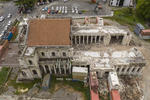
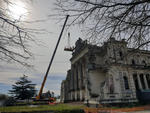
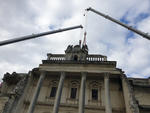
Christ Church Cathedral restoration: Massive steel frame being installed t…
Audio, Radio New Zealand
Moves towards returning the famed rose window to Christ Church Cathedral begin today. An eighteen-tonne steel frame is being installed onto the cathedral's west facade as part of restoration work. It will eventually housing the rose window. The cathedral was critically damaged in the Christchurch earthquake of 2011. Project director Keith Paterson is in Cathedral Square. He speaks to Susie Ferguson.
How can tiny homes encourage adaptive community development in response to…
Research papers, University of Canterbury Library
The affect that the Christchurch Earthquake Sequence(CES) had on Christchurch residents was severe, and the consequences are still being felt today. The Ōtākaro Avon River Corridor (OARC) was particularly impacted, a geographic zone that had over 7,000 homes which needed to be vacated and demolished. The CES demonstrated how disastrous a natural hazard can be on unprepared communities. With the increasing volatility of climate change being felt around the world, considering ways in which communities can reduce their vulnerabilities to natural hazards is vital. This research explores how communities can reduce their vulnerabilities to natural hazards by becoming more adaptable, and in particular the extent to which tiny homes could facilitate the development of adaptive communities. In doing so, three main themes were explored throughout this research: (1) tiny homes, (2) environmental adaptation and (3) community adaptability. To ensure that it is relevant and provides real value to the local community, the research draws upon the local case study of the Riverlution Tiny House Village(RTHV), an innovative community approach to adaptable, affordable, low-impact, sustainable living on margins of land which are no longer suitable for permanent housing. The main findings of the research are that Christchurch is at risk of climate change and natural hazards and it is therefore important to consider ways in which communities can stay intact and connected while adapting to the risks they face. Tiny homes provide an effective way of doing so, as they represent a tangible way that people can take adaptation into their own hands while maintaining a high-quality lifestyle.
Meet local hero 86 year old Māori warden Peggy Hughes
Audio, Radio New Zealand
Meet a local town hero from Auckland's Northshore - 86-year-old Māori Warden Peggy Hughes. Peggy has been serving in her community as a volunteer for about 60 years and officially as a Māori Warden for almost 50 years. She's won dozens of awards for her services - from working at the 1981 Springbok tour protests, supporting Christchurch residents after the 2011 earthquakes, serving at many memorable Waitangi Day events to the recent Black Lives Matter protests.
Porirua earthquake simulation to help hillside homes
Audio, Radio New Zealand
There are hopes an earthquake simulation in Porirua might result in homes being better prepared for a big shake. Houses on Christchurch's Port Hills suffered more damage than houses in other areas during the Canterbury Earthquakes - even though the ground shaking was roughly the same. Now the Earthquake Commission is on a mission to find out why that was - and prevent the same level of damage in a future quake. Checkpoint reporter Logan Church and video journalist Dom Thomas start their report up on a hilly farm above Wellington.
Coronavirus: Schools warned to be careful of mental health on reopening
Audio, Radio New Zealand
Education advisors are warning that children could suffer mental health problems for years to come if schools botch their return to the classroom. They say the Christchurch earthquakes and Australian bushfires show teachers should resist the temptation to launch straight back into normal lessons after a major event. Principals are hoping to learn today when they will move into alert level two and how many of their students will be able to return to school. RNZ's education correspondent John Gerritsen reports.
ChCh quake experience helps family isolated in Spain
Audio, Radio New Zealand
A family who lived through the 2010 and 2011 Christchurch earthquakes is now in isolation in Spain because of the Covid-19 virus. Spain is currently the fourth most affected country in the world, with more than 2000 new cases reported in the past 48 hours. More than 600 people have died, 90 of which have been reported in the past 24 hours. Yuri Bacas Hosaka, who grew up in Madrid says the family's quake experiences helped prepare them for what they're experiencing right now. Indira asked her how she and her family are coping
School leader says Ministry of Education wasted taxpayer money
Audio, Radio New Zealand
A school leader says the Ministry of Education of wasted millions of taxpayer dollars over years of earthquake repairs, and was obstructive and misleading. The building budget at Christchurch Girls High School has blown out by 50 percent to $40 million and it's not finished, even after five years of work. Mike Lay, who was chair of the board of trustees for most of those years, until 2018, says the ministry botched the job then targeted him when he tried to hold it accountable. He told Phil Pennington about the school's struggle to get the school re-built properly.
Residents fed up with red zone rubbish
Audio, Radio New Zealand
Christchurch red zone residents say the area is experiencing an increasing amount of petty crime and dumped rubbish, due to a lack of people. The red zone was established after thousands of houses - and the land underneath them - suffered severe damage in the 2010 and 2011 earthquakes. Last year (2019), a Regeneration Plan for the area was signed off by the government - which included building walkways, cycleways, forests, wetlands, and sport and recreation areas. That's all designed to get people back into the red zone area - but much of the work is still years away. Logan Church met a resident who told him that in the meantime, things are deteriorating.
Managed isolation hotels too posh for returnee
Audio, Radio New Zealand
Our managed isolation hotels are too posh and returnees should not be treated like hotel guests with luxuries like free menu choices and drycleaning. That's the verdict from New Zealand woman Toni Foster who has returned to the country to take up a job and has spent the past 11 days in isolation at Ellerslie's Novotel Hotel. Toni says she had expected to return to isolation in accommodation similar to the container village after the Christchurch earthquakes - not a free four or five star hotel which she said some returnees were treating as a holiday. She says returnees should not be treated like hotel guests because they're not paying a cent to be there.
Seismic isolation of light frame wood buildings in New Zealand
Research papers, University of Canterbury Library
Seismic isolation is an effective technology for significantly reducing damage to buildings and building contents. However, its application to light-frame wood buildings has so far been unable to overcome cost and technical barriers such as susceptibility of light-weight buildings to movement under high-wind loading. The 1994 Northridge Earthquake (6.7 MW) in the United States, 1995 Kobe Earthquake (6.9 MW) in Japan and 2011 Christchurch Earthquake (6.7 Mw) all highlighted significant loss to light-frame wood buildings with over half of earthquake recovery costs allocated to their repair and reconstruction. This poster presents a value case to highlight the benefits of seismically isolated residential buildings compared to the standard fixed-base dwellings for the Wellington region. Loss data generated by insurance claim information from the 2011 Christchurch Earthquake has been used to determine vulnerability functions for the current light-frame wood building stock. By using a simplified single degree of freedom (SDOF) building model, methods for determining vulnerability functions for seismic isolated buildings are developed. Vulnerability functions are then applied directly in a loss assessment to determine the Expected Annual Loss. Vulnerability was shown to dramatically reduce for isolated buildings compared to an equivalent fixed-base building resulting in significant monetary savings, justifying the value case. A state-of-the-art timber modelling software, Timber3D, is then used to model a typical residential building with and without seismic isolation to assess the performance of a proposed seismic isolation system which addresses the technical and cost issues.
Transcending chaos: spirituality and coping in post-earthquake Canterbury,…
Research papers, Lincoln University
When an “I thought I was going to die quake” occurs amidst four additional major earthquakes and 15,000 aftershocks during a sixteen-month period, it challenges people’s ability to cope and recover. Residents of Canterbury, New Zealand endured this extended, chaotic state in 2010/11; and continue to deal with lingering effects on their devastated central city, Christchurch. Stress and coping theory suggests that finding meaning in such situations can help people recover, and that religion and spirituality often play a role in post-disaster resilience. Despite this, there is very little research literature examining this phenomenon and even less that considers spirituality separate from religion. This research focuses on this underrepresented area by considering the personal spiritual or meaningful experiences of people in post-earthquake Canterbury. Data from sixteen in-depth, minimally directed interviews were thematically analyzed to understand each individual’s meaning construction and coping/recovery process and identify connective themes and patterns amongst their experiences. Four core elements of acceptance, clarity and choice, connection, and transcendence emerged from the thematic analysis to conceptualize a model of transcendent coping. Transcendent coping represents an additional type of coping in the transactional model of stress and coping, which serves to support the previous denoted problem-, emotion-, and meaning-focused coping approaches. Transcendent coping offers openness, empowerment, comfort and expansion not necessarily reliant upon theistic or religious beliefs and practices. Rather, this secular spiritual coping is inherent in everyday, mundane practices such as being in the moment, aligning to and acting from personal values, connecting to that and those who bring comfort, and experiencing transcendence in moments of awe and expansion. This research contributes to the growing interest in spirituality as an important facet of human nature that can support wellbeing in the face of stress.
Gun emplacements restored so history not forgotten
Audio, Radio New Zealand
A heritage advocate says he is over the moon to see a special piece of this country's history restored for future generations to enjoy. Three second world war era gun emplacements have been officially opened at Godley Head near Christchurch. The concrete bunkers and network of tunnels were badly damaged in the 2011 earthquakes and have only now been repaired and had screeds of graffiti removed. At the height of the war, the guns at the entry to Lyttelton Harbour were home to two thousand army personnel. They were the main defence from an anticipated Japanese invasion. The Godley Heads Heritage Trust chair, Peter Wilkins, told Conan Young the restored emplacements will ensure this history is never forgotten.