

Search
found 818 results
Images for Canterbury earthquakes; more images...


MEDIANZ Vol 14, No 1: Against the Odds
Articles, UC QuakeStudies
An article from the Media Studies Journal of Aotearoa New Zealand Volume 14, Number 1. The article is titled, "Against the Odds: community access radio broadcasting during the Canterbury earthquakes, some reflections on Plains FM 96.9". It was written by Brian Pauling and Nicki Reece.
Reparability of earthquake damaged Reinforced Concrete walls
Research papers, University of Canterbury Library
The 2010-2011 Christchurch earthquakes generated damage in several Reinforced Concrete (RC) buildings, which had RC walls as the principal resistant element against earthquake demand. Despite the agreement between structural engineers and researchers in an overall successfully performance there was a lack of knowledge about the behaviour of the damaged structures, and even deeper about a repaired structure, which triggers arguments between different parties that remains up to these days. Then, it is necessary to understand the capacity of the buildings after the earthquake and see how simple repairs techniques improve the building performance. This study will assess the residual capacity of ductile slender RC walls according to current standards in New Zealand, NZS 3101.1 2006 A3. First, a Repaired RC walls Database is created trying to gather previous studies and to evaluate them with existing international guidelines. Then, an archetype building is designed, and the wall is extracted and scaled. Four half-scale walls were designed and will be constructed and tested at the Structures Testing Laboratory at The University of Auckland. The overall dimensions are 3 [m] height, 2 [m] length and 0.175 [m] thick. All four walls will be identical, with differences in the loading protocol and the presence or absence of a repair technique. Results are going to be useful to assess the residual capacity of a damaged wall compare to the original behaviour and also the repaired capacity of walls with simpler repair techniques. The expected behaviour is focussed on big changes in stiffness, more evident than in previously tested RC beams found in the literature.
Rebuilding Christchurch: Amended Building Codes and their Impacts in NZ
Research papers, University of Canterbury Library
The level of destruction from the 2011 Christchurch earthquakes led to changes in the New Zealand seismic building code. The destruction showed that the NZ building codes did not fully performed to expectation and needed Improvement to ensure that impact of future earthquakes would be minimised. The building codes have been amended to improve buildings resilience to earthquake and other related extreme loading conditions. Rebuilding Christchurch with the new modifications in the seismic building code comes with its own unique challenges to the entire system. This project investigates the impact of rebuilding Christchurch with the new seismic Building codes in terms of how the new changes affected the building industry and the management of construction.
Could Base Isolation be an Effective Structural System for NZ Housing?
Research papers, University of Canterbury Library
A significant portion of economic loss from the Canterbury Earthquake sequence in 2010-2011 was attributed to losses to residential buildings. These accounted for approximately $12B of a total $40B economic losses (Horspool, 2016). While a significant amount of research effort has since been aimed at research in the commercial sector, little has been done to reduce the vulnerability of the residential building stock.
Observatory Tower Photograph 03
Images, UC QuakeStudies
A photograph of the Observatory tower at the Christchurch Arts Centre. There are cracks in the masonry of the tower near where the two storeys join. The cracks formed as a result of the 4 September 2010 earthquake.
Community Resilience Capital Framwork: A Critical Assessment based on a Wa…
Research papers, University of Canterbury Library
1. INTRODUCTION. Earthquakes and geohazards, such as liquefaction, landslides and rock falls, constitute a major risk for New Zealand communities and can have devastating impacts as the Canterbury 2010/2011 experience shows. Development patterns expose communities to an array of natural hazards, including tsunamis, floods, droughts, and sea level rise amongst others. Fostering community resilience is therefore vitally important. As the rhetoric of resilience is mainstreamed into the statutory framework, a major challenge emerges: how can New Zealand operationalize this complex and sometimes contested concept and build ‘community capitals’? This research seeks to provide insights to this question by critically evaluating how community capitals are conceptualized and how they can contribute to community resilience in the context of the Waimakariri District earthquake recovery and regeneration process.
Observatory Tower Photograph 27
Images, UC QuakeStudies
A photograph of the rubble of the Observatory tower in the South Quad of the Christchurch Arts Centre. The tower collapsed during the 22 February 2011 earthquake. A digger was used to clear the rubble away from the building.
Move to Library Level 5 - Photograph 10
Images, UC QuakeStudies
Jess Hollis, a member of the University of Canterbury's E-Learning team in their temporary office in the James Hight building. The photographer comments, "Yet another change of workplace for our E-Learning group, as the University juggles people and buildings to carry out earthquake repairs. My desk with Jess behind".
Move to Library Level 5 - Photograph 11
Images, UC QuakeStudies
Jess Hollis, a member of the University of Canterbury's E-Learning team in their temporary office in the James Hight building. The photographer comments, "Yet another change of workplace for our E-Learning group, as the University juggles people and buildings to carry out earthquake repairs. Jess, with my desk behind".
Observatory Tower Photograph 26
Images, UC QuakeStudies
A photograph of the rubble of the Observatory tower in the South Quad of the Christchurch Arts Centre. The tower collapsed during the 22 February 2011 earthquake. Scaffolding constructed around the tower has also collapsed and is amongst the rubble.
Key Parmeters in Pre-Event Data Collection for Emergency Response and Seis…
Research papers, University of Canterbury Library
Abstract This study provides a simplified methodology for pre-event data collection to support a faster and more accurate seismic loss estimation. Existing pre-event data collection frameworks are reviewed. Data gathered after the Canterbury earthquake sequences are analysed to evaluate the relative importance of different sources of building damage. Conclusions drawns are used to explore new approaches to conduct pre-event building assessment.
Development of a Seismic Damage Prediction Model Using Machine Learning
Research papers, University of Canterbury Library
Natural catastrophes are increasing worldwide. They are becoming more frequent but also more severe and impactful on our built environment leading to extensive damage and losses. Earthquake events account for the smallest part of natural events; nevertheless seismic damage led to the most fatalities and significant losses over the period 1981-2016 (Munich Re). Damage prediction is helpful for emergency management and the development of earthquake risk mitigation projects. Recent design efforts focused on the application of performance-based design engineering where damage estimation methodologies use fragility and vulnerability functions. However, the approach does not explicitly specify the essential criteria leading to economic losses. There is thus a need for an improved methodology that finds the critical building elements related to significant losses. The here presented methodology uses data science techniques to identify key building features that contribute to the bulk of losses. It uses empirical data collected on site during earthquake reconnaissance mission to train a machine learning model that can further be used for the estimation of building damage post-earthquake. The first model is developed for Christchurch. Empirical building damage data from the 2010-2011 earthquake events is analysed to find the building features that contributed the most to damage. Once processed, the data is used to train a machine-learning model that can be applied to estimate losses in future earthquake events.
SeisFinder : A Web Application for Extraction of Data from Computationally…
Research papers, University of Canterbury Library
Overview of SeisFinder SeisFinder is an open-source web service developed by QuakeCoRE and the University of Canterbury, focused on enabling the extraction of output data from computationally intensive earthquake resilience calculations. Currently, SeisFinder allows users to select historical or future events and retrieve ground motion simulation outputs for requested geographical locations. This data can be used as input for other resilience calculations, such as dynamic response history analysis. SeisFinder was developed using Django, a high-level python web framework, and uses a postgreSQL database. Because our large-scale computationally-intensive numerical ground motion simulations produce big data, the actual data is stored in file systems, while the metadata is stored in the database. The basic SeisFinder architecture is shown in Figure 1.
WEMO ERT Set 4 - March 2011 - Photograph 10
Images, UC QuakeStudies
A photograph of three petrol pumps at a BP station. One of the pumps has been covered by a piece of paper with a sticker reading, "out". Underneath the sticker, the paper reads, "Available - diesel only. Due to high demand (following the Canterbury Earthquake) we are currently out of petrol".
Play, politics and the production of space: DIY urbanism in post-earthquak…
Research papers, The University of Auckland Library
The Canterbury earthquake sequence of 2010-2011 wrought ruptures in not only the physical landscape of Canterbury and Christchurch’s material form, but also in its social, economic, and political fabrics and the lives of Christchurch inhabitants. In the years that followed, the widespread demolition of the CBD that followed the earthquakes produced a bleak landscape of grey rubble punctuated by damaged, abandoned buildings. It was into this post-earthquake landscape that Gap Filler and other ‘transitional’ organisations inserted playful, creative, experimental projects to bring life and energy back into the CBD. This thesis examines those interventions and the development of the ‘Transitional Movement’ between July 2013 and June 2015 via the methods of walking interviews and participant observation. This critical period in Christchurch’s recovery serves as an example of what happens when do-it-yourself (DIY) urbanism is done at scale across the CBD and what urban experimentation can offer city-making. Through an understanding of space as produced, informed by Lefebvre’s thinking, I explore how these creative urban interventions manifested a different temporality to orthodox planning and demonstrate how the ‘soft’ politics of these interventions contain the potential for gentrification and also a more radical politics of the city, by creating an opening space for difference.
Observatory Tower Photograph 12
Images, UC QuakeStudies
A photograph of parts of the Townsend Telescope recovered from the rubble of the Observatory tower. The telescope was housed in the tower at the Christchurch Arts Centre. It was severely damaged when the tower collapsed during the 22 February 2011 earthquake.
Move to Library Level 5 - Photograph 14
Images, UC QuakeStudies
Members of the University of Canterbury's E-Learning team Susan Tull and Nick Ford in their temporary office in the James Hight building. The photographer comments, "Yet another change of workplace for our E-Learning group, as the University juggles people and buildings to carry out earthquake repairs. Susan and Nick settle in".
WEMO ERT Set 1 - March 2011 - Photograph 97
Images, UC QuakeStudies
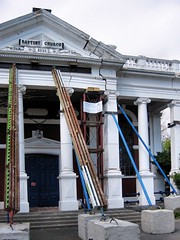
A photograph of the earthquake-damaged Stone Chamber of the Canterbury Provincial Council Buildings on Durham Street North. Large sections of the Chamber have collapsed and the masonry and other rubble has spilled onto the footpath in front. To the left scaffolding constructed up the side of the building has also collapsed and twisted out of shape. Wire fences have been placed along the side of the building as a cordon.
Observatory Tower Photograph 11
Images, UC QuakeStudies
A photograph of the largest section of the Townsend Telescope recovered from the rubble of the Observatory tower. The telescope was housed in the tower at the Christchurch Arts Centre. It was severely damaged when the tower collapsed during the 22 February 2011 earthquake.
Observatory Tower Photograph 13
Images, UC QuakeStudies
A close-up photograph of parts of the Townsend Telescope recovered from the rubble of the Observatory tower. The telescope was housed in the tower at the Christchurch Arts Centre. It was severely damaged when the tower collapsed during the 22 February 2011 earthquake.
Observatory Tower Photograph 14
Images, UC QuakeStudies
A close-up photograph of parts of the Townsend Telescope recovered from the rubble of the Observatory tower. The telescope was housed in the tower at the Christchurch Arts Centre. It was severely damaged when the tower collapsed during the 22 February 2011 earthquake.
Observatory Tower Photograph 18
Images, UC QuakeStudies
A photograph of the earthquake damage to the second story of the Observatory tower at the Christchurch Arts Centre. The front of the storey has collapsed, exposing the inside. A tarpaulin has been draped over the top and the roof of the building behind.
People in Disasters Conference - A Systematic Review of Compassion Fatigue…
Videos, UC QuakeStudies
A video of a presentation by Jai Chung during the Staff and Patients Stream of the 2016 People in Disasters Conference. The presentation is titled, "A Systematic Review of Compassion Fatigue of Nurses During and After the Canterbury Earthquakes".The abstract for the presentation reads as follows: Limited research is currently available about compassion fatigue of health professionals during and after disasters in New Zealand. The purpose of this systematic literature review was to provide a comprehensive outline of existing research. National and international literature was compared and contrasted to determine the importance of recognising compassion fatigue during and after disasters. Health professionals responding to disasters have played an important role in saving lives. Especially, during and after the Canterbury earthquakes, many health professionals cared for the traumatized public of the region. When responding to and caring for many distressed people, health professionals - particularly nurses - may strongly empathise with people's pain, fear, and distress. Consequently, they can be affected both emotionally and physically. Nurses may experience intensive and extreme distress and trauma directly and indirectly. Physical exhaustion can arise quickly. Emotional exhaustion such as hopelessness and helplessness may lead to nurses losing the ability to nurture and care for people during disasters. This can lead to compassion fatigue. It is important to understand how health professionals, especially nurses, experience compassion fatigue in order to help them respond to disasters appropriately. International literature explains the importance of recognising compassion fatigue in nursing, and explores different coping mechanisms that assist nurses overcome or prevent this health problem. In contrast, New Zealand literature is limited to experiences of nurses' attitudes in responding to natural disasters. In light of this, this literature review will help to raise awareness about the importance of recognising and addressing symptoms of compassion fatigue in a profession such as nursing. Gaps within the research will also be identified along with recommendations for future research in this area, especially from a New Zealand perspective. Please note that due to a recording error the sound cuts out at 9 minutes.
Cyclic Undrained DSS Testing of Christchurch Sandy Silty Soils
Research papers, University of Canterbury Library
Earthquake-triggered soil liquefaction caused extensive damage and heavy economic losses in Christchurch during the 2010-2011 Canterbury earthquakes. The most severe manifestations of liquefaction were associated with the presence of natural deposits of clean sands and silty sands of fluvial origin. However, liquefaction resistance of fines-containing sands is commonly inferred from empirical relationships based on clean sands (i.e. sands with less than 5% fines). Hence, existing evaluation methods have poor accuracy when applied to silty sands. The liquefaction behaviour of Christchurch fines-containing (silty) sands is investigated through a series of Direct Simple Shear (DSS) tests. This type of test better resembles earthquake loading conditions in soil deposits compared to cyclic triaxial tests. Soil specimens are reconstituted in the laboratory with the water sedimentation technique. This preparation method yields soil fabrics similar to those encountered in fluvial soil deposits, which are common in the Christchurch area. Test results provide preliminary indications on how void ratio, relative density, preparation method and fines content influence the cyclic liquefaction behaviour of sand-silt mixtures depending on the properties of host sand and silt.
BeckerFraserPhotos March 2013 photograph 122
Images, UC QuakeStudies
An aerial photograph looking west over the Arts Centre and Christ's College towards Hagley Park. The photograph has been captioned by BeckerFraserPhotos, "At the centre of this photo is a group of heritage stone buildings. Canterbury Museum and Christ's College were extensively earthquake strengthened prior to the EQs and re-opened to the public relatively quickly. The Arts Centre is undergoing extensive renovations. Hagley Park and the Botanic Gardens provide a richly colourful surrounding to these historic buildings".
Performance of adhesive wall-to-diaphragm connections in the Canterbury ea…
Research papers, The University of Auckland Library
The connections between walls of unreinforced masonry (URM) buildings and flexible timber diaphragms are critical building components that must perform adequately before desirable earthquake response of URM buildings may be achieved. Field observations made during the initial reconnaissance and the subsequent damage surveys of clay brick URM buildings following the 2010/2011 Canterbury, New Zealand earthquakes revealed numerous cases where anchor connections joining masonry walls or parapets with roof or floor diaphragms appeared to have failed prematurely. These observations were more frequent for the case of adhesive anchor connections than for the case of through-bolt connections (i.e. anchorages having plates on the exterior façade of the masonry walls). Subsequently, an in-field test program was undertaken in an attempt to evaluate the performance of adhesive anchor connections between unreinforced clay brick URM walls and roof or floor diaphragm. The study consisted of a total of almost 400 anchor tests conducted in eleven existing URM buildings located in Christchurch, Whanganui and Auckland. Specific objectives of the study included the identification of failure modes of adhesive anchors in existing URM walls and the influence of the following variables on anchor load-displacement response: adhesive type, strength of the masonry materials (brick and mortar), anchor embedment depth, anchor rod diameter, overburden level, anchor rod type, quality of installation and the use of metal foil sleeve. In addition, the comparative performance of bent anchors (installed at an angle of minimum 22.5o to the perpendicular projection from the wall surface) and anchors positioned horizontally was investigated. Observations on the performance of wall-to-diaphragm connections in the 2010/2011 Canterbury earthquakes and a snapshot of the performed experimental program and the test results are presented herein. http://hdl.handle.net/2292/21050
Observatory Tower Photograph 09
Images, UC QuakeStudies
A photograph of staff from the Department of Physics and Astronomy from the University of Canterbury recovering parts of the Townsend Telescope from the rubble of the Observatory tower. The telescope was housed in the tower at the Christchurch Arts Centre. It was severely damaged when the tower collapsed during the 22 February 2011 earthquake.
Observatory Tower Photograph 10
Images, UC QuakeStudies
A photograph of staff from the Department of Physics and Astronomy from the University of Canterbury recovering parts of the Townsend Telescope from the rubble of the Observatory tower. The telescope was housed in the tower at the Christchurch Arts Centre. It was severely damaged when the tower collapsed during the 22 February 2011 earthquake.
the day after
Images, eqnz.chch.2010
Cleaning up the silt and sand from Hoon Hay properties. Here Laura, Robbie, and Ronny are part of the clean-up crew on Wyn Street.
Three Wise Men Photograph 2
Images, UC QuakeStudies
A photograph of a paste-up depicting Roger Sutton, the CEO of CERA, with a band-aid over his mouth; Warwick Isaacs, the Deputy Chief Executive of CERA, with hearing protection over his ears; and Jerry Brownlee, Minister for Canterbury Earthquake Recovery, with a blindfold over his eyes. The paste-up has been stuck on a bus stop timetable.