
Search
found 1452 results
Images for houses; more images...


Christchurch Press Image: Martin van Beynen 2010:09:04 (05)
Images, UC QuakeStudies
Photograph captioned by Fairfax, "The historic Godley House accommodation/restaurant at Diamond Harbour".
Photograph by Jocelyn Kinghorn 324
Images, UC QuakeStudies
A damaged house with cracks down the wall sits on an uneven surface.
Christchurch Press Image: Martin van Beynen 2010:09:04 (04)
Images, UC QuakeStudies
Photograph captioned by Fairfax, "The historic Godley House accommodation/restaurant at Diamond Harbour".
Photograph by Eroica Ritchie 115
Images, UC QuakeStudies
A damaged house in St Martens, the roof of which has partially collapsed.
Photograph by Jocelyn Kinghorn 041
Images, UC QuakeStudies
The roof of a house damaged by a fallen chimney on Springfield Road.
Christchurch Press Image: Martin van Beynen 2010:09:04 (01)
Images, UC QuakeStudies
Photograph captioned by Fairfax, "The historic Godley House accommodation/restaurant at Diamond Harbour".
Photograph of 116 Centaurus Road (8)
Images, UC QuakeStudies
A photograph of the basement of a demolished house at 116 Centaurus Road.
Photograph by Jocelyn Kinghorn 628
Images, UC QuakeStudies
Earthquake damage inside a house in St Albans. Pot plants have fallen over.
Christchurch Press Image: Iain McGregor 2010:09:03 22:08:21
Images, UC QuakeStudies
Photograph captioned by Fairfax, "Earthquake in Christchurch. House on Sherbourne Street, St Albans".
Christchurch Press Image: Iain McGregor 2010:09:03 22:08:48
Images, UC QuakeStudies
Photograph captioned by Fairfax, "Earthquake in Christchurch. House on Sherbourne Street, St Albans".
Christchurch Press Image: Iain McGregor 2010:09:03 22:06:15
Images, UC QuakeStudies
Photograph captioned by Fairfax, "Earthquake in Christchurch. House on Sherbourne Street, St Albans".
Christchurch Press Image: Iain McGregor 2010:09:03 22:08:10
Images, UC QuakeStudies
Photograph captioned by Fairfax, "Earthquake in Christchurch. House on Sherbourne Street, St Albans".
Christchurch Press Image: Iain McGregor 2010:09:03 22:09:17
Images, UC QuakeStudies
Photograph captioned by Fairfax, "Earthquake in Christchurch. House on Sherbourne Street, St Albans".
Christchurch Press Image: Iain McGregor 2010:09:03 22:09:21
Images, UC QuakeStudies
Photograph captioned by Fairfax, "Earthquake in Christchurch. House on Sherbourne Street, St Albans".
Photograph by Eroica Ritchie 065
Images, UC QuakeStudies
A damaged house, the outer brick wall of which has completely fallen away.
Photograph by Jocelyn Kinghorn 052
Images, UC QuakeStudies
Damage to the roof of a house where the chimney has fallen down.
Photograph by Jocelyn Kinghorn 053
Images, UC QuakeStudies
Damage to the roof of a house where the chimney has fallen down.
Photograph by Jocelyn Kinghorn 051
Images, UC QuakeStudies
Damage to the roof of a house where the chimney has fallen down.
Photograph by Jocelyn Kinghorn 404
Images, UC QuakeStudies
A damaged house that has been fenced off with tape and road cones.
Photograph by Jocelyn Kinghorn 405
Images, UC QuakeStudies
A red-stickered house where cracks can be clearly seen in the foundation.
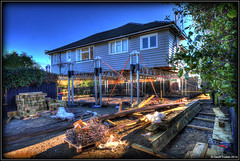
My trees have gone!
Images, eqnz.chch.2010
20130613_7577_1D3-24 My Trees cut down so a house being removed from behind could get out above the fence on one of those elevating house removal trailers. I don't know the story about the yellow (recycling) wheelie bin - the wheels have been removed. This was my house from March 2004 to mid-2012 when it was purchased by the government as it s...
The Vault - Earthquake at Radio New Zealand House
Audio, Radio New Zealand
Deborah Nation recalls how it was in the Sound Archives and Radio New Zealand offices in Christchurch on the day of the February earthquake. The building on the corner of Durham and Chester Street West has been condemned. Please be aware that the first sounds of this report may be upsetting, especially to listenners who experienced the earthquake.
Photograph of Ironside House, 381 Montreal Street (19)
Images, UC QuakeStudies
A photograph of a window of Ironside on Montreal Street.
Archaeological Report on 62 Park Terrace, Weston House
Articles, UC QuakeStudies
An archaeological report compiled for New Zealand Historic Places Trust under the Historical Places Act 1993
20121124_0566_1D3-67 Cunningham House
Images, eqnz.chch.2010
Cunningham House at the Christchurch Botanic Gardens is still closed due to earthquake damage. I wonder if it will ever re-open or suffer the demolition fate many other iconic structures in Christchurch have.
101 demolitions : how a disaster shed light on life in nineteenth century …
Research papers, University of Canterbury Library
On 22 February 2011, Ōtautahi Christchurch was struck by a devastating earthquake. The city was changed forever: lives were lost, buildings destroyed and much of the city’s infrastructure needed to be repaired or replaced. One of the unexpected outcomes of the process of recovery was the volume of archaeological work that was carried out in the city, including the substantial amount of buildings archaeology that was undertaken (that is, recording standing buildings prior to and during their demolition, using archaeological techniques). Amongst the numerous buildings recorded in this way were 101 houses from across the city (but concentrated in those areas hit hardest by the earthquakes), built between 1850 and 1900. This work yielded a wealth of data about what houses in the city looked like in the nineteenth century. It is this data that forms the core of my thesis, providing an opportunity to examine the question of what life was like in nineteenth century Christchurch through these houses and the people who built them. Christchurch was founded in 1850 by European settlers, most of whom were English. These people came to New Zealand to build a better life for themselves and their families. For many of them, this ‘better life’ included the possibility of owning their own home and, in some instances, building that house (or at least, commissioning its construction). The buildings archaeology data collected following the Canterbury earthquakes enabled a detailed analysis of what houses in the city looked like in the nineteenth century – their form, and both their external and internal appearance – and how this changed as the century progressed. A detailed examination of the lives of those who built 21 of the houses enabled me to understand why each house looked the way it did, and how the interplay of class, budget and family size and expectations (amongst other factors) shaped each house. It is through these life stories that more about life in Christchurch in the nineteenth century was revealed. These are stories of men and women, of success and failure, of businesses and bankruptcies. There are themes that run through the stories: class, appearances, death, religion, gender, improvement. Just as importantly, though, they reveal the everyday experiences of people as they set about building a new city. Thus, through the archaeology of the houses and the history of the people who built them, an earthquake has revealed more about life in nineteenth century Christchurch, as well as providing the means for a deeper understanding of the city’s domestic architecture.
We Lived Here: Oxford Terrace Photograph 058
Images, UC QuakeStudies
A photograph of Donna Allfrey's dog Niko, sitting on the front porch of her house on Oxford Terrace. The photographer comments, "Niko found Doug Sexton, Allfrey's neighbour, after the 22 February 2011 earthquake. Sexton had a heart attack during the earthquake and could not leave his damaged house".
Fairfax Video, December 2011 (7)
Videos, UC QuakeStudies
A video about the reopening of Alice in Videoland, in the back of the former Post Office on the corner of Tuam and High Streets. The redesigned space has allowed Alice in Videoland to expand from a DVD rental store to include an art-house cinema as well.
We Lived Here: Oxford Terrace Photograph 072
Images, UC QuakeStudies
A photograph of Robin Duff standing on the porch of his house at 386 Oxford Terrace. There is a sign in the window to his left depicting a bulldozer with a line through it. The photographer comments, "Avon Loop resident Donna Allfrey made this sign for Duff".
We Lived Here: Oxford Terrace Photograph 070
Images, UC QuakeStudies
A photograph of Robin Duff standing on the porch of his house at 386 Oxford Terrace. There is a sign in the window to his left depicting a bulldozer with a line through it. The photographer comments, "Avon Loop resident Donna Allfrey made this sign for Duff".