

Search
found 6692 results
Images for Damage; more images...


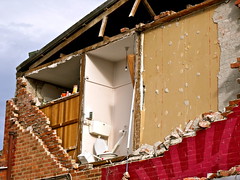
Hubbard, James, 1949- : Chch. World Cup games. 16 March 2011
Images, Alexander Turnbull Library
The cartoon shows a rugby goalpost in a bad state of repair; it is held together with bandages and when a player kicks a ball that represents 'World Cup Games' towards the goalpost, it hits one of the side posts that flies a Christchurch flag, causing the post to break. Context - the decision that Christchurch will not be able to host any of the Rugby World Cup games because of the damage caused by the earthquakes of 4 September 2010 and 22 February 2011. Quantity: 1 digital cartoon(s).
Nisbet, Alistair, 1958-: "Don't be upset dear... we'll get the World Cup s…
Images, Alexander Turnbull Library
A man reading a newspaper wails and sobs when he discovers that Christchurch will not be hosting any Rugby World Cup games. The newspaper is covered with real disaster news like the Japanese earthquake and potential nuclear disaster, economy problems , and 'aftershock anxiety'. Context - The Christchurch earthquakes of 4 September 2010 and 22 February 2011 that have led to the decision that because of the amount of damage to the venue plus infrastructures and accommodation for visitors the Rugby World Cup will not be played in Christchurch. Quantity: 1 digital cartoon(s).
Earthquake Performance of Two Vintage URM Buildings Retrofitted Using Surf…
Research papers, The University of Auckland Library
As part of a seismic retrofit scheme, surface bonded glass fiber-reinforced polymer (GFRP) fabric was applied to two unreinforced masonry (URM) buildings located in Christchurch, New Zealand. The unreinforced stone masonry of Christchurch Girls’ High School (GHS) and the unreinforced clay brick masonry Shirley Community Centre were retrofitted using surface bonded GFRP in 2007 and 2009, respectively. Much of the knowledge on the seismic performance of GFRP retrofitted URM was previously assimilated from laboratory-based experimental studies with controlled environments and loading schemes. The 2010/2011 Canterbury earthquake sequence provided a rare opportunity to evaluate the GFRP retrofit applied to two vintage URM buildings and to document its performance when subjected to actual design-level earthquake-induced shaking. Both GFRP retrofits were found to be successful in preserving architectural features within the buildings as well as maintaining the structural integrity of the URM walls. Successful seismic performance was based on comparisons made between the GFRP retrofitted GHS building and the adjacent nonretrofitted Boys’ High School building, as well as on a comparison between the GFRP retrofitted and nonretrofitted walls of the Shirley Community Centre building. Based on detailed postearthquake observations and investigations, the GFRP retrofitted URM walls in the subject buildings exhibited negligible to minor levels of damage without delamination, whereas significant damage was observed in comparable nonretrofitted URM walls. AM - Accepted Manuscript
Observed performance of residential masonry veneer construction in the 201…
Research papers, The University of Auckland Library
Following the 2010/2011 Canterbury earthquakes a detailed campaign of door to door assessments was conducted in a variety of areas of Christchurch to establish the earthquake performance of residential dwellings having masonry veneer as an external cladding attached to a lightweight timber framing system. Specifically, care was taken to include regions of Christchurch which experienced different levels of earthquake shaking in order to allow comparison between the performance of different systems and different shaking intensities. At the time of the inspections the buildings in the Christchurch region had been repeatedly subjected to large earthquakes, presenting an opportunity for insight into the seismic performance of masonry veneer cladding. In total just under 1100 residential dwellings were inspected throughout the wider Christchurch area, of which 24% were constructed using the older nail-on veneer tie system (prior to 1996) and 76% were constructed using screw fixed ties to comply with the new 1996 standards revision (post-1996), with 30% of all inspected houses being of two storey construction. Of the inspected dwellings 27% had some evidence of liquefaction, ground settlement or lateral spreading. Data such as damage level, damage type, crack widths, level of repair required and other parameters were collected during the survey. A description of the data collection processes and a snapshot of the analysis results are presented within. http://15ibmac.com/home/
Seismic Anisotropy and Stress of the Canterbury Plains
Research papers, Victoria University of Wellington
The Mѡ=7.1 Darfield (Canterbury) earthquake struck on 4 September 2010, approximately 45 km west of Christchurch, New Zealand. It revealed a previously unknown fault (the Greendale fault) and caused billions of dollars of damage due to high peak ground velocities and extensive liquefaction. It also triggered the Mw=6.3 Christchurch earthquake on 22 February 2011, which caused further damage and the loss of 185 lives. The objective of this research was to determine the relationship between stress and seismic properties in a seismically active region using manually-picked P and S wave arrival times from the aftershock sequence between 8 September 2010-13 January 2011 to estimate shear-wave splitting (SWS) parameters, VP =VS-ratios, anisotropy (delay-time tomography), focal mechanisms, and tectonic stress on the Canterbury plains. The maximum horizontal stress direction was highly consistent in the plains, with an average value of SHmax=116 18 . However, the estimates showed variation in SHmax near the fault, with one estimate rotating by as much as 30° counter-clockwise. This suggests heterogeneity of stress at the fault, though the cause remains unclear. Orientations of the principal stresses predominantly indicate a strike-slip regime, but there are possible thrust regimes to the west and north/east of the fault. The SWS fast directions (ø) on the plains show alignment with SHmax at the majority of stations, indicating stress controlled anisotropy. However, structural effects appear more dominant in the neighbouring regions of the Southern Alps and Banks Peninsula.
The once and future cathedral
Research papers, University of Canterbury Library
This is an ethnographic case study, tracking the course of arguments about the future of a city’s central iconic building, damaged following a major earthquake sequence. The thesis plots this as a social drama and examines the central discourses of the controversy. The focus of the drama is the Anglican neo-Gothic Christ Church Cathedral, which stands in the central square of Christchurch, New Zealand. A series of major earthquakes in 2010/2011 devastated much of the inner city, destroying many heritage-listed buildings. The Cathedral was severely damaged and was declared by Government officials in 2011 to be a dangerous building, which needed to be demolished. The owners are the Church Property Trustees, chaired by Bishop Victoria Matthews, a Canadian appointed in 2008. In March 2012 Matthews announced that the Cathedral, because of safety and economic factors, would be deconstructed. Important artefacts were to be salvaged and a new Cathedral built, incorporating the old and new. This decision provoked a major controversy, led by those who claimed that the building could and should be restored. Discourses of history and heritage, memory, place and identity, ownership, economics and power are all identified, along with the various actors, because of their significance. However, the thesis is primarily concerned with the differing meanings given to the Cathedral. The major argument centres on the symbolic interaction between material objects and human subjects and the various ways these are interpreted. At the end of the research period, December 2015, the Christ Church Cathedral stands as a deteriorating wreck, inhabited by pigeons and rats and shielded by protective, colourfully decorated wooden fences. The decision about its future remains unresolved at the time of writing.
The continued response of the New Zealand Government to the Canterbury ear…
Research papers, University of Canterbury Library
The Canterbury earthquakes of 2010 and 2011 caused significant damage and disruption to the city of Christchurch, New Zealand. A Royal Commission was established to report on the causes of building failure as a result of the earthquakes as well as look at the legal and best-practice requirements for buildings in New Zealand Central Business Districts. The Royal Commission made 189 recommendations on a variety of matters including managing damaged buildings after an earthquake, the adequacy of building codes and standards, and the processes of seismic assessments of existing buildings to determine their earthquake vulnerability. In response the Ministry of Business, Innovation and Employment, the agency responsible for administering building regulation in New Zealand, established a work programme to assist with the Canterbury rebuild and to implement the lessons learned throughout New Zealand. The five primary work streams in the programme are: • Facilitating the Canterbury Rebuild • Structural Performance and Design Standards • Geotechnical and structural guidance • Existing Building Resilience • Post Disaster Building Management This paper provides more detail on each of the work streams. There has been significant collaboration between the New Zealand Government and the research community, technical societies, and engineering consultants, both within New Zealand and internationally, to deliver the programme and improve the resilience of the New Zealand built environment. This has presented major challenges for an extremely busy industry in the aftermath of the Canterbury earthquakes. The paper identifies the items of work that have been completed and the work that is still in progress at the time of writing.
Geotechnical aspects of the 2016 Kaikōura Earthquake on the South Island o…
Research papers, University of Canterbury Library
The magnitude Mw7.8 ‘Kaikōura’ earthquake occurred shortly after midnight on 14 November 2016. This paper presents an overview of the geotechnical impacts on the South Island of New Zealand recorded during the postevent reconnaissance. Despite the large moment magnitude of this earthquake, relatively little liquefaction was observed across the South Island, with the only severe manifestation occurring in the young, loose alluvial deposits in the floodplains of the Wairau and Opaoa Rivers near Blenheim. The spatial extent and volume of liquefaction ejecta across South Island is significantly less than that observed in Christchurch during the 2010-2011 Canterbury Earthquake Sequence, and the impact of its occurrence to the built environment was largely negligible on account of the severe manifestations occurring away from the areas of major development. Large localised lateral displacements occurred in Kaikōura around Lyell Creek. The soft fine-grained material in the upper portions of the soil profile and the free face at the creek channel were responsible for the accumulation of displacement during the ground shaking. These movements had severely impacted the houses which were built close (within the zone of large displacement) to Lyell Creek. The wastewater treatment facility located just north of Kaikōura also suffered tears in the liners of the oxidation ponds and distortions in the aeration system due to ground movements. Ground failures on the Amuri and Emu Plains (within the Waiau Valley) were small considering the large peak accelerations (in excess of 1g) experienced in the area. Minor to moderate lateral spreading and ejecta was observed at some bridge crossings in the area. However, most of the structural damage sustained by the bridges was a result of the inertial loading, and the damage resulting from geotechnical issues were secondary.
New Zealand contributions to the global earthquake model’s earthquake cons…
Research papers, The University of Auckland Library
The Global Earthquake Model’s (GEM) Earthquake Consequences Database (GEMECD) aims to develop, for the first time, a standardised framework for collecting and collating geocoded consequence data induced by primary and secondary seismic hazards to different types of buildings, critical facilities, infrastructure and population, and relate this data to estimated ground motion intensity via the USGS ShakeMap Atlas. New Zealand is a partner of the GEMECD consortium and to-date has contributed with 7 events to the database, of which 4 are localised in the South Pacific area (Newcastle 1989; Luzon 1990; South of Java 2006 and Samoa Islands 2009) and 3 are NZ-specific events (Edgecumbe 1987; Darfield 2010 and Christchurch 2011). This contribution to GEMECD represented a unique opportunity for collating, comparing and reviewing existing damage datasets and harmonising them into a common, openly accessible and standardised database, from where the seismic performance of New Zealand buildings can be comparatively assessed. This paper firstly provides an overview of the GEMECD database structure, including taxonomies and guidelines to collect and report on earthquake-induced consequence data. Secondly, the paper presents a summary of the studies implemented for the 7 events, with particular focus on the Darfield (2010) and Christchurch (2011) earthquakes. Finally, examples of specific outcomes and potentials for NZ from using and processing GEMECD are presented, including: 1) the rationale for adopting the GEM taxonomy in NZ and any need for introducing NZ-specific attributes; 2) a complete overview of the building typological distribution in the Christchurch CBD prior to the Canterbury earthquakes and 3) some initial correlations between the level and extent of earthquake-induced physical damage to buildings, building safety/accessibility issues and the induced human casualties.
The right tools at the right time : encouraging community involvement in t…
Research papers, University of Canterbury Library
In 2010/11 Christchurch, New Zealand suffered a series of major earthquakes that resulted in significant damage to the physical and social environment. The majority of buildings suffered some type of damage, with an estimated 11% of homes requiring demolition. The total cost of rebuilding the city has been estimated at $31bn; equivalent to 17% of NZ’s annual GDP. The social impacts of the disaster are ongoing and difficult to estimate, with continuing social displacement throughout the city and metropolitan area. These impacts will continue to have a significant impact on community recovery and resilience for some time to come. This paper introduces the Greening the Greyfields research project, which aims to develop and implement of a number of tools to aid urban planning decision-making with an overt focus on community and stakeholder engagement in the post-disaster reconstruction of Christchurch. The research was initially developed in two Australian metropolitan areas (Perth and Melbourne) and has been extended to New Zealand, to help facilitate the reconstruction process in Christchurch. The project has developed a geospatial toolkit designed to help produce best reconstruction options, by identifying potential redevelopment precincts, and simulating different scenarios in a 3D visualisation environment. The implementation of the project in Christchurch includes direct feedback from different stakeholders, in order to get buy-in and make the reconstruction process more sustainable and community-inclusive. This paper will briefly outline the methodology comprising the tools, and how it encourages community and stakeholder involvement in the post-disaster reconstruction of Christchurch.
Fairfax Video, February 2011 (4)
Videos, UC QuakeStudies
Aerial footage of Christchurch recorded the day after the 22 February 2011 earthquake. The footage shows damage to the Smith City car park, the Cathedral of the Blessed Sacrament, the CTV Building, the PGC Building, the Durham Street Methodist Church, the Lyttelton Timeball Station, the roads alongside the Avon River, and the ChristChurch Cathedral. It also shows New Zealand Army road blocks outside the hospital, crushed buses on Colombo Street, a Royal New Zealand Navy vessel in Lyttelton Harbour, rock fall on the Summit Road, collapsed cliffs in Sumner and Redcliffs, tents set up in a park, flooding in New Brighton, and liquefaction in QEII Park.
Southern Response in court contesting class action
Audio, Radio New Zealand
Southern Response is back in court today - this time having a final go at arguing that a class action against it should not be an 'opt-out'. Christchurch residents Brendan and Colleen Ross say the state insurer deliberately withheld the true cost of repairing their home which was damaged in the Canterbury earthquakes. They are now among 3000 people represented in a class action led by Christchurch lawyer Grant Cameron. In September last year the Court of Appeal decided the class action could proceed on an 'opt-out' basis - which means it would cover more people and potentially cost the state-owned insurer more money if it loses. Southern Response is challenging that decision in the Supreme Court, a two day hearing wrapped up on Tuesday. Checkpoint reporter Logan Church was there.
Neil Cox: Christchurch Theatre Royal CEO
Audio, Radio New Zealand
Christchurch's historic Theatre Royal will reopen for business in November, with bookings about to open for the first show, the Royal New Zealand Ballet season of "A Christmas Carol" The 106-year old theatre has been closed for almost four years because of earthquake damage in the 2010 and 2011 earthquakes. The $40million rebuild and restoration project will be completed over the next five months and on 17 November 2014, the 'Grand Old Lady' of New Zealand theatre will reopen her doors for performances. With so few venues for performance left in the city, including the Town Hall out of commission indefinitely, the rebuild of the Theatre Royal is very good news for Christchurch audiences Chief executive Neil Cox explains the process of getting oldest Edwardian theatre in the country back in use and mounting the large scale theatrical productions it has been famous for.
Innovative seismic solutions for multi-storey LVL timber buildings
Research papers, University of Canterbury Library
Describes an extensive experimental program at the University of Canterbury, for the development of new structural systems and connections for multi-storey laminated veneer lumber (LVL) timber buildings in earthquake-prone areas. The proposed innovative ductile timber connections are conceptually similar to recent seismic solutions successfully developed for precast concrete multi- storey buildings. The paper gives an overview of the research program, and the results of quasi-static cyclic tests on frame subassemblies, including exterior beam-column joints and cantilever columns, as well as pseudo-dynamic tests on cantilever columns. The experimental results showed significant dissipation of hysteretic energy, good self-centering capacity and no appreciable damage of the structural elements, confirming the expected enhanced performance of the proposed structural systems.
New Zealand Media Law Update
Research papers, University of Canterbury Library
Media law developments have continued across many areas in the period to mid-2013. In defamation, the New Zealand courts have begun to consider the issue of third party liability for publication on the internet, with cases involving Google searches and comments on a Facebook page. A parliamentary inquiry into a case that restricted parliamentary privilege has recommended a Parliamentary Privilege Act containing a definition of ‘proceedings in Parliament’. A satirical website increased its popularity when it fought off threatened defamation proceedings. In breach of confidence, a government body, the Earthquake Commission, obtained an interim injunction prohibiting publication of information accidentally released that dealt with the repair of earthquake-damaged properties in Christchurch, and a blogger made the information available online in breach of the order.
Nisbet, Alastair, 1958- :Census night in ChCh...5 March 2013
Images, Alexander Turnbull Library
A couple in a red-zoned dog kennel, completing the dwelling census. Their accommodation has one room;, their only heating is by body heat and burning furniture; their rent is $1000 per week. Two years after the earthquakes, the living conditions of many in the 'red zones' of Christchurch was poor, owing to local body, government and insurance companies' tardiness. Quantity: 1 digital cartoon(s).
Nisbet, Alastair, 1958- :[Rose]. 11 July 2012
Images, Alexander Turnbull Library
The cartoon depicts a rose window set in a stone wall. The glass circles each contain a dollar sign. Refers to the future of the Christchurch Cathedral after the Canterbury earthquakes of 2010 and 2011. The Anglican Church seemed to only consider the money in arguing that it would be too expensive to be repaired or rebuilt. Title from file name Quantity: 1 digital cartoon(s).
Performance of precast cladding panels with rocking connections under late…
Research papers, University of Canterbury Library
Several concrete cladding panels were damaged during the 2011 Christchurch Earthquakes in New Zealand. Damage included partial collapse of panels, rupture of joint sealants, cracking and corner crushing. Installation errors, faulty connections and inadequate detailing were also contributing factors to the damage. In New Zealand, two main issues are considered in order to accommodate story drifts in the design of precast cladding panels: 1) drift compatibility of tieback or push-pull connections and 2) drift compatibility of corner joints. Tieback connections restrain the panels in the out-of-plane direction while allowing in-plane translation with respect to the building frame. Tieback connections are either in the form of slots or oversized holes or ductile rods usually located at the top of the panels. Bearing connections are also provided at the bottom of panels to transfer gravity loads. At the corners of a building, a vertical joint gap, usually filled with sealants, is provided between the two panels on the two orthogonal sides to accommodate the relative movement. In cases where the joint gap is not sufficient to accommodate the relative movements, panels can collide, generating large forces and the likely failure of the connections. On the other hand, large gaps are aesthetically unpleasing. The current design standards appear to recognize these issues but then leave most of the design and detailing to the discretion of the designers. In the installation phase, the alignment of panels is one of the main challenges faced by installers (and/or contractors). Many prefer temporary props to guide, adjust and hold the panels in place whilst the bearing connections are welded. Moreover, heat generated from extensive welding can twist the steel components inducing undesirable local stresses in the panels. Therefore, the installation phase itself is time-consuming, costly and prone to errors. This paper investigates the performance of a novel panel system that is designed to accommodate lateral inter-story drift through a ‘rocking’ motion. In order to gauge the feasibility of the system, six 2m high precast concrete panels within a single-story steel frame structure have been tested under increasing levels of lateral cyclic drift at the University of Canterbury, New Zealand. Three different panel configurations are tested: 1) a panel with return cover and a flat panel at a corner under unidirectional loading, 2) Two adjacent flat panels under unidirectional loading, and 3) Two flat panels at another oblique corner under bidirectional loading. A vertical seismic joint of 25 mm, filled with one-stage joint sealant, is provided between two of the panels. The test results show the ability of the panels with ‘rocking’ connection details to accommodate larger lateral drifts whilst allowing for smaller vertical joints between panels at corners, quick alignment and easy placement of panels without involving extensive welding on site.
Murdoch, Sharon Gay, 1960- :[Rebuilding Christchurch] 21 February 2011
Images, Alexander Turnbull Library
The cartoon, which looks like a woodcut depicts a muscled workman wearing a black singlet; his arms are folded and the fingers of one hand are crossed. On his arms are tattoos of a helmet and pick, a '$' symbol, a petrol pump, and a high magnitude earthquake graph. Behind him are buildings, including the Christchurch Cathedral, damaged following the Christchurch earthquake of 22 February 2011. Below the cartoon are the words 'Apologies to Nigel Brown' - a black singlet is a recurring motif in the work of New Zealand artist Nigel Brown. Quantity: 1 digital cartoon(s).
Tremain, Garrick, 1941-:[Christchurch earthquake puts things in perspectiv…
Images, Alexander Turnbull Library
Two men sit safe amongst the devastation of an earthquake surrounded by collapsed buildings and crushed cars; one has his head in his hands and the other says 'Remind me what we were all arguing about before all this'. Context - on 22 February 2011 a 6.3 magnitude earthquake struck in Christchurch which has probably killed more than 200 people (at this point the number is still not known) and caused very severe damage. The second man is aware of the relative unimportance of petty squabbles and differences of opinion against the enormity of the earthquake. Quantity: 1 digital cartoon(s).
Evans, Malcolm Paul, 1945-:The Red Zone Opened. 28 March 2011
Images, Alexander Turnbull Library
A business owner has been allowed into the 'Red Zone' in the Christchurch CBD in order to investigate the damage to his business premises. He is dismayed to discover that he has forgotten his keys; the Civil Defence officer who is with him, looks at him askance as the door is the only part of his premises still standing. Context - Some time after the earthquake of 22 March 2011 business owners were allowed through the cordon to collect belongings and see their premises for themselves. Colour and black and white versions of this cartoon are available Quantity: 2 digital cartoon(s).
Hubbard, James, 1949- : "Severe aftershocks continue.." 28 March 2011
Images, Alexander Turnbull Library
In four frames a man watches the news on TV. He hears that 'Severe aftershocks continue as the demolition crew move into the red zone.. amidst the badly damaged infrastructure..' His wife offers him a cup of tea and assumes the report is about Christchurch but it is not, it is about 'Phil Goff & Labour' Context - Christchurch continues to have aftershocks following the February 22 earthquake and the Labour Party is suffering one bodyblow after another - the last being the Darren Hughes affair. This is disastrous for Labour because the 2011 election is in November. Quantity: 1 digital cartoon(s).
Winter, Mark, 1958-: Rugby World Cup. 17 March 2011
Images, Alexander Turnbull Library
The text 'Rugby World Cup' runs across the top of the cartoon. Below is a poster depicting the shape of a rugby ball with a double koru design and the year '2011'. It is accompanied by the words 'Rugby New Zealand (well not quite all New Zealand)' Someone off screen kicks a rugby ball that represents 'Christrch' across the frame. Context - Christchurch has been told that they will not be able to host any Rugby World Cup games because of the damage to the city after the earthquakes 4 September 2010 and 22 February 2011. Quantity: 1 digital cartoon(s).
Hawkey, Allan Charles 1941-:[Looting after the Christchurch earthquake] 25…
Images, Alexander Turnbull Library
A policeman and his dog stop outside a house wrecked in the Christchurch earthquake and phone for assistance saying 'Have found signs of low-life' because he can see 'Christchurch looting in progress'. Context - on 22 February 2011 a 6.3 magnitude earthquake struck in Christchurch, which has probably killed more than 200 people (at this point the number is still not known) and caused very severe damage. The courage, generosity and 'can do' attitude of the people has been wonderful apart from the antisocial behaviour of a few looters and others taking advantage of the situation. Quantity: 1 digital cartoon(s).
Nisbet, Alastair, 1958- :Shamrox. 15 June 2012
Images, Alexander Turnbull Library
Shows a shamrock superimposed on the city of Christchurch. It represents the green zone. Context: Probably refers to the zoning review process for those insured residential property owners who wish to query their land zoning. Zoning of flat land in greater Christchurch began in June last year and was completed last month. Over that period 7253 properties were zoned red as unsuitable for residential occupation due to significant earthquake damage; while a further 180,000 properties were zoned green as suitable for residential occupation, some with conditions. (rebuildchristchurch, 15 June 2012) Quantity: 1 digital cartoon(s).
Dynamic Testing of Precast, Post-Tensioned Rocking Wall Systems with Alter…
Research papers, University of Canterbury Library
During the past two decades, the focus has been on the need to provide communities with structures that undergo minimal damage after an earthquake event while still being cost competitive. This has led to the development of high performance seismic resisting systems, and advances in design methodologies, in order respect this demand efficiently. This paper presents the experimental response of four pre-cast, post-tensioned rocking wall systems tested on the shake-table at the University of Canterbury. The wall systems were designed as a retrofit solution for an existing frame building, but are equally applicable for use in new design. Design of the wall followed a performance-based retrofit strategy in which structural limit states appropriate to both the post-tensioned wall and the existing building were considered. Dissipation for each of the four post-tensioned walls was provided via externally mounted devices, located in parallel to post-tensioned tendons for re-centring. This allowed the dissipation devices to be easily replaced or inspected following a major earthquake. Each wall was installed with viscous fluid dampers, tension-compression yielding steel dampers, a combination of both or no devices at all – thus relying on contact damping alone. The effectiveness of both velocity and displacement dependant dissipation are investigated for protection against far-field and velocity-pulse ground motion characteristics. The experimental results validate the behaviour of ‘Advanced Flag-Shape’ rocking, dissipating solutions which have been recently proposed and numerically tested. Maximum displacements and material strains were well controlled and within acceptable bounds, and residual deformations were minimal due to the re-centring contribution from the post-tensioned tendons. Damage was confined to inelastic yielding (or fluid damping) of the external dampers.
Post-earthquake structural design for fire - a New Zealand perspective
Research papers, University of Canterbury Library
On Tuesday 22 February 2011, a 6.3 magnitude earthquake struck Christchurch, New Zealand’s second largest city. The ‘earthquake’ was in fact an aftershock to an earlier 7.1 magnitude earthquake that had occurred on Saturday 4 September 2010. There were a number of key differences between the two events that meant they had dramatically different results for Christchurch and its inhabitants. The 22 February 2011 event resulted in one of New Zealand’s worst natural disasters on record, with 185 fatalities occurring and hundreds more being injured. In addition, a large number of buildings either collapsed or were damaged to the point where they needed to be totally demolished. Since the initial earthquake in September 2010, a large amount of building-related research has been initiated in New Zealand to investigate the impact of the series of seismic events – the major focus of these research projects has been on seismic, structural and geotechnical engineering matters. One project, however, conducted jointly by the University of Canterbury, the Fire Protection Association of New Zealand and BRANZ, has focused on the performance of fire protection systems in the earthquakes and the effectiveness of the systems in the event of post-earthquake fires occurring. Fortunately, very few fires actually broke out following the series of earthquake events in Christchurch, but fire after earthquakes still has significant implications for the built environment in New Zealand, and the collaborative research has provided some invaluable insight into the potential threat posed by post-earthquake fires in buildings. As well as summarising the damage caused to fire protection systems, this paper discusses the flow-on effect for designing structures to withstand post-earthquake fires. One of the underlying issues that will be explored is the existing regulatory framework in New Zealand whereby structural earthquake design and structural design for fire are treated as discrete design scenarios.
The case of the vulnerable persons interagency emergency response team: Le…
Research papers, University of Canterbury Library
Interagency Emergency Response Teams (IERTs) play acrucial role in times of disasters. Therefore it is crucial to understand more thoroughly the communication roles and responsibilities of interagency team members and to examine how individual members communicate within a complex, evolving, and unstable environment. It is also important to understand how different organisational identities and their spatial geographies contribute to the interactional dynamics. Earthquakes hit the Canterbury region on September, 2010 and then on February 2011 a more devastating shallow earthquake struck resulting in severe damage to the Aged Residential Care (ARC) sector. Over 600 ARC beds were lost and 500 elderly and disabled people were displaced. Canterbury District Health Board (CDHB) set up an interagency emergency response team to address the issues of vulnerable people with significant health and disability needs who were unable to access their normal supports due to the effects of the earthquake. The purpose of this qualitative interpretive study is to focus on the case study of the response and evacuation of vulnerable people by interagencies responding to the event. Staff within these agencies were interviewed with a focus on the critical incidents that either stabilised or negatively influenced the outcome of the response. The findings included the complexity of navigating multiple agencies communication channels; understanding the different hierarchies and communication methods within each agency; data communication challenges when infrastructures were severely damaged; the importance of having the right skills, personal attributes and understanding of the organisations in the response; and the significance of having a liaison in situ representing and communicating through to agencies geographically dispersed from Canterbury. It is hoped that this research will assist in determining a future framework for interagency communication best practice and policy.
Nisbet, Alistair, 1958- :"Dang! I'm busting again!" 16 June 2011
Images, Alexander Turnbull Library
A man, half shown, sits on a loo and says 'Dang! I'm busting again! as he reaches for the toilet paper which has a different 'quake claim' printed on each section. Context - Magnitude 6.0 and 5.5 earthquakes rocked Christchurch again at 1pm and 2.20pm on 13th June 2011. These quakes follow the first earthquake on September 4th 2010 and the second on February 22nd 2011. (www.stuff.co.nz, 13 June 2011) Each time there is a significant quake more damage is done and so people have to make further insurance claims. Quantity: 1 digital cartoon(s).
"Did you read this George? The Regional Council says rural people should b…
Images, Alexander Turnbull Library
A woman sits at the breakfast table reading the paper - As her husband comes through the door behind her she comments that the 'Regional Council says rural people should be checking their septic tanks!' Her husband is covered in muck and surrounded by flies - he has clearly been taking the council's advice. Refers to the news that the Canterbury Regional Council is encouraging rural residents with septic tanks to check their wastewater system for any signs of damage following September's earthquake. (Radio NZ News 5 November 2010) Both colour and black and white versions of this cartoon are available Quantity: 1 digital cartoon(s).