
Search
found 262 results
Images for risk; more images...

Lyttelton Review 19 March 2012
Articles, UC QuakeStudies
The "Lyttelton Review" newsletter for 19 March 2012, produced by the Lyttelton Harbour Information Centre.
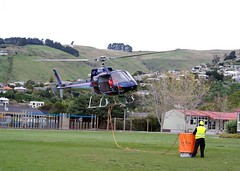
Helicopter landing at school
Images, eqnz.chch.2010
There was a risk of rocks falling off cliffs behind Redcliffs school following Sept 4th earthquake. A helicopter was used to wash off loose rocks to lower the risk to the school.
Helicopter flooding off rocks
Images, eqnz.chch.2010
There was a risk of rocks falling off cliffs behind Redcliffs school following Sept 4th earthquake. A helicopter was used to wash off loose rocks to lower the risk to the school.
Ruth Gardner's Blog 02/08/2013: Drilling Deep
Articles, UC QuakeStudies
An entry from Ruth Gardner's blog for 2 August 2013 entitled, "Drilling Deep".
Ruth Gardner's Blog 22/09/2011: Steady on Stilts
Articles, UC QuakeStudies
An entry from Ruth Gardner's blog for 22 September 2011 entitled, "Steady on Stilts".
Ruth Gardner's Blog 09/11/2011: Amuri Abandoned
Articles, UC QuakeStudies
An entry from Ruth Gardner's blog for 9 November 2011 entitled, "Amuri Abandoned".
Patients, staff face quake risks at Christchurch Hospital
Audio, Radio New Zealand
Construction delays and cost over-runs are prolonging the earthquake risks facing patients and staff at Christchurch hospital. Six major hospital buildings at the central city site have been listed as earthquake prone since May, but there is no safer space to shift patients into. Phil Pennington reports.
Lyttelton Harbour Information Centre Community Earthquake Update Friday 23…
Articles, UC QuakeStudies
The Lyttelton Harbour Information Centre's "Community Earthquake Update" bulletin, published on Friday 23 September 2011.
Lyttelton Review 29 October 2012
Articles, UC QuakeStudies
The "Lyttelton Review" newsletter for 29 October 2012, produced by the Lyttelton Harbour Information Centre.
Christchurch hospital quake risk endangers patients, staff
Audio, Radio New Zealand
Construction delays and cost over-runs are prolonging the earthquake risks facing patients and staff at Christchurch hospital. Six major hospital buildings at the central city site have been listed as earthquake prone since May, but there is no safer space to shift patients into. Christchurch Hospital boss David Meates pron; Mates says the hospital is still basically a construction site. One earthquake prone building has roof tanks containing 75 tonnes of water. Mr Meates told RNZ reporter Phil Pennington removing the water from the tanks in the meantime is not an option.
UC Risk Evaluation Process for Building Occupancy
Articles, UC QuakeStudies
A document outlying the initial evaluation process for building occupancy on campus after the 22 February 2011 earthquake.
Improving regulatory frameworks for earthquake risk mitigation
Research papers, The University of Auckland Library
New Zealand's devastating Canterbury earthquakes provided an opportunity to examine the efficacy of existing regulations and policies relevant to seismic strengthening of vulnerable buildings. The mixed-methods approach adopted, comprising both qualitative and quantitative approaches, revealed that some of the provisions in these regulations pose as constraints to appropriate strengthening of earthquake-prone buildings. Those provisions include the current seismic design philosophy, lack of mandatory disclosure of seismic risks and ineffective timeframes for strengthening vulnerable buildings. Recommendations arising from these research findings and implications for pre-disaster mitigation for future earthquake and Canterbury's post-disaster reconstruction suggest: (1) a reappraisal of the requirements for earthquake engineering design and construction, (2) a review and realignment of all regulatory frameworks relevant to earthquake risk mitigation, and (3) the need to develop a national programme necessary to achieve consistent mitigation efforts across the country. These recommendations are important in order to present a robust framework where New Zealand communities such as Christchurch can gradually recover after a major earthquake disaster, while planning for pre-disaster mitigation against future earthquakes. AM - Accepted Manuscript
Fairfax Video, March 2012 (4)
Videos, UC QuakeStudies
A video of an interview with Mark Yetton, Engineering Geologist at the Port Hills Geotech Group, about their work to assess the risk of rock fall and cliff collapse on the Christchurch Port Hills.
Ruth Gardner's Blog 20/02/2013: Drilling Deep
Articles, UC QuakeStudies
An entry from Ruth Gardner's blog for 20 February 2013 entitled, "Drilling Deep".
Ruth Gardner's Blog 10/03/2011: Day 17, 6pm - inside the red zone
Articles, UC QuakeStudies
An entry from Ruth Gardner's blog for 10 March 2011 entitled, "Day 17, 6pm - inside the red zone".
Ruth Gardner's Blog 09/08/2011: Sounding the Soil
Articles, UC QuakeStudies
An entry from Ruth Gardner's blog for 9 August 2011 entitled, "Sounding the Soil".
Roz Johnson's Blog 19/01/2013: New Home
Articles, UC QuakeStudies
An entry from Roz Johnson's blog for 19 January 2013 entitled, "New Home".
Incentives and Motivators for Enhancing Earthquake Risk Mitigation Decision
Research papers, The University of Auckland Library
Whole document is available to authenticated members of The University of Auckland until Feb. 2014. The increasing scale of losses from earthquake disasters has reinforced the need for property owners to become proactive in seismic risk reduction programs. However, despite advancement in seismic design methods and legislative frameworks, building owners are often reluctant to adopt mitigation measures required to reduce earthquake losses. The magnitude of building collapses from the recent Christchurch earthquakes in New Zealand shows that owners of earthquake prone buildings (EPBs) are not adopting appropriate risk mitigation measures in their buildings. Owners of EPBs are found unwilling or lack motivation to adopt adequate mitigation measures that will reduce their vulnerability to seismic risks. This research investigates how to increase the likelihood of building owners undertaking appropriate mitigation actions that will reduce their vulnerability to earthquake disaster. A sequential two-phase mixed methods approach was adopted for the research investigation. Multiple case studies approach was adopted in the first qualitative phase, followed by the second quantitative research phase that includes the development and testing of a framework. The research findings reveal four categories of critical obstacles to building owners‘ decision to adopt earthquake loss prevention measures. These obstacles include perception, sociological, economic and institutional impediments. Intrinsic and extrinsic interventions are proposed as incentives for overcoming these barriers. The intrinsic motivators include using information communication networks such as mass media, policy entrepreneurs and community engagement in risk mitigation. Extrinsic motivators comprise the use of four groups of incentives namely; financial, regulatory, technological and property market incentives. These intrinsic and extrinsic interventions are essential for enhancing property owners‘ decisions to voluntarily adopt appropriate earthquake mitigation measures. The study concludes by providing specific recommendations that earthquake risk mitigation managers, city councils and stakeholders involved in risk mitigation in New Zealand and other seismic risk vulnerable countries could consider in earthquake risk management. Local authorities could adopt the framework developed in this study to demonstrate a combination of incentives and motivators that yield best-valued outcomes. Consequently, actions can be more specific and outcomes more effective. The implementation of these recommendations could offer greater reasons for the stakeholders and public to invest in building New Zealand‘s built environment resilience to earthquake disasters.
Lyttelton Harbour Information Centre Community Earthquake Update Friday 22…
Articles, UC QuakeStudies
The Lyttelton Harbour Information Centre's "Community Earthquake Update" bulletin, published on Friday 22 July 2011.
Lyttelton Harbour Information Centre Community Earthquake Update Friday 29…
Articles, UC QuakeStudies
The Lyttelton Harbour Information Centre's "Community Earthquake Update" bulletin, published on Friday 29 July 2011.
Lyttelton Review 12 March 2012
Articles, UC QuakeStudies
The "Lyttelton Review" newsletter for 12 March 2012, produced by the Lyttelton Harbour Information Centre.
Christchurch Press Infographic: 10 March 2012 (4)
Images, UC QuakeStudies
An infographic showing a simulation of rockfall risk in Sumner.
Managing the science/policy boundary after a disaster : the research respo…
Research papers, University of Canterbury Library
The Sendai Framework for Disaster Risk Reduction 2015-2030 finds that, despite progress in disaster risk reduction over the last decade “evidence indicates that exposure of persons and assets in all countries has increased faster than vulnerability has decreased, thus generating new risk and a steady rise in disaster losses” (p.4, UNISDR 2015). Fostering cooperation among relevant stakeholders and policy makers to “facilitate a science-policy interface for effective decisionmaking in disaster risk management” is required to achieve two priority areas for action, understanding disaster risk and enhancing disaster preparedness (p. 13, p. 23, UNISDR 2015). In other topic areas, the term science-policy interface is used interchangeably with the term boundary organisation. Both terms are usually used refer to systematic collaborative arrangements used to manage the intersection, or boundary, between science and policy domains, with the aim of facilitating the joint construction of knowledge to inform decision-making. Informed by complexity theory, and a constructivist focus on the functions and processes that minimize inevitable tensions between domains, this conceptual framework has become well established in fields where large complex issues have significant economic and political consequences, including environmental management, biodiversity, sustainable development, climate change and public health. To date, however, there has been little application of this framework in the disaster risk reduction field. In this doctoral project the boundary management framework informs an analysis of the research response to the 2010-2011 Canterbury Earthquake Sequence, focusing on the coordination role of New Zealand’s national Natural Hazards Research Platform. The project has two aims. It uses this framework to tell the nuanced story of the way this research coordination role evolved in response to both the complexity of the unfolding post-disaster environment, and to national policy and research developments. Lessons are drawn from this analysis for those planning and implementing arrangements across the science-policy boundary to manage research support for disaster risk reduction decision-making, particularly after disasters. The second aim is to use this case study to test the utility of the boundary management framework in the disaster risk reduction context. This requires that terminology and concepts are explained and translated in terms that make this analysis as accessible as possible across the disciplines, domains and sectors involved in disaster risk reduction. Key findings are that the focus on balance, both within organisations, and between organisations and domains, and the emphasis on systemic effects, patterns and trends, offer an effective and productive alternative to the more traditional focus on individual or organisational performance. Lessons are drawn concerning the application of this framework when planning and implementing boundary organisations in the hazard and disaster risk management context.
Object Overview: Earthquake hazard and risk assessment study Stage 1 Part …
Articles, UC QuakeStudies
Object Overview of 'Earthquake hazard and risk assessment study Stage 1 Part B: Probabilistics seismic hazard assessment and earthquake scenarios for the Canterbury region, and historic earthquakes in Christchurch (Stirling et al, 1999).'
Christchurch Press Infographic: 10 August 2012 (1)
Images, UC QuakeStudies
A page banner promoting an article about tsunami risks for Christchurch.
Christchurch Real Estate agents' livelihoods are at risk
Audio, Radio New Zealand
The Real Estate Institute says earthquake related delays in getting LIM reports for house purchases in Christchurch could ruin the livelihoods of real estate agents.
Agencies move to establish the asbestos exposure risk
Audio, Radio New Zealand
Nine to Noon has been told that the Ministry of Business, Innovation and Employment is leading a multiagency group - including the Earthquake Commission, Fletcher Construction's EQR and the Department of Prime Minister and Cabinet - to try to identify which houses may have have had a high risk of containing asbestos and thereby quantify how many people may have been exposed. With Graham Darlow, Chief executive of Fletcher Construction and Gerry Brownlee, Minister for Canterbury Earthquake Recovery.
Seismic performance and financial risk of masonry houses
Research papers, University of Canterbury Library
Seismic behaviour of typical unreinforced masonry (URM) brick houses, that were common in early last century in New Zealand and still common in many developing countries, is experimentally investigated at University of Canterbury, New Zealand in this research. A one halfscale model URM house is constructed and tested under earthquake ground motions on a shaking table. The model structure with aspect ratio of 1.5:1 in plan was initially tested in the longitudinal direction for several earthquakes with peak ground acceleration (PGA) up to 0.5g. Toppling of end gables (above the eaves line) and minor to moderate cracking around window and door piers was observed in this phase. The structure was then rotated 90º and tested in the transverse (short) direction for ground motions with PGA up to 0.8g. Partial out-of-plane failure of the face loaded walls in the second storey and global rocking of the model was observed in this phase. A finite element analysis and a mechanism analysis are conducted to assess the dynamic properties and lateral strength of the model house. Seismic fragility function of URM houses is developed based on the experimental results. Damping at different phases of the response is estimated using an amplitude dependent equivalent viscous damping model. Financial risk of similar URM houses is then estimated in term of expected annual loss (EAL) following a probabilistic financial risk assessment framework. Risks posed by different levels of damage and by earthquakes of different frequencies are then examined.
Ruth Gardner's Blog 20/08/2011: Diverse Drilling
Articles, UC QuakeStudies
An entry from Ruth Gardner's blog for 20 August 2011 entitled, "Diverse Drilling".
Christchurch Press Infographic: 11 October 2012 (1)
Images, UC QuakeStudies
A map showing areas of Christchurch with increased flood risk following the earthquakes.