
Search
found 342 results
Images for earthquake-affected; more images...
New Zealand Defence Force photograph 140
Images, UC QuakeStudies
Royal New Zealand Air Force personnel preparing a Hercules C-130 to evacuate rest home residents affected by the Canterbury Earthquake.
New Zealand Defence Force photograph 135
Images, UC QuakeStudies
Royal New Zealand Air Force personnel preparing a Hercules C-130 to evacuate rest home residents affected by the Canterbury Earthquake.
New Zealand Defence Force photograph 139
Images, UC QuakeStudies
Royal New Zealand Air Force personnel preparing a Hercules C-130 to evacuate rest home residents affected by the Canterbury Earthquake.
New Zealand Defence Force photograph 126
Images, UC QuakeStudies
Royal New Zealand Air Force personnel preparing a Hercules C-130 to evacuate rest home residents affected by the Canterbury Earthquake.
New Zealand Defence Force photograph 127
Images, UC QuakeStudies
Royal New Zealand Air Force personnel preparing a Hercules C-130 to evacuate rest home residents affected by the Canterbury Earthquake.
Impact of Canterbury's earthquake on the cultural sector
Audio, Radio New Zealand
We assess how last the earthquake has affected three major arts festivals and Christchurch's historic Repertory Theatre, and the part the arts have to play in helping the city to get back on its feet.
New Zealand Defence Force photograph 107
Images, UC QuakeStudies
New Zealand Army Engineers working at New Brighton beach to provide desalinated water for residents affected by the 22 February 2011 earthquake.
Quake-hit beneficiaries get payments docked
Audio, Radio New Zealand
Some earthquake-affected residents in Christchurch are having their pensions and benefits cut, because they are earning interest on their insurance payouts.
Residents of hard hit quake street calling for firmer timeline
Audio, Radio New Zealand
Residents in one of the streets worst affected by the Canterbury earthquake say they're still in the dark about their future.
New Zealand Defence Force photograph 104
Images, UC QuakeStudies
New Zealand Army Engineers working at New Brighton beach to provide desalinated water for residents affected by the 22 February 2011 earthquake.
New Zealand Defence Force photograph 105
Images, UC QuakeStudies
New Zealand Army Engineers working at New Brighton beach to provide desalinated water for residents affected by the 22 February 2011 earthquake.
New Zealand Defence Force photograph 106
Images, UC QuakeStudies
New Zealand Army Engineers working at New Brighton beach to provide desalinated water for residents affected by the 22 February 2011 earthquake.
New Zealand Defence Force photograph 110
Images, UC QuakeStudies
A doctor from the Royal New Zealand Air Force preparing to evacuate Christchurch rest home residents affected by the 22 February 2011 earthquake.
New Zealand Defence Force photograph 112
Images, UC QuakeStudies
A doctor from the Royal New Zealand Air Force preparing to evacuate Christchurch rest home residents affected by the 22 February 2011 earthquake.
The Timaru Herald Image: Alexia Johnston 2010:09:14 16:42:32
Images, UC QuakeStudies
Photograph captioned by Fairfax, "Mellanie Brown of Timaru encourages people to support Com'on Canterbury, to help people affected by the Christchurch earthquake".
SPCA Canterbury Photograph 17
Images, UC QuakeStudies
A photograph of the Animal Rescue Unit preparing to drop off food at welfare centres and other sites in earthquake affected areas after the 22 February 2011 earthquake. In the background, a member of SPCA Canterbury is being interviewed by TVNZ.
What are the implications of the leaked EQC documents?
Audio, Radio New Zealand
Phil Holdstock, a homeowner; Leanne Curtis, relationships manager for the Canterbury Communities' Earthquake Recovery Network, a network of residents association and community group representatives from the earthquake-affected neighbourhoods of Canterbury; and Jeremy Johnson, insurance partner at Wynn Williams in Christchurch.
Preliminary Observations of the Impacts the 22 February Christchurch Earth…
Research papers, University of Canterbury Library
On 22 February 2011, Canterbury and its largest city Christchurch experienced its second major earthquake within six months. The region is facing major economic and organisational challenges in the aftermath of these events. Approximately 25% of all buildings in the Christchurch CBD have been “red tagged” or deemed unsafe to enter. The New Zealand Treasury estimates that the combined cost of the February earthquake and the September earthquake is approximately NZ$15 billion[2]. This paper examines the national and regional economic climate prior to the event, discusses the immediate economic implications of this event, and the challenges and opportunities faced by organisations affected by this event. In order to facilitate recovery of the Christchurch area, organisations must adjust to a new norm; finding ways not only to continue functioning, but to grow in the months and years following these earthquakes. Some organisations relocated within days to areas that have been less affected by the earthquakes. Others are taking advantage of government subsidised aid packages to help retain their employees until they can make long-term decisions about the future of their organisation. This paper is framed as a “report from the field” in order to provide insight into the early recovery scenario as it applies to organisations affected by the February 2011 earthquake. It is intended both to inform and facilitate discussion about how organisations can and should pursue recovery in Canterbury, and how organisations can become more resilient in the face of the next crisis.
Southern Story for 5 July 2012 - The Quake Box
Audio, Radio New Zealand
To Christchurch now, where the people most affected by the region's earthquakes are getting a chance to tell their stories to a wider audience.
Christchurch Press Image: Iain McGregor 2010:09:16 10:04:30
Images, UC QuakeStudies
Photograph captioned by Fairfax, "Meeting for earthquake affected residents at Burwood Primary to get EQC and insurance information. John Jennings demanding a few answers".
Animals in Emergencies - Donelle Gadenne
Audio, Radio New Zealand
Cats, dogs, horses, parrots, rats, hedgehogs and turtles. Just like people, these animals were affected by the earthquakes in Christchurch. And two researchers have published a new book into just how big the impact of the September 2010 and February 2011 earthquakes were. 'Animals in Emergencies: Learning from the Christchurch Earthquakes' is co-authored by Canterbury University's associate professor Annie Potts, and former veterinary nurse Donelle Gadenne.
Quake clean-up begins in Avonside for a second time
Audio, Radio New Zealand
In Avonside, one of the suburbs most badly affected by the September 4th earthquake in Christchurch, a second massive clean-up operation is underway.
New Zealand Defence Force photograph 114
Images, UC QuakeStudies
Members of the Royal New Zealand Air Force Air Security team preparing to evacuate Christchurch rest home residents affected by the 22 February 2011 earthquake.
EQC level assessments questioned
Audio, Radio New Zealand
Some Canterbury homeowners say their houses have dropped in value because the damage to their properties was inadequately assessed by the Earthquake Commission after the 2010 and 2011 earthquakes. Independent land surveyor, Adrian Cowie, and a Burwood homeowner affected by the quakes, Selwyn Stafford, talk about the issues facing them.
BeckerFraserPhotos December 2011 photograph 2306
Images, UC QuakeStudies
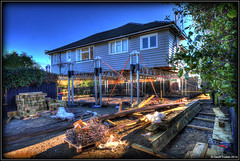
A photograph captioned by BeckerFraserPhotos, "This house at 23 Seabreeze Close, Bexley, was badly affected by liquefaction in the previous earthquakes. The impact of the 23 December 2011 earthquakes and further liquefaction was to break the house through the middle".
Christchurch Press Image: Joseph Johnson 2010:09:08 10:24:53
Images, UC QuakeStudies
Photograph captioned by Fairfax, "John Key on his visit to Kaiapoi and Hororata to meet badly-affected people and see the damage from the earthquake. Prime Minister John Key talks to the media outside the Hororata church that was badly damaged by the earthquake".
Reaction to press conference
Audio, Radio New Zealand
The Canterbury Communities' Earthquake Recovery Network or CanCERN represents dozens of residents' associations and community groups. Tom McBrearty is chairman, whose own house has been badly affected.
Quake affected residents say they are being neglected
Audio, Radio New Zealand
More than two weeks after the massive earthquake that rocked Canterbury, some living in one of Christchurch's worst hit suburbs are feeling neglected and abandoned.
Investigating the relationship between depression and psychosocial factors…
Research papers, University of Canterbury Library
Earthquake events can be sudden, stressful, unpredictable, and uncontrollable events in which an individual’s internal and external assumptions of their environment may be disrupted. A number of studies have found depression, and other psychological symptoms may be common after natural disasters. They have also found an association between depression, losses and disruptions for survivors. The present study compared depression symptoms in two demographically matched communities differentially affected by the Canterbury (New Zealand) earthquakes. Hypotheses were informed by the theory of learned helplessness (Abramson, Seligman & Teasdale, 1978). A door-to-door survey was conducted in a more physically affected community sample (N=67) and a relatively unaffected community sample (N=67), 4 months after the February 2011 earthquake. Participants were again assessed approximately 10 months after the quake. Measures of depression, acute stress, anxiety, aftershock anxiety, losses, physical disruptions and psychological disruptions were taken. In addition, prior psychological symptoms, medication, alcohol and cigarette use were assessed. Participants in the more affected community reported higher depression scores than the less affected community. Overall, elevated depressive score at time 2 were predicted by depression at time 1, acute stress and anxiety symptoms at time 2, physical disruptions following the quake and psychosocial functioning disruptions at time 2. These results suggest the influence of acute stress, anxiety and disruptions in predicting depression sometime after an earthquake. Supportive interventions directed towards depression, and other psychological symptoms, may prove helpful in psychological adjustment following ongoing disruptive stressors and uncontrollable seismic activity.
New Zealand Defence Force photograph 234
Images, UC QuakeStudies
Photograph captioned by the New Zealand Defence Force, "Chief of Defence Force, Major General Rhys Jones on an operational tour of earthquake affected areas of Christchurch".