
Search
found 69 results
Images for 2013; more images...

SCIRT Collaborative Approach to Global Consenting Framework
Articles, UC QuakeStudies
A copy of the award application which SCIRT, the Christchurch City Council, Environment Canterbury and Beca submitted for the New Zealand Planning Institute Best Practice Award in February 2013.
Well Under Way
Images, eqnz.chch.2010
Knox Church earthquake repair/rebuild on a walk around Christchurch December 11, 2013 New Zealand. www.stuff.co.nz/the-press/news/christchurch-earthquake-20... All about our ear...
Canterbury Cultural Recovery Centre Photograph 002
Images, UC QuakeStudies
A photograph of the Canterbury Cultural Recovery Centre's main floor, taken in August 2013. There are St John's uniforms hanging from a clothes rack at the end of one of the stacks.
Central City Delivery Management Plan
Articles, UC QuakeStudies
A plan which describes how SCIRT would manage the risks associated with rebuilding horizontal infrastructure within Christchurch's central city area. The first version of this plan was produced on 24 October 2013.
Dewatering 101: A process to lower groundwater
Articles, UC QuakeStudies
A poster which outlines the dewatering process.
Triumphal Arch and Bridge of Remembrance communication updates
Articles, UC QuakeStudies
A series of communication updates provided by SCIRT's Downer Delivery Team to the Christchurch City Council. These updates detailed the progress of the Arch and Bridge restoration. The updates were produced between 28 June 2013 and 8 September 2015.
Crisis Management Plan
Articles, UC QuakeStudies
A plan which provides SCIRT with clear direction and guidelines regarding communication in the event of a crisis. The first version of this plan was produced on 1 December 2013. Note that personal details of key personnel have been removed from this document.
Designer's Guideline 007 Technical Leads
Articles, UC QuakeStudies
A designer's guideline which explains the role of Technical Leads at SCIRT.
Heritage guide for Delivery Teams
Articles, UC QuakeStudies
A guideline created for SCIRT Delivery Teams which outlines the requirements for working around heritage items.
Work Notices in a business community
Articles, UC QuakeStudies
An example of a tool SCIRT has used to communicate its projects to the business community.
DG46: Asset Assessment Spreadsheet Guideline
Articles, UC QuakeStudies
A design guideline which provides information about how to use the SCIRT Asset Assessment Spreadsheet.
Implications of the Canterbury earthquake sequence for Adelaide, South Aus…
Research papers, The University of Auckland Library
The city of Christchurch has experienced over 10,000 aftershocks since the 4th of September 2010 earthquake of which approximately 50 have been greater than magnitude 5. The damage caused to URM buildings in Christchurch over this sequence of earthquakes has been well documented. Due to the similarity in age and construction of URM buildings in Adelaide, South Australia and Christchurch (they are sister cities, of similar age and heritage), an investigation was conducted to learn lessons for Adelaide based on the Christchurch experience. To this end, the number of URM buildings in the central business districts of both cities, the extent of seismic strengthening that exists in both cities, and the relative earthquake hazards for both cities were considered. This paper will report on these findings and recommend strategies that the city of Adelaide could consider to significantly reduce the seismic risk posed by URM buildings in future earthquake.
SCIRT AutoCAD Customisation Manual - General Tools
Articles, UC QuakeStudies
A manual which provides SCIRT AutoCAD users with general guidance about how to use AutoCAD.
Horizontal Infrastructure Governance - Client Governance Group
Articles, UC QuakeStudies
A document which details the structure, roles and terms of reference for the Client Governance Group (CGG).
Best practice subsurface utility location
Articles, UC QuakeStudies
A document which contains a set of procedures for the "best practice" mark out and recording of subsurface utilities.
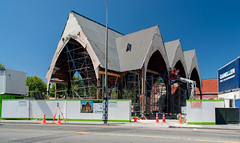
Work Has Started
Images, eqnz.chch.2010
The earthquake re-pair work has started on the Knox Church on Bealey Avenue, August 14, 2013 Christchurch New Zealand. While building after building is torn down in Christchurch, plans are in place to ensure as much of a 131-year-old church is retained as possible. Knox Church on Bealey Avenue suffered major damage in the February 22 earthquak...
DG018 Document Control
Articles, UC QuakeStudies
A guideline which defined the process and ownership of templates used by the design team and the management of the design team electronic library.
GIS Abandoned Removed Tool
Articles, UC QuakeStudies
This document describes the tool developed for capturing the abandoned and removed assets using the SCIRT GIS viewer.
Profilometer Design Guideline
Articles, UC QuakeStudies
A guideline to inform designers of the pipe profilometer operation, including requesting profile surveys, standards and assessments of the survey results.
SCIRT AutoCAD Customisation Manual - Overview Tools Summary
Articles, UC QuakeStudies
A manual which informs SCIRT AutoCAD users of all tools, utilities, keyboard shortcuts, and tips available within the SCIRT CAD System.
Colours of the Rainbow
Images, eqnz.chch.2010
Christchurch "New Zealand" architecture building "Demolition of old Millers building" demolition detail rubbleDemolition started on the old Millers building on a walk around Christchurch May 6, 2013 New Zealand. The building was originally designed in 1935 by G. A. Hart for the retail store, factory and warehouse Millers and was completed in 19...
Eating Away Slowly
Images, eqnz.chch.2010
Demolition work on Christchurch's "distinctive" former civic building and the Front Runner store. On a walk around Christchurch May 9, 2013 New Zealand. Demolition work on Christchurch's "distinctive" former civic building is under way. The category-2 heritage building was designed by G A J Hart and opened in 1939 as the Miller's department s...
Rebuild schedule map
Articles, UC QuakeStudies
An example of the five year rebuild schedule map created as part of the prioritisation process detailing where and when construction would start. The data behind this map was updated every quarter.
Evaluation of Whole of Life Costs for Rebuild Option Evaluation (Design Gu…
Articles, UC QuakeStudies
A design guideline which provides guidance to designers on how to carry out a whole of life evaluation of rebuild options.
Project Prioritisation Management Plan
Articles, UC QuakeStudies
A plan which describes the framework, principles and process for determining project prioritisation and the sequence in which those projects are carried out. The first version of this plan was produced on 23 September 2011.
Effectiveness and efficiency of arrangements to repair pipes and roads in …
Articles, UC QuakeStudies
A report which details the findings of a performance audit carried out by the Office of the Auditor-General to assess the effectiveness and efficiency of arrangements to repair Christchurch's horizontal infrastructure.
DG023 The use of Pipe Damage Assessment Tool (PDAT) outputs for Project De…
Articles, UC QuakeStudies
A design guideline which provides guidance to project definition and design teams on how to use Pipe Damage Assessment Tool (PDAT) outputs in their scoping and concept design work.
Townsend Telescope: Part Photograph 67
Images, UC QuakeStudies
A photograph of the lens of the Townsend Telescope. The lens is the most crucial component of the telescope. Despite damage to the surrounding parts, the lens was unharmed during the 22 February 2011 earthquake. Because of this, the telescope can be restored.
FESTA Promotional Video
Videos, UC QuakeStudies
A video made by Julian Vares about FESTA - the Festival of Transitional Architecture. The video includes explanations from FESTA director Jessica Halliday and key collaborators about what FESTA is about, and the important role it plays in the rebuild and recovery of Christchurch. It also includes a compilation of footage from the first three FESTA events of 2012, 2013 and 2014. This footage was shot by Rick Harvie (Belmont Productions), Peter Young (Fisheye Films), Ed Lust and John Chrisstoffels.
Performance of adhesive wall-to-diaphragm connections in the Canterbury ea…
Research papers, The University of Auckland Library
The connections between walls of unreinforced masonry (URM) buildings and flexible timber diaphragms are critical building components that must perform adequately before desirable earthquake response of URM buildings may be achieved. Field observations made during the initial reconnaissance and the subsequent damage surveys of clay brick URM buildings following the 2010/2011 Canterbury, New Zealand earthquakes revealed numerous cases where anchor connections joining masonry walls or parapets with roof or floor diaphragms appeared to have failed prematurely. These observations were more frequent for the case of adhesive anchor connections than for the case of through-bolt connections (i.e. anchorages having plates on the exterior façade of the masonry walls). Subsequently, an in-field test program was undertaken in an attempt to evaluate the performance of adhesive anchor connections between unreinforced clay brick URM walls and roof or floor diaphragm. The study consisted of a total of almost 400 anchor tests conducted in eleven existing URM buildings located in Christchurch, Whanganui and Auckland. Specific objectives of the study included the identification of failure modes of adhesive anchors in existing URM walls and the influence of the following variables on anchor load-displacement response: adhesive type, strength of the masonry materials (brick and mortar), anchor embedment depth, anchor rod diameter, overburden level, anchor rod type, quality of installation and the use of metal foil sleeve. In addition, the comparative performance of bent anchors (installed at an angle of minimum 22.5o to the perpendicular projection from the wall surface) and anchors positioned horizontally was investigated. Observations on the performance of wall-to-diaphragm connections in the 2010/2011 Canterbury earthquakes and a snapshot of the performed experimental program and the test results are presented herein. http://hdl.handle.net/2292/21050