

Search
found 5847 results
Images for earthquake; more images...

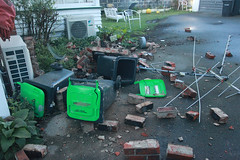

WEMO ERT Set 1 - March 2011 - Photograph 138
Images, UC QuakeStudies
A photograph of the earthquake damage to a block of buildings on Hereford Street. Large sections of the buildings have collapsed and the rubble has spilled onto the footpath and street in front. USAR codes have been spray-painted on the front of Calendar Girls.
WEMO ERT Set 3 - February 2011 - Photograph 005
Images, UC QuakeStudies
A photograph of volunteers from the Wellington Emergency Management Office being photographed in front of a truck. The volunteers are preparing to travel to Christchurch to help out after the 22 February 2011 earthquake. In the background is the Wellington Emergency Management Office building.
WEMO ERT Set 3 - February 2011 - Photograph 006
Images, UC QuakeStudies
A photograph of volunteers from the Wellington Emergency Management Office being photographed in front of a truck. The volunteers are preparing to travel to Christchurch to help out after the 22 February 2011 earthquake. In the background is the Wellington Emergency Management Office building.
WEMO ERT Set 1 - March 2011 - Photograph 34
Images, UC QuakeStudies
A photograph of the Wellington Emergency Management Office Emergency Response Team standing in a car park on Lichfield Street. The team are wearing face and gas masks, hard hats, safety glasses, knee pads, and rubber gloves. In the background are several earthquake-damaged buildings.
WEMO ERT Set 1 - March 2011 - Photograph 13
Images, UC QuakeStudies
A photograph of members of the Wellington Emergency Management Office Emergency Response Team standing on the intersection of Manchester and Lichfield Streets. In the background is the Majestic Theatre. Piles of rubble from earthquake-damaged buildings has been piled on the road below the building.
WEMO ERT Set 1 - March 2011 - Photograph 132
Images, UC QuakeStudies
A photograph of the earthquake damage to the Oxford Terrace Baptist Church. The middle section of the church has collapsed and the roof is now resting on a pile of bricks and other rubble. The front and back walls of the church are still standing.
WEMO ERT Set 3 - February 2011 - Photograph 103
Images, UC QuakeStudies
A photograph of cars on Manchester Street which has been crushed by falling rubble. Bricks and other rubble from the earthquake-damaged shops above are scattered across the road in front. The word "clear" has been spray-painted on the side of the cars.
WEMO ERT Set 3 - February 2011 - Photograph 136
Images, UC QuakeStudies
A photograph of the earthquake damage to the Canterbury Provincial Chambers Building on Durham Street. Large sections of the masonry have collapsed, spilling onto the road. Wire fencing has been placed around the building as a cordon. Scaffolding erected up the side has collapsed.
WEMO ERT Set 3 - February 2011 - Photograph 135
Images, UC QuakeStudies
A photograph of the earthquake damage to the Canterbury Provincial Chambers Building on Durham Street. Large sections of the masonry have collapsed, spilling onto the road. Wire fencing has been placed around the building as a cordon. Scaffolding erected up the side has collapsed.
WEMO ERT Team Set 3 - April 2011 - Photograph 01
Images, UC QuakeStudies
A photograph of the photocopy template for the Christchurch City Council's green sticker. The sticker was used by the Civil Defence after the 2010 and 2011 earthquakes to indicate that a building had been inspected and that 'no structural or other safety hazards' were found.
WEMO ERT Team Set 1 - June 2011 - Photograph 4
Images, UC QuakeStudies
A photograph of members of the Wellington Emergency Management Office at a graduation ceremony in the Wellington Town Hall. The volunteers were awarded certificates of appreciation at the ceremony, for their work in the emergency response to the 22 February 2011 earthquake in Christchurch.
WEMO ERT Set 1 - March 2011 - Photograph 78
Images, UC QuakeStudies
A photograph of the earthquake-damaged Oxford Terrace Baptist Church. Steels bracing has been used to stabilise the front of the building. Crumbled masonry and other rubble is still lying in front. Wire fences have been placed around the building site as a cordon.
WEMO ERT Set 1 - March 2011 - Photograph 174
Images, UC QuakeStudies
A photograph of the earthquake damage to a Stonehurst Accommodation building on Gloucester Street. The bottom storey of the building has collapsed and the top two storeys are resting on the rubble. The closest wall of the building has also collapsed, exposing the rooms inside.
Kim Wright WEMO Photograph 018
Images, UC QuakeStudies
A photograph of the earthquake damage to the Cranmer Courts on the corner of Montreal and Kilmore Streets. The tops of the gables of the section of the building on the corner have crumbled. Ties have been placed around all of the gables as bracing.
WEMO ERT Set 1 - March 2011 - Photograph 77
Images, UC QuakeStudies
A photograph of the earthquake-damaged Oxford Terrace Baptist Church. Steels bracing has been used to stabilise the front of the building. Crumbled masonry and other rubble is still lying in front. Wire fences have been placed around the building site as a cordon.
WEMO ERT Set 1 - March 2011 - Photograph 112
Images, UC QuakeStudies
A photograph looking west down Dundas Street. Rubble has been stacked on both sides of the street. Several earthquake-damaged cars, recovered from the Smiths City car park, have also been stacked on the left. In the background two excavators are sorting through the rubble.
Observatory Tower Photograph 14
Images, UC QuakeStudies
A close-up photograph of parts of the Townsend Telescope recovered from the rubble of the Observatory tower. The telescope was housed in the tower at the Christchurch Arts Centre. It was severely damaged when the tower collapsed during the 22 February 2011 earthquake.
MEDIANZ Vol 14, No 1: Heroic Radio
Articles, UC QuakeStudies
An article from the Media Studies Journal of Aotearoa New Zealand Volume 14, Number 1. The article is titled, "Heroic Radio: a study of radio responses in the immediate aftermath of the September 2010 Earthquake in Christchurch, New Zealand". It was written by Ruth Zanker.
BeckerFraserPhotos October 2010 photograph 017
Images, UC QuakeStudies
A crack next to the Avon River caused by the ground slumping after the 4 September earthquake. A blue pipe has been laid over the crack. Many kilometres of these temporary water pipes have been run overground in Avonside to supply houses with water.
BeckerFraserPhotos February 2011 photograph 269
Images, UC QuakeStudies
A gutter on Bracken Street in Avonside showing cracks from the 4 September 2010 earthquake. The edges of the footpath above it have fallen away, and the gutter has filled with the loose gravel which was used to fill pot holes in the road.
WEMO ERT Set 1 - March 2011 - Photograph 129
Images, UC QuakeStudies
A photograph of a member of an emergency management team walking down Cashel Street. In the background is a crushed van, piles of rubble from earthquake-damaged buildings, and partially-collapsed scaffolding. Wire fences have been placed in front of the buildings as cordons.
Observatory Tower Photograph 18
Images, UC QuakeStudies
A photograph of the earthquake damage to the second story of the Observatory tower at the Christchurch Arts Centre. The front of the storey has collapsed, exposing the inside. A tarpaulin has been draped over the top and the roof of the building behind.
QuakeStory Photo 315
Images, UC QuakeStudies
A photograph submitted by Raymond Morris to the QuakeStories website. The description reads, "This painting of the ‘Frame workshop’ 456 Colombo St. Sydenham is by artist Raymond Morris. It is one of many paintings he has done of buildings demolished in the earthquakes 2010-2011.".
Helen Devereux Photograph 095
Images, UC QuakeStudies
For the first time in November 2011, Christchurch residents finally had the opportunity to see the earthquake-damaged city centre on the Red Zone bus tours organised by CERA. The podium which formerly held the Godley statue. Behind is the Regent Theatre dome which has been removed from the building.
Henry Africa's Demolition - Photograph 01
Images, UC QuakeStudies
A digger demolishes Henry Africa's restaurant. The photographer comments, "A building housing a restaurant and a great little neighbourhood bar is finally coming down because of earthquake damage. The left half. Janes Bar and one of the upstairs flats were still standing today, but they'll be gone soon".
Deb Robertson's Blog 19/11/2012: Christchurch: Trying to make sense of liv…
Articles, UC QuakeStudies
An entry from Deb Robertson's blog for 19 November 2012 entitled, "Christchurch: Trying to make sense of living here....".
Deb Robertson's Blog 17/07/2013: ps, I love you too
Articles, UC QuakeStudies
An entry from Deb Robertson's blog for 17 July 2013 entitled, "ps, I love you too".
Governing community resilience: Interconnections between community resilie…
Research papers, University of Canterbury Library
The lived reality of the 2010-2011 Canterbury earthquakes and its implications for the Waimakariri District, a small but rapidly growing district (third tier of government in New Zealand) north of Christchurch, can illustrate how community well-being, community resilience, and community capitals interrelate in practice generating paradoxical results out of what can otherwise be conceived as a textbook ‘best practice’ case of earthquake recovery. The Waimakariri District Council’s integrated community based recovery framework designed and implemented post-earthquakes in the District was built upon strong political, social, and moral capital elements such as: inter-institutional integration and communication, participation, local knowledge, and social justice. This approach enabled very positive community outputs such as artistic community interventions of the urban environment and communal food forests amongst others. Yet, interests responding to broader economic and political processes (continuous central government interventions, insurance and reinsurance processes, changing socio-cultural patterns) produced a significant loss of community capitals (E.g.: social fragmentation, participation exhaustion, economic leakage, etc.) which simultaneously, despite local Council and community efforts, hindered community well-being in the long term. The story of the Waimakariri District helps understand how resilience governance operates in practice where multi-scalar, non-linear, paradoxical, dynamic, and uncertain outcomes appear to be the norm that underpins the construction of equitable, transformative, and sustainable pathways towards the future.
Swimming with ideas: What happens to creativity in the wake of a disaster …
Research papers, Lincoln University
Creativity that is driven by a need for physical or economic survival, which disasters are likely to inspire, raises the question of whether such creativity fits with conventional theories and perspectives of creativity. In this paper we use the opportunity afforded by the 2010-2013 Christchurch, New Zealand earthquakes to follow and assess the creative practices and responses of a number of groups and individuals. We use in-depth interviews to tease out motivations and read these against a range of theoretical propositions about creativity. In particular, we focus on the construct of “elite panic” and the degree to which this appeared to be evident in the Christchurch earthquakes context. Bureaucratic attempts to control or limit creativity were present but they did not produce a completely blanket dampening effect. Certain individuals and groups seemed to be pre-equipped to navigate or ignore potential blocks to creativity. We argue, using Geir Kaufmann’s novelty-creativity matrix and aspects of Teresa Amabile’s and Michael G. Pratt’s revised componential theory of creativity that a special form of disaster creativity does exist.
BeckerFraserPhotos March 2012 photograph 153
Images, UC QuakeStudies
A worker in a high visibility vest and a hard hat repairing and strengthening the outside of a building at the University of Canterbury. The photograph has been captioned by BeckerFraserPhotos, "The repair work on the buildings at the University of Canterbury looks similar to the scenes in the CBD".