

Search
found 559 results
Images for September 2010 Canterbury Earthquake; more images...


UC Civil and Natural Resources Engineering Photograph 138
Images, UC QuakeStudies
A photograph of a crack in a wall of Room 212 in the Department of Civil and Natural Resources Engineering at the University of Canterbury when staff were let in after the 4 September 2010 earthquake.
Jim Baltaxe WEMO Photograph 109
Images, UC QuakeStudies
A photograph of the earthquake damage to the Canterbury Provincial Chambers on Durham Street. The top of the chamber has crumbled, and the masonry has fallen onto the footpath. Scaffolding which was erected after the 4 September 2010 earthquake has also fallen.
Jim Baltaxe WEMO Photograph 110
Images, UC QuakeStudies
A photograph of the earthquake damage to the Canterbury Provincial Chambers on Durham Street. The top of the chamber has crumbled, and the masonry has fallen onto the footpath. Scaffolding which was erected after the 4 September 2010 earthquake has also fallen.
Observatory Tower Photograph 08
Images, UC QuakeStudies
A photograph of cracks around a window of the Observatory tower at the Christchurch Arts Centre. The cracks formed as a result of the 4 September 2010 earthquake.
Observatory Tower Photograph 04
Images, UC QuakeStudies
A photograph of cracks around a window of the Observatory tower at the Christchurch Arts Centre. The cracks formed as a result of the 4 September 2010 earthquake.
Observatory Tower Photograph 02
Images, UC QuakeStudies
A photograph of cracks in the masonry of the Observatory tower at the Christchurch Arts Centre. The cracks formed as a result of the 4 September 2010 earthquake.
Observatory Tower Photograph 06
Images, UC QuakeStudies
A photograph of cracks around a window of the Observatory tower at the Christchurch Arts Centre. The cracks formed as a result of the 4 September 2010 earthquake.
Unexpected faults: Managing entomology collections through the 2010/11 Can…
Research papers, Lincoln University
On 4 September 2010, a 7.1 magnitude earthquake struck near Darfield, 40 kilometres west of Christchurch, New Zealand. The quake caused significant damage to land and buildings nearby, with damage extending to Christchurch city. On 22 February 2011, a 6.3 magnitude earthquake struck Christchurch, causing extensive and significant damage across the city and with the loss of 185 lives. Years on from these events, occasional large aftershocks continue to shake the region. Two main entomological collections were situated within close proximity to the 2010/11 Canterbury earthquakes. The Lincoln University Entomology Research Collection, which is housed on the 5th floor of a 7 storey building, was 27.5 km from the 2010 Darfield earthquake epicentre. The Canterbury Museum Entomology Collection, which is housed in the basement of a multi-storeyed heritage building, was 10 km from the 2011 Christchurch earthquake epicentre. We discuss the impacts of the earthquakes on these collections, the causes of the damage to the specimens and facilities, and subsequent efforts that were made to prevent further damage in the event of future seismic events. We also discuss the wider need for preparedness against the risks posed by natural disasters and other catastrophic events.
UC Civil and Natural Resources Engineering Photograph 109
Images, UC QuakeStudies
A photograph of a trolley stacked with computers and keyboards in the Civil Suite at the University of Canterbury after the 4 September 2010 earthquake. The photograph was taken on the day when the staff were allowed to return to the building.
UC Civil and Natural Resources Engineering Photograph 125
Images, UC QuakeStudies
A photograph of Room 212 in the Department of Civil and Natural Resources Engineering at the University of Canterbury after the 4 September 2010 earthquake. The photograph was taken on the day when the staff were allowed to return to the building.
UC Civil and Natural Resources Engineering Photograph 124
Images, UC QuakeStudies
A photograph of Room 212 in the Department of Civil and Natural Resources Engineering at the University of Canterbury after the 4 September 2010 earthquake. The photograph was taken on the day when the staff were allowed to return to the building.
UC Civil and Natural Resources Engineering Photograph 126
Images, UC QuakeStudies
A photograph of Room 212 in the Department of Civil and Natural Resources Engineering at the University of Canterbury after the 4 September 2010 earthquake. The photograph was taken on the day when the staff were allowed to return to the building.
The seismic performance of unreinforced stone masonry buildings during the…
Research papers, The University of Auckland Library
The sequence of earthquakes that has affected Christchurch and Canterbury since September 2010 has caused damage to a great number of buildings of all construction types. Following post-event damage surveys performed between April 2011 and June 2011, the damage suffered by unreinforced stone masonry buildings is reported and different types of observed failures are described. A detailed technical description of the most prevalently observed failure mechanisms is provided, with reference to recognised failure modes for unreinforced masonry structures. The observed performance of existing seismic retrofit interventions is also provided, as an understanding of the seismic response of these interventions is of fundamental importance for assessing the vulnerability of similar strengthening techniques when applied to unreinforced stone masonry structures.
UC Civil and Natural Resources Engineering Photograph 025
Images, UC QuakeStudies
A photograph of a fence on the Greendale Fault line which has been damaged by the 4 September 2010 earthquake. The wire has been pulled off the posts and is hanging loose.
UC Civil and Natural Resources Engineering Photograph 132
Images, UC QuakeStudies
A photograph of a pile of books in an office in the Department of Civil and Natural Resources Engineering at the University of Canterbury after the 4 September 2010 earthquake. The book at the top is called, "Wellington After the 'Quake: The Challenge of Rebuilding Cities".
Assessment of Farmland Affected by Liquefaction Following the 4 September …
Articles, UC QuakeStudies
A report by Peter Almond, Thomas Wilson, Derrick Moot, Andre Eger, Fiona Shanhun and Zach Whitman. The report summarises trials undertaken to rehabilitate sediment-covered and blistered pasture paddocks throughout early- to mid- October 2010.
Rosalee Jenkin Photograph 07
Images, UC QuakeStudies
A photograph of the rebuilt Blackwell's Department Store on the corner of Williams Street and Raven Quay in Kaiapoi. The department store was rebuilt after the previous building was damaged in the 2010 and 2011 Canterbury earthquakes. This photograph was modelled off an image taken by BeckerFraserPhotos in September 2010.
WEMO ERT Set 3 - February 2011 - Photograph 114
Images, UC QuakeStudies
A photograph of the earthquake damage to the Canterbury Provincial Chambers Buildings on Durham Street. Large sections of the masonry have collapsed, spilling onto the road. Wire fencing has been placed around the building as a cordon. Scaffolding erected up the side of the building after the 4 September 2010 earthquake has collapsed. In the distance, a crane is parked on the street.
UC Civil and Natural Resources Engineering Photograph 030
Images, UC QuakeStudies
A photograph of a fence on the Greendale Fault line which has shifted considerably due to the 4 September 2010 earthquake. Police tape and cones have been placed across the road to close it off.
UC Civil and Natural Resources Engineering Photograph 020
Images, UC QuakeStudies
A photograph of a fence on the Greendale Fault line which has shifted considerably due to the 4 September 2010 earthquake. Police tape and cones have been placed across the road to close it off.
Earthquake response #1: Enquiry, research, design and community projects, …
Research papers, Lincoln University
The September and February earthquakes were terrifying and devastating. In February, 185 people were killed (this number excludes post earthquake related deaths) and several thousand injured. Damage to infrastructure above and below ground in and around Christchurch was widespread and it will take many years and billions of dollars to rebuild. The ongoing effects of the big quakes and aftershocks are numerous, with the deepest impact being on those who lost family and friends, their livelihoods and homes. What did Cantabrians do during the days, weeks and months of uncertainty and how have we responded? Many grieved, some left, some stayed, some arrived, many shovelled (liquefaction left thousands of tons of silt to be removed from homes and streets), and some used their expertise or knowledge to help in the recovery. This book highlights just some of the projects staff and students from The Faculty of Environment, Society and Design have been involved in from September 2010 to October 2012. The work is ongoing and the plan is to publish another book to document progress and new projects.
Environmental Health Officers from the New Zealand Army testing water in C…
Videos, UC QuakeStudies
A video about the New Zealand Army testing the quality of water across Christchurch. After the 4 September 2010 earthquake, the NZ Army developed ties with the Canterbury District Health Board. This relationship continued after the 22 February 2011 earthquake with the NZ Army taking on the role of examining Christchurch's water quality.
Rosalee Jenkin Photograph 06
Images, UC QuakeStudies
A photograph of the rebuilt Blackwell's Department Store on the corner of Williams Street and Raven Quay in Kaiapoi. The department store was rebuilt after the previous building was damaged in the 2010 and 2011 Canterbury earthquakes. This photograph was modelled off an image taken by BeckerFraserPhotos in September 2010.
Observatory Tower Photograph 03
Images, UC QuakeStudies
A photograph of the Observatory tower at the Christchurch Arts Centre. There are cracks in the masonry of the tower near where the two storeys join. The cracks formed as a result of the 4 September 2010 earthquake.
Jim Baltaxe WEMO Photograph 107
Images, UC QuakeStudies
A photograph of the earthquake damage to the Canterbury Provincial Chambers on Durham Street. The top of one of the chambers has crumbled and the masonry has fallen onto the footpath. Scaffolding which was erected after the 4 September 2010 earthquake has also fallen. Wire fences have been placed around the building as a cordon.
Jim Baltaxe WEMO Photograph 108
Images, UC QuakeStudies
A photograph of the earthquake damage to the Canterbury Provincial Chambers on Durham Street. The top of one of the chambers has crumbled and the masonry has fallen onto the footpath. Scaffolding which was erected after the 4 September 2010 earthquake has also fallen. Wire fences have been placed around the building as a cordon.
Empowered Christchurch Letter to Gerry Brownlee 2
Articles, UC QuakeStudies
A copy of a letter from Empowered Christchurch which was sent to Gerry Brownlee, Minsiter for the Canterbury Earthquake Recovery, on 15 April 2014. The letter lodges an Official Information Act request about Imminent Loss claims settled by the EQC since September 2010.
UC Civil and Natural Resources Engineering Photograph 104
Images, UC QuakeStudies
A photograph of a corner of the Civil Suite at the University of Canterbury after the 4 September 2010 earthquake. The photograph was taken on the day when the staff were allowed to return to the building. One of the ceiling panels has fallen onto a desk below, exposing the insulation underneath.
UC Civil and Natural Resources Engineering Photograph 199
Images, UC QuakeStudies
A photograph of a sign on the door of the Botanic Gardens Cafe. The sign indicates that the premises have been assessed by the Christchurch City Council after the 4 September 2010 earthquake and no apparent food safety issues were found.
UC Civil and Natural Resources Engineering Photograph 019
Images, UC QuakeStudies
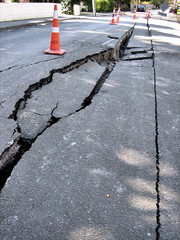
A photograph of a section of road lying on the Greendale Fault line which has cracked due to the 4 September 2010 earthquake. In the distance, police tape and cones have been used to close off the road.