

Search
found 559 results
Images for Canterbury Earthquake 2010; more images...


Hagley Park
Images, eqnz.chch.2010
Helicopter Flight over Christchurch New Zealand
sand volcano tours
Images, eqnz.chch.2010
Yes, it was a joke. The tours, that is, not the yard filled with earthquake-caused sand volcanos. They were very real. You can see one covering the driveway in this photo. The signs read as follows. "Tours run 1/2 hourly. $5.25 admission. Eftpos unavailable." "If you think this is bad... you should see the back!"
Addington Rugby Stadium
Images, eqnz.chch.2010
Helicopter Flight over Christchurch New Zealand
Manchester/High Streets
Images, eqnz.chch.2010
Helicopter Flight over Christchurch New Zealand
On-going challenges in physics-based ground motion prediction and insights…
Research papers, University of Canterbury Library
This paper presents on-going challenges in the present paradigm shift of earthquakeinduced ground motion prediction from empirical to physics-based simulation methods. The 2010-2011 Canterbury and 2016 Kaikoura earthquakes are used to illustrate the predictive potential of the different methods. On-going efforts on simulation validation and theoretical developments are then presented, as well as the demands associated with the need for explicit consideration of modelling uncertainties. Finally, discussion is also given to the tools and databases needed for the efficient utilization of simulated ground motions both in specific engineering projects as well as for near-real-time impact assessment.
Addington Rugby Stadium & CBS Arena
Images, eqnz.chch.2010
Helicopter Flight over Christchurch New Zealand
brick fence down on Samuel Street
Images, eqnz.chch.2010
None
the jolt opened most kitchen cupboard doors
Images, eqnz.chch.2010
None
BeckerFraserPhotos March 2012 photograph 198
Images, UC QuakeStudies
Photograph captioned by BeckerFraserPhotos, "Jeremy Stewart of Alice in Videoland holding 'When a City Falls', the film recently released about the 2010 and 2011 Canterbury earthquakes".
People in Disasters Conference - Canterbury Primary Care Response to Earth…
Videos, UC QuakeStudies
A video of a presentation by Dr Phil Schroeder, Managing Director of Rolleston Central Health, during the second plenary of the 2016 People in Disasters Conference. The presentation is titled, "Canterbury Primary Care Response to Earthquakes in 2010/2011".
Photograph by Paul Corliss 0125
Images, UC QuakeStudies
A photograph of a sign reading, "Emergency, campus closed, no entry". The photograph is captioned by Paul Corliss, "Canterbury University post earthquake".
Kim Wright WEMO Photograph 061
Images, UC QuakeStudies
A photograph of an excavator on the side of a road in Canterbury. This stretch of road is near the Greendale fault line which caused the 4 September 2010 earthquake.
Jim Baltaxe WEMO Photograph 109
Images, UC QuakeStudies
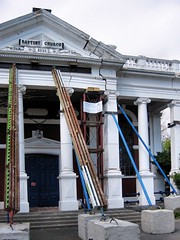
A photograph of the earthquake damage to the Canterbury Provincial Chambers on Durham Street. The top of the chamber has crumbled, and the masonry has fallen onto the footpath. Scaffolding which was erected after the 4 September 2010 earthquake has also fallen.
Jim Baltaxe WEMO Photograph 110
Images, UC QuakeStudies
A photograph of the earthquake damage to the Canterbury Provincial Chambers on Durham Street. The top of the chamber has crumbled, and the masonry has fallen onto the footpath. Scaffolding which was erected after the 4 September 2010 earthquake has also fallen.
Paul and Sam Corliss's Street Art Photograph (2015:03:28 13:19:18)
Images, UC QuakeStudies
A photograph of street art on a wall along Oxford Street in Lyttelton. The street art depicts buildings that were lost in Lyttelton after the 2010 and 2011 Canterbury earthquakes.
Paul and Sam Corliss's Street Art Photograph (2015:03:28 13:19:44)
Images, UC QuakeStudies
A photograph of street art on a wall along Oxford Street in Lyttelton. The street art depicts buildings that were lost in Lyttelton after the 2010 and 2011 Canterbury earthquakes.
Paul and Sam Corliss's Street Art Photograph (2015:03:28 13:19:30)
Images, UC QuakeStudies
A photograph of street art on a wall along Oxford Street in Lyttelton. The street art depicts buildings that were lost in Lyttelton after the 2010 and 2011 Canterbury earthquakes.
Paul and Sam Corliss's Street Art Photograph (2015:03:28 13:19:41)
Images, UC QuakeStudies
A photograph of street art on a wall along Oxford Street in Lyttelton. The street art depicts buildings that were lost in Lyttelton after the 2010 and 2011 Canterbury earthquakes.
Paul and Sam Corliss's Street Art Photograph (2015:03:28 13:19:15)
Images, UC QuakeStudies
A photograph of street art on a wall along Oxford Street in Lyttelton. The street art depicts buildings that were lost in Lyttelton after the 2010 and 2011 Canterbury earthquakes.
Paul and Sam Corliss's Street Art Photograph (2015:03:28 13:19:26)
Images, UC QuakeStudies
A photograph of street art on a wall along Oxford Street in Lyttelton. The street art depicts buildings that were lost in Lyttelton after the 2010 and 2011 Canterbury earthquakes.
Christchurch Natural Disaster Response and Recovery presentation
Articles, UC QuakeStudies
A pdf copy of a PowerPoint presentation made for the Water Services Association of Australia conference, about SCIRT's approach to asset investigation after the Canterbury earthquakes of 2010 and 2011.
EXAMPLES OF RECOGNITION OF VULNERABILITY IN NATURAL DISASTER CONTEXTS (ESP…
Research papers, University of Canterbury Library
These research papers explore the concept of vulnerability in international human rights law. In the wake of the Christchurch earthquakes of 2010-2011, this research focuses on how "vulnerability" has been used and developed within the wider human rights discourse. They also examine jurisprudence of international human rights bodies, and how the concept of "vulnerability" has been applied. The research also includes a brief investigation into the experiences of vulnerable populations in disaster contexts, focusing primarily on the experiences of "vulnerable persons" in the Christchurch earthquakes and their aftermath.
Simulation of site amplification effects at Heathcote Valley during the 20…
Research papers, University of Canterbury Library
Heathcote Valley school strong motion station (HVSC) consistently recorded ground motions with higher intensities than nearby stations during the 2010-2011 Canterbury earthquakes. For example, as shown in Figure 1, for the 22 February 2011 Christchurch earthquake, peak ground acceleration at HVSC reached 1.4 g (horizontal) and 2 g (vertical), the largest ever recorded in New Zealand. Strong amplification of ground motions is expected at Heathcote Valley due to: 1) the high impedance contrast at the soil-rock interface, and 2) the interference of incident and surface waves within the valley. However, both conventional empirical ground motion prediction equations (GMPE) and the physics-based large scale ground motions simulations (with empirical site response) are ineffective in predicting such amplification due to their respective inherent limitations.
Helen Devereux Photograph 006
Images, UC QuakeStudies
The crowd at the Band Together concert, a concert that was put on at Hagley Park for the people of Canterbury following the September earthquake.
Helen Devereux Photograph 007
Images, UC QuakeStudies
The crowd at the Band Together concert, a concert that was put on at Hagley Park for the people of Canterbury following the September earthquake.
Helen Devereux Photograph 008
Images, UC QuakeStudies
The crowd at the Band Together concert, a concert that was put on at Hagley Park for the people of Canterbury following the September earthquake.
Helen Devereux Photograph 005
Images, UC QuakeStudies
The crowd at the Band Together concert, a concert that was put on at Hagley Park for the people of Canterbury following the September earthquake.
the day after
Images, eqnz.chch.2010
Cleaning up the silt and sand from Hoon Hay properties. Here Laura, Robbie, and Ronny are part of the clean-up crew on Wyn Street.
A machine learning-supported rapid classification of building damage follo…
Research papers, The University of Auckland Library
The rapid classification of building damage states or placards after an earthquake is vital for enabling an efficient emergency response and informed decision-making for rehabilitation and recovery purposes. Traditional methods rely heavily on inspector-led on-site surveys, which are often time-consuming, resource-intensive, and susceptible to human error. This study introduces a machine learning-supported surrogate model designed to streamline the assessment of building damage, focusing on the automated assignment of damage placards within the context of New Zealand's post-earthquake evaluation frameworks. The study evaluates two key safety evaluation protocols—Rapid Building Assessment (RBA) and Detailed Damage Evaluation (DDE)—and integrates corresponding databases derived from the 2010–2011 Canterbury Earthquake Sequence (CES) in Christchurch. Six ML classifiers—Multilayer Perceptron (MLP), Random Forest (RF), Support Vector Machine (SVM), K-Nearest Neighbours (KNN), Gradient Boosting Classifier (GBC), and Gradient Bagging (GBag)—were rigorously tested across both databases. The results indicate that the RF-based surrogate model outperforms the other classifiers across both RBA and DDE protocols. Two distinct sets of critical predictors have been further identified for each protocol, allowing for the rapid retrieval of essential data for future on-site surveys, while retaining the RF model's predictive accuracy. The developed surrogate model provides a pragmatic tool for practising engineers to rapidly assign placards to damaged structures and for policymakers and building owners to make informed recovery decisions for earthquake-affected buildings.
Observatory Tower Photograph 08
Images, UC QuakeStudies
A photograph of cracks around a window of the Observatory tower at the Christchurch Arts Centre. The cracks formed as a result of the 4 September 2010 earthquake.