
Search
found 47337 results
Images for 2011; more images...

Mark Lincoln Photograph 041
Images, UC QuakeStudies
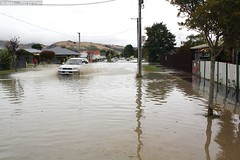
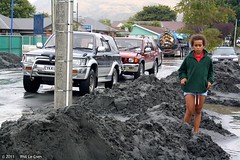
A car on Rowses Road has its entire front half embedded in liquefaction after falling into a sink hole. Another car has its wheels stuck in the silt. In the foreground, a car drives through flooding which covers the road. The photographer comments, "Perhaps the most impressively stuck car was this small silver hatchback that went head first into a large hole in a street just off Shortland Street (between Shortland and Breezes Road) in Aranui. The rear hatch was open when we came across it. Apparently there had been one person and a dog inside but they managed to escape. The silt has now settled around and inside the car, making the vehicle an intimidating monument to the earthquake".
Mark Lincoln Photograph 059
Images, UC QuakeStudies
Army personnel beside the damaged Colombo Street Wesleyan Church. Danger tape has been stretched across Colombo Street to create a cordon. The photographer comments, "After the 22nd February earthquake, my wife and I spent one night in a tent outside our home and then left to stay with friends in Timaru for a couple of nights. On the way along Brougham Street, we passed the Sydenham Church on the corner of Colombo Street and Brougham Street. As you can see from the photos, the upper area has been extensively damaged. Most of the damage appears to be on the east facing wall although we didn't get much of a look at the other sides or, of course, the interior".
Mark Lincoln Photograph 060
Images, UC QuakeStudies
Damage to the Colombo Street Wesleyan Church. The gable end has partially collapsed, and the window is damaged. The photographer comments, "After the 22nd February earthquake, my wife and I spent one night in a tent outside our home and then left to stay with friends in Timaru for a couple of nights. On the way along Brougham Street, we passed the Sydenham Church on the corner of Colombo Street and Brougham Street. As you can see from the photos, the upper area has been extensively damaged. Most of the damage appears to be on the east facing wall although we didn't get much of a look at the other sides or, of course, the interior".
Mark Lincoln Photograph 052
Images, UC QuakeStudies
A car on Rowses Road has its entire front half embedded in liquefaction after falling into a sink hole. Behind it, another car has its wheels stuck in the silt, and in the background a car drives through flooding. The photographer comments, "Perhaps the most impressively stuck car was this small silver hatchback that went head first into a large hole in a street just off Shortland Street (between Shortland and Breezes Road) in Aranui. The rear hatch was open when we came across it. Apparently there had been one person and a dog inside but they managed to escape. The silt has now settled around and inside the car, making the vehicle an intimidating monument to the earthquake".
Rebekah Rogers WEMO Photograph 037
Images, UC QuakeStudies
A photograph of paper hearts pegged on the cordon fence around the Chinese Methodist Church on Papanui Road. Quotes on the hearts read, "'Even though I walk through the valley of the shadow of death, I will fear no evil for you are with me.' Psalm 23", "'We can do no great things; only small things with great love.' Mother Teresa, and, "'Peace begins with a smile,' Mother Teresa". In the background, the earthquake damage to the Christchurch Chinese Methodist Church can be seen. The wall of the gable has crumbled, the bricks spilling onto the grass below.
Mark Lincoln Photograph 188
Images, UC QuakeStudies
The temporary ASB branch in the Re:Start mall. The photographer comments, "The new temporary city mall has been open in Christchurch now for a week. Buildings damaged in the earthquake have been demolished and replaced with cargo containers to create a new, temporary, Cashel Mall. I visited the mall yesterday and was quite impressed with what they have done. The cargo containers have been nicely converted, brightly painted and smartly branded to create some good looking stores ... ASB is the only bank to grab a container, which is fair enough seeing as they appear to be a large sponsor of the mall. The 'Re:START' Cashel Mall signs also display the tag line 'Supported by ASB'".
Rebekah Rogers WEMO Photograph 018
Images, UC QuakeStudies
A photograph of a sign on a lamp post on Bealey Avenue. The sign reads, "Attention Public, there is a cordon in effect. From the timings of 0600 to 1800 only personal with legitimate reasons and home owners are permitted to enter the cordon. Home owners, please have proof of address and identification ready for inspection. At 1800 to 0600 the cordoned area is under curfew. The only personnel permitted to enter are: health professionals, Canterbury Council staff, contractors, media. No exceptions. If you have any questions, please approach police or NZDF personnel. Thank you for your co-operation".
Photograph by Paul Corliss 0996
Images, UC QuakeStudies
A photograph of an earthquake-damaged house on Marine Parade in North Brighton. The front section of the house has collapsed, the rest buckled. The wall of the gable has also collapsed as well as part of the lower front wall. A red sticker in the window indicates that the building is unsafe to enter. A message has been spray painted on the front window, reading, "Roof tiles, $3 each". Police tape has been used to cordon off the house. Public notices can be seen on the fence, on the roof of the collapsed section and the section behind.
The Move to KB02 - Photograph 05
Images, UC QuakeStudies
Members of the University of Canterbury's Digital Media Group in their temporary office in KB02 in Kirkwood Village, the complex of prefabs set up after the earthquakes to provide temporary office and classroom space for the university. The photographer comments, "The e-learning group and the video conferencing team are now located in the Kirkwood Village at the University of Canterbury. It's a very impressive project, about 60 buildings arranged in various configurations with some used for teaching or computer labs, and others as staff offices. We will probably stay here for several years now. Looking back along the centre area from the doors. The e-learning advisers and Herbert Thomas, our team leader, sit along the south wall".
20111227_7175_1D3-28 Track damage
Images, eqnz.chch.2010
Following the 5.8 and 6.0 quakes of 23/12/11 there is further damage to the track separating the Bexley Wetlands from the Pacific Park housing area.
20111227_7185_1D3-80 Track damage
Images, eqnz.chch.2010
Following the 5.8 and 6.0 quakes of 23/12/11 there is further damage to the track separating the Bexley Wetlands from the Pacific Park housing area.
Nisbet, Alistair, 1958- : `But ya said the meeting was in the spa, Roger!'
Images, Alexander Turnbull Library
The cartoon shows Gerry Brownlee, the Minister for Earthquake Recovery, walking towards a spa wearing swimming togs and with a blow-up toy around his waist. Context: The cartoon illustrated an article entitled 'Sutton candid about struggles'. Cera boss Roger Sutton received politicians in the empty Centennial Park spa pool after the February earthquake when he was still head of lines company Orion. Quantity: 1 digital cartoon(s).
Mark Lincoln Photograph 032
Images, UC QuakeStudies
Dust rises from fallen buildings on Tuam Street shortly after the 22 February earthquake. The photographer comments, "Just after the aftershock settled on Tuesday afternoon, myself and colleagues fled our Tuam Street office to absolute devastation outside. We couldn't see more than a block in either direction due to the clouds of dust that had arisen from buildings that had just collapsed. Above is looking along Tuam Street to the corner of Manchester Street where a number of buildings have just collapsed. This is 1pm and the sky was previously reasonably clear - this is all dust. From here, we picked up our vehicles from the CCC car park and headed out to get out of the chaos to a position where we could check on loved ones".
Mark Lincoln Photograph 036
Images, UC QuakeStudies
People walk down Colombo Street past collapsed buildings shortly after the 22 February earthquake. The photographer comments, "Just after the aftershock settled on Tuesday afternoon, myself and colleagues fled our Tuam Street office to absolute devastation outside. We couldn't see more than a block in either direction due to the clouds of dust that had arisen from buildings that had just collapsed ... From here, we picked up our vehicles from the CCC car park and headed out to get out of the chaos to a position where we could check on loved ones. Heading first along Manchester Street, buildings that were already heavily damaged were now completely written off. We couldn't get much further down Manchester Street so eventually made it to Colombo Street".
Disaster by design: the role of Landscape Architects in the Canterbury ear…
Research papers, Lincoln University
Earthquakes and other major disasters present communities and their authorities with an extraordinary challenge. While a lot can be done to prepare a city’s response in the event of a disaster, few cities are truly prepared for the initial impact, devastation, grief, and the seemingly formidable challenge of recovery. Many people find themselves overwhelmed with facing critical problems; ones which they have often never had experience with before. While the simple part is agreeing on a desired outcome for recovery, it appears the argument that exists between stakeholders is the conflicting ideas of How To effectively achieve the main objective. What I have identified as an important step toward collaborating on the How To of recovery is to identify the ways in which each discipline can most effectively contribute to the recovery. Landscape architecture is just one of the many disciplines (that should be) invovled in the How To of earthquake recovery. Canterbury has an incredible opportunity to set the benchmark for good practice in earthquake recovery. To make the most of this opportuntiy, it is critical that landscape architects are more effectively engaged in roles of recovery across a much broader spectrum of recovery activities. The overarching purpose of this research is to explore and provide insight to the current and potential of landscape architects in the earthquake recovery period in Canterbury, using international good practice as a benchmark. The research is aimed at stimulating and guiding landscape architects dealing with the earthquake recovery in Canterbury, while informing stakeholders: emergency managers, authorities, other disciplines and the wider community of themost effective role(s) for landscape architects in the recovery period.
Mark Lincoln Photograph 091
Images, UC QuakeStudies
The damaged Knox Church on Bealey Avenue. The brick walls have collapsed, exposing the wooden structure beneath. The photographer comments, "Bealey Avenue is open to traffic, as are many of the side streets, and the damage to buildings along this street is quite impressive and perhaps just a small taste of the damage that lies beyond the cordon ... At the Hagley Park end of Bealey Avenue lies the Knox Church. This church suffered in the first earthquake and featured in the news a fair bit at the time. It's crazy to think that all that appeared to be damaged then were some bricks that had fallen from near the roof. Now, Knox Church is all but a wooden frame holding up a roof. It's eerie to drive past this large church and be able to look straight through it to trees on the other side".
The Move to KB02 - Photograph 03
Images, UC QuakeStudies
Paul Nicholls from the University of Canterbury's E-Learning team and Digital Media Group Manager Wayne Riggall in their temporary office in KB02 in Kirkwood Village, the complex of prefabs set up after the earthquakes to provide temporary office and classroom space for the university. The photographer comments, "The e-learning group and the video conferencing team are now located in the Kirkwood Village at the University of Canterbury. It's a very impressive project, about 60 buildings arranged in various configurations with some used for teaching or computer labs, and others as staff offices. We will probably stay here for several years now. Adjoining our area is a space for Wayne, the Digital Media Group Manager, who will organise a sitting area for visitors and small meetings. Beyond Wayne is a closed-off meeting room".
The Move to KB02 - Photograph 04
Images, UC QuakeStudies
Members of the University of Canterbury's Digital Media Group in their temporary office in KB02 in Kirkwood Village, the complex of prefabs set up after the earthquakes to provide temporary office and classroom space for the university. The photographer comments, "The e-learning group and the video conferencing team are now located in the Kirkwood Village at the University of Canterbury. It's a very impressive project, about 60 buildings arranged in various configurations with some used for teaching or computer labs, and others as staff offices. We will probably stay here for several years now. Looking up the centre of the room towards the front doors. The video conferencing team and Nikki Saunders, the course reader publisher, sit here. (The pizzas are for a moving-in celebration held just after I took these photos.)
Mark Lincoln Photograph 035
Images, UC QuakeStudies
People gather at the corner of Colombo and St Asaph Streets shortly after the 22 February earthquake. A building has collapsed, and bricks and rubble litter the street. The photographer comments, "Just after the aftershock settled on Tuesday afternoon, myself and colleagues fled our Tuam Street office to absolute devastation outside. We couldn't see more than a block in either direction due to the clouds of dust that had arisen from buildings that had just collapsed ... From here, we picked up our vehicles from the CCC car park and headed out to get out of the chaos to a position where we could check on loved ones. Heading first along Manchester Street, buildings that were already heavily damaged were now completely written off. We couldn't get much further down Manchester Street so eventually made it to Colombo Street".
22 February Earthquake - Photograph 01
Images, UC QuakeStudies
Damage to River Road in Richmond. The road is badly cracked and slumped, and is closed off with a row of road cones tied with warning tape. The word "closed" has been spray painted on the road surface. The photographer comments, "These photos show our old house in River Rd and recovery work around Richmond and St Albans. River Rd was again subject to severe lateral spreading. The river is still grey with silt, the road is ripped and sunken, and power poles lean at random angles. The red car belonged to a postie, who had to come back with a tow truck to extricate the car from the hole that had opened underneath it. Looking along River Road to the north-east. Taken outside 79 Medway St".
The Move to KB02 - Photograph 02
Images, UC QuakeStudies
Paul Nicholls, a member of the University of Canterbury's E-Learning team, in their temporary office in KB02 in Kirkwood Village, the complex of prefabs set up after the earthquakes to provide temporary office and classroom space for the university. The photographer comments, "The e-learning group and the video conferencing team are now located in the Kirkwood Village at the University of Canterbury. It's a very impressive project, about 60 buildings arranged in various configurations with some used for teaching or computer labs, and others as staff offices. We will probably stay here for several years now. Closer view of our corner of the building. We will have some cubicle partitions soon, but I don't know how we'll configure the space then. It's quite nice being so open, but it may be too noisy".
The Move to KB02 - Photograph 01
Images, UC QuakeStudies
Paul Nicholls, a member of the University of Canterbury's E-Learning team, in their temporary office in KB02 in Kirkwood Village, the complex of prefabs set up after the earthquakes to provide temporary office and classroom space for the university. The photographer comments, "The e-learning group and the video conferencing team are now located in the Kirkwood Village at the University of Canterbury. It's a very impressive project, about 60 buildings arranged in various configurations with some used for teaching or computer labs, and others as staff offices. We will probably stay here for several years now. Our "techy corner", with Paul waiting for the desk-assembler to come back and put his desk together. My desk is in the corner, and Jess is on the right of the window".
Riding the seismic waves: Re-blending teacher education in response to cha…
Research papers, University of Canterbury Library
Blended learning plays an important role in many tertiary institutions but little has been written about the implementation of blended learning in times of adversity, natural disaster or crisis. This paper describes how, in the wake of the 22 February Canterbury earthquake, five teacher educators responded to crisis-driven changing demands and changing directions. Our narratives describe how blended learning provided students in initial teacher education programmes with some certainty and continuity during a time of civil emergency. The professional learning generated from our experiences provides valuable insights for designing and preparing for blended learning in times of crisis, as well as developing resilient blended learning programmes for the future.
20111230_7222_1D3-70 New Brighton
Images, eqnz.chch.2010
20111230_7222_1D3-70 New Brighton Further damage to the bank following the two quakes on 23/12/11. The sewer line broke here and was repaired (patched) by council staff on Christmas Eve. It is hard to beleve that this rock wall was level with the land here, before any of the quakes. #2004
20110307_2009_1D3-85 Liquefaction silt pile [EQNZ]
Images, eqnz.chch.2010
This is a temporary pile of silt piled on the old Bexley landfill sight. Some trucks are addng to the pile, while other truck and trailer units are taking it away to the old Bottle Lake landfill sight, a few km to the north of here.
20110228_1595_1D3-24 The Clean Up [EQNZ]
Images, eqnz.chch.2010
Cleaning up Manning Signs of the silt from liquefaction. Three fellow workers man the shovels while two building engineers talk to the boss (hidden). After doing the car park we then turned our hands to the inside of the factory, once clearance was given that we could go inside.
(Re-)Writing the End: Apocalyptic Narratives in the Postmodern Novel
Research papers, University of Canterbury Library
This thesis investigates the relationship between the apocalyptic narrative and the postmodern novel. It explores and builds on Patricia Waugh‟s hypothesis in Practising Postmodernism: Reading Modernism (1992) which suggests that that the postmodern is characterised by an apocalyptic sense of crisis, and argues that there is in fact a strong relationship between the apocalyptic and the postmodern. It does so through an exploration of apocalyptic narratives and themes in five postmodern novels. It also draws on additional supporting material which includes literary and cultural theory and criticism, as well as historical theory. In using the novel as a medium through which to explore apocalyptic narratives, this thesis both assumes and affirms the novel‟s importance as a cultural artefact which reflects the concerns of the age in which it is written. I suggest that each of the novels discussed in this thesis demonstrates the close relationship between the apocalyptic and the postmodern through society‟s concern over the direction of history, the validity of meta-narratives, and other cultural phenomenon, such as war, the development of nuclear weaponry, and terrorism. Although the scope of this thesis is largely confined to the historical-cultural epoch known as postmodernity, it also draws on literature and cultural criticism from earlier periods so as to provide a more comprehensive framework for investigating apocalyptic ideas and their importance inside the postmodern novel. A number of modernist writers are therefore referred to or quoted throughout this thesis, as are other important thinkers from preceding periods whose ideas are especially pertinent. The present thesis was researched and written between March 2010 and August 2011 and is dedicated to all of those people who lost their lives in the apocalyptic events of the February 22nd Christchurch earthquake.
Mark Lincoln Photograph 037
Images, UC QuakeStudies
Cars crushed between the collapsed levels of the Smiths City car park. The photographer comments, "Just after the aftershock settled on Tuesday afternoon, myself and colleagues fled our Tuam Street office to absolute devastation outside. We couldn't see more than a block in either direction due to the clouds of dust that had arisen from buildings that had just collapsed ... From here, we picked up our vehicles from the CCC car park and headed out to get out of the chaos to a position where we could check on loved ones ... eventually made it to Colombo Street where we slowly crawled past the horrific sight of the Colombo Street Smiths City over-bridge car park. Layers had collapsed onto each other and cars were sticking out of the gaps. Hopefully if anyone was inside they would have hit the ground and would be safe under the support of the cars either side of them".
Mark Lincoln Photograph 038
Images, UC QuakeStudies
Cars crushed between the collapsed levels of the Smiths City car park. The photographer comments, "Just after the aftershock settled on Tuesday afternoon, myself and colleagues fled our Tuam Street office to absolute devastation outside. We couldn't see more than a block in either direction due to the clouds of dust that had arisen from buildings that had just collapsed ... From here, we picked up our vehicles from the CCC car park and headed out to get out of the chaos to a position where we could check on loved ones ... eventually made it to Colombo Street where we slowly crawled past the horrific sight of the Colombo Street Smiths City over-bridge car park. Layers had collapsed onto each other and cars were sticking out of the gaps. Hopefully if anyone was inside they would have hit the ground and would be safe under the support of the cars either side of them".
Design of UFP-coupled post-tensioned timber shear walls
Research papers, University of Canterbury Library
Recent advances in timber design at the University of Canterbury have led to new structural systems that are appropriate for a wide range of building types, including multi-storey commercial office structures. These buildings are competitive with more traditional construction materials in terms of cost, sustainability and structural performance. This paper provides seismic design recommendations and analytical modelling approaches, appropriate for the seismic design of post-tensioned coupled timber wall systems. The models are based on existing seismic design theory for precast post-tensioned concrete, modified to more accurately account for elastic deformation of the timber wall systems and the influence of the floor system. Experimental test data from a two storey post-tensioned timber building, designed, constructed and tested at the University of Canterbury is used to validate the analytical models.