
Search
found 4537 results
Images for christchurch earthquake; more images...


Observatory Tower Photograph 21
Images, UC QuakeStudies
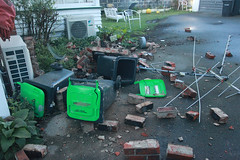
A photograph of the rubble from the Observatory tower in the South Quad of the Christchurch Arts Centre. The tower collapsed during the 22 February 2011 earthquake. A digger was used to clear the rubble away from the building. Scaffolding constructed around the tower has also collapsed and is amongst the rubble. A car and the bumper of another car can be seen under the rubble.
Observatory Tower Photograph 33
Images, UC QuakeStudies
A photograph of the rubble of the Observatory tower in the South Quad of the Christchurch Arts Centre. The tower collapsed during the 22 February 2011 earthquake. A digger was used to clear the rubble away from the building. Scaffolding constructed around the tower has also collapsed and is amongst the rubble. In the background is the damaged tower with a tarpaulin draped over the top.
Observatory Tower Photograph 15
Images, UC QuakeStudies
A photograph of the rubble of the Observatory tower in the South Quad of the Christchurch Arts Centre. The tower collapsed during the 22 February 2011 earthquake and a digger was used to clear the rubble away from the building. Scaffolding constructed around the tower has also collapsed and is amongst the rubble. In the background is the damaged tower with a tarpaulin draped over the top.
Performance of posttensioned seismic retrofit of two stone masonry buildin…
Research papers, The University of Auckland Library
Seismic retrofitting of unreinforced masonry buildings using posttensioning has been the topic of many recent experimental research projects. However, the performance of such retrofit designs in actual design level earthquakes has previously been poorly documented. In 1984 two stone masonry buildings within The Arts Centre of Christchurch received posttensioned seismic retrofits, which were subsequently subjected to design level seismic loads during the 2010/2011 Canterbury earthquake sequence. These 26 year old retrofits were part of a global scheme to strengthen and secure the historic building complex and were subject to considerable budgetary constraints. Given the limited resources available at the time of construction and the current degraded state of the steel posttension tendons, the posttensioned retrofits performed well in preventing major damage to the overall structure of the two buildings in the Canterbury earthquakes. When compared to other similar unretrofitted structures within The Arts Centre, it is demonstrated that the posttensioning significantly improved the in-plane and out-of-plane wall strength and the ability to limit residual wall displacements. The history of The Arts Centre buildings and the details of the Canterbury earthquakes is discussed, followed by examination of the performance of the posttension retrofits and the suitability of this technique for future retrofitting of other historic unreinforced masonry buildings. http://www.aees.org.au/downloads/conference-papers/2013-2/
WEMO ERT Set 1 - February 2011 - Photograph 54
Images, UC QuakeStudies
A photograph of the earthquake-damaged Canterbury Provincial Chambers on Durham Street. The roof and upper walls of the Stone Chamber have collapsed, the masonry falling onto the footpath below. The building has been cordoned off with wire fencing.
WEMO ERT Set 1 - February 2011 - Photograph 58
Images, UC QuakeStudies
A photograph of the earthquake-damaged Canterbury Provincial Chambers on Durham Street. The roof and upper walls of the Stone Chamber have collapsed, the masonry falling onto the footpath below. The building has been cordoned off with wire fencing.
Predicting Seismic Damage and Loss for Residential Buildings using Data Sc…
Research papers, The University of Auckland Library
This thesis presents the application of data science techniques, especially machine learning, for the development of seismic damage and loss prediction models for residential buildings. Current post-earthquake building damage evaluation forms are developed for a particular country in mind. The lack of consistency hinders the comparison of building damage between different regions. A new paper form has been developed to address the need for a global universal methodology for post-earthquake building damage assessment. The form was successfully trialled in the street ‘La Morena’ in Mexico City following the 2017 Puebla earthquake. Aside from developing a framework for better input data for performance based earthquake engineering, this project also extended current techniques to derive insights from post-earthquake observations. Machine learning (ML) was applied to seismic damage data of residential buildings in Mexico City following the 2017 Puebla earthquake and in Christchurch following the 2010-2011 Canterbury earthquake sequence (CES). The experience showcased that it is readily possible to develop empirical data only driven models that can successfully identify key damage drivers and hidden underlying correlations without prior engineering knowledge. With adequate maintenance, such models have the potential to be rapidly and easily updated to allow improved damage and loss prediction accuracy and greater ability for models to be generalised. For ML models developed for the key events of the CES, the model trained using data from the 22 February 2011 event generalised the best for loss prediction. This is thought to be because of the large number of instances available for this event and the relatively limited class imbalance between the categories of the target attribute. For the CES, ML highlighted the importance of peak ground acceleration (PGA), building age, building size, liquefaction occurrence, and soil conditions as main factors which affected the losses in residential buildings in Christchurch. ML also highlighted the influence of liquefaction on the buildings losses related to the 22 February 2011 event. Further to the ML model development, the application of post-hoc methodologies was shown to be an effective way to derive insights for ML algorithms that are not intrinsically interpretable. Overall, these provide a basis for the development of ‘greybox’ ML models.
Image 3 - Defence Medical Personnel Use Their Expertise
Images, UC QuakeStudies
An image from a Army News March 2011 article titled, "Defence Medical Personnel Use Their Expertise". In the image, New Zealand Navy, Air Force, and Army personnel are checking on a rest home resident who was being evacuated from Christchurch after the 22 February 2011 earthquake.
WEMO ERT Set 1 - March 2011 - Photograph 15
Images, UC QuakeStudies
A photograph of the earthquake damage to a house in Christchurch. The front and side of the house has collapsed, the bricks and other rubble spilling onto the garden, exposing the rooms inside. Emergency tape has been draped across the front of the property as a cordon.
WEMO ERT Set 1 - March 2011 - Photograph 81
Images, UC QuakeStudies
A photograph of the earthquake damage to a building in central Christchurch. The basement of the building has collapsed and the concrete blocks have broken away from each other. The left corner of the building has also suffered damage, with many of the concrete blocks shaking loose.
Rebekah Rogers WEMO Photograph 049
Images, UC QuakeStudies
A photograph of an earthquake-damaged house in Christchurch. The house has moved off its foundations and many of the walls have crumbled, the bricks spilling onto the street in front. Messages such as "Clear" and "Danger keep out" have been spray-painted on the foundation wall.
Rebekah Rogers WEMO Photograph 051
Images, UC QuakeStudies
A photograph of an earthquake-damaged house in Christchurch. The house has moved off its foundations and many of the walls have crumbled, the bricks spilling onto the street in front. Messages such as "Clear" and "Danger keep out" have been spray-painted on the foundation wall.
Rebekah Rogers WEMO Photograph 050
Images, UC QuakeStudies
A photograph of an earthquake-damaged house in Christchurch. The house has moved off its foundations and many of the walls have crumbled, the bricks spilling onto the street in front. Messages such as "Clear" and "Danger keep out" have been spray-painted on the foundation wall.
WEMO ERT Set 1 - March 2011 - Photograph 14
Images, UC QuakeStudies
A photograph of the earthquake damage to a house in Christchurch. The front and side of the house has collapsed, the bricks and other rubble spilling onto the garden, exposing the rooms inside. Emergency tape has been draped across the front of the property as a cordon.
Comparing the direct human impact of natural disasters for two cases in 20…
Research papers, Victoria University of Wellington
The standard way in which disaster damages are measured involves examining separately the number of fatalities, of injuries, of people otherwise affected, and the financial damage that natural disasters cause. Here, we implement a novel way to aggregate these separate measures of disaster impact and apply it to two catastrophic events from 2011: the Christchurch (New Zealand) earthquakes and the Greater Bangkok (Thailand) flood. This new measure, which is similar to the World Health Organization's calculation of Disability Adjusted Life Years (DALYs) lost due to the burden of diseases and injuries, is described in detail in Noy [7]. It allows us to conclude that New Zealand lost 180 thousand lifeyears as a result of the 2011 events, and Thailand lost 2644 thousand lifeyears. In per capita terms, the loss is similar, with both countries losing about 15 days per person due to the 2011 catastrophic events in these two countries. © This manuscript version is made available under the CC-BY-NC-ND 4.0 license https://creativecommons.org/licenses/by-nc-nd/4.0/
Swimming with ideas: What happens to creativity in the wake of a disaster …
Research papers, Lincoln University
Creativity that is driven by a need for physical or economic survival, which disasters are likely to inspire, raises the question of whether such creativity fits with conventional theories and perspectives of creativity. In this paper we use the opportunity afforded by the 2010-2013 Christchurch, New Zealand earthquakes to follow and assess the creative practices and responses of a number of groups and individuals. We use in-depth interviews to tease out motivations and read these against a range of theoretical propositions about creativity. In particular, we focus on the construct of “elite panic” and the degree to which this appeared to be evident in the Christchurch earthquakes context. Bureaucratic attempts to control or limit creativity were present but they did not produce a completely blanket dampening effect. Certain individuals and groups seemed to be pre-equipped to navigate or ignore potential blocks to creativity. We argue, using Geir Kaufmann’s novelty-creativity matrix and aspects of Teresa Amabile’s and Michael G. Pratt’s revised componential theory of creativity that a special form of disaster creativity does exist.
WEMO ERT Set 1 - March 2011 - Photograph 71
Images, UC QuakeStudies
A photograph of the earthquake damage to the Iconic Bar and the former Christchurch City Council offices on Manchester Street. The outer walls of the Council offices and the top storey of Iconic have collapsed, exposing the insides of the buildings. The bricks and other rubble have been cleared from the footpath in front. USAR codes have been spray-painted next to the entrance of Iconic.
New Zealand Defence Force photograph 674
Images, UC QuakeStudies
A member of the Los Angeles County Fire Department Search and Rescue Team with an Australian Police Officer outside the US Aid tent in Latimer Square. After the 22 February 2011 earthquake, emergency service agencies set up their headquarters in Latimer Square.
Inventory and seismic assessment of earthquake-vulnerable masonry and conc…
Research papers, The University of Auckland Library
Following the 2010–2011 Canterbury earthquakes, a renewed focus has been directed across New Zealand to the hazard posed by the country‘s earthquake-vulnerable buildings, namely unreinforced masonry (URM) and reinforced concrete (RC) buildings with potentially nonductile components that have historically performed poorly in large earthquakes. The research reported herein was pursued with the intention of addressing several recommendations made by the Canterbury Earthquakes Royal Commission of Inquiry which were classified into the following general categories: Identification and provisional vulnerability assessment of URM and RC buildings and building components; Testing, assessment, and retrofitting of URM walls loaded out-of-plane, with a particular focus on highly vulnerable URM cavity walls; Testing and assessment of RC frame components, especially those with presumably non-ductile reinforcement detailing; Portfolio management considering risks, regulations, and potential costs for a portfolio that includes several potentially earthquake-vulnerable buildings; and Ongoing investigations and proposed research needs. While the findings from the reported research have implications for seismic assessments of buildings across New Zealand and elsewhere, an emphasis was placed on Auckland given this research program‘s partnership with the Auckland Council, the Auckland region accounting for about a third each of the country‘s population and economic production, and the number and variety of buildings within the Auckland building stock. An additional evaluation of a historic building stock was carried out for select buildings located in Hawke‘s Bay, and additional experimental testing was carried out for select buildings located in Hawke‘s Bay and Christchurch.
Image 1 - Defence Medical Personnel Use Their Expertise
Images, UC QuakeStudies
An image from a Army News March 2011 article titled, "Defence Medical Personnel Use Their Expertise". In the image, members of the New Zealand Air Force are checking on a rest home resident on a Boeing 757. The resident was evacuated from Christchurch after the 22 February 2011 earthquake.
New Zealand Defence Force photograph 154
Images, UC QuakeStudies
Defence Force personnel walking down Norwich Quay during an operational tour of Lyttelton taken by Commander Joint Forces New Zealand, Air Vice Marshal Peter Stockwell and Chief of Army Tim Keating to view the aftermath of the Christchurch Earthquake. A large crack can be seen in the footpath.
Photograph by Neil Macbeth 507
Images, UC QuakeStudies
Students at the University of Canterbury relaxing inside the UCSA's "Big Top" tent. The tent was erected to provide support for students in the aftermath of the 22 February 2011 earthquake. The students have spent the day clearing liquefaction from Christchurch properties as part of the Student Volunteer Army.
New Zealand Defence Force photograph 153
Images, UC QuakeStudies
Defence Force personnel walking down Norwich Quay during an operational tour of Lyttelton taken by Commander Joint Forces New Zealand, Air Vice Marshal Peter Stockwell and Chief of Army Tim Keating to view the aftermath of the Christchurch Earthquake. A large crack can be seen in the footpath.
WEMO ERT Set 1 - March 2011 - Photograph 79
Images, UC QuakeStudies
A photograph of the earthquake damage to a block of buildings in central Christchurch. The basement of the buildings have collapsed and the concrete blocks have spilled into the car park. Large cracks have also formed in between the blocks in the walls of the building to the left.
Image 2 - Defence Medical Personnel Use Their Expertise
Images, UC QuakeStudies
An image from a Army News March 2011 article titled, "Defence Medical Personnel Use Their Expertise". In the image, Royal New Zealand Air Force and New Zealand Army personnel are checking on a rest home resident who is being evacuated from Christchurch after the 22 February 2011 earthquake.
Sam Butcher's LEGO Cathedral, Photograph 52
Images, UC QuakeStudies
A photograph of components of a model of the ChristChurch Cathedral being built from LEGO by Sam Butcher. Sam comments "Fixing a large variety of bits that were wrong/annoying/cheating (not purist) about the last model. The new one is set AFTER the Feb 22 earthquake. This newer, and much stronger model is also completely modular for easier transport. Obviously still a WIP, I'm currently waiting for a pretty large bricklink order at the moment, and will probably need to place a couple more after that to".
Elizabeth Ackermann Photograph 336
Images, UC QuakeStudies
A photograph of the north side of the ChristChurch Cathedral in Cathedral Square. The front of the building has been propped up with steel bracing but further earthquakes have caused more damage, leaving a gap between the bracing and the wall. The tower has been partially demolished, but the lower section is still visible. Wire fencing has been placed around the entire building. In the background, a crane is rising high above the square.
Elizabeth Ackermann Photograph 337
Images, UC QuakeStudies
A photograph of the north side of the ChristChurch Cathedral in Cathedral Square. The front of the building has been propped up with steel bracing but further earthquakes have caused more damage, leaving a gap between the bracing and the wall. The tower has been partially demolished, but the lower section is still visible. Wire fencing has been placed around the entire building. In the background, a crane is rising high above the square.
Observatory Tower Photograph 25
Images, UC QuakeStudies
A photograph of the rubble of the Observatory tower in the South Quad of the Christchurch Arts Centre. The tower collapsed during the 22 February 2011 earthquake. A digger was used to clear the rubble away from the building. Scaffolding constructed around the tower has also collapsed and is amongst the rubble. In the background is a shipping container. A red sticker has been placed on the door to the Physics Building.
Elizabeth Ackermann Photograph 347
Images, UC QuakeStudies
A photograph of the north side of the ChristChurch Cathedral in Cathedral Square. The front of the building has been propped up with steel bracing but further earthquakes have caused more damage, leaving a gap between the bracing and the wall. The tower has been partially demolished, but the lower section is still visible. Wire fencing has been placed around the entire building. In the background, a crane is rising high above the square.