
Search
found 4537 results
Images for christchurch earthquake; more images...


Helen Devereux Photograph 070
Images, UC QuakeStudies
For the first time in November 2011, Christchurch residents finally had the opportunity to see the earthquake-damaged city centre on the Red Zone bus tours organised by CERA. Damage to buildings on Cashel Street can be seen out the window.
Helen Devereux Photograph 096
Images, UC QuakeStudies
For the first time in November 2011, Christchurch residents finally had the opportunity to see the earthquake-damaged city centre on the Red Zone bus tours organised by CERA. The Regent Theatre dome which has been removed from the building.
Helen Devereux Photograph 090
Images, UC QuakeStudies
For the first time in November 2011, Christchurch residents finally had the opportunity to see the earthquake-damaged city centre on the Red Zone bus tours organised by CERA. Looking into Cathedral Square, the Regent Theatre dome can be partially seen.
The consumption of chaos: From the charm of chaos to the tedium of order -…
Research papers, Lincoln University
Prior to the devastating 2010 and 2011 earthquakes, parts of the CBD of Christchurch, New Zealand were undergoing revitalisation incorporating aspects of adaptive reuse and gentrification. Such areas were often characterised by a variety of bars, restaurants, and retail outlets of an “alternative” or “bohemian” style. These early 20th century buildings also exhibited relatively low rents and a somewhat chaotic and loosely planned property development approach by small scale developers. Almost all of these buildings were demolished following the earthquakes and a cordon placed around the CBD for several years. A paper presented at the ERES conference in 2013 presented preliminary results, from observation of post-earthquake public meetings and interviews with displaced CBD retailers. This paper highlighted a strongly held fear that the rebuild of the central city, then about to begin, would result in a very different style and cost structure from that which previously existed. As a result, permanent exclusion from the CBD of the types of businesses that previously characterised the successfully revitalised areas would occur. Five years further on, new CBD retail and office buildings have been constructed, but large areas of land between them remain vacant and the new buildings completed are often having difficulty attracting tenants. This paper reports on the further development of this long-term Christchurch case study and examines if the earlier predictions of the displaced retailers are coming true, in that a new CBD that largely mimics a suburban mall in style and tenancy mix, inherently loses some of its competitive advantage?
Reparability of earthquake damaged Reinforced Concrete walls
Research papers, University of Canterbury Library
The 2010-2011 Christchurch earthquakes generated damage in several Reinforced Concrete (RC) buildings, which had RC walls as the principal resistant element against earthquake demand. Despite the agreement between structural engineers and researchers in an overall successfully performance there was a lack of knowledge about the behaviour of the damaged structures, and even deeper about a repaired structure, which triggers arguments between different parties that remains up to these days. Then, it is necessary to understand the capacity of the buildings after the earthquake and see how simple repairs techniques improve the building performance. This study will assess the residual capacity of ductile slender RC walls according to current standards in New Zealand, NZS 3101.1 2006 A3. First, a Repaired RC walls Database is created trying to gather previous studies and to evaluate them with existing international guidelines. Then, an archetype building is designed, and the wall is extracted and scaled. Four half-scale walls were designed and will be constructed and tested at the Structures Testing Laboratory at The University of Auckland. The overall dimensions are 3 [m] height, 2 [m] length and 0.175 [m] thick. All four walls will be identical, with differences in the loading protocol and the presence or absence of a repair technique. Results are going to be useful to assess the residual capacity of a damaged wall compare to the original behaviour and also the repaired capacity of walls with simpler repair techniques. The expected behaviour is focussed on big changes in stiffness, more evident than in previously tested RC beams found in the literature.
Observatory Tower Photograph 22
Images, UC QuakeStudies
A photograph of the base of the Townsend Telescope, still attached to a piece of rubble. The rubble is from the Observatory tower at the Christchurch Arts Centre. The tower collapsed during the 22 February 2011 earthquake and the rubble spilled into the courtyard in front. A digger was used to clear the rubble away from the building.
Jim Baltaxe WEMO Photograph 122
Images, UC QuakeStudies
A photograph of the earthquake damage to the Christchurch Chinese Methodist Church on Papanui Road. The gable walls have crumbled, bricks spilling onto the ground. The tower has been removed and braced on the ground in front. Cordon fencing has been placed around the building. Parts of the fence have been decorated with hearts and the word 'love'.
Readout of the President's Call to Prime Minister Key of New Zealand
Articles, UC QuakeStudies
A press release from the Office of the Press Secretary in the US White House about President Obama's call to Prime Minister John Key to express his condolences over the 22 February 2011 earthquake in Christchurch and to offer American assistance.
Rebekah Rogers WEMO Photograph 074
Images, UC QuakeStudies
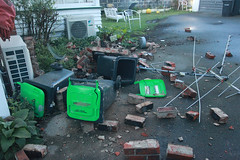
A photograph of the earthquake damage the brick fence of a house in Christchurch. Bricks from the broken fence have been stacked on the footpath in front. Liquefaction has been piled on the footpath and road cones placed in front.
Rebekah Rogers WEMO Photograph 075
Images, UC QuakeStudies
A photograph of the earthquake damage the brick fence of a house in Christchurch. Bricks from the broken fence have been stacked on the footpath in front. Liquefaction has been piled on the footpath and road cones placed in front.
Rebekah Rogers WEMO Photograph 103
Images, UC QuakeStudies
A photograph of a kitchen in the back of a van parked in Hagley Park. The van was one of many that were used as temporary accommodation for emergency management personnel who travelled to Christchurch after the 22 February 2011 earthquake.
Jim Baltaxe WEMO Photograph 039
Images, UC QuakeStudies
A photograph of an earthquake-damaged house in Christchurch. The walls on the side of the house have crumbled and the bricks have damaged the fence. A red sticker on the front window indicates that the building is unsafe to enter.
WEMO ERT Set 1 - March 2011 - Photograph 111
Images, UC QuakeStudies
A photograph of members of the Wellington Emergency Management Office Emergency Response Team in the back of a New Zealand Army truck. The ERT members are in Christchurch to help out in the emergency response to the 22 February 2011 earthquake.
WEMO ERT Set 1 - February 2011 - Photograph 31
Images, UC QuakeStudies
A photograph of a Singapore Rescue Team tent set up in Latimer Square after the 22 February 2011 earthquake. In the foreground there is a group of tents, cordoned off with tape and plastic mesh.
Women's place-making through craft in in post earthquake Canterbury
Research papers, University of Canterbury Library
INTRODUCTION: There is little research on the role of creative arts and craft in disaster recovery. This article reports findings about the emergent role of crafting from research conducted after the 2010–2011 series of earthquakes in Christchurch and surrounding districts in Aotearoa New Zealand. In particular, the article focuses on the significance and differing interpretations of the notion of place expressed by participants through their craftwork, in this case led by women and mediated by the post-earthquake geographic and temporal context. METHOD: This qualitative research included nine individual interviews and five focus group interviews with crafters from Christchurch and surrounding districts. There were 35 participants in total, 33 were women. Applied thematic analysis was used to code the data and identify themes. These themes included connection to place, the symbolism of craft, the healing experience of craft groups and places for women. The notion of place was evident across all three themes. FINDINGS: The findings from the research demonstrate differing ways in which the significance of place was reflected in the craftwork. Participants interpreted the concept of place in descriptive, symbolic, and therapeutic ways. IMPLICATIONS: More understanding about the way creative endeavours like crafting can be used to help ameliorate the impact of natural disasters is needed. Social work practitioners are encouraged to explore place-based wellbeing during their work with service users and to include aspects of artistry, craft and creativity.
New Zealand Defence Force photograph 762
Images, UC QuakeStudies
The Cathedral of the Blessed Sacrament on Barbadoes Street, severely damaged after the 22 February 2011 earthquake. The domes on either side of the Cathedral have collapsed and are lying in the area in front.
Observatory Tower Photograph 20
Images, UC QuakeStudies
A photograph of staff from the Department of Physics and Astronomy examining the rubble of the Observatory tower in the South Quad of the Christchurch Arts Centre. The tower collapsed during the 22 February 2011 earthquake. A digger was used to clear the rubble away from the building. Scaffolding around the tower has also collapsed and is amongst the rubble.
Observatory Tower Photograph 19
Images, UC QuakeStudies
A photograph of the rubble from the Observatory tower in the South Quad of the Christchurch Arts Centre. The tower collapsed during the 22 February 2011 earthquake. A digger was used to clear the rubble away from the building. Scaffolding constructed around the tower has also collapsed and is amongst the rubble. The roof of the tower and a ladder can also be seen.
Fragility functions for buried pipelines in liquefaction-prone areas based…
Research papers, University of Canterbury Library
Motivation This poster aims to present fragility functions for pipelines buried in liquefaction-prone soils. Existing fragility models used to quantify losses can be based on old data or use complex metrics. Addressing these issues, the proposed functions are based on the Christchurch network and soil and utilizes the Canterbury earthquake sequence (CES) data, partially represented in Figure 1. Figure 1 (a) presents the pipe failure dataset, which describes the date, location and pipe on which failures occurred. Figure 1 (b) shows the simulated ground motion intensity median of the 22nd February 2011 earthquake. To develop the model, the network and soil characteristics have also been utilized.
Tidal Behavior and Water-Level Changes in Gravel Aquifers in Response to M…
Research papers, Victoria University of Wellington
©2019. American Geophysical Union. All Rights Reserved. Earthquakes have been inferred to induce hydrological changes in aquifers on the basis of either changes to well water-levels or tidal behavior, but the relationship between these changes remains unclear. Here, changes in tidal behavior and water-levels are quantified using a hydrological network monitoring gravel aquifers in Canterbury, New Zealand, in response to nine earthquakes (of magnitudes M w 5.4 to 7.8) that occurred between 2008 and 2015. Of the 161 wells analyzed, only 35 contain water-level fluctuations associated with “Earth + Ocean” (7) or “Ocean” (28) tides. Permeability reduction manifest as changes in tidal behavior and increased water-levels in the near field of the Canterbury earthquake sequence of 2010–2011 support the hypothesis of shear-induced consolidation. However, tidal behavior and water-level changes rarely occurred simultaneously (~2%). Water-level changes that occurred with no change in tidal behavior reequilibrated at a new postseismic level more quickly (on timescales of ~50 min) than when a change in tidal behavior occurred (~240 min to 10 days). Water-level changes were more than likely to occur above a peak dynamic stress of ~50 kPa and were more than likely to not occur below ~10 kPa. The minimum peak dynamic stress required for a tidal behavior change to occur was ~0.2 to 100 kPa.
New Zealand Defence Force photograph 663
Images, UC QuakeStudies
Los Angeles County Fire Department Search and Rescue Team gear tied to a fence in Latimer Square. After the 22 February 2011 earthquake, emergency service agencies set up their headquarters in Latimer Square.
A machine learning-supported rapid classification of building damage follo…
Research papers, The University of Auckland Library
The rapid classification of building damage states or placards after an earthquake is vital for enabling an efficient emergency response and informed decision-making for rehabilitation and recovery purposes. Traditional methods rely heavily on inspector-led on-site surveys, which are often time-consuming, resource-intensive, and susceptible to human error. This study introduces a machine learning-supported surrogate model designed to streamline the assessment of building damage, focusing on the automated assignment of damage placards within the context of New Zealand's post-earthquake evaluation frameworks. The study evaluates two key safety evaluation protocols—Rapid Building Assessment (RBA) and Detailed Damage Evaluation (DDE)—and integrates corresponding databases derived from the 2010–2011 Canterbury Earthquake Sequence (CES) in Christchurch. Six ML classifiers—Multilayer Perceptron (MLP), Random Forest (RF), Support Vector Machine (SVM), K-Nearest Neighbours (KNN), Gradient Boosting Classifier (GBC), and Gradient Bagging (GBag)—were rigorously tested across both databases. The results indicate that the RF-based surrogate model outperforms the other classifiers across both RBA and DDE protocols. Two distinct sets of critical predictors have been further identified for each protocol, allowing for the rapid retrieval of essential data for future on-site surveys, while retaining the RF model's predictive accuracy. The developed surrogate model provides a pragmatic tool for practising engineers to rapidly assign placards to damaged structures and for policymakers and building owners to make informed recovery decisions for earthquake-affected buildings.
Jim Baltaxe WEMO Photograph 016
Images, UC QuakeStudies
A photograph of signs on the windows of the Christchurch Art Gallery. The art gallery was used as the temporary Civil Defence headquarters after the 22 February 2011 earthquake. The signs read, "Today is Thursday 3 March 2011" and "Wash your hands!". In the background, emergency management personnel and a New Zealand Fire Service truck can be seen.
New Zealand Defence Force photograph 543
Images, UC QuakeStudies
LT Gore with a signed football from the Blackburn Rovers football team player, Ryan Nelson. Ryan Nelson visited the HMNZS Otago in Lyttelton after the 22 February 2011 earthquake to thank the sailors for their support.
New Zealand Defence Force photograph 544
Images, UC QuakeStudies
LT Gore with a signed football from the Blackburn Rovers football team player, Ryan Nelson. Ryan Nelson visited the HMNZS Otago in Lyttelton after the 22 February 2011 earthquake to thank the sailors for their support.
Photograph by Jennifer Middendorf 299
Images, UC QuakeStudies
People cast flowers into the Avon River during the River of Flowers event held in Riccarton Bush, commemorating the second anniversary of the 22 February earthquake. In the background is the string quartet from Christchurch Girls High School which played before the event.
Photograph by Jennifer Middendorf 298
Images, UC QuakeStudies
People cast flowers into the Avon River during the River of Flowers event held in Riccarton Bush, commemorating the second anniversary of the 22 February earthquake. In the background is the string quartet from Christchurch Girls High School which played before the event.
Helen Devereux Photograph 087
Images, UC QuakeStudies
For the first time in November 2011, Christchurch residents finally had the opportunity to see the earthquake-damaged city centre on the Red Zone bus tours organised by CERA. Looking down the new Re:Start Mall as the bus goes down Colombo Street.
Photograph by Jennifer Middendorf 297
Images, UC QuakeStudies
People cast flowers into the Avon River during the River of Flowers event held in Riccarton Bush, commemorating the second anniversary of the 22 February earthquake. In the background is the string quartet from Christchurch Girls High School which played before the event.
How community gardens may contribute to community resilience following an …
Research papers, Lincoln University
The paper examines community benefits provided by an established community garden following a major earthquake and discusses possible implications for community garden planning and design in disaster-prone cities. Recent studies show that following extreme storm events community gardens can supply food, enhance social empowerment, provide safe gathering spots, and restorative practices, to remind people of normality. However, the beneficial role played by community gardens following earthquakes is less well known. To fill this gap, the study examines the role played by a community garden in Christchurch, New Zealand, following the 2010/2011 Canterbury Earthquakes. The garden's role is evaluated based on a questionnaire-based survey and in-depth interviews with gardeners, as well as on data regarding the garden use before and after the earthquakes. Findings indicate the garden helped gardeners cope with the post-quake situation. The garden served as an important place to de-stress, share experiences, and gain community support. Garden features that reportedly supported disaster recovery include facilities that encourage social interaction and bonding such as central meeting and lunch places and communal working areas.