
Search
found 4537 results
Images for christchurch earthquake; more images...


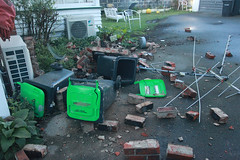
20100906-113522.jpg
Images, eqnz.chch.2010
None
The Star 10 August 2012
Articles, UC QuakeStudies
A PDF copy of The Star newspaper, published on Friday 10 August 2012.
Seismically Induced Shear of a Concrete Reservoir in the February 2011 Chr…
Articles, UC QuakeStudies
A pdf copy of a PowerPoint presentation prepared for the Australia New Zealand Geotechnical Engineering Conference.
Resilience Examples in Reservoirs, Pump Stations and Pipelines - Lessons L…
Articles, UC QuakeStudies
A paper prepared for the Water New Zealand 2014 conference which considers resilience lessons for reservoirs, pump stations and pipelines.
BeckerFraserPhotos April 2012 photograph 315
Images, UC QuakeStudies
A notice on the fence outside the CTV site on Madras Street. The notice reads, "Please respect this site. In recognition of the special significance this site holds for the people of our city and all those affected by the earthquakes, the Christchurch City Council is working with Canterbury Museum to preserve aspects of our remembering. Tributes may be left at this site. Older tributes will be removed for archiving by the Canterbury Museum to become part of the city's memory of the Canterbury Earthquakes. Organic materials will be composted and used in the city's gardens. Canterbury Museum. Christchurch City Council".
WEMO ERT Team Set 3 - April 2011 - Photograph 01
Images, UC QuakeStudies
A photograph of the photocopy template for the Christchurch City Council's green sticker. The sticker was used by the Civil Defence after the 2010 and 2011 earthquakes to indicate that a building had been inspected and that 'no structural or other safety hazards' were found.
New Zealand Defence Force photograph 116
Images, UC QuakeStudies
Members of the Royal New Zealand Air Force Air Security team carrying a rest home resident onto an air craft. The resident is being evacuated from Christchurch after the 22 February 2011 earthquake.
New Zealand Defence Force photograph 122
Images, UC QuakeStudies
Members of the Royal New Zealand Air Force Air Security team carrying a rest home resident onto an air craft. The resident is being evacuated from Christchurch after the 22 February 2011 earthquake.
New Zealand Defence Force photograph 119
Images, UC QuakeStudies
Medics from the New Zealand Army lifting a rest home resident from an ambulance. The resident was being transferred onto a Boeing 757 and evacuated from Christchurch after the 22 February 2011 earthquake.
New Zealand Defence Force photograph 121
Images, UC QuakeStudies
Members of the Royal New Zealand Air Force Air Security team carrying a rest home resident onto an air craft. The resident is being evacuated from Christchurch after the 22 February 2011 earthquake.
Rebekah Rogers WEMO Photograph 026
Images, UC QuakeStudies
A photograph of an open sign for CIRA Coffee & Wares on a residential street in the Christchurch central city. The café was set up in a house after the 22 February 2011 earthquake.
Kim Wright WEMO Photograph 051
Images, UC QuakeStudies
A photograph of earthquake damage to a road in Christchurch. A hole has been filled with gravel, and a road cone placed on top. In the background, cracks and liquefaction can be seen.
WEMO ERT Set 1 - March 2011 - Photograph 17
Images, UC QuakeStudies
A photograph of the earthquake damage to a house in Christchurch. The front and side of the house has collapsed, the bricks and other rubble spilling onto the garden, exposing the rooms inside.
Dan Neely WEMO Photograph 03
Images, UC QuakeStudies
A photograph of an earthquake damaged house in Christchurch. USAR codes have been spray painted on the front wall. A red sticker in the window indicates that the building is unsafe to enter.
Helen Devereux Photograph 089
Images, UC QuakeStudies
For the first time in November 2011, Christchurch residents finally had the opportunity to see the earthquake-damaged city centre on the Red Zone bus tours organised by CERA. Looking into Cathedral Square.
Helen Devereux Photograph 094
Images, UC QuakeStudies
For the first time in November 2011, Christchurch residents finally had the opportunity to see the earthquake-damaged city centre on the Red Zone bus tours organised by CERA. Looking into Cathedral Square.
Helen Devereux Photograph 091
Images, UC QuakeStudies
For the first time in November 2011, Christchurch residents finally had the opportunity to see the earthquake-damaged city centre on the Red Zone bus tours organised by CERA. Looking into Cathedral Square.
Jim Baltaxe WEMO Photograph 001
Images, UC QuakeStudies
A photograph of luggage from the volunteers of the Wellington Emergency Management Office who travelled to Christchurch after the 22 February 2011 earthquake. Items include several bags, a teddy bear, and a guitar.
Helen Devereux Photograph 092
Images, UC QuakeStudies
For the first time in November 2011, Christchurch residents finally had the opportunity to see the earthquake-damaged city centre on the Red Zone bus tours organised by CERA. Looking into Cathedral Square.
The seismic performance of unreinforced stone masonry buildings during the…
Research papers, The University of Auckland Library
The sequence of earthquakes that has affected Christchurch and Canterbury since September 2010 has caused damage to a great number of buildings of all construction types. Following post-event damage surveys performed between April 2011 and June 2011, the damage suffered by unreinforced stone masonry buildings is reported and different types of observed failures are described. A detailed technical description of the most prevalently observed failure mechanisms is provided, with reference to recognised failure modes for unreinforced masonry structures. The observed performance of existing seismic retrofit interventions is also provided, as an understanding of the seismic response of these interventions is of fundamental importance for assessing the vulnerability of similar strengthening techniques when applied to unreinforced stone masonry structures.
People in Disasters Conference - Education Renewal: A sector response to t…
Videos, UC QuakeStudies
A video of a presentation by Garry Williams during the fourth plenary of the 2016 People in Disasters Conference. Williams is the Programme Manager of the Ministry of Education's Greater Christchurch Education Renewal Programme. The presentation is titled, "Education Renewal: A section response to the February 2011 Christchurch earthquake".The abstract for this presentation reads as follows: The Canterbury earthquakes caused a disaster recovery situation unparalleled in New Zealand's history. In addition to widespread damage to residential dwellings and destruction of Christchurch's central business district, the earthquakes damaged more than 200 schools from Hurunui in the north, to the Mackenzie District in the east, and Timaru in the south. The impact on education provision was substantial, with the majority of early childhood centres, schools and tertiary providers experiencing damage or subsequent, with the majority of early childhood centres, schools and tertiary providers experiencing damage or subsequent operational issues caused by the ensuing migration of people. Following the February earthquake, over 12,000 students had left the school they had been attending and enrolled elsewhere - often at a school outside the region. Shortened school days and compression of teaching into short periods meant shift-sharing students engaged in the curriculum being delivered in more diverse ways. School principals and staff reported increased fatigue and stress and changes in student behaviours, often related to repeated exposure to and ongoing reminders of the trauma of the earthquakes. While there has been a shift from direct, trauma-related presentations to the indirect effects of psychological adversity and daily life stresses, international experiences tells us that psychological recovery generally lags behind the immediate physical recovery and rebuilding. The Ministries of Health and Education and the Canterbury District Health Board have developed and implemented a joint action plan to address specifically the emerging mental health issues for youth in Canterbury. However, the impact of vulnerable and stressed adults on children's behaviour contributes to the overall impact of ongoing wellbeing issues on the educational outcomes for the community. There is substantial evidence supporting the need to focus on adults' resilience so they can support children and youth. Much of the Ministry's work around supporting children under stress is through supporting the adults responsible for teaching them and leading their schools. The education renewal programme exists to assist education communities to rebuild and look toward renewal. The response to the earthquakes provides a significant opportunity to better meet the needs and aspirations of children and youth people. All the parents want to see their children eager to learn, achieving success, and gaining knowledge and skills that will, in time, enable them to become confident, adaptable, economically independent adults. But this is not always the case, hence our approach to education renewal seeks to address inequities and improve outcome, while prioritising actions that will have a positive impact on learners in greatest need of assistance.
Resilience through Building Back Better: Assessing Christchurch Recovery f…
Research papers, The University of Auckland Library
Disasters, either man-made or natural, are characterised by a multiplicity of factors including loss of property, life, environmental degradation, and psychosocial malfunction of the affected community. Although much research has been undertaken on proactive disaster management to help reduce the impacts of natural and man-made disasters, many challenges still remain. In particular, the desire to re-house the affected as quickly as possible can affect long-term recovery if a considered approach is not adopted. Promoting recovery activities, coordination, and information sharing at national and international levels are crucial to avoid duplication. Mannakkara and Wilkinson’s (2014) modified “Build Back Better” (BBB) concept aims for better resilience by incorporating key resilience elements in post-disaster restoration. This research conducted an investigation into the effectiveness of BBB in the recovery process after the 2010–2011 earthquakes in greater Christchurch, New Zealand. The BBB’s impact was assessed in terms of its five key components: built environment, natural environment, social environment, economic environment, and implementation process. This research identified how the modified BBB propositions can assist in disaster risk reduction in the future, and used both qualitative and quantitative data from both the Christchurch and Waimakariri recovery processes. Semi-structured interviews were conducted with key officials from the Christchurch Earthquake Recovery Authority, and city councils, and supplemented by reviewing of the relevant literature. Collecting data from both qualitative and quantitative sources enabled triangulation of the data. The interviewees had directly participated in all phases of the recovery, which helped the researcher gain a clear understanding of the recovery process. The findings led to the identification of best practices from the Christchurch and Waimakariri recovery processes and underlined the effectiveness of the BBB approach for all recovery efforts. This study contributed an assessment tool to aid the measurement of resilience achieved through BBB indicators. This tool provides systematic and structured approach to measure the performance of ongoing recovery.
Spatio-temporal variation in Christchurch earthquake recovery: Interaction…
Research papers, The University of Auckland Library
None
Assessment of Empirical Lateral Spreading Displacement Models using Data f…
Research papers, University of Canterbury Library
Liquefaction-induced lateral spreading during the 2011 Christchurch earthquake in New Zealand was severe and extensive, and data regarding the displacements associated with the lateral spreading provides an excellent opportunity to better understand the factors that influence these movements. Horizontal displacements measured from optical satellite imagery and subsurface data from the New Zealand Geotechnical Database (NZGD) were used to investigate four distinct lateral spread areas along the Avon River in Christchurch. These areas experienced displacements between 0.5 and 2 m, with the inland extent of displacement ranging from 100 m to over 600 m. Existing empirical and semi-empirical displacement models tend to under estimate displacements at some sites and over estimate at others. The integrated datasets indicate that the areas with more severe and spatially extensive displacements are associated with thicker and more laterally continuous deposits of liquefiable soil. In some areas, the inland extent of displacements is constrained by geologic boundaries and geomorphic features, as expressed by distinct topographic breaks. In other areas the extent of displacement is influenced by the continuity of liquefiable strata or by the presence of layers that may act as vertical seepage barriers. These observations demonstrate the need to integrate geologic/geomorphic analyses with geotechnical analyses when assessing the potential for lateral spreading movements.
BeckerFraserPhotos April 2011 photograph 444
Images, UC QuakeStudies
Moira Fraser standing in front of the 'Passing Time' sculpture on the corner of St Asaph Street and Madras Street. 'Passing Time' was installed outside the CPIT Building for the 6th SCAPE (a contemporary public art programme in Christchurch) a few days prior to the 22 February 2011 earthquake. The work features twisting boxes depicting each year between 1906 (the founding of CPIT) and 2010 (the date of the sculpture's production).
BeckerFraserPhotos April 2011 photograph 397
Images, UC QuakeStudies
A plaque on the ground in front of the 'Passing Time' sculpture on the corner of Madras Street and St Asaph Street. The 'Passing Time' sculpture was installed outside the CPIT Building for the 6th SCAPE (a contemporary public art programme in Christchurch) a few days prior to the 22 February 2011 earthquake. The work features twisting boxes depicting each year between 1906 (the founding of CPIT) and 2010 (the date of the sculpture's production).
Observatory Tower Photograph 31
Images, UC QuakeStudies
A photograph of a crack in between the stairway and a column of the Physics Building at the Canterbury Arts Centre. The crack formed during the 22 February 2011 earthquake.
20100906-150820.jpg
Images, eqnz.chch.2010
None
20100906-150906.jpg
Images, eqnz.chch.2010
None
20100906-150728.jpg
Images, eqnz.chch.2010
None