
Search
found 4537 results
Images for christchurch earthquake; more images...


London Street demolitions
Images, eqnz.chch.2010
Photos taken in Lyttelton on April 15 showing the demolition of the Volcano Cafe, the Lava Bar, Lyttelton Fisheries and the coastal living design store following the February 22 earthquake. File reference: CCL-2011-04-15-London-Street-Demolition-IMG_0125 From the collection of
OTBC - closeup of shoring on front
Images, eqnz.chch.2010
Oxford Terrace Baptist Church on the corner of Madras St and Oxford Terrace, and alongside the Central City Fire Station on Kilmore St.
Mike Cameron WEMO Photograph 21
Images, UC QuakeStudies
A photograph of the earthquake damage to the Chinese Methodist Church on Papanui Road. The bricks at the top of the tower have crumbled, and the wooden bracing is hanging half off the building. The spire of the tower can be seen to the left where it was moved to following the 4 September 2010 earthquake.
Observatory Tower Photograph 12
Images, UC QuakeStudies
A photograph of parts of the Townsend Telescope recovered from the rubble of the Observatory tower. The telescope was housed in the tower at the Christchurch Arts Centre. It was severely damaged when the tower collapsed during the 22 February 2011 earthquake.
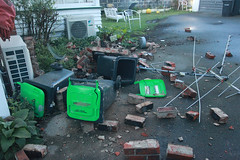
boxes down
Images, eqnz.chch.2010
None
PGC building
Images, eqnz.chch.2010
The CTV collapse is the worst and most devastating, from what I saw of the CBD yesterday.
brick fence down
Images, eqnz.chch.2010
None
Innovative judging following natural disasters: Lessons from the Christchu…
Research papers, The University of Auckland Library
In September 2010 and February 2011 the Canterbury region of New Zealand was struck by two powerful earthquakes, registering magnitude 7.1 and 6.3 respectively on the Richter scale. The second earthquake was centred 10 kilometres south-east of the centre of Christchurch (the region’s capital and New Zealand’s third most populous urban area, with approximately 360,000 residents) at a depth of five kilometres. 185 people were killed, making it the second deadliest natural disaster in New Zealand’s history. (66 people were killed in the collapse of one building alone, the six-storey Canterbury Television building.) The earthquake occurred during the lunch hour, increasing the number of people killed on footpaths and in buses and cars by falling debris. In addition to the loss of life, the earthquake caused catastrophic damage to both land and buildings in Christchurch, particularly in the central business district. Many commercial and residential buildings collapsed in the tremors; others were damaged through soil liquefaction and surface flooding. Over 1,000 buildings in the central business district were eventually demolished because of safety concerns, and an estimated 70,000 people had to leave the city after the earthquakes because their homes were uninhabitable. The New Zealand Government declared a state of national emergency, which stayed in force for ten weeks. In 2014 the Government estimated that the rebuild process would cost NZ$40 billion (approximately US$27.3 billion, a cost equivalent to 17% of New Zealand’s annual GDP). Economists now estimate it could take the New Zealand economy between 50 and 100 years to recover. The earthquakes generated tens of thousands of insurance claims, both against private home insurance companies and against the New Zealand Earthquake Commission, a government-owned statutory body which provides primary natural disaster insurance to residential property owners in New Zealand. These ranged from claims for hundreds of millions of dollars concerning the local port and university to much smaller claims in respect of the thousands of residential homes damaged. Many of these insurance claims resulted in civil proceedings, caused by disputes about policy cover, the extent of the damage and the cost and/or methodology of repairs, as well as failures in communication and delays caused by the overwhelming number of claims. Disputes were complicated by the fact that the Earthquake Commission provides primary insurance cover up to a monetary cap, with any additional costs to be met by the property owner’s private insurer. Litigation funders and non-lawyer claims advocates who took a percentage of any insurance proceeds also soon became involved. These two factors increased the number of parties involved in any given claim and introduced further obstacles to resolution. Resolving these disputes both efficiently and fairly was (and remains) central to the rebuild process. This created an unprecedented challenge for the justice system in Christchurch (and New Zealand), exacerbated by the fact that the Christchurch High Court building was itself damaged in the earthquakes, with the Court having to relocate to temporary premises. (The High Court hears civil claims exceeding NZ$200,000 in value (approximately US$140,000) or those involving particularly complex issues. Most of the claims fell into this category.) This paper will examine the response of the Christchurch High Court to this extraordinary situation as a case study in innovative judging practices and from a jurisprudential perspective. In 2011, following the earthquakes, the High Court made a commitment that earthquake-related civil claims would be dealt with as swiftly as the Court's resources permitted. In May 2012, it commenced a special “Earthquake List” to manage these cases. The list (which is ongoing) seeks to streamline the trial process, resolve quickly claims with precedent value or involving acute personal hardship or large numbers of people, facilitate settlement and generally work proactively and innovatively with local lawyers, technical experts and other stakeholders. For example, the Court maintains a public list (in spreadsheet format, available online) with details of all active cases before the Court, listing the parties and their lawyers, summarising the facts and identifying the legal issues raised. It identifies cases in which issues of general importance have been or will be decided, with the expressed purpose being to assist earthquake litigants and those contemplating litigation and to facilitate communication among parties and lawyers. This paper will posit the Earthquake List as an attempt to implement innovative judging techniques to provide efficient yet just legal processes, and which can be examined from a variety of jurisprudential perspectives. One of these is as a case study in the well-established debate about the dialogic relationship between public decisions and private settlement in the rule of law. Drawing on the work of scholars such as Hazel Genn, Owen Fiss, David Luban, Carrie Menkel-Meadow and Judith Resnik, it will explore the tension between the need to develop the law through the doctrine of precedent and the need to resolve civil disputes fairly, affordably and expeditiously. It will also be informed by the presenter’s personal experience of the interplay between reported decisions and private settlement in post-earthquake Christchurch through her work mediating insurance disputes. From a methodological perspective, this research project itself gives rise to issues suitable for discussion at the Law and Society Annual Meeting. These include the challenges in empirical study of judges, working with data collected by the courts and statistical analysis of the legal process in reference to settlement. September 2015 marked the five-year anniversary of the first Christchurch earthquake. There remains widespread dissatisfaction amongst Christchurch residents with the ongoing delays in resolving claims, particularly insurers, and the rebuild process. There will continue to be challenges in Christchurch for years to come, both from as-yet unresolved claims but also because of the possibility of a new wave of claims arising from poor quality repairs. Thus, a final purpose of presenting this paper at the 2016 Meeting is to gain the benefit of other scholarly perspectives and experiences of innovative judging best practice, with a view to strengthening and improving the judicial processes in Christchurch. This Annual Meeting of the Law and Society Association in New Orleans is a particularly appropriate forum for this paper, given the recent ten year anniversary of Hurricane Katrina and the plenary session theme of “Natural and Unnatural Disasters – human crises and law’s response.” The presenter has a personal connection with this theme, as she was a Fulbright scholar from New Zealand at New York University in 2005/2006 and participated in the student volunteer cleanup effort in New Orleans following Katrina. http://www.lawandsociety.org/NewOrleans2016/docs/2016_Program.pdf
Insurance as a Double-Edged Sword: Quantitative Evidence from the 2011 Chr…
Research papers, Victoria University of Wellington
We examine the role of business interruption (BI) insurance in business recovery following the Christchurch earthquake in 2011. First, we ask whether BI insurance increases the likelihood of business survival in the immediate (3-6 months) aftermath of a disaster. We find positive but statistically insignificant evidence that those firms that had incurred damage, but were covered by BI insurance, had higher likelihood of survival post-quake compared with those firms that did not have any insurance. For the medium-term (2-3 years) survival of firms, our results show a more explicit role for insurance. Firms with BI insurance experience increased productivity and improved performance following a catastrophe. Furthermore, we find that those organisations that receive prompt and full payments of their claims have a better recovery than those that had protracted or inadequate claims payments, but this difference between the two groups is not statistically significant. We find no statistically significant evidence that the latter group (inadequate payment) did any better than those organisations that had damage but no insurance coverage. In general, our analysis indicates the importance not only of adequate insurance coverage, but also of an insurance system that delivers prompt claim payments. This is a post-peer-review, pre-copyedit version of an article published in 'The Geneva Papers on Risk and Insurance - Issues and Practice'. The final authenticated version is available online at: https://doi.org/10.1057/s41288-017-0067-y. The following terms of use apply: https://www.springer.com/gp/open-access/publication-policies/aam-terms-of-use.
Observatory Tower Photograph 38
Images, UC QuakeStudies
A photograph of the earthquake-damaged Observatory tower at the Christchurch Arts Centre. The photograph was taken using a cellphone camera. The top of the tower collapsed during the 22 February 2011 earthquake. The rubble from the tower has been cleared and a tarpaulin has been placed over the top of the broken tower. Tyres have been placed on the tarpaulin to hold it down. A temporary roof has also been constructed over the tower to keep out the rain. Two vehicles are parked in front.
WEMO ERT Team Set 3 - April 2011 - Photograph 02
Images, UC QuakeStudies
A photograph of the photocopy template for the Christchurch City Council's yellow sticker. The sticker was used by the Civil Defence after the 2010 and 2011 earthquakes to indicate that a building had been inspected and that structural damage or other safety hazards had been found. The sticker states that there should be no entry to the building, 'except on essential business'. It also states that 'earthquake aftershocks present danger' and that people who enter must do so at their own risk.
UC Civil and Natural Resources Engineering Photograph 054
Images, UC QuakeStudies
A photograph of a house in Christchurch with an earthquake-damaged chimney. The chimney has crumbled, leaving a hole in the roof. The hole has been covered with a tarpaulin.
UC Civil and Natural Resources Engineering Photograph 053
Images, UC QuakeStudies
A photograph of a house in Christchurch with an earthquake-damaged chimney. The chimney has crumbled, leaving a hole in the roof. The hole has been covered in plastic sheeting.
New Zealand Defence Force photograph 033
Images, UC QuakeStudies
The Royal New Zealand Air Force's C-130 Hercules almost ready to take off. The Hercules was being used to evacuate people from Christchurch after the 22 February 2011 earthquake.
New Zealand Defence Force photograph 403
Images, UC QuakeStudies
A member of the Royal New Zealand Air Force refuelling a Iroquois helicopter in Hagley Park. The Iroquois helicopters were used to tour Christchurch after the 22 February 2011 earthquake.
New Zealand Defence Force photograph 120
Images, UC QuakeStudies
Medics from the New Zealand Army assisting a rest home resident. The resident was being transferred onto a Boeing 757 and evacuated from Christchurch after the 22 February 2011 earthquake.
New Zealand Defence Force photograph 164
Images, UC QuakeStudies
Aerial image of a residential area of Christchurch taken by the Royal New Zealand Air Force for the Earthquake Commission. Porritt Park is visible on the right of the photograph.
New Zealand Defence Force photograph 019
Images, UC QuakeStudies
The Royal New Zealand Air Force's C-130 Hercules almost ready to take off. The Hercules was being used to evacuate people from Christchurch after the 22 February 2011 earthquake.
New Zealand Defence Force photograph 012
Images, UC QuakeStudies
Members of No. 40 Squadron, a transport squadron in the Royal New Zealand Air Force, preparing the Hercules to move people out of Christchurch after the 22 February 2011 earthquake.
New Zealand Defence Force photograph 004
Images, UC QuakeStudies
A member of the Air Force supporting the loading of a C-130 Hercules. The Hercules was used to evacuate people from Christchurch City after the 22 February 2011 earthquake.
New Zealand Defence Force photograph 005
Images, UC QuakeStudies
A member of the Air Force supporting the loading of a C-130 Hercules. The Hercules was used to evacuate people from Christchurch City after the 22 February 2011 earthquake.
New Zealand Defence Force photograph 006
Images, UC QuakeStudies
A member of the Air Force supporting the loading of a C-130 Hercules. The Hercules was used to evacuate people from Christchurch City after the 22 February 2011 earthquake.
New Zealand Defence Force photograph 011
Images, UC QuakeStudies
Members of No. 40 Squadron, a transport squadron in the Royal New Zealand Air Force, preparing the Hercules to move people out of Christchurch after the 22 February 2011 earthquake.
New Zealand Defence Force photograph 010
Images, UC QuakeStudies
Members of No. 40 Squadron, a transport squadron in the Royal New Zealand Air Force, preparing the Hercules to move people out of Christchurch after the 22 February 2011 earthquake.
WEMO ERT Set 1 - March 2011 - Photograph 27
Images, UC QuakeStudies
A photograph of a member of the Wellington Emergency Management Office Emergency Response Team standing among broken furniture and rubble in the room of an earthquake-damaged house in Christchurch.
Jim Baltaxe WEMO Photograph 003
Images, UC QuakeStudies
A photograph of volunteers from the Wellington Emergency Management Office in Wellington Airport. The volunteers travelled to Christchurch after the 22 February 2011 earthquake to help with the emergency response.
New Zealand Defence Force photograph 017
Images, UC QuakeStudies
The Royal New Zealand Air Force's C-130 Hercules almost ready to take off. The Hercules was being used to evacuate people from Christchurch after the 22 February 2011 earthquake.
Natalie Kerschner WEMO Photograph 120
Images, UC QuakeStudies
A photograph of plastic bags around a chimney of a house in Christchurch. The top of the chimney has broken during the earthquake and made a hole in the roof.
Jim Baltaxe WEMO Photograph 002
Images, UC QuakeStudies
A photograph of volunteers from the Wellington Emergency Management Office in Wellington Airport. The volunteers travelled to Christchurch after the 22 February 2011 earthquake to help with the emergency response.
WEMO ERT Set 1 - March 2011 - Photograph 26
Images, UC QuakeStudies
A photograph of a member of the Wellington Emergency Management Office Emergency Response Team standing amongst broken furniture and rubble in the room of an earthquake-damaged house in Christchurch.