

Search
found 503 results
Images for Canterbury earthquakes; more images...
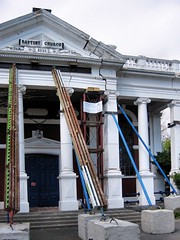


Catholic Basilica
Images, eqnz.chch.2010
Helicopter Flight over Christchurch New Zealand
Cathedral Square
Images, eqnz.chch.2010
Helicopter Flight over Christchurch New Zealand
Cathedral Square
Images, eqnz.chch.2010
Helicopter Flight over Christchurch New Zealand
Cathedral Square
Images, eqnz.chch.2010
Helicopter Flight over Christchurch New Zealand
Christchurch Cathedral
Images, eqnz.chch.2010
Helicopter Flight over Christchurch New Zealand
Cathedral Square
Images, eqnz.chch.2010
Helicopter Flight over Christchurch New Zealand
Hagley Park
Images, eqnz.chch.2010
Helicopter Flight over Christchurch New Zealand
Townsend Telescope: Part Photograph 15
Images, UC QuakeStudies
A photograph of a slow motion knob and shaft from the Townsend Telescope. The knob broke off the shaft during the 22 February 2011 earthquake.
Townsend Telescope: Part Photograph 46
Images, UC QuakeStudies
A photograph of the weight for the clock drive from the Townsend Telescope. The weight was chipped and scratched during the 22 February 2011 earthquake.
Townsend Telescope: Part Photograph 47
Images, UC QuakeStudies
A photograph of the declinator axle and counterweight from the Townsend Telescope. The axle broken off from the weight during the 22 February 2011 earthquake.
Geologic and geomorphic influence on the spatial extent of lateral spreadi…
Research papers, University of Canterbury Library
Liquefaction-induced lateral spreading during earthquakes poses a significant hazard to the built environment, as observed in Christchurch during the 2010 to 2011 Canterbury Earthquake Sequence (CES). It is critical that geotechnical earthquake engineers are able to adequately predict both the spatial extent of lateral spreads and magnitudes of associated ground movements for design purposes. Published empirical and semi-empirical models for predicting lateral spread displacements have been shown to vary by a factor of <0.5 to >2 from those measured in parts of Christchurch during CES. Comprehensive post- CES lateral spreading studies have clearly indicated that the spatial distribution of the horizontal displacements and extent of lateral spreading along the Avon River in eastern Christchurch were strongly influenced by geologic, stratigraphic and topographic features.
Townsend Telescope: Part Photograph 29
Images, UC QuakeStudies
A photograph of the lower end of the main tube of the Townsend Telescope. The tube was crushed and bent during the 22 February 2011 earthquake.
Townsend Telescope: Part Photograph 25
Images, UC QuakeStudies
A photograph of a bolt head from the Townsend Telescope. The bolt head broke off one of the telescope's bolts during the 22 February 2011 earthquake.
Townsend Telescope: Part Photograph 27
Images, UC QuakeStudies
A photograph of the lower end of the main tube of the Townsend Telescope. The tube was crushed and bent during the 22 February 2011 earthquake.
Townsend Telescope: Part Photograph 28
Images, UC QuakeStudies
A photograph of the lower end of the main tube of the Townsend Telescope. The tube was crushed and bent during the 22 February 2011 earthquake.
Townsend Telescope: Part Photograph 31
Images, UC QuakeStudies
A photograph of the lower end of the main tube of the Townsend Telescope. The tube was crushed and bent during the 22 February 2011 earthquake.
Townsend Telescope: Part Photograph 62
Images, UC QuakeStudies
A photograph of the clock drive from the Townsend Telescope. Many of the plates around the clock drive broke off during the 22 February 2011 earthquake.
Townsend Telescope: Part Photograph 30
Images, UC QuakeStudies
A photograph of the lower end of the main tube of the Townsend Telescope. The tube was crushed and bent during the 22 February 2011 earthquake.
Townsend Telescope: Part Photograph 63
Images, UC QuakeStudies
A photograph of the clock drive from the Townsend Telescope. Many of the plates around the clock drive broke off during the 22 February 2011 earthquake.
Resilience Examples in Reservoirs, Pump Stations and Pipelines - Lessons L…
Articles, UC QuakeStudies
A paper prepared for the Water New Zealand 2014 conference which considers resilience lessons for reservoirs, pump stations and pipelines.
Observatory Tower Photograph 24
Images, UC QuakeStudies
A photograph of the earthquake damage to the Observatory tower at the Christchurch Arts Centre. The top two storeys of the tower collapsed during the 22 February 2011 earthquake and the rubble spilled into the courtyard in front. A digger was used to clear the rubble away from the building. A tarpaulin has been draped over the top of the tower.
Townsend Telescope: Part Photograph 53
Images, UC QuakeStudies
A photograph of the damage to a gear from the worm gear drive of the Townsend Telescope. The gear was bent during the 22 February 2011 earthquake.
Townsend Telescope: Part Photograph 49
Images, UC QuakeStudies
A photograph of the right ascension slow motion gears from the Townsend Telescope. Some of the larger gear's teeth were damaged during the 22 February 2011 earthquake.
Townsend Telescope: Part Photograph 02
Images, UC QuakeStudies
A photograph of the declination vernier from the Townsend Telescope. The left side of the vernier was bent out of shape during the 22 February 2011 earthquake.
Townsend Telescope: Part Photograph 01
Images, UC QuakeStudies
A photograph of the declination vernier from the Townsend Telescope. The left side of the vernier was bent out of shape during the 22 February 2011 earthquake.
Addington Rugby Stadium
Images, eqnz.chch.2010
Helicopter Flight over Christchurch New Zealand
Manchester/High Streets
Images, eqnz.chch.2010
Helicopter Flight over Christchurch New Zealand
Unreinforced Masonry Churches in New Zealand Towards a Holistic Framework …
Research papers, University of Canterbury Library
Unreinforced masonry churches in New Zealand, similarly to everywhere else in the word have proven to be highly vulnerable to earthquakes, because of their particular construction features. The Canterbury (New Zealand) earthquake sequence, 2010-2011 caused an invaluable loss of local architectural heritage and of churches, as regrettably, some of them were demolished instead of being repaired. It is critical for New Zealand to advance the data collection, research and understanding pertaining to the seismic performance and protection of church buildings, with the aim to:
Townsend Telescope: Part Photograph 10
Images, UC QuakeStudies
A photograph of the top cover of the clock from the Townsend Telescope. Parts of the cover were bent out of shape during the 22 February 2011 earthquake.
Townsend Telescope: Part Photograph 32
Images, UC QuakeStudies
A close-up photograph of the lower end of the main tube from the Townsend Telescope. The tube was crushed and bent during the 22 February 2011 earthquake.