
Search
found 3454 results
Images for christchurch earthquake; more images...


Helen Devereux Photograph 075
Images, UC QuakeStudies
For the first time in November 2011, Christchurch residents finally had the opportunity to see the earthquake-damaged city centre on the Red Zone bus tours organised by CERA. Damage to buildings can be seen out the window.
Helen Devereux Photograph 084
Images, UC QuakeStudies
For the first time in November 2011, Christchurch residents finally had the opportunity to see the earthquake-damaged city centre on the Red Zone bus tours organised by CERA. Damage to buildings can be seen out the window.
Helen Devereux Photograph 067
Images, UC QuakeStudies
For the first time in November 2011, Christchurch residents finally had the opportunity to see the earthquake-damaged city centre on the Red Zone bus tours organised by CERA. Damage to buildings can be seen out the window.
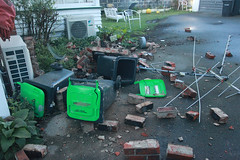
the jolt opened most kitchen cupboard doors
Images, eqnz.chch.2010
None
The SCIRT Innovation Project
Articles, UC QuakeStudies
A report created by the University of Canterbury Quake Centre and the University of Auckland, funded by the Building Research Levy. It shows how an innovation process was initiated and managed throughout the rebuilding of the horizontal infrastructure after the Canterbury earthquakes.
Paul and Sam Corliss's Street Art Photograph (2011:07:13 04:42:33)
Images, UC QuakeStudies
A photograph of street art on the wall of a building on Colombo Street. The artwork is by Otis Frizzell and depicts police officer Constable Nao Yoshimizu comforting the grieving relative of an earthquake victim. Constable Yoshimizu acted as liaison officer for the families of Japanese victims of the earthquake. The mural was commissioned by the New Zealand Police as a recruitment advertisement.
BeckerFraserPhotos April 2011 photograph 443
Images, UC QuakeStudies
A sculpture titled 'Passing Time' on the corner of St Asaph Street and Madras Street. 'Passing Time' was installed outside the CPIT Building for the 6th SCAPE (a contemporary public art programme in Christchurch) a few days prior to the 22 February 2011 earthquake. The work features twisting boxes depicting each year between 1906 (the founding of CPIT) and 2010 (the date of the sculpture's production).
BeckerFraserPhotos April 2011 photograph 399
Images, UC QuakeStudies
A sculpture titled 'Passing Time' on the corner of St Asaph Street and Madras Street. 'Passing Time' was installed outside the CPIT Building for the 6th SCAPE (a contemporary public art programme in Christchurch) a few days prior to the 22 February 2011 earthquake. The work features twisting boxes depicting each year between 1906 (the founding of CPIT) and 2010 (the date of the sculpture's production).
BeckerFraserPhotos April 2011 photograph 400
Images, UC QuakeStudies
A sculpture titled 'Passing Time' on the corner of St Asaph Street and Madras Street. 'Passing Time' was installed outside the CPIT Building for the 6th SCAPE (a contemporary public art programme in Christchurch) a few days prior to the 22 February 2011 earthquake. The work features twisting boxes depicting each year between 1906 (the founding of CPIT) and 2010 (the date of the sculpture's production).
BeckerFraserPhotos April 2011 photograph 402
Images, UC QuakeStudies
A sculpture titled 'Passing Time' on the corner of St Asaph Street and Madras Street. 'Passing Time' was installed outside the CPIT Building for the 6th SCAPE (a contemporary public art programme in Christchurch) a few days prior to the 22 February 2011 earthquake. The work features twisting boxes depicting each year between 1906 (the founding of CPIT) and 2010 (the date of the sculpture's production).
AN EXPLORATION OF THE DEVELOPMENT AND CURRENT USE OF THE CONCEPT OF “VULNE…
Research papers, University of Canterbury Library
These research papers explore the concept of vulnerability in international human rights law. In the wake of the Christchurch earthquakes of 2010-2011, this research focuses on how "vulnerability" has been used and developed within the wider human rights discourse. They also examine jurisprudence of international human rights bodies, and how the concept of "vulnerability" has been applied. The research also includes a brief investigation into the experiences of vulnerable populations in disaster contexts, focusing primarily on the experiences of "vulnerable persons" in the Christchurch earthquakes and their aftermath.
BeckerFraserPhotos February 2012 photograph 0354
Images, UC QuakeStudies
A photograph of the ChristChurch Cathedral showing the damage to the west wall and steel bracing. In the foreground is the plinth where a statue of John Robert Godley stood prior to the February 2011 earthquake.
WEMO ERT Set 1 - February 2011 - Photograph 06
Images, UC QuakeStudies
A photograph of a group of tents set up in Latimer Square next to the USAID tent. The tents were used as temporary accommodation for emergency management personnel after the 22 February 2011 earthquake.
Liquefaction Constitutive Model Validation Using Pore Pressure Records fro…
Research papers, University of Canterbury Library
Well-validated liquefaction constitutive models are increasingly important as non-linear time history analyses become relatively more common in industry for key projects. Previous validation efforts of PM4Sand, a plasticity model specifically for liquefaction, have generally focused on centrifuge tests; however, pore pressure transducers installed at several free-field sites during the Canterbury Earthquake Sequence (CES) in Christchurch, New Zealand provide a relatively unique dataset to validate against. This study presents effective stress site response analyses performed in the finite difference software FLAC to examine the capability of PM4Sand to capture the generation of excess pore pressures during earthquakes. The characterization of the subsurface is primarily based on extensive cone penetration tests (CPT) carried out in Christchurch. Correlations based on penetration resistances are used to estimate soil parameters, such as relative density and shear wave velocity, which affect liquefaction behaviour. The resulting free-field FLAC model is used to estimate time histories of excess pore pressure, which are compared with records during several earthquakes in the CES to assess the suitability of PM4Sand.
Jim Baltaxe WEMO Photograph 019
Images, UC QuakeStudies
A photograph of a volunteer from the Wellington Emergency Management Office sitting on a bed in a campervan. The campervan served as temporary accommodation for emergency management personnel who travelled to Christchurch after the 22 February 2011 earthquake.
Jim Baltaxe WEMO Photograph 038
Images, UC QuakeStudies
A photograph of an earthquake-damaged house in Christchurch. The bricks on the side of the house have crumbled and damaged the fence. A red sticker on the front window indicates that the building is unsafe to enter.
Observatory Tower Photograph 07
Images, UC QuakeStudies
A photograph of the Observatory tower at the Christchurch Arts Centre. There are cracks in the masonry of the tower near where the two storeys join. The cracks formed as a result of the 4 September 2010 earthquake. Wire fencing has been placed at the entrance to the courtyard in front as a cordon.
Helen Devereux Photograph 097
Images, UC QuakeStudies
For the first time in November 2011, Christchurch residents finally had the opportunity to see the earthquake-damaged city centre on the Red Zone bus tours organised by CERA. Partial view of the Citizens' War Memorial beside the cathedral.
Central City Asset Assessment Report
Articles, UC QuakeStudies
An outline, created in 2011, of the levels of service and condition of the horizontal infrastructure within the central city, providing a broad indication of damage, service levels provided to residents and business owners, and used to estimate the cost of repairs following the earthquake events.
BeckerFraserPhotos February 2012 photograph 0752
Images, UC QuakeStudies
A photograph captioned by BeckerFraserPhotos, "Two tourists studying a map in the Botanic Gardens. Tourists are seen again in reasonable numbers in Christchurch. Some of the maps are not updated to reflect the changes since the earthquake".
Observatory Tower Photograph 09
Images, UC QuakeStudies
A photograph of staff from the Department of Physics and Astronomy from the University of Canterbury recovering parts of the Townsend Telescope from the rubble of the Observatory tower. The telescope was housed in the tower at the Christchurch Arts Centre. It was severely damaged when the tower collapsed during the 22 February 2011 earthquake.
Observatory Tower Photograph 10
Images, UC QuakeStudies
A photograph of staff from the Department of Physics and Astronomy from the University of Canterbury recovering parts of the Townsend Telescope from the rubble of the Observatory tower. The telescope was housed in the tower at the Christchurch Arts Centre. It was severely damaged when the tower collapsed during the 22 February 2011 earthquake.
BeckerFraserPhotos April 2011 photograph 398
Images, UC QuakeStudies
Moira Fraser standing in front of the 'Passing Time' sculpture on the corner of St Asaph Street and Madras Street. 'Passing Time' was installed outside the CPIT Building for the 6th SCAPE (a contemporary public art programme in Christchurch) a few days prior to the 22 February 2011 earthquake. The work features twisting boxes depicting each year between 1906 (the founding of CPIT) and 2010 (the date of the sculpture's production).
BeckerFraserPhotos April 2011 photograph 401
Images, UC QuakeStudies
Moira Fraser in front of the 'Passing Time' sculpture on the corner of St Asaph Street and Madras Street. 'Passing Time' was installed outside the CPIT Building for the 6th SCAPE (a contemporary public art programme in Christchurch) a few days prior to the 22 February 2011 earthquake. The work features twisting boxes depicting each year between 1906 (the founding of CPIT) and 2010 (the date of the sculpture's production).
Photograph by Jennifer Middendorf 281
Images, UC QuakeStudies
A string quartet from Christchurch Girls High School plays on the riverbank before the River of Flowers event held in Riccarton Bush, commemorating the second anniversary of the 22 February earthquake. In the foreground people wait for the event to start.
Photograph by Jennifer Middendorf 294
Images, UC QuakeStudies
A string quartet from Christchurch Girls High School plays on the riverbank before the River of Flowers event held in Riccarton Bush, commemorating the second anniversary of the 22 February earthquake. In the foreground people wait for the event to start.
Helen Devereux Photograph 080
Images, UC QuakeStudies
For the first time in November 2011, Christchurch residents finally had the opportunity to see the earthquake-damaged city centre on the Red Zone bus tours organised by CERA. Damage to the Odeon Theatre can be seen out the window.
Helen Devereux Photograph 081
Images, UC QuakeStudies
For the first time in November 2011, Christchurch residents finally had the opportunity to see the earthquake-damaged city centre on the Red Zone bus tours organised by CERA. Damage to the Odeon Theatre can be seen out the window.
Helen Devereux Photograph 070
Images, UC QuakeStudies
For the first time in November 2011, Christchurch residents finally had the opportunity to see the earthquake-damaged city centre on the Red Zone bus tours organised by CERA. Damage to buildings on Cashel Street can be seen out the window.
Helen Devereux Photograph 096
Images, UC QuakeStudies
For the first time in November 2011, Christchurch residents finally had the opportunity to see the earthquake-damaged city centre on the Red Zone bus tours organised by CERA. The Regent Theatre dome which has been removed from the building.