
Search
found 375 results
Images for river damage; more images...


Christchurch Mail Image: John Bisset 2010:09:10 14:24:02
Images, UC QuakeStudies
Photograph captioned by Fairfax, "Members of the Red Cross civil defence response team and South Canterbury Police have been in Christchurch helping with the earthquake clean up. Welfare checks required the team to walk along River Road checking on householders. Pictured looking at a damaged bridge on River Road near Tai Tapu are (from left) Andy Todd, Anna Munro and Ken Weavers".
Kaiapoi Street
Images, eqnz.chch.2010
One Month after the Christchurch Earthquake. This is in Kaiapoi at the north end of Christchurch. A view down the walkway next to the river Twitter | Facebook |
Earthquake Contortions
Images, UC QuakeStudies
The badly twisted Medway Street footbridge. The photographer comments, "The September 4th 2010 earthquake in Christchurch was so violent that the banks of the Avon River moved towards each other. This footbridge being metal had to twist sideways to release the pressure of being pushed from both river banks. It looked like it had been wrung out like a wet towel".
22 February Earthquake - Photograph 07
Images, UC QuakeStudies
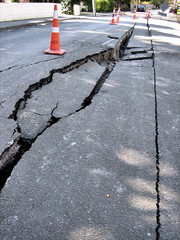
Damage to River Road in Richmond. The road surface is badly cracked and slumped, and liquefaction silt covers part of the road. Two people in gumboots walk towards a barrier erected across the road using road cones and warning tape, and in the background the badly twisted Medway Street bridge can be seen. The photographer comments, "Longitudinal cracks indicate lateral movement as the land sagged towards the river. Near 373 River Rd, looking south-east towards Medway St. The Medway St bridge is visible in the background".
Geotechnical aspects of the Mw6.2 2011 Christchurch New Zealand Earthquake
Research papers, University of Canterbury Library
The 22 February 2011, Mw6.2 Christchurch earthquake is the most costly earthquake to affect New Zealand, causing an estimated 181 fatalities and severely damaging thousands of residential and commercial buildings. This paper presents a summary of some of the observations made by the NSF-sponsored GEER Team regarding the geotechnical/geologic aspects of this earthquake. The Team focused on documenting the occurrence and severity of liquefaction and lateral spreading, performance of building and bridge foundations, buried pipelines and levees, and significant rockfalls and landslides. Liquefaction was pervasive and caused extensive damage to residential properties, water and wastewater networks, high-rise buildings, and bridges. Entire neighborhoods subsided, resulting in flooding that caused further damage. Additionally, liquefaction and lateral spreading resulted in damage to bridges and to stretches of levees along the Waimakariri and Kaiapoi Rivers. Rockfalls and landslides in the Port Hills damaged several homes and caused several fatalities.
The potential of an active transport corridor along Christchurch's earthqu…
Research papers, University of Canterbury Library
None
Long wait for quake repairs for some Canterbury homeowners
Audio, Radio New Zealand
Canterbury earthquake victims with the most damaged homes could have to wait more than two and half years for their houses to be fixed - but one owner says her problems are nothing compared to the misery of the Pike River mine disaster.
Christchurch Press Image: Stacy Squires 2010:09:23 11:55:09
Images, UC QuakeStudies
Photograph captioned by Fairfax, "Engineers from ECAN and other areas in New Zealand have been inspecting the Waimakariri River stop banks on the coast side of State Highway 1 after the September earthquake. Earthquake damage repair work on the stop bank".
Brownbait patties - $2 per kilo. 6 October 2010
Images, Alexander Turnbull Library
The cartoon shows a platter of 'Brownbait patties $2 per kilo'. In the background is a 'contaminated' river. Refers to the contamination of Canterbury's waterways after the earthquake of 4th September which resulted in sewage pipes being damaged thus contaminating the rivers. This means that people should not be attempting to catch whitebait in these rivers during the annual whitebait season which is open between 15 August and 30 November. Quantity: 1 digital cartoon(s).
UC Restarts - Photograph 27
Images, UC QuakeStudies
A damaged wooden footbridge across the Avon River beside University Drive is blocked off with sheets of plywood and danger signs. The photographer comments, "The University restarts its teaching, and the techies in e-learning move out of NZi3. The bridge to the Rec Centre".
22 February Earthquake - Photograph 15
Images, UC QuakeStudies
Damage to a house in Richmond. The brick wall is badly cracked and twisted, and some bricks have fallen, exposing the lining paper below. The photographer comments, "These photos show our old house in River Rd. Bricks are skewed and pulled in several directions".
22 February Earthquake - Photograph 34
Images, UC QuakeStudies
A man signals directions to a car attempting to make a u-turn on the badly damaged River Road. The road surface is cracked and buckled. The photographer comments, "More stranded cars, and rubbernecking sightseers turning around to go back the way they came".
Geotechnical Aspects of the 2010 Darfield (Canterbury) Earthquake
Research papers, University of Canterbury Library
On 4 September 2010, a magnitude Mw 7.1 earthquake struck the Canterbury region on the South Island of New Zealand. The epicentre of the earthquake was located in the Darfield area about 40 km west of the city of Christchurch. Extensive damage was inflicted to lifelines and residential houses due to widespread liquefaction and lateral spreading in areas close to major streams, rivers and wetlands throughout Christchurch and Kaiapoi. Unreinforced masonry buildings also suffered extensive damage throughout the region. Despite the severe damage to infrastructure and residential houses, fortunately, no deaths occurred and only two injuries were reported in this earthquake. From an engineering viewpoint, one may argue that the most significant aspects of the 2010 Darfield Earthquake were geotechnical in nature, with liquefaction and lateral spreading being the principal culprits for the inflicted damage. Following the earthquake, an intensive geotechnical reconnaissance was conducted to capture evidence and perishable data from this event. This paper summarizes the observations and preliminary findings from this early reconnaissance work.
Performance of Stopbanks in Multi-hazards - New Zealand Earthquakes
Research papers, The University of Auckland Library
This thesis presents an assessment of historic seismic performance of the New Zealand stopbank network from the 1968 Inangahua earthquake through to the 2016 Kaikōura earthquake. An overview of the types of stopbanks and the main aspects of the design and construction of earthen stopbanks was presented. Stopbanks are structures that are widely used on the banks of rivers and other water bodies to protect against the impact of flood events. Earthen stopbanks are found to be the most used for such protection measures. Different stopbank damage or failure modes that may occur due to flooding or earthquake excitation were assessed with a focus on past earthquakes internationally, and examples of these damage and failure modes were presented. Stopbank damage and assessment reports were collated from available reconnaissance literature to develop the first geospatial database of stopbank damage observed in past earthquakes in New Zealand. Damage was observed in four earthquakes over the past 50 years, with a number of earthquakes resulting in no stopbank damage. The damage database therefore focussed on the Edgecumbe, Darfield, Christchurch and Kaikōura earthquakes. Cracking of the crest and liquefaction-induced settlement were the most common forms of damage observed. To understand the seismic demand on the stopbank network in past earthquakes, geospatial analyses were undertaken to approximate the peak ground acceleration (PGA) across the stopbank network for ten large earthquakes that have occurred in New Zealand over the past 50 years. The relationship between the demand, represented by the peak ground acceleration (PGA) and damage is discussed and key trends identified. Comparison of the seismic demand and the distribution of damage suggested that the seismic performance of the New Zealand stopbank network has been generally good across all events considered. Although a significant length of the stopbank networks were exposed to high levels of shaking in past events, the overall damage length was a small percentage of this. The key aspect controlling performance was the performance of the underlying foundation soils and the effect of this on the stopbank structure and stability.
Christchurch Mail Image: John Bisset 2010:09:10 14:22:22
Images, UC QuakeStudies
Photograph captioned by Fairfax, "Members of the Red Cross civil defence response team and South Canterbury Police have been in Christchurch helping with the earthquake clean up. Having a look at a damaged bridge on River Road near Tai Tapu is Anna Sole".
River could burst banks in shaken Christchurch
Audio, Radio New Zealand
The state of emergency in Christchurch has just been extended until midday on Wednesday. In latest developments Canterbury Civil Defence is now warning people to prepare for potential flooding, only two days after the major earthquake that caused widespread damage to much of the region.
22 February Earthquake - Photograph 01
Images, UC QuakeStudies
Damage to River Road in Richmond. The road is badly cracked and slumped, and is closed off with a row of road cones tied with warning tape. The word "closed" has been spray painted on the road surface. The photographer comments, "These photos show our old house in River Rd and recovery work around Richmond and St Albans. River Rd was again subject to severe lateral spreading. The river is still grey with silt, the road is ripped and sunken, and power poles lean at random angles. The red car belonged to a postie, who had to come back with a tow truck to extricate the car from the hole that had opened underneath it. Looking along River Road to the north-east. Taken outside 79 Medway St".
22 February Earthquake - Photograph 26
Images, UC QuakeStudies
Damage to the garden of a house in Richmond. Liquefaction is visible among the plants and on the driveway. The photographer comments, "These photos show our old house in River Rd and recovery work around Richmond and St Albans. Back lawn under 10cm of water and silt".
Bromhead, Peter, 1933-:[Earthquakes and Pike River Mine disasters] 25 Febr…
Images, Alexander Turnbull Library
A man representing the South Island stands under an umbrella representing 'hope' to shelter from a bucketload of water representing 'misfortune'. Context - in the last year apart from the usual droughts and floods the South Island has suffered the Pike River Mine disaster on 19 November 2010 in which 29 coal miners were killed, the 7.1 earthquake on 4 September 2010 in which there was a lot of damage but no deaths and now on 22 February 2011 a 6.3 magnitude earthquake which has probably killed more than 200 people (at this point the number is still not known) and caused more severe damage. The reason the apparently lesser magnitude quake caused more destruction is because it was very shallow, was in the middle of the day and struck very close to the centre of the city. Quantity: 1 digital cartoon(s).
22 February Earthquake - Photograph 22
Images, UC QuakeStudies
Damage to a house in Richmond. The brick wall is badly cracked and twisted, and some bricks have fallen, exposing the lining paper and framing below. The photographer comments, "These photos show our old house in River Rd and recovery work around Richmond and St Albans. I think it's broken".
22 February Earthquake - Photograph 04
Images, UC QuakeStudies
Damage to Medway Street in Richmond. The road surface is cracked and buckled, and covered in liquefaction silt. A temporary road sign restricting speed to 30 is visible, with road cones behind. The photographer comments, "Medway St, between Woodchester Ave and River Rd. Woodchester Ave on right just beyond the 30 sign".
22 February Earthquake - Photograph 28
Images, UC QuakeStudies
Damage to a house in Richmond. Stucco underneath a window has cracked, and the foundation appears to be on a lean. The photographer comments, "These photos show our old house in River Rd and recovery work around Richmond and St Albans. The bay window of our bedroom has jumped off the foundations, cracking the stucco".
Twisted Memories
Images, UC QuakeStudies
A digitally manipulated photograph of the badly twisted Medway Street footbridge. The photographer comments, "This bridge over the Avon River in Christchurch, New Zealand has been left in place since the first major earthquake back in September 2010. Graffiti artists or taggers are still leaving their marks on it even though it is nearly twisted at 90 degrees at one point".
Earthquake Street
Images, eqnz.chch.2010
A Simple shot down the street where the shops are now marked for demolition. Twitter | Facebook | My Website |
Beyond the Fence
Images, eqnz.chch.2010
One Month after the Christchurch Earthquake. A view in Sydenham suburb - Columbo St Twitter | Facebook | My Website |
Sydenham Building
Images, eqnz.chch.2010
A corner shop in Sydenham - a Suburb of Christchurch. Front walls are all missing Twitter | Facebook | My Website |
22 February Earthquake - Photograph 16
Images, UC QuakeStudies
Damage to a residential property in Richmond. The brick wall of the garage has collapse inward, and the roof fallen in on top of it. The driveway is badly cracked and buckled. The photographer comments, "These photos show our old house in River Rd. The brick garage just collapsed, pulling the gate over as it fell".
Are My Boots Big Enough to Tackle a Broken Sewer?
Images, UC QuakeStudies
Workers inspect a broken sewerage line in New Brighton. The photographer comments, "After the Christchurch earthquake on 23 December 2011 the sewer pipe got badly damaged at New Brighton and was leaking into the Avon River. I think the guy was worried about the fast flow causing him to fill his boots rather than the depth".
22 February Earthquake - Photograph 25
Images, UC QuakeStudies
Damage to a house in Richmond. The brick wall is badly cracked and twisted, and some bricks have fallen, exposing the lining paper and framing below. The driveway is cracked and covered in liquefaction. The photographer comments, "These photos show our old house in River Rd and recovery work around Richmond and St Albans. Does that wall look straight to you?
Church Gates
Images, eqnz.chch.2010
One Month after the Christchurch Earthquake. The remains of a Church in St albans, Edgeware Rd Twitter | Facebook | My Website | <...