
Search
found 3454 results
Images for christchurch earthquake; more images...


London Street demolitions
Images, eqnz.chch.2010
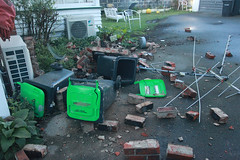
Photos taken in Lyttelton on April 19 showing the demolition of buildings on London Street, Lyttelton, following the February 22 earthquake. File reference: CCL-2011-04-19-London-Street-Demolition-IMG_0202 From the collection of Christchurch City Libraries.
BeckerFraserPhotos March 2011 photograph 183
Images, UC QuakeStudies
Photograph captioned by BeckerFraserPhotos, "The conical top of the tower at the Arts Centre was removed and secured after the September earthquake".
BeckerFraserPhotos March 2011 photograph 130
Images, UC QuakeStudies
A wooden brace holding up a window of the Cramner Centre, formerly Christchurch Girls' High School. The masonry above the window has fallen away during the earthquake.
Observatory Tower Photograph 37
Images, UC QuakeStudies
A photograph of the earthquake-damaged Observatory tower at the Christchurch Arts Centre. The photograph was taken using a cellphone camera. The top of the tower collapsed during the 22 February 2011 earthquake. The rubble from the tower has been cleared and a tarpaulin has been placed over the top of the broken tower. Tyres have been placed on the tarpaulin to hold it down. A temporary roof has also been constructed over the tower to keep out the rain.
Anglican Advocacy: Incentive scheme proposal
Articles, UC QuakeStudies
A PDF copy of a proposal prepared by Anglican Advocacy (formerly the Anglican Life Social Justice Unit) and Te Whare Roimata to MBIE and CERA in 2012. The report outlines how social housing could look in Christchurch's Inner City East following the Christchurch earthquakes.
River of Flowers - Te Waitohi Maumahara
Images, eqnz.chch.2010
Friday 22 February 2013. Official Supported Site for River of Flowers: Horseshoe Lake Riverbank on Lake Terrace Road, opposite the bus stop between Oregon and Tangmere Places Hosted by: Burwood Primary School and Community. File reference: CCL-2013-02-22-River-of-FlowersDSC_03401.JPG From the collection of Christchurch City Libraries. ...
Shermine Kwok Photograph 8
Images, UC QuakeStudies
A photograph of a plaque dedicate to those who lost their lives in City Mall during the earthquake of 22 February 2011. The plague is located under a tree in Re:START mall.
BeckerFraserPhotos July 2011 photograph 214
Images, UC QuakeStudies
A photograph captioned by BeckerFraserPhotos, "The Christchurch Chinese Methodist Church on Papanui Road. The steeple was removed after the September earthquake. The future of church is unclear, but the church hall has been demolished".
BeckerFraserPhotos July 2011 photograph 209
Images, UC QuakeStudies
A photograph captioned by BeckerFraserPhotos, "The Christchurch Chinese Methodist Church on Papanui Road. The steeple was removed after the September earthquake. The future of church is unclear, but the church hall has been demolished".
Play, politics and the production of space: DIY urbanism in post-earthquak…
Research papers, The University of Auckland Library
The Canterbury earthquake sequence of 2010-2011 wrought ruptures in not only the physical landscape of Canterbury and Christchurch’s material form, but also in its social, economic, and political fabrics and the lives of Christchurch inhabitants. In the years that followed, the widespread demolition of the CBD that followed the earthquakes produced a bleak landscape of grey rubble punctuated by damaged, abandoned buildings. It was into this post-earthquake landscape that Gap Filler and other ‘transitional’ organisations inserted playful, creative, experimental projects to bring life and energy back into the CBD. This thesis examines those interventions and the development of the ‘Transitional Movement’ between July 2013 and June 2015 via the methods of walking interviews and participant observation. This critical period in Christchurch’s recovery serves as an example of what happens when do-it-yourself (DIY) urbanism is done at scale across the CBD and what urban experimentation can offer city-making. Through an understanding of space as produced, informed by Lefebvre’s thinking, I explore how these creative urban interventions manifested a different temporality to orthodox planning and demonstrate how the ‘soft’ politics of these interventions contain the potential for gentrification and also a more radical politics of the city, by creating an opening space for difference.
Observatory Tower Photograph 03
Images, UC QuakeStudies
A photograph of the Observatory tower at the Christchurch Arts Centre. There are cracks in the masonry of the tower near where the two storeys join. The cracks formed as a result of the 4 September 2010 earthquake.
A new crack in the footpath in Rydal Park.
Images, eqnz.chch.2010
Cracks in the roads and foot paths were surprisingly hard to find given the strength of the earthquake.
Print III
Images, eqnz.chch.2010
The obligatory earthquake damage shot. Taken on Ilford Pan F+ with a Yashica-Mat 124G, developed in ID-11 for 8.5 minutes, printed on Ilford Multigrade IV RC, print developed in Ilford Universal PQ.
A System Dynamic Model of Post-Earthquake Reconstruction pathways
Research papers, University of Canterbury Library
Objectives • To develop a system dynamics model of Christchurch post-quake reconstruction process that captures all the critical dynamics influencing its pathway • To investigate the implications of current rebuild pathway • To build a reconstruction module to be integrated in MERIT (Measuring the Economics of Resilient Infrastructure Tool)
Homage to the Lost Spaces Photograph 6
Images, UC QuakeStudies
A photograph of part of Mike Hewson's installation 'Homage to the Lost Spaces' on the earthquake-damaged Cranmer Courts building.
Dan Neely WEMO Photograph 26
Images, UC QuakeStudies
A photograph of Mayor Bob Parker speaking on a phone in the restaurant and bar in the Christchurch Art Gallery. The Art Gallery served as the headquarters for the Civil Defence after the 22 February 2011 earthquake.
Life-Safety Risk in Earthquakes: Investigating Risk Factors and Developmen…
Research papers, The University of Auckland Library
This thesis investigates life-safety risk in earthquakes. The first component of the thesis utilises a dataset of earthquake injuries and deaths from recent earthquakes in New Zealand to identify cause, context, and risk factors of injury and death in the 2011 MW6.3 Christchurch earthquake and 2016 MW7.8 Kaikōura earthquake. Results show that nearly all deaths occurred from being hit by structural elements from buildings, while most injuries were caused by falls, strains and being hit by contents or non-structural elements. Statistical analysis of injured cases compared to an uninjured control group found that age, gender, building damage, shaking intensity, and behaviour during shaking were the most significant risk factors for injury during these earthquakes. The second part of the thesis uses the empirical findings from the first section to develop two tools for managing life-safety risk in earthquakes. The first tool is a casualty estimation model for health system and emergency response planning. An existing casualty model used in New Zealand was validated against observed data from the 2011 Christchurch earthquake and found to underestimate moderate and severe injuries by an order of magnitude. The model was then updated to include human behaviour such as protective actions, falls and strain type injuries that are dependent on shaking intensity, as well as injuries and deaths outside buildings. These improvements resulted in a closer fit to observed casualties for the 2011 Christchurch earthquake. The second tool that was developed is a framework to set seismic loading standards for design based on fatality risk targets. The proposed framework extends the risk-targeted hazard method, by moving beyond collapse risk targets, to fatality risk targets for individuals in buildings and societal risk in cities. The framework also includes treatment of epistemic uncertainty in seismic hazard to allow this uncertainty to be used in risk-based decision making. The framework is demonstrated by showing how the current New Zealand loading standards could be revised to achieve uniform life-safety risk across the country and how the introduction of a new loading factor can reduce risk aggregation in cities. Not on Alma, moved and emailed. 1/02/2023 ce
Jim Baltaxe WEMO Photograph 021
Images, UC QuakeStudies
A photograph of campervans parked in Hagley Park. The campervans served as temporary accommodation for emergency management personnel who travelled to Christchurch after the 22 February 2011 earthquake.
WEMO ERT Set 1 - March 2011 - Photograph 10
Images, UC QuakeStudies
A photograph of the earthquake damage to a house in Christchurch. The roof of the house has collapsed, bringing the top of the front wall down with it.
Jim Baltaxe WEMO Photograph 040
Images, UC QuakeStudies
A photograph of the earthquake damage to a house in Christchurch. Bricks from the demolished house next door still lie on the roof and against the side wall.
Ray Whelan WEMO Photograph 10
Images, UC QuakeStudies
A photograph of the earthquake damage to a building in the Christchurch central city. Some of the windows have been broken, and blinds are hanging out of them.
WEMO ERT Set 1 - March 2011 - Photograph 11
Images, UC QuakeStudies
A photograph of the earthquake damage to a house in Christchurch. The roof of the house has collapsed, bringing the top of the front wall down with it.
Crowd on The Grassy
Images, eqnz.chch.2010
Photos taken at the Lyttelton Community briefing held on March 7 2011 following the magnitude 6.3 earthquake on 22 February 2011. File Ref: CCL-2011-03-07-Lyttelton-Community-Briefing-P1110625 From the collection of Christchurch City Libraries.
TV3 reporter Ali Ikram
Images, eqnz.chch.2010
Photos taken at the Lyttelton Community briefing held on March 7 2011 following the magnitude 6.3 earthquake on 22 February 2011. File Ref: CCL-2011-03-07-Lyttelton-Community-Briefing-P1110622 From the collection of Christchurch City Libraries.
Large crowd at community briefing
Images, eqnz.chch.2010
Photos taken at the Lyttelton Community briefing held on March 7 2011 following the magnitude 6.3 earthquake on 22 February 2011. File Ref: CCL-2011-03-07-Lyttelton-Community-Briefing-P1110619 From the collection of Christchurch City Libraries.
Photographer in the crowd
Images, eqnz.chch.2010
Photos taken at the Lyttelton Community briefing held on March 7 2011 following the magnitude 6.3 earthquake on 22 February 2011. File Ref: CCL-2011-03-07-Lyttelton-Community-Briefing-P1110621 From the collection of Christchurch City Libraries.
Observatory Tower Photograph 27
Images, UC QuakeStudies
A photograph of the rubble of the Observatory tower in the South Quad of the Christchurch Arts Centre. The tower collapsed during the 22 February 2011 earthquake. A digger was used to clear the rubble away from the building.
20100906-124704.jpg
Images, eqnz.chch.2010
None
Cylic Undrained DSS Testing of Christchurch Sands
Research papers, University of Canterbury Library
Earthquake-triggered soil liquefaction caused extensive damage and heavy economic losses in Christchurch during the 2010-2011 Canterbury earthquakes. The most severe manifestations of liquefaction were associated with the presence of natural deposits of clean sands and silty sands of fluvial origin. However, liquefaction resistance of fines-containing sands is commonly inferred from empirical relationships based on clean sands (i.e. sands with less than 5% fines). Hence, existing evaluation methods have poor accuracy when applied to silty sands. Also, existing methods do not quantify appropriately the influence on liquefaction resistance of soil fabric and structure, which are unique to a specific depositional environment. This study looks at the influence of fines content, soil fabric (i.e. arrangement of soil particles) and structure (e.g. layering, segregation) on the undrained cyclic behaviour and liquefaction resistance of fines-containing sandy soils from Christchurch using Direct Simple Shear (DSS) tests on soil specimens reconstituted in the laboratory with the water sedimentation technique. The poster describes experimental procedures and presents early test results on two sands retrieved at two different sites in Christchurch.
Mayor Bob Parker talks with residents
Images, eqnz.chch.2010
Photos taken at the Lyttelton Community briefing held on March 7 2011 following the magnitude 6.3 earthquake on 22 February 2011. File Ref: CCL-2011-03-07-Lyttelton-Community-Briefing-P1110624 From the collection of Christchurch City Libraries.